Why Do I Crave a Cigarette When I Drink Coffee? Breaking Caffeine-Smoking Triggers (2026)
Morning. The alarm has gone. You shuffle to the kitchen, boil the kettle, pour the first coffee — and before the mug even reaches your lips, you want a cigarette. Not vaguely. Urgently. The pull is so automatic and so consistent that it almost does not feel like a craving anymore; it feels like the natural next step in a sequence. And in a very real neurological sense, it is exactly that — a sequence your nervous system has rehearsed thousands of times until it became automatic.
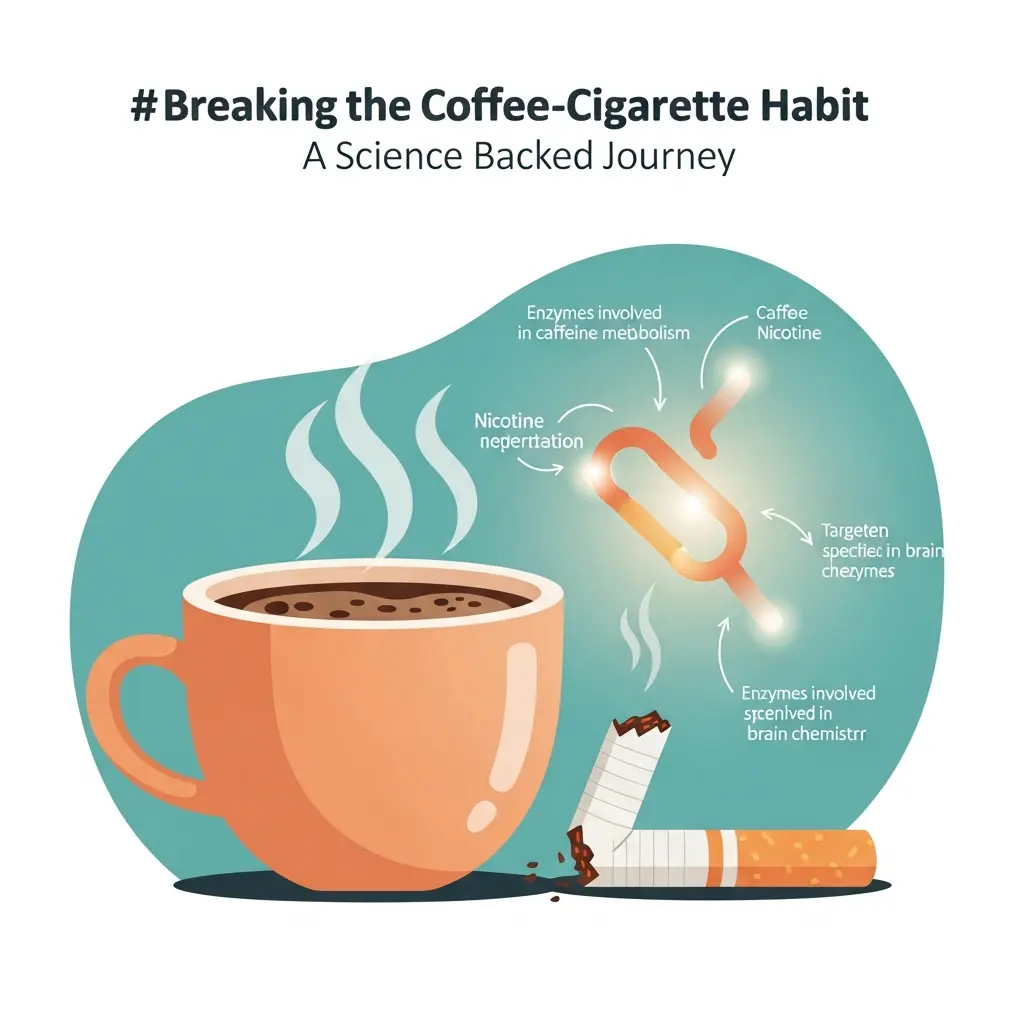
The coffee cigarette craving trigger is one of the most reported and most persistent associations in smoking cessation, and it has a fascinating dimension that most people are not aware of: there is a genuine pharmacological reason why coffee and cigarettes were always paired, and understanding it changes both how you manage the craving and what to expect from your morning coffee once you quit.
The Conditioned Association: Morning Ritual
Before we get to the pharmacology, it is worth acknowledging the behavioural layer. For most smokers, coffee and cigarettes were combined so consistently — and so early in the day, when habit formation is most powerful — that the brain has formed an extremely strong associative link between the two. The smell of coffee, the warmth of the mug, the specific quiet of the morning — all of these have become cues that trigger the expectation of a cigarette.
This is classical conditioning at work. The coffee is the bell; the cigarette is the reward. After years of pairing, the bell alone is enough to produce the salivation response. Understanding your triggers is the foundation of craving management — our guide to identifying and avoiding smoking triggers covers the full behavioural framework in detail.
But the coffee-cigarette connection has an additional layer that goes beyond habit. There is real biochemistry involved, and it matters for how you manage your quit.
The CYP1A2 Pharmacology: Why Coffee Hits Harder After Quitting
Caffeine is metabolised primarily by an enzyme called CYP1A2, located in the liver. This enzyme is responsible for around 80 to 95% of caffeine clearance in the body. The rate at which CYP1A2 works determines how long caffeine stays in your system and how strongly you feel its effects.
Tobacco smoke contains polycyclic aromatic hydrocarbons (PAHs) — chemical compounds produced by combustion. These PAHs are potent inducers of CYP1A2, meaning they activate the enzyme and significantly increase its activity. In smokers, this means caffeine is cleared from the bloodstream considerably faster than in non-smokers.
A systematic analysis published in Frontiers in Pharmacology (2021) documents the pharmacokinetics of caffeine metabolism in detail, noting that CYP1A2-mediated metabolism is significantly enhanced in smokers. The World Journal of Gastrointestinal Pharmacology and Therapeutics also describes this mechanism, noting that smoking induces CYP1A2, with direct effects on the metabolism of drugs and substances — including caffeine — that share this metabolic pathway.
What this means in practice:
- As a smoker, your body was metabolising caffeine faster than it would in a non-smoker. You may have been drinking more coffee to feel the same effect, without realising the tobacco smoke was partly responsible for why it was clearing so quickly.
- When you quit smoking, CYP1A2 induction decreases — typically over the first few days to weeks. Caffeine metabolism slows to match that of a non-smoker. The same cup of coffee that felt normal before quitting now delivers a stronger and longer-lasting effect.
This is not a minor adjustment. It is a meaningful pharmacological shift that affects how your body processes one of the most commonly consumed substances in the world.
| Measure | Smokers | Non-Smokers |
|---|---|---|
| Mean CYP1A2 activity | 20.0 ± 9.6 | 10.8 ± 5.8 |
| Caffeine half-life (approx.) | ~2–3 hours | ~4–6 hours |
| Effect after quitting | CYP1A2 activity falls towards non-smoker baseline within days to weeks; same coffee intake feels significantly stronger | |
Source: Tobacco Smoke and CYP1A2 Activity — PMC / Journal of Occupational Medicine | Frontiers in Pharmacology 2021
What You Might Notice After Quitting
If you keep drinking the same amount of coffee after quitting smoking, you may notice:
- Increased jitteriness or restlessness after your usual amount of coffee
- Heart palpitations or a racing heartbeat that were not there before
- Heightened anxiety — caffeine at higher effective doses amplifies the anxiety that is already elevated during withdrawal
- Disrupted sleep — caffeine staying in your system longer means it is still affecting you at bedtime
- Increased difficulty concentrating — counterintuitively, too much caffeine can produce a jangled, distracted state rather than the focused alertness you were seeking
Some of these symptoms overlap with nicotine withdrawal, which can make the first week after quitting feel more uncomfortable than it needs to be — not because withdrawal is severe, but because your caffeine intake has effectively increased relative to your body’s new capacity to process it.
It is worth noting that this is not a reason to stop enjoying coffee. It is a reason to adjust the amount during the transition period — and to frame that adjustment as the body recalibrating rather than as deprivation.
Managing Your Caffeine Intake After Quitting
There is no universally correct amount of coffee after quitting smoking — it depends on your pre-quit intake, your individual CYP1A2 activity, and how sensitive you are to caffeine. The practical guidance is:
Reduce by roughly a third in the first two weeks
If you were drinking three or four cups per day as a smoker, reducing to two in the first few weeks of cessation gives your body time to adjust to the slower caffeine metabolism. This is not a permanent change — it is a transition adjustment. Many former smokers find that after a month their tolerance to caffeine at non-smoker levels is comfortable and they can reintroduce more if they choose.
Shift your last coffee earlier in the day
With slower caffeine clearance, the half-life of caffeine in your body is longer. If you used to drink coffee at 3 pm without it affecting your sleep, that same cup may now keep you awake after quitting. Moving your last coffee to before noon or early afternoon is a simple adjustment that protects your sleep quality — and good sleep is one of the most important factors in a successful quit attempt.
Watch for anxiety amplification
Nicotine withdrawal can involve elevated anxiety in the first two weeks. Caffeine at higher effective doses amplifies anxiety. This combination can create a feedback loop that makes the withdrawal period feel more intense. If you are noticing heightened anxiety after your morning coffee, reducing your intake or switching to half-caffeinated coffee is a reasonable step.
Breaking the Conditioned Coffee-Cigarette Link
The behavioural component of the coffee-cigarette association requires its own strategy, separate from the caffeine adjustment. The goal is to build a new “coffee alone” routine that does not feel like something is missing.
Approaches that work:
- Change the setting for your morning coffee. Sit somewhere different, face a different direction, open a window that you did not open before. Environmental disruption interrupts automatic behaviour chains more effectively than willpower alone.
- Add a new element to the coffee ritual. A specific podcast, a page of reading, a five-minute journal entry — something that gives the ritual a new reward and redirects attention away from the absent cigarette.
- Pair the coffee with a breathing exercise. The deep inhale-and-exhale of a slow breathing exercise provides some of the same physiological calming effect that smoking once delivered alongside the coffee. It becomes the new post-coffee behaviour. Our guide to breathing exercises for stopping smoking cravings has step-by-step techniques you can use in exactly this context.
- Use the craving surfing technique. When the coffee-cigarette craving arrives, observe it without acting on it. Name it: “I know this is the conditioned response to coffee. It will peak and pass in five minutes.” This metacognitive awareness reduces the craving’s power significantly over time. The craving surfing technique is worth reading in full for this specific use case.
Switching Up Your Coffee Ritual
Some people find that switching their morning drink entirely — even temporarily — breaks the association more cleanly than trying to maintain coffee without cigarettes. Herbal tea, matcha (which has a more gradual caffeine release via L-theanine), or a good decaf alternative all give you the warm mug, the morning ritual, and the pause — without the caffeine spike or the associated cigarette trigger.
This is not a permanent change unless you want it to be. Many people switch for four to six weeks and then gradually reintroduce coffee, by which point the conditioned response to coffee has weakened considerably. The new association — coffee equals a calm morning without a cigarette — has had time to form.
The iQuit app can help you notice patterns: if you log your craving moments, you will quickly see whether coffee-time is consistently your highest-risk window. That data allows you to be specifically prepared for it each morning — your substitute is ready, your breathing exercise is queued — rather than being caught off-guard day after day.
For a comprehensive look at all the ways cravings can be managed in the moment, our guide to smoking craving relief techniques covers twenty evidence-based approaches.
Frequently Asked Questions
Will the coffee-cigarette craving go away permanently?
Yes, for the vast majority of ex-smokers. The conditioned link between coffee and cigarettes weakens with every morning that passes without acting on it. Most people find that by two to three months into their quit, the morning coffee no longer reliably triggers a cigarette craving. For long-term heavy smokers it may take a little longer, but the association does fade.
How much does caffeine metabolism actually change when I quit smoking?
The CYP1A2 enzyme that breaks down caffeine is significantly induced by the polycyclic aromatic hydrocarbons in tobacco smoke. When you quit, CYP1A2 activity returns towards baseline non-smoker levels over days to weeks. For heavy smokers, the effective dose of a given amount of caffeine can increase substantially. This is not dangerous, but it means practical adjustments — drinking slightly less coffee or shifting the timing — are worthwhile during the transition.
Should I give up coffee entirely when I quit smoking?
No — and attempting to give up both caffeine and nicotine at exactly the same time risks compounding withdrawal effects unnecessarily. A modest reduction in coffee, a slight shift in timing, and some deliberate ritual disruption are sufficient for most people. Complete coffee cessation is only worth considering if the coffee trigger is proving genuinely unmanageable.
Does the jitteriness after quitting come from withdrawal or caffeine?
Often both, and they can be difficult to separate. Nicotine withdrawal can cause restlessness and anxiety, while a higher effective caffeine dose from slower metabolism adds to that restlessness. A simple test: reduce your coffee intake by one cup for two or three days and see if the jitteriness reduces. If it does, the caffeine component is significant. If not, the withdrawal itself is the main driver, and it will ease within two weeks regardless.
Why does my coffee taste different since I quit smoking?
Your sense of taste and smell recover significantly after quitting — sometimes within days. Smoking impairs taste receptor sensitivity and the olfactory system; without nicotine and tobacco smoke, both begin to recover. Coffee genuinely tastes different (often better, with more complexity) after quitting, and the same is true of most foods and drinks. This is one of the pleasures of early cessation that many people do not anticipate.