
A quitSTART app review is really a review of a government-built tool: quitSTART is free, ad-free, and made by the U.S. National Cancer Institute, not a startup. That changes what questions are worth asking about it — not “will they raise the price” or “is the free tier crippled,” but “does a rules-based, government-funded app actually cover what a smoker needs, or does it feel thin next to a commercially developed alternative.” If you are deciding what to install tonight, this review covers exactly what quitSTART does well, where it genuinely falls short, and how it stacks up against iQuit so you can pick the right tool — or use both, since they are both free.
What quitSTART is and who makes it
quitSTART is “developed by Smokefree.gov, a resource created by the Tobacco Control Research Branch at the National Cancer Institute, in collaboration with the U.S. Food and Drug Administration.” That parentage matters for a review like this: there is no subscription upsell hiding behind the free download, no ad network, and no incentive to exaggerate how well the app works, because it is a public health tool, not a business trying to convert a free user into a paying one.
Smokefree.gov itself describes its mission plainly: “we provide free, science-based tools and support for people who want to quit smoking or vaping,” run under the National Institutes of Health within the Department of Health and Human Services. That government backing is also why quitSTART is unlikely to disappear or start charging suddenly — it is treated as public health infrastructure, funded the way a highway sign or a poison-control hotline is, not as a startup product that needs to find a revenue model to survive.
Setup and first session
The setup flow centers on building what the app calls a personalized “Quit Kit with customized tips and materials” — you answer questions about your smoking history and triggers, and the app tailors its suggestions from there, refining them “as more information is added about smoking behaviors.” Before your quit date, it also offers to “get ready to quit with tips and information,” which is useful groundwork rather than jumping straight into tracking with no preparation.
This preparation-first structure is a deliberate design choice, not padding. A lot of quit-smoking apps assume you already know your triggers and just want a counter; quitSTART instead spends its first session getting that information out of you so the rest of the app has something to personalize against. If you have never tried an app before and are not sure what your own risky moments even are, that upfront question-and-answer flow is genuinely useful rather than a chore to click through.
SmokefreeTeen, the youth-focused arm of the same NCI Smokefree.gov family, has its own walkthrough of the app:
Craving tools and the challenges
For in-the-moment cravings, quitSTART lets you “distract yourself from cravings with games and challenges” and offers ways to “manage cravings and bad moods in healthy ways.” It also has a location- and time-based trigger tool: you can “tag times or places that make you want to smoke so you get encouragement when you need it most,” which turns your own pattern of risky moments into proactive nudges rather than something you have to remember to log manually every time. The “challenges” framing gives the distraction tools a game-like structure — short, bite-sized activities meant to occupy the two or three minutes a craving typically takes to pass, rather than a passive tip you read once and forget.
If you slip, the app has a built-in recovery path rather than treating a lapse as a dead end: it helps you “get back on track if you slip and smoke once or twice” — a non-judgmental framing that matches how most cessation research treats a lapse today. That matters more than it might sound: apps that treat any slip as a total reset can discourage someone from reopening the app at all after a bad day, while a built-in recovery flow keeps the door open.
Tracking and milestones
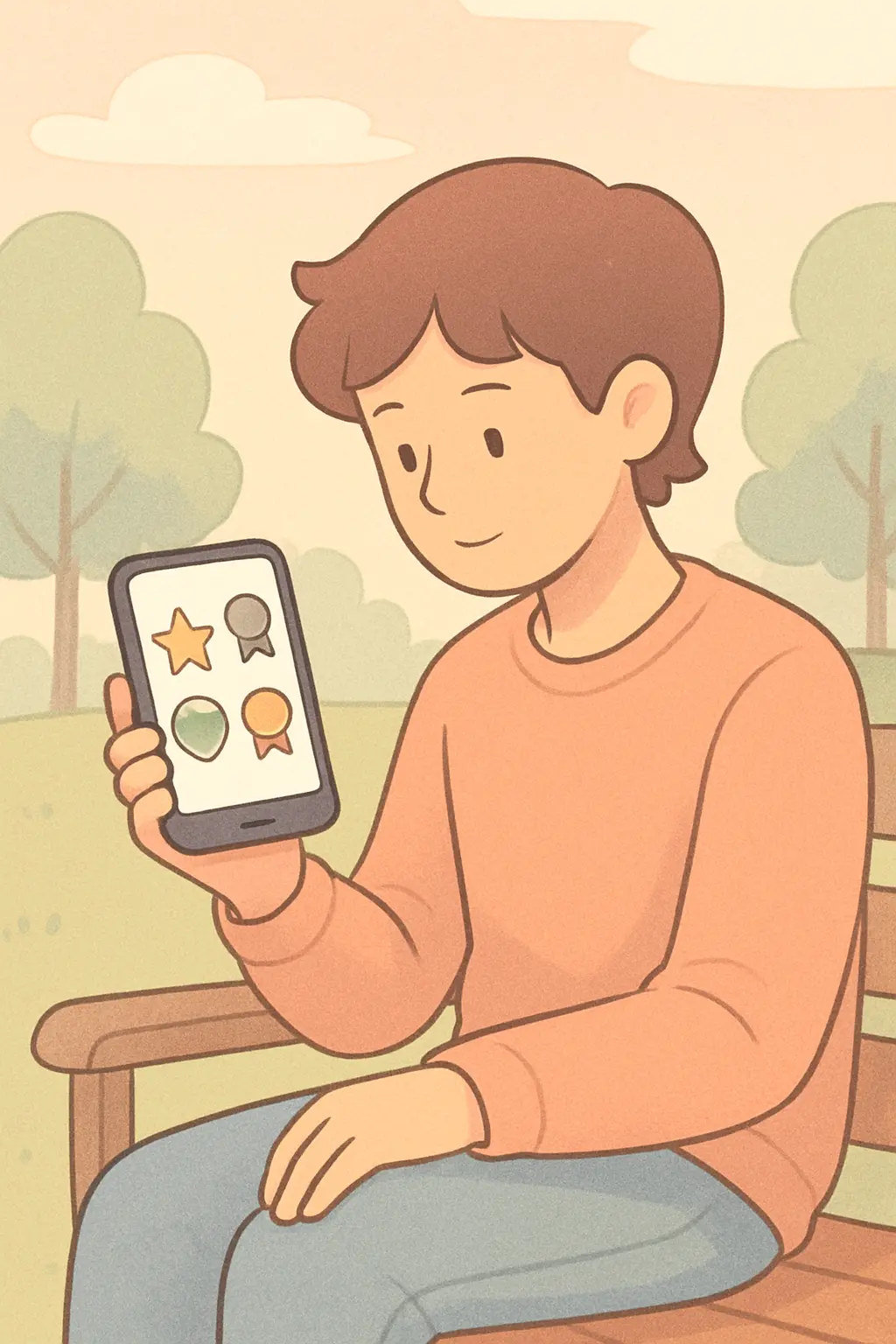
Progress tracking centers on badges: you “monitor your progress and earn badges for smokefree milestones and other achievements,” and there is a social-sharing option to “share your progress and favorite tips through social media” if public accountability motivates you. It is a straightforward, gamified milestone system rather than a deep analytics dashboard — you will not find granular charts of craving intensity over time or multi-currency savings projections here, just clear milestone markers and encouragement at each one.
For some users that simplicity is exactly the point: a badge system that does not require interpreting a graph is genuinely easier to check at a glance during a stressful week, even if it gives up some of the depth a data-heavy tracker would offer.
Where it falls short
Two honest gaps stand out. First, there is no AI coach or live human coaching inside the app itself — the personalization is rules-based (tailored tips from your intake answers), not a conversational assistant you can ask a question and get an answer from. Second, on Google Play the app currently shows a middling 3.5-star rating from 348 reviews and “100K+” downloads, last updated Feb 17, 2025 — a real but modest user base and rating on that platform, even though the same app rates noticeably higher on Apple’s App Store at roughly 4.6 stars from 2,423 ratings, last updated August 2026. Ratings and review counts change over time; these were checked 2026-09-20. A government app is not obligated to chase ratings the way a commercial one is, and the discrepancy between the two stores is worth knowing rather than assuming either number tells the whole story.
It is also worth noting that neither rating, on its own, tells you whether the app will work for your specific quit attempt — ratings measure satisfaction with the app experience, not verified quit outcomes, and a government tool with no marketing budget will naturally accumulate reviews more slowly than a commercial app that actively prompts users to rate it.
None of this means quitSTART is unreliable — it means it is a solid, evidence-based utility rather than a feature-rich, frequently iterated commercial product, and its Google Play numbers reflect that more modest pace of updates.
SmokefreeTXT and the rest of the Smokefree.gov toolkit
quitSTART is one piece of a larger free government toolkit. SmokefreeTXT offers “free daily text messages with encouragement, advice, and tips to help you quit smoking” over a 6–8 week program, which works well as a second layer of support if you want reminders that do not require opening an app. Smokefree.gov also runs a LiveHelp chat service and personalized quit plans on its website, so quitSTART is best understood as the mobile-app arm of a wider, entirely free support system rather than the whole offering.
Running quitSTART and SmokefreeTXT together costs nothing and covers two different moments: the app for structured tracking and craving tools when you’re already on your phone, and the text program for the reminder that shows up on its own, even on days you would not have thought to open an app at all.
| Feature | quitSTART | iQuit |
|---|---|---|
| Publisher | U.S. National Cancer Institute (Smokefree.gov) | Independent app developer |
| Cost | Free, no premium tier | Free core app; optional premium subscription |
| AI coach | Not included | Included, free daily messages |
| Trigger tagging | Time/place tagging | Craving logging with triggers and intensity |
| Milestones | Badge-based achievements | Health milestones from 20 minutes to 15 years |
| Store ratings | 3.5★ Google Play (348 reviews); ~4.6★ App Store (2,423 ratings) | No public star rating on either store |
| Platforms | iOS and Android | Google Play and the App Store |
Who should use which
If you want a no-frills, government-vetted tool with zero commercial angle and are comfortable without an AI coach, quitSTART is a genuinely trustworthy choice, and it is well suited to following alongside a general step-by-step quit-smoking app guide. If you want daily AI coaching, a savings dashboard, and SOS craving tools like breathing exercises and craving surfing, iQuit ranks well in the full feature comparison of quit-smoking apps and is free on both Google Play and the App Store. Nothing stops you running both — quitSTART’s badges plus iQuit’s AI coach and money-saved dashboard is a reasonable free combination.
If you’d rather see the fuller field before committing to one app, the best free quit-smoking apps and resources are compared side by side here, and if you want quitSTART weighed specifically against a paid-model competitor, iQuit has also been compared directly against Smoke Free. For readers outside the US wondering what free national resources exist where they live, NHS, CDC and other free resources are compared country by country, and if you’ve reviewed a rebranded employer program already, quitSTART is a genuinely free alternative to a benefit-gated program like Pelago — no eligibility check, no waiting for HR to confirm coverage, just a direct download available to anyone in the US today.
Frequently Asked Questions
Who makes the quitSTART app?
quitSTART is developed by Smokefree.gov, a resource created by the Tobacco Control Research Branch at the National Cancer Institute, with the U.S. Food and Drug Administration (smokefree.gov, fetched 2026-09-19).
Is quitSTART actually free?
Yes. It is a free government app with no premium tier or in-app purchases, listed at price 0.0 on the App Store (iTunes lookup API, checked 2026-09-20).
What rating does quitSTART have?
3.5 stars from 348 reviews on Google Play, and about 4.6 stars from 2,423 ratings on the App Store, checked 2026-09-20 (Google Play listing; iTunes lookup API). Ratings and review counts change over time.
Does quitSTART have an AI coach like iQuit?
No. quitSTART’s personalization comes from a rules-based Quit Kit built from your intake answers, not a conversational AI coach (smokefree.gov, fetched 2026-09-19).
What is SmokefreeTXT and is it different from quitSTART?
SmokefreeTXT is a separate free text-message program from the same Smokefree.gov team, sending daily encouragement and tips over 6-8 weeks, rather than an app you open (smokefree.gov, fetched 2026-09-19).
Can I use quitSTART and iQuit together?
Yes. Both are free, so using quitSTART’s badge tracking alongside iQuit’s AI coach and savings dashboard is a reasonable combination rather than an either-or choice.
Is quitSTART only for US smokers?
It is built and maintained by a US government agency and is US-focused in its content and quitline references, though the app itself is downloadable wherever the app stores allow it (smokefree.gov, fetched 2026-09-19).
Add an AI coach to your toolkit
iQuit’s free AI coach, craving log and savings dashboard pair well with quitSTART’s badges — free on Google Play and the App Store.
Download iQuit Free on Google Play Download on the App Store


