
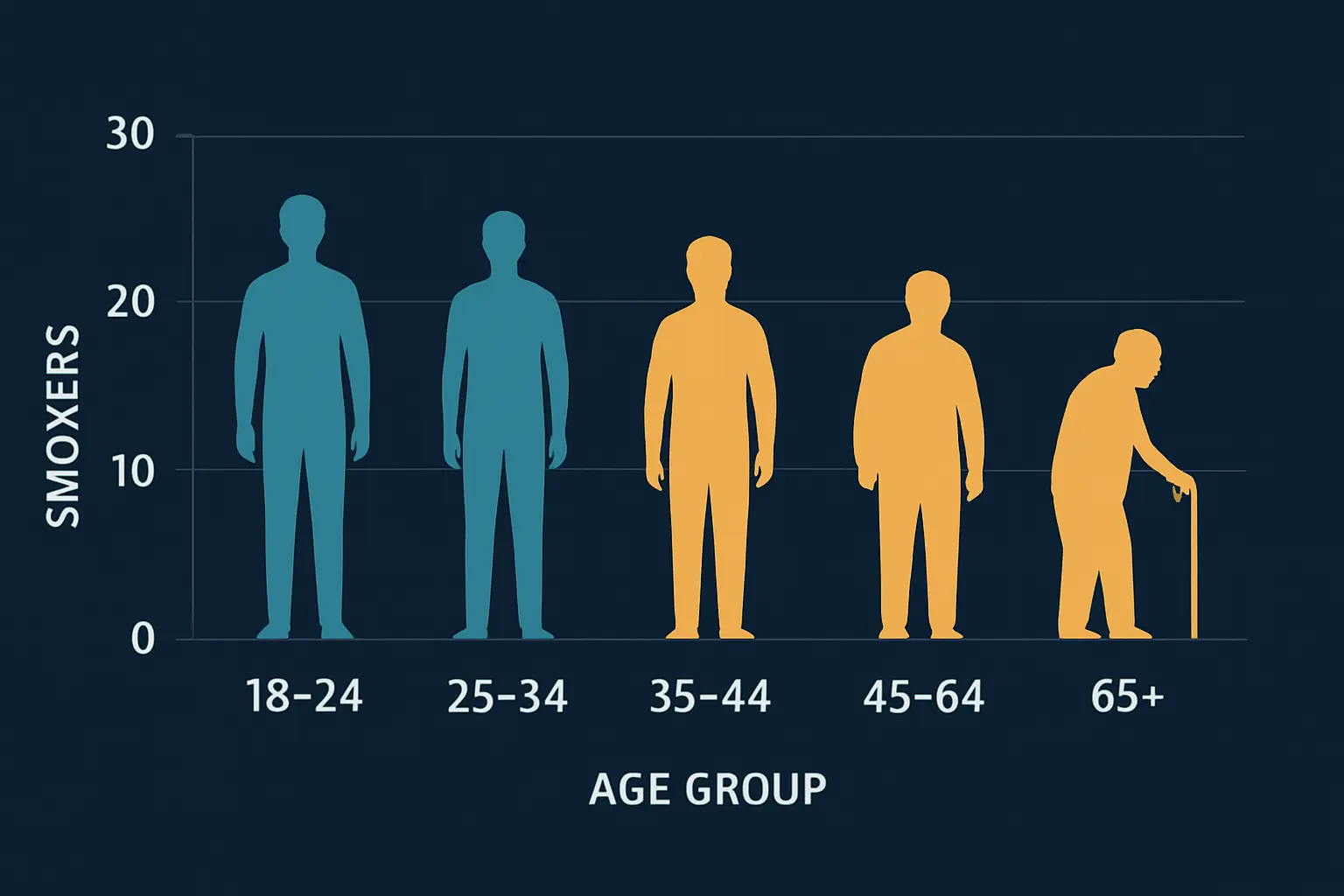
The age curve of smoking has flipped. For most of the 20th century, young adults were the heaviest smokers and rates declined with age. In 2026 the pattern is inverted: US 18–24-year-olds now smoke cigarettes at roughly 5% or below — a historic low — while the highest rates sit with adults 45–64, around 14–15%. Similar inversions show up across Europe. The story behind the flip explains where smoking is going — and what it means if you’re in the peak bracket.
The 2026 age picture (US benchmark data)
| Age group | Cigarette smoking rate (approx.) | Trend |
|---|---|---|
| 18–24 | ~4–5% | Collapsing — down from ~13% a decade ago |
| 25–44 | ~10–12% | Falling steadily |
| 45–64 | ~14–15% | Highest bracket; declining slowly |
| 65+ | ~8–9% | Lower — a mix of past quitting and, bluntly, survivorship |
Figures are drawn from CDC/NHIS-lineage surveys and rounded; country specifics vary, but the shape — young lows, midlife peak — repeats across most high-income countries.
Why the young stopped starting
- Prevention compounding: price rises, indoor bans, plain packaging, and the total denormalization of smoking in youth culture — a cigarette on a 20-year-old’s night out now reads as unusual, not default.
- The initiation window closed: the overwhelming majority of smokers start before 25. Every cohort that passes that window clean locks in a lifetime low rate.
- Vaping’s double edge: e-cigarettes absorbed some of the nicotine experimentation that once began with cigarettes — a public-health trade with its own controversies, but one that shows up in the cigarette numbers.
Why midlife smokers became the peak
Today’s 45–64 smokers started in the 80s and 90s, when initiation was mainstream. The group that remains is selected for dependence: the lighter smokers of that generation already quit, so the survivors smoke more heavily and report higher addiction markers — earlier first cigarettes of the day, more past attempts. It’s the cohort where multiple quit attempts are most normal — and where each attempt is most worth upgrading with real support.
What this means if you’re 45–64 and still smoking
You’re not a laggard — you’re the statistical center of today’s smoking population, carrying the strongest version of the addiction. Two data points matter more than any judgment: quitting at 45–55 still recovers roughly six of the ten years smoking costs, and structured support roughly doubles any attempt’s odds versus willpower alone. The tools built for this — craving prediction, slip recovery, an always-available coach — exist precisely because the remaining smokers are the hardest cases. The free iQuit app was designed on that assumption: heavy dependence, prior attempts, real life. You’re the user it expects.
Where the curve goes next
Project the cohorts forward and the endgame is visible: as near-zero-smoking generations age and the midlife peak quits or ages out, several countries now target “smoke-free” status (under 5% prevalence) in the 2030s. The last chapters of smoking will be written by exactly two groups — the midlife peak deciding to quit, and the systems that help them do it.
FAQ
Which age group smokes most?
Adults 45–64, at roughly 14–15% in US data — the inverted peak of the modern curve.
How low are youth rates?
Around 4–5% for 18–24s — historic lows, down from double digits a decade ago.
Why did the curve flip?
Prevention stopped new starts among the young, while the most-dependent members of older cohorts remain.
Is it harder to quit at 50 than 25?
Dependence tends to be deeper, but success rates with support are comparable — and the health payoff at 50 remains enormous.
In the peak bracket? The tools are built for you: download iQuit free on Google Play.