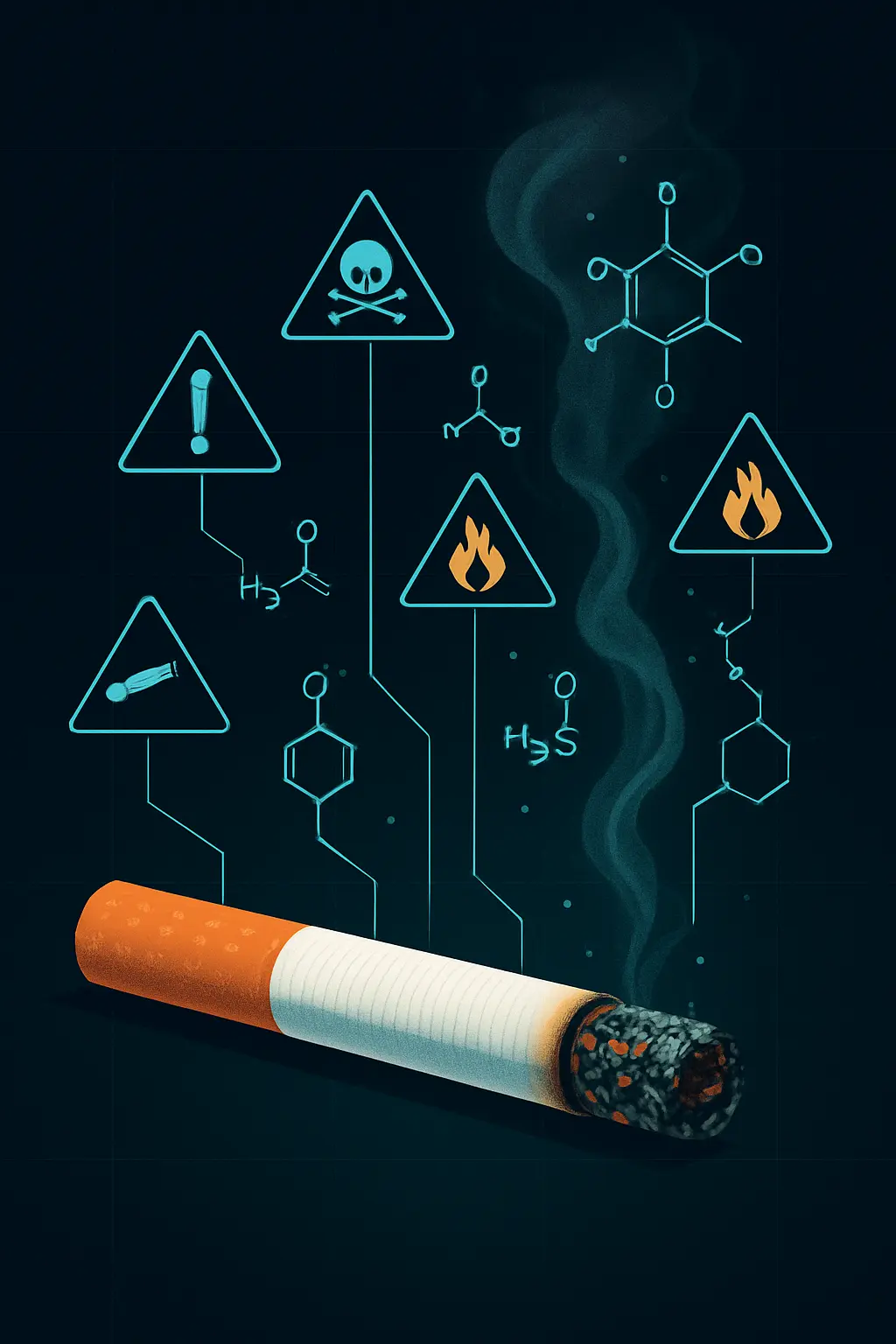
A cigarette contains tobacco; a lit cigarette manufactures over 7,000 chemicals. Combustion is the chemistry lab: per Surgeon General and National Cancer Institute analyses, at least 250 of those compounds are known to be harmful and roughly 70 are proven carcinogens. The famous three — nicotine, tar, carbon monoxide — are just the department heads. Understanding what the rest actually do is less about fear than about clarity: it explains precisely why the body starts repairing so fast once the deliveries stop.
The big three, precisely
- Nicotine — the reason you smoke, and almost the only thing on this list that isn’t trying to kill you directly. Its job is addiction: brain in 10 seconds, dopamine spike, the craving loop. It keeps you coming back for everything else.
- Tar — not one chemical but the sticky aggregate of combustion particles. It coats the airways brown, paralyzes cilia, and delivers the carcinogen payload directly into lung tissue. A pack-a-day smoker paints roughly a cup of it into their lungs per year.
- Carbon monoxide — binds hemoglobin ~200× more readily than oxygen, so every cigarette partially suffocates you from the inside. It’s the main driver of smoking’s cardiovascular harm — and the fastest to leave, as the 48-hour blood recovery timeline shows.
The rogues’ gallery you’ve never been introduced to
| Chemical | Also found in | What it does in smoke |
|---|---|---|
| Benzene | Gasoline | Leukemia-linked carcinogen |
| Formaldehyde | Embalming fluid | Nasal/throat carcinogen, airway irritant |
| Arsenic | Rat poison | Carcinogen; accumulates with exposure |
| Cadmium | Batteries | Kidney damage, lung carcinogen |
| Ammonia | Cleaning products | Boosts nicotine delivery (freebasing effect) |
| Hydrogen cyanide | Chemical weapons | Cripples cilia, impairs cellular respiration |
| Benzo[a]pyrene | Coal tar | Directly mutates the p53 tumor-suppressor gene |
| Polonium-210 | Radioactive metal | Alpha radiation delivered to lung hotspots |
Yes — polonium: tobacco plants concentrate radioactive lead and polonium from fertilizers and air, making a heavy smoker’s annual radiation dose to lung tissue meaningfully elevated. And ammonia isn’t an accident; it raises the fraction of free nicotine, speeding the hit.
The cleanup schedule after your last cigarette
- 12 hours: carbon monoxide normal; oxygen delivery restored.
- 72 hours: nicotine and its metabolites cleared (details in how long nicotine stays in your system).
- Days–weeks: volatile toxins (benzene, cyanide compounds) clear; cilia begin regrowing and start hauling tar out — the recovering cough of smoker’s flu.
- Months–years: tar deposits gradually removed; DNA-repair outpaces new damage; cancer risk declines on the decade-scale curve toward a never-smoker’s.
Why this list is good news
Every chemical above shares one property: your body stops receiving it the moment you stop lighting cigarettes. There is no residue of benzene worth fearing after quitting, no ongoing polonium — the harm model of smoking is a delivery service, and you can cancel the subscription today. The free iQuit app tracks the cancellation in real time: CO normalization at 12 hours is among the first of its 15 milestones, and the counter of cigarettes-not-smoked is, equivalently, a counter of 7,000-chemical deliveries refused.
FAQ
How many chemicals are in cigarette smoke?
Over 7,000 — at least 250 harmful, ~70 proven carcinogens. Most are combustion products, not additives.
What’s the single worst one?
For cancer, the nitrosamines and benzo[a]pyrene; for your heart, carbon monoxide; for staying hooked, nicotine plus ammonia’s delivery boost.
Are “natural” or additive-free cigarettes cleaner?
No — combustion itself creates the toxins. Burning organic tobacco still makes benzene, tar and CO.
How fast does the body clear it all?
CO in 12 hours, nicotine in ~72, volatile toxins in days-weeks, tar over months — with risk falling for years after.
Cancel the delivery service today: get iQuit free on Google Play and watch the cleanup milestones tick off from hour one.