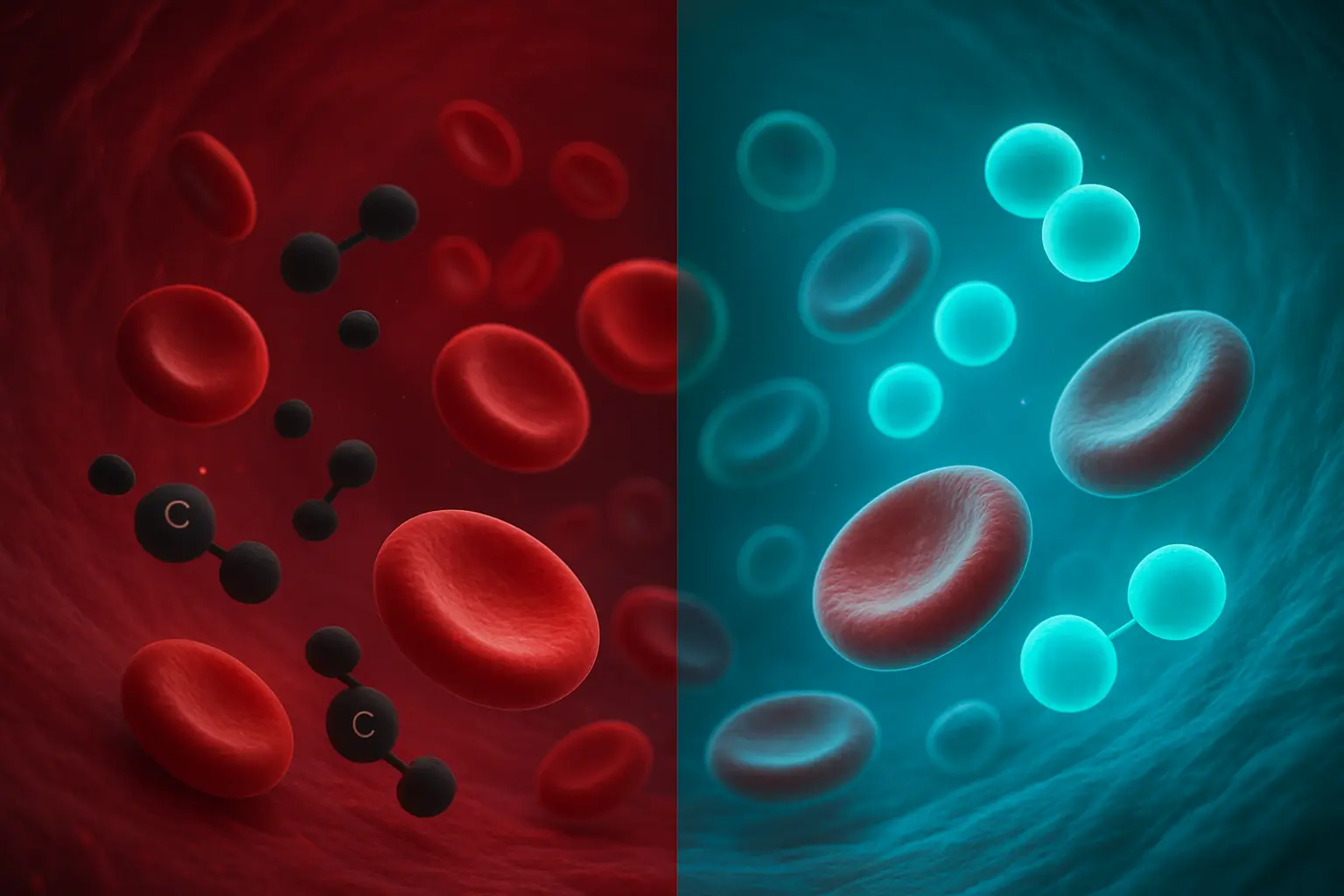
Of all the damage smoking does, the carbon monoxide is the fastest to undo — and the arithmetic is beautiful. CO binds hemoglobin roughly 200 times more tightly than oxygen, so every cigarette converts a slice of your blood into sealed cargo space, carrying poison where oxygen should ride. But CO’s half-life in blood is only 4–6 hours on room air: stop smoking, and levels halve by hour 8 and reach a non-smoker’s baseline within 12–24 hours. You get your blood back in a day.
What was actually happening while you smoked
Each puff delivers CO from combustion straight across the lungs into arterial blood, where it forms carboxyhemoglobin (COHb). A non-smoker runs COHb around 1%; a pack-a-day smoker typically 5–10% — meaning up to a tenth of the oxygen fleet was permanently loaded with the wrong cargo. The body compensates the only ways it can: the heart beats faster (10–20 bpm above its true baseline), breathing effort rises, and over years the body even manufactures extra red blood cells to make up the shortfall — thickening the blood, which brings its own cardiovascular costs.
Hour by hour: the first 48
- Hour 0–4: with no new CO arriving, every exhale offloads a little. COHb begins its exponential decline.
- Hour 8: CO roughly halved; blood oxygen measurably climbing. This is the classic “8 hours” milestone on every quit timeline — now you know its mechanism.
- Hour 12–24: COHb at or near non-smoker baseline. Full oxygen-carrying capacity restored. The heart’s compensation contract is cancelled — a key driver of the heart-rate drop in day one.
- Hour 24–48: tissues notice. Better-oxygenated muscles fatigue later; the brain, a ferocious oxygen consumer, often feels the first clarity through the withdrawal fog; warmer fingers and toes hint at the circulation recovery that deepens over coming weeks. Meanwhile taste and smell begin their own 48-hour awakening.
The proof you can measure
CO clearance is one of the few quit benefits you can verify with hardware: exhaled-CO monitors (the breathalyzer-style devices stop-smoking clinics use) show smokers readings of 10–30 ppm dropping into the non-smoker range (under ~6 ppm) within a day of quitting. Watching your number fall from 22 to 3 has converted more skeptics than any pamphlet. If you slip, the number honestly rises — which is exactly why clinics love it: the blood doesn’t negotiate.
Why this milestone punches above its weight
Most quit benefits ask for faith — cancer risk curves pay out over decades. The CO story pays out today, and it compounds immediately: restored oxygen delivery is why day-two walks feel easier, why the gym stops being humiliating weeks before lung mechanics fully improve, and why “I already feel better” is usually true rather than placebo. The free iQuit app marks CO normalization among the first of its 15 tracked milestones — for most quitters it unlocks while they’re still in day one, the earliest concrete proof that the body noticed you stopped.
FAQ
How long does CO stay in blood after quitting?
Half-life 4–6 hours: roughly halved by hour 8, non-smoker baseline by 12–24 hours.
How much of a smoker’s blood was carrying CO?
Typically 5–10% of hemoglobin in a pack-a-day smoker, versus ~1% in non-smokers.
Can I measure my own recovery?
Yes — exhaled-CO monitors show the drop within a day; readings under ~6 ppm indicate non-smoker range.
Does one cigarette reset the CO clock?
It spikes COHb for several hours, then clears again. The real cost of a slip is the craving loop, not permanent CO.
Unlock the 8-hour milestone tonight: download iQuit free on Google Play — your blood starts the paperwork the moment you stop.