Best Apps to Quit Vaping in 2026: Ranked & Compared
Vaping was supposed to be the off-ramp from smoking — but for tens of millions of people, it became a new addiction. The World Health Organization’s first global vaping report (2025) found more than 100 million people now vape worldwide, including 14.7 million adolescents aged 13–15. The good news: the best quit vaping app in 2026 is dramatically more capable than anything that existed two years ago — with AI coaches that learn your triggers, craving-rescue tools built for nicotine pods rather than cigarettes, and clinical backing from randomised controlled trials.
This guide ranks every major vaping cessation app side by side, explains exactly which features matter (and which are marketing fluff), and gives you a clear recommendation based on who you are and what you need. Every factual claim below is sourced to peer-reviewed research or a public health authority.
Why Vaping Is Uniquely Hard to Quit
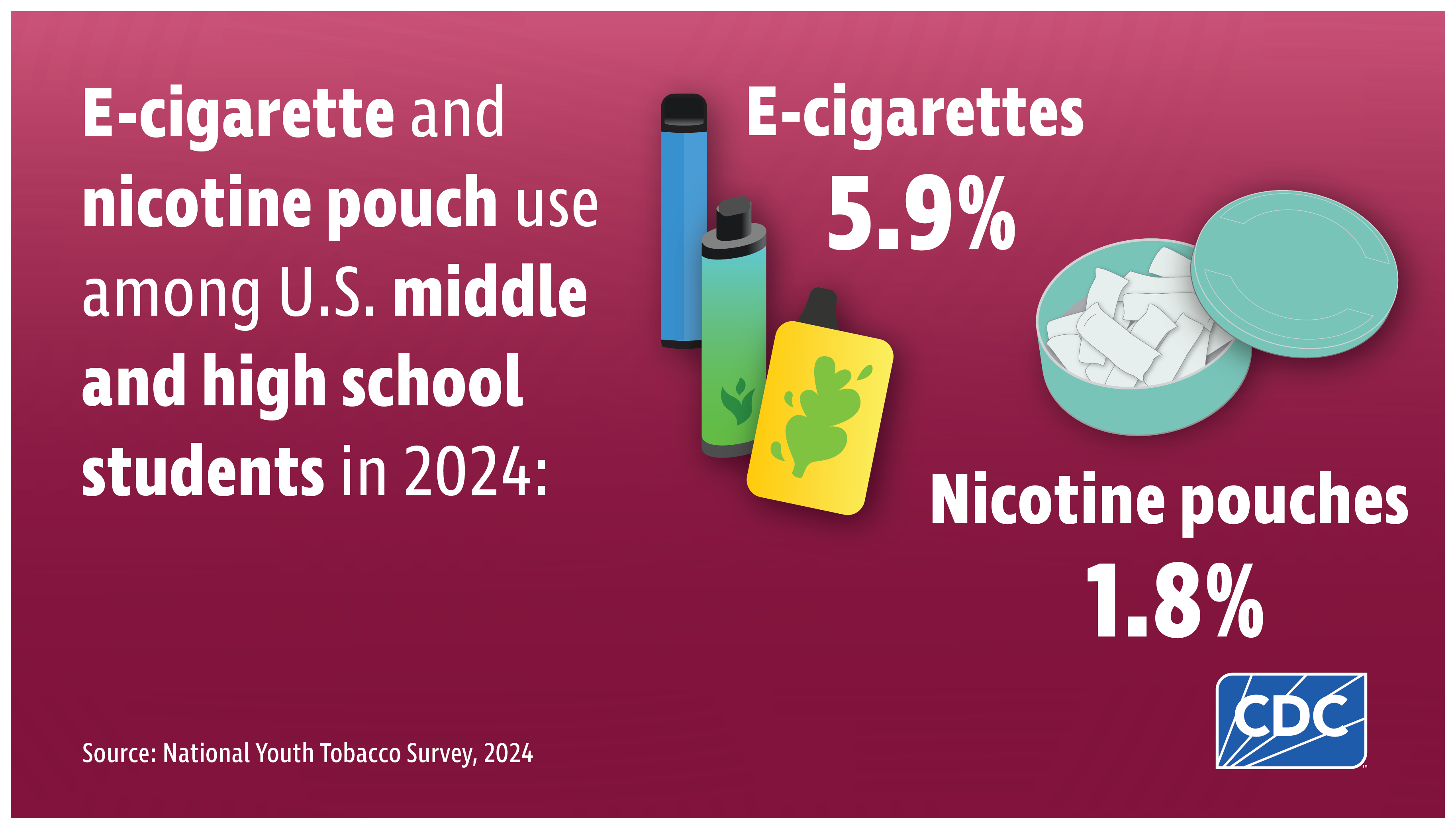
Disposable e-cigarettes like Elf Bar and Mr. Fog deliver nicotine faster and in higher concentrations than most cigarettes — and they do it without the ritual cues (lighting up, ashtrays, smoke smell) that traditional quit approaches use as anchor points for behaviour change. CDC data from 2024 show that among young people who currently use e-cigarettes, 26.3% report daily use and 38.4% vape on at least 20 of the last 30 days — patterns consistent with significant nicotine dependence.
This matters because most quit-smoking apps were built around cigarette cessation research. A peer-reviewed quality assessment of vaping cessation apps published in JMIR mHealth found that the average app scored just 3.66 out of 5 on the Mobile App Rating Scale, with the lowest sub-score on information quality — a sign that many apps are engaging but thin on evidence. In other words, not all apps are created equal when your goal is to quit vaping specifically.
The encouraging news is that demand-side pressure has pushed developers to improve rapidly. The apps ranked below in 2026 are meaningfully better than the cohort assessed in 2022 — and a randomised trial published in JAMA now gives us real quit-rate data for at least one program. If you are also looking for a complete, structured quit plan to run alongside your chosen app, the step-by-step guide to quitting vaping in 2026 covers every phase from quit-date setting to relapse prevention.
How We Ranked These Apps
Each app was evaluated against six criteria drawn from the scientific literature on what actually improves cessation outcomes:
- Evidence base — published RCTs, peer review, or government/NHS/CDC backing
- Vaping-specific features — built for nicotine pods and disposables, not just cigarettes
- Behaviour change techniques (BCTs) — craving management, trigger identification, goal-setting
- Personalisation — AI adaptation, quit-method flexibility, progress tracking
- Community and support — peer forums, coach access, helpline integration
- Accessibility — free tier quality, iOS and Android availability, ease of use
2026 Comparison Table
| App | Best For | Vaping-Specific | AI Coaching | Free Tier | Evidence Level | Platforms |
|---|---|---|---|---|---|---|
| iQuit | Adults, all-round | ✓ | ✓ Adaptive | ✓ Full | Behavioural science | iOS, Android |
| This Is Quitting | Teens 13–24 | ✓ (e-cig only) | Text-based | ✓ Free | RCT in JAMA | SMS (any phone) |
| Smoke Free | Data-driven quitters | Partial | Pro tier only | ✓ Strong | CBT-based | iOS, Android |
| QuitSure | Gradual mindful quit | ✓ | Programme-led | Limited | CBT / REBT | iOS, Android |
| quitSTART | Government-backed free | Partial | No | ✓ Fully free | NCI / FDA | iOS, Android |
| Kwit | Gamification fans | Partial | No | Limited | Highest MARS score | iOS, Android |
| QuitNow! | Community-first | Partial | No | ✓ Strong | Community-driven | iOS, Android |
Apps Ranked: #1 to #7
#1 iQuit — Best Overall Quit Vaping App 2026
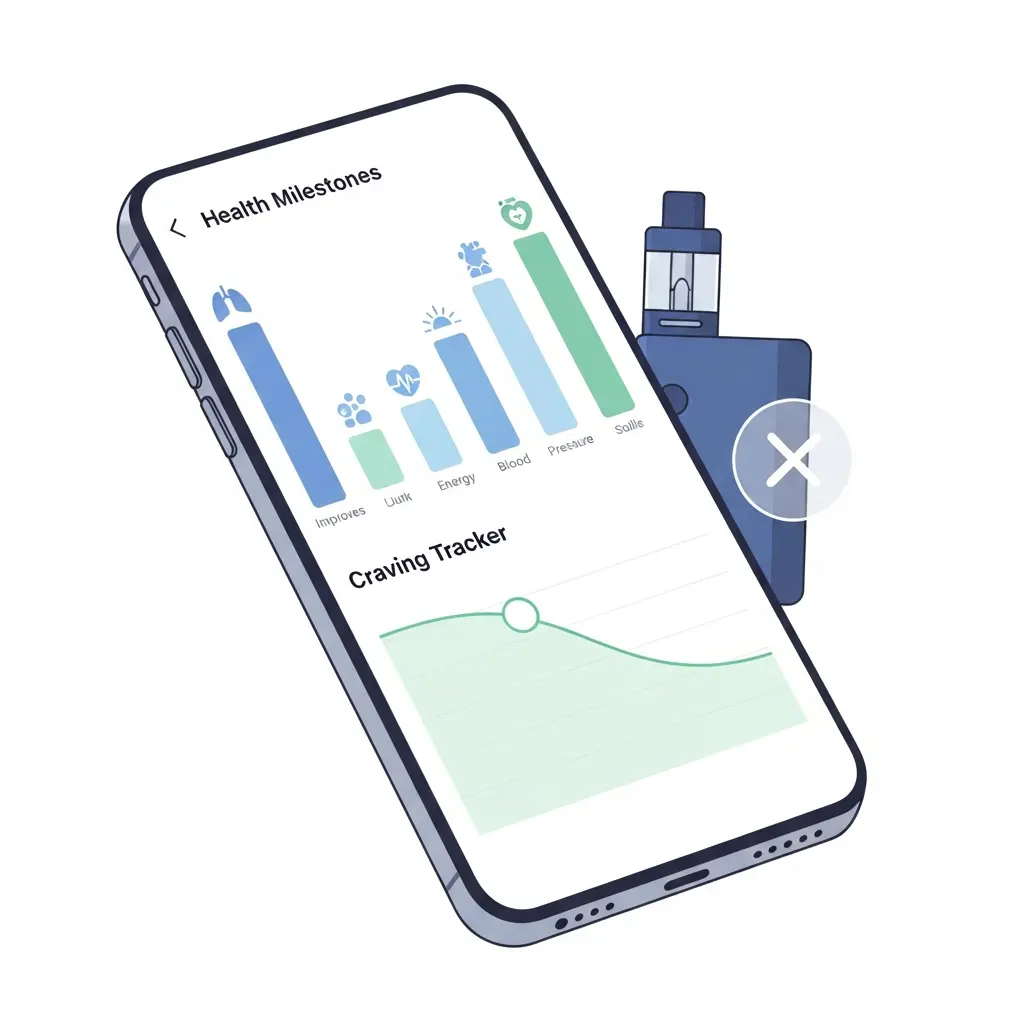
iQuit’s approach centres on three things the science says matter most: knowing your personal triggers, having an in-the-moment craving rescue when a wave hits, and seeing your body’s recovery progress in concrete, motivating milestones. Its AI coach doesn’t follow a generic script — it learns your patterns from mood and craving logs, adapts its nudges accordingly, and is available 24/7 for those 2 a.m. moments when a disposable vape feels like the only answer.
Critically for vapers, iQuit supports both cold turkey and gradual reduction — essential because many e-cigarette users have never set a single quit date in the cigarette-smoker sense. The app also surfaces the Quit Support Helpline (1-800-784-8669) directly within its interface, giving users a human fallback at any point. The health recovery timeline — showing lung function, circulation, and cardiovascular risk improving hour by hour — is tailored to nicotine recovery, not just “days since your last cigarette.” You can explore how iQuit compares against the broader smoking-cessation app market in our complete 2026 feature comparison and rankings. For a dedicated deep-dive into how iQuit specifically supports vaping cessation, see the full guide on iQuit’s vape cessation features.
Strengths: Adaptive AI, craving rescue tools, money-saved calculator, health milestones, fully free, both quit methods
Weaknesses: Newer app; community forum less mature than QuitNow!
Price: Free
Platforms: iOS, Android
#2 This Is Quitting — Best Evidence-Based App for Teens
Run by the non-profit Truth Initiative, This Is Quitting is a text-message program rather than a smartphone app — and that design choice is deliberate. SMS works on any phone, reaches teens wherever they are, and sidesteps the friction of downloading and opening an app during a craving. The JAMA trial enrolled 1,503 adolescents aged 13–17 across the US: quit rates were 37.8% in the intervention group versus 28% in the control group at the seven-month endpoint. The program worked equally well across gender, race, and ethnicity, and among teens with higher nicotine dependence.
To enrol, teens text DITCHVAPE to 88709. The messages draw on peer support, clinical tobacco treatment guidelines, and real advice from young people who have already quit. Over 750,000 young people have enrolled since 2019. It is completely free. For a broader look at which digital tools pair well with text-based programs, see our guide to the best free quit smoking apps and resources for 2026.
Strengths: Only vaping-specific RCT in JAMA; free; any phone; teen-specific peer content
Weaknesses: SMS only — no progress dashboard, no health milestone tracking
Price: Free
Platforms: SMS (iOS, Android, any feature phone)
#3 Smoke Free — Best for Detail-Oriented Quitters
Smoke Free earned a 4.8/5 on the iOS App Store and consistently ranks among the top apps in CBT-based cessation research. Its free tier is genuinely useful: it tracks quit days, health recovery milestones, money saved, and craving patterns. The paid Pro plan adds personalised quit plans and AI coaching. Daily missions — small, achievable behavioural tasks drawn from CBT principles — give the app a structured feel without being rigid. For vapers who vape in specific situations (after meals, when stressed, in the car), Smoke Free’s trigger mapping feature is especially powerful because it transforms vague patterns into actionable data.
One limitation: Smoke Free was built primarily around cigarette cessation and its health-timeline data still defaults to cigarette-centric milestones. Vaping users should manually configure their nicotine intake levels for the most accurate tracking.
Strengths: Excellent free tier; granular health and financial tracking; CBT missions; high app store ratings
Weaknesses: Pro features behind paywall; not vaping-native; AI coaching is premium-only
Price: Free; Pro subscription available
Platforms: iOS, Android
#4 QuitSure — Best for a Mindful, Gradual Approach
QuitSure’s philosophy is structurally different from every other app on this list: it asks you to keep vaping at first, but to do so mindfully — observing cravings and rituals rather than automatically satisfying them. This approach, grounded in CBT and Rational Emotive Behaviour Therapy (REBT), works by dismantling the unconscious habit loop rather than trying to override it with willpower. Reviewers consistently rate QuitSure highly for its depth of behaviour change techniques — craving management, trigger identification, goal-setting, and mindfulness practice are all built into its structured curriculum.
The 6-day and 6-week programme formats suit vapers who need a structured runway rather than a cold-turkey cliff edge. The free tier is limited; most users will need the paid programme to access the full behavioural curriculum.
Strengths: Strong behaviour-change toolkit; gradual-quit approach; CBT/REBT/self-hypnosis methods
Weaknesses: Premium-gated; not free; can feel intensive for casual vapers
Price: Paid programme
Platforms: iOS, Android
#5 quitSTART — Best Free Government-Backed Option
quitSTART is produced by Smokefree.gov, a resource created by the National Cancer Institute in collaboration with the US Food and Drug Administration. It is completely free, requires no subscription, and is the most institutionally credible app on this list. Features include a customisable Quit Kit, trigger mapping, craving management games, badge milestones, and social sharing. Because it was built by tobacco control professionals with FDA input, its health recovery information is rigorously accurate.
Its limitation is that it was designed for cigarette cessation and has not been updated with vaping-specific content. For a teen or young adult whose only nicotine exposure has been through a pod device, some of the framing will feel off. That said, as a free, trustworthy option with zero upsell pressure, quitSTART is an excellent complement to This Is Quitting for young adults who want a visual progress dashboard alongside the SMS program.
Strengths: 100% free; NCI/FDA credibility; solid feature set; no account needed
Weaknesses: Cigarette-centric; no AI; dated interface
Price: Free
Platforms: iOS, Android
#6 Kwit — Best for Gamification
Kwit earned the highest overall Mobile App Rating Scale score (4.24 out of 5) in the 2022 peer-reviewed assessment of vaping cessation apps — ahead of every app studied. It translates quit progress into a video-game experience: levelling up, unlocking achievements, and earning badges that correspond to real health milestones. Breathing exercises and motivational push notifications round out the feature set. For a head-to-head look at how Kwit stacks up against iQuit and QuitNow! on specific features, the 2026 head-to-head comparison of iQuit, QuitNow!, and Kwit goes deeper.
For quitters who respond well to extrinsic motivation and enjoy a sense of progress through visual rewards, Kwit fills a gap that the more clinical apps don’t address. However, its free tier is limited, and the gamification layer can feel thin once the novelty wears off after the first few weeks.
Strengths: Highest MARS score in peer review; strong engagement mechanics; breathing exercises
Weaknesses: Shallow free tier; gamification alone won’t sustain long-term quit; no AI coaching
Price: Free (limited); Pro subscription
Platforms: iOS, Android
#7 QuitNow! — Best Community Support
QuitNow! stands out for one thing: community. Its built-in forums are active, topic-specific (with threads specifically for vaping), and moderated. For quitters who do best with peer accountability — sharing milestones, asking questions, reading others’ success stories — QuitNow! delivers a social support layer that standalone tracking apps cannot replicate. Progress metrics (money saved, life regained, cigarette/pod-free days) are displayed clearly, and milestone badges create a sense of forward momentum.
The app is less sophisticated on the AI and personalisation front, and its health data defaults to cigarette metrics. But as a free community hub to complement a more feature-rich tool, it earns a solid place on this list.
Strengths: Active vaping-specific forums; strong free tier; milestone badges; broad platform support
Weaknesses: No AI coaching; limited personalisation; cigarette-centric health data
Price: Free
Platforms: iOS, Android
Best App for Teens vs Adults
| Profile | Top Pick | Why |
|---|---|---|
| Teen (13–17) | This Is Quitting | Only program with a teen-specific RCT; peer-voice messaging; no app download required |
| Young adult (18–24) | iQuit + This Is Quitting | iQuit provides the progress dashboard and AI; This Is Quitting adds proven SMS support |
| Adult (25+) cold turkey | iQuit | Adaptive AI, craving rescue, health milestones, and full free access |
| Adult — gradual quit | QuitSure | Mindful smoking/vaping methodology; strong behaviour-change toolkit; structured programme |
| Data obsessive | Smoke Free | Granular financial and health data; CBT missions; excellent visualisation |
| Budget-constrained / US | quitSTART | 100% free; NCI/FDA backing; no sign-up upsell |
| Community-driven | QuitNow! | Active forums with vaping threads; peer accountability |
Features That Actually Move the Needle
The peer-reviewed literature identifies specific behaviour change techniques (BCTs) that predict better cessation outcomes. When evaluating a quit vaping app, look for these — not just high app store ratings:
1. Craving Management Tools
Cravings peak around 3–5 minutes and then subside — the right app gives you a structured distraction technique (breathing exercise, craving timer, grounding task) to surf the wave rather than break under it. Apps that only offer a craving log without a rescue tool are missing half the mechanism. iQuit and Smoke Free both provide in-the-moment craving rescue. For a deeper look at how AI coaching changes this dynamic, see our guide to the best AI coaching apps for quitting smoking in 2026.
2. Trigger Identification and Mapping
Vaping habits are often tightly bound to contexts: specific locations, emotional states, social situations, or times of day. An app that helps you map your personal trigger landscape — and then build a substitute behaviour for each — is addressing root cause rather than symptom. Both iQuit and Smoke Free do this systematically.
3. Health Recovery Timeline
Seeing exactly what your body is doing — cardiovascular risk dropping, lung capacity improving, circulation normalising — provides evidence-based hope during the difficult early days. The milestones are real: within 20 minutes of quitting, heart rate begins to normalise; within 12 hours, carbon monoxide levels fall; within two weeks, circulation improves. An app that puts these milestones on a visual timeline turns abstract benefit into moment-by-moment motivation. To see how iQuit specifically tracks these health milestones in real time, read the breakdown of how iQuit tracks health recovery milestones.
4. Money-Saved Tracking
Disposable vapes are expensive — a daily user in the US can spend $150–$250 per month or more. Seeing that money accumulate in a real-time counter is one of the most consistently cited motivators in cessation app reviews. The best apps auto-calculate this from your usage pattern and update it continuously. For detail on how quit smoking apps handle financial motivation, our full guide to quit smoking app features, pricing, and results goes deeper.
5. Peer Support and Accountability
Social support is a significant predictor of sustained cessation. Apps that integrate community — whether through forums, partner sharing, or social milestone badges — outperform purely solo tracking tools for users who are socially motivated. QuitNow! leads here; iQuit’s community features are growing.
Some vapers, rather than quitting nicotine outright, consider switching to nicotine pouches as an intermediate step. Whichever app you choose, that trade-off is worth understanding on its own terms: our comparison of nicotine pouches vs vaping to quit smoking weighs the evidence on both sides before you decide whether it belongs in your quit plan.
Start Your Quit with iQuit — Free, Today
iQuit — Your AI Quit Vaping Coach
Join thousands of people who have already started their quit journey with iQuit. AI coaching that learns your triggers. Craving rescue when you need it most. Health milestones to celebrate every step forward. All completely free.
- ✓ Adaptive AI coach
- ✓ Craving rescue tools
- ✓ Health milestone tracker
- ✓ Money saved counter
- ✓ Gradual reduction or cold turkey
Frequently Asked Questions
What is the best app to quit vaping in 2026?
The best quit vaping app in 2026 for most adults is iQuit — it combines an adaptive AI coach, craving rescue tools, health milestones, and a money-saved counter in a fully free app available on iOS and Android. For teens aged 13–17, This Is Quitting (text DITCHVAPE to 88709) is the top choice, backed by the only randomised controlled trial of a vaping cessation program published in JAMA, showing a 35% increase in quit rates versus control.
Are there any vaping cessation apps backed by clinical research?
Yes. This Is Quitting from Truth Initiative is the only vaping-specific cessation program with a published randomised controlled trial in a peer-reviewed journal (JAMA, 2024). The trial of 1,503 teens aged 13–17 found a 35% higher quit rate versus the control group. A 2025 Cochrane review also found low-certainty evidence that text-message-based interventions increase quit rates among 13–24-year-olds. Smartphone apps in general have a smaller evidence base for vaping specifically; however, apps built on CBT principles and behaviour change techniques are considered best practice by cessation researchers.
Is there a free app to quit vaping?
Several excellent options are completely free. iQuit offers its full feature set — AI coaching, craving tracker, health milestones, and money counter — at no cost. This Is Quitting is free (text-message only). quitSTART (Smokefree.gov) is 100% free with NCI/FDA backing. QuitNow! has a strong free tier with active community forums. Smoke Free’s free tier is also solid for tracking and CBT missions, though AI coaching requires the Pro subscription.
How long does it take to quit vaping with an app?
There is no universal timeline — nicotine addiction severity varies widely, and vaping devices deliver different nicotine concentrations. The JAMA trial of This Is Quitting assessed outcomes at seven months, which is the benchmark period used in most cessation research. Nicotine withdrawal typically peaks in the first one to three days and subsides significantly within two to four weeks. Most people who make it past 90 days without nicotine sustain their quit long-term. App-supported gradual reduction programmes like QuitSure run 6 days to 6 weeks. iQuit’s AI coach adapts its timeline to your individual progress rather than imposing a fixed schedule.
Can a quit smoking app help me quit vaping if I’ve never smoked cigarettes?
Yes, though the fit varies by app. Many quit smoking apps were built for cigarette users and use cigarette-centric language and metrics. Apps like iQuit and QuitSure explicitly support vaping cessation alongside smoking cessation, and their AI personalisation means the experience adapts to your specific usage pattern. This Is Quitting was designed exclusively for e-cigarette users and has no cigarette-based framing at all — making it particularly relevant for people whose only nicotine experience has been through vaping. When setting up any cessation app, configure your nicotine delivery as vaping or e-cigarette (not cigarettes) to ensure accurate health milestone and money-saved calculations.
Should I use nicotine replacement therapy (NRT) alongside a quit vaping app?
This is a question worth discussing with your doctor. A 2025 Cochrane review found that combination NRT (nicotine patches plus lozenges) showed no clear benefit specifically for vaping cessation — unlike its well-established efficacy for cigarette cessation. Varenicline (Champix/Chantix) showed low-certainty evidence of benefit. This suggests the pharmacological toolkit for vaping cessation is still evolving. Behavioural support through a well-designed app remains the most accessible and evidence-supported approach for most vapers, particularly younger users for whom medication may not be appropriate.
This article cites sources from the World Health Organization, CDC, Truth Initiative (JAMA), NHS Greater Glasgow and Clyde, and peer-reviewed research in JMIR mHealth. All external links were verified as working at time of publication (June 2026). This content is for informational purposes only and does not constitute medical advice. Consult a healthcare professional for personalised cessation support.