
If you have already moved off cigarettes and are weighing nicotine pouches vs vaping to quit smoking, the honest answer is that both routes keep you nicotine-dependent — the real question is which is the more manageable off-ramp, and what your exit plan looks like from each. We compared the two on delivery, discretion, cost, regulation, and the actual cessation evidence (which is thinner than either category’s marketing suggests).
Nicotine Pouches vs Vaping at a Glance
| Factor | Nicotine pouches (Zyn, Velo, etc.) | Vaping (e-cigarettes) |
|---|---|---|
| Nicotine delivery | Slower, steadier absorption through the gum | Faster, closer to a cigarette’s spike, via inhalation |
| Discretion | Very high — no vapor, no odor, usable almost anywhere | Lower — visible vapor and scent, restricted indoors in most places |
| Regulatory status (US) | 20 ZYN products hold FDA marketing authorization (Jan 2025) — permission to sell, explicitly not a reduced-risk claim and not an FDA approval; most other pouch brands lack authorization | FDA-regulated tobacco product category; no e-cigarette has FDA cessation approval |
| Cessation evidence | No randomized trial has shown a significant cessation effect; not approved or licensed as a quit aid anywhere | Cochrane’s living review finds high-certainty evidence nicotine e-cigarettes help more smokers quit than NRT — but they are still not licensed as a medicine |
| Independent safety research | Limited; non-industry lab testing has found tobacco-specific nitrosamines, trace metals, undisclosed additives and mislabeled nicotine content in some products | Much larger evidence base; UK OHID finds vaping poses only a small fraction of the risks of smoking, while stressing it is not risk-free |
| Typical exit difficulty | Nicotine dependence persists; tapering strength and frequency is the main exit route | Nicotine dependence persists; step-down in strength/frequency is the main exit route |
Nicotine Delivery: Speed and Curve
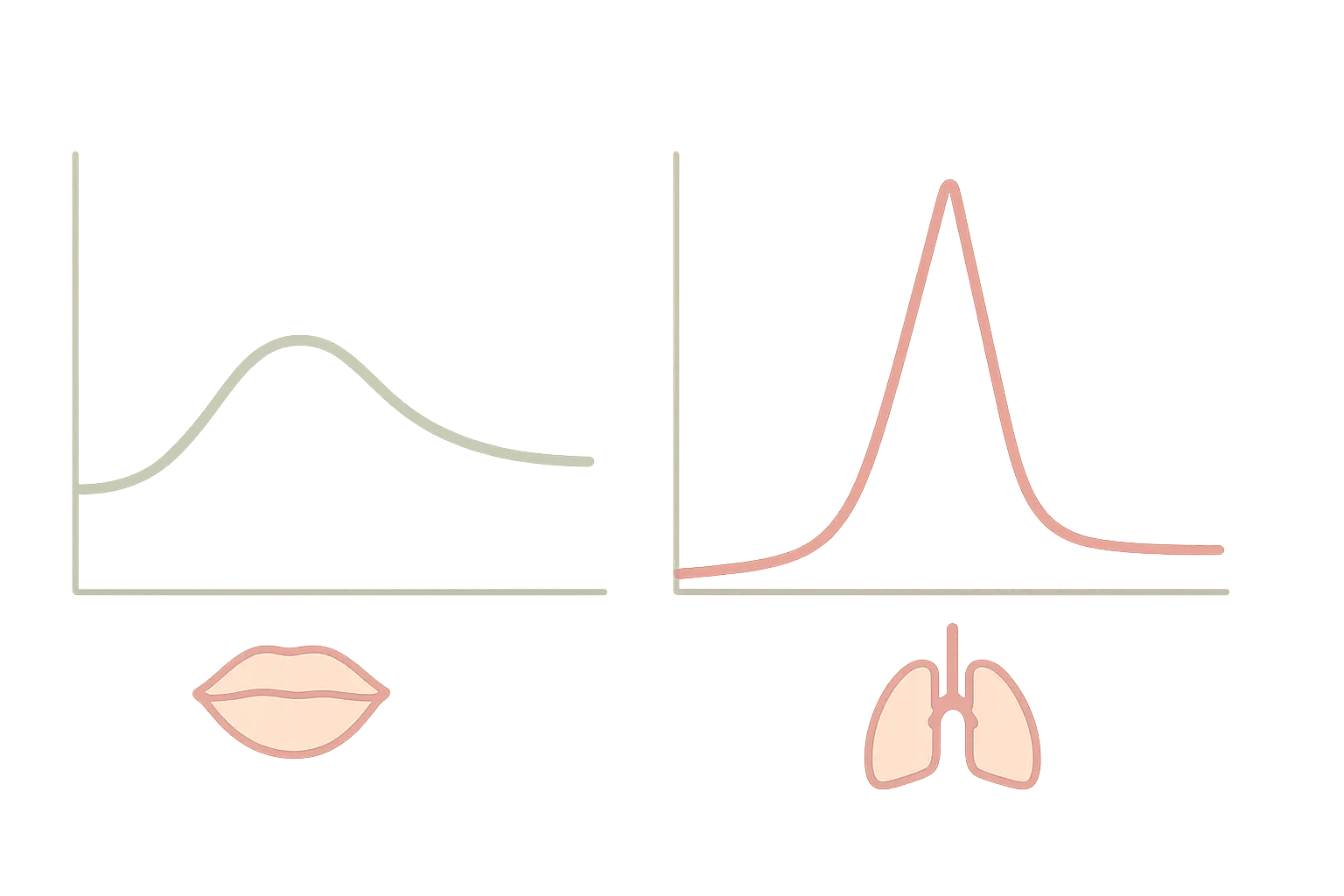
The two products deliver nicotine through different routes, and that difference matters for anyone using one to manage cravings. Pouches release nicotine through the oral mucosa (gum tissue) over a slower, steadier curve, similar in shape (though not identical in speed) to nicotine gum or lozenge. Vaping delivers nicotine through the lungs, producing a faster rise in blood nicotine that more closely mimics a cigarette’s spike — part of why many smokers find switching to vaping easier in the first weeks, but also part of why the habit loop (hand-to-mouth, inhale, exhale) stays more intact than it does with a pouch.
What the Cessation Evidence Actually Shows
Neither product is licensed as a stop-smoking medicine in the US, UK, or EU — but the evidence behind them is not equal. For nicotine pouches, no randomized trial has demonstrated a statistically significant cessation effect, and manufacturers are not pursuing approval as quit aids, since that would require the kind of trial data NRT products already have. On 16 January 2025 the FDA authorized the marketing of 20 ZYN products through its premarket tobacco product application pathway. That is permission to sell, and the FDA was blunt about its limits: the authorization “does not allow the company to make reduced risk claims,” and “it does not mean these tobacco products are safe, nor are they ‘FDA approved.’”
Vaping has a far larger evidence base. Cochrane’s living review of electronic cigarettes for smoking cessation reports high-certainty evidence that nicotine e-cigarettes help more people stop smoking than nicotine replacement therapy does. That is a genuine finding — but “helps people stop smoking cigarettes” is not the same as “gets you off nicotine,” and it is not the same as being a licensed medicine. Many people who switch stay on the replacement product long term. For the fuller data picture, see our evidence review on whether vaping helps people quit smoking.
Safety: What Independent Research Has Found
Independent, non-industry-funded research on both categories tells a more cautious story than either industry’s marketing. For pouches, independent lab testing — including NIH-funded analyses at Roswell Park — has found tobacco-specific nitrosamines (recognized carcinogens), trace metals, undisclosed additives, and nicotine content that does not always match the label. Levels of most toxicants are far below combustible cigarette smoke, but no longitudinal studies yet exist tracking pouch users over the years needed to measure cancer risk directly.
For vaping, the UK Office for Health Improvement and Disparities concluded in its Nicotine vaping in England evidence update that vaping produces substantially lower exposure to the carcinogens behind smoking’s health risks — while stressing that “the degree of any residual risk remains unclear” and that people who have never smoked should be discouraged from starting. Systematic reviews published in 2025 have also flagged elevated respiratory symptom risk among people who vape but have never smoked, so “much less harmful than smoking” and “harmless” are very different claims.
The common thread across both categories: independent, conflict-of-interest-free research is thinner than most consumers assume, and both products are recent enough that the multi-decade safety data cigarettes and NRT have is simply not available yet for either. A pattern seen repeatedly across nicotine-product research generally is that studies funded or supported by manufacturers tend to report more favorable safety and switching outcomes than independently funded studies of the same category. That does not make industry-funded research automatically wrong, but it is a reason to weigh a manufacturer’s own claims more cautiously, and to treat marketing language (“reduced exposure,” “cleaner,” “tobacco-free”) as narrower and more conditional than it sounds.
Ranked by Smoker Type
- Heavy smokers (20+/day) wanting the fastest possible off-ramp: Vaping’s faster nicotine delivery and closer match to a cigarette’s hand-to-mouth ritual often makes the initial switch easier, and it has the stronger cessation evidence — though the habit loop persists longer as a result.
- Workplace-restricted or frequently indoor smokers: Pouches are more practical day to day — no vapor cloud, no device to charge, usable in meetings, flights, and no-vaping zones.
- Social or occasional smokers: Either can work, but pouches carry less risk of becoming a new “smoke break” ritual, since there is no visible act to replace the old one.
- Anyone who has not yet tried licensed NRT: Consider starting there first — see the ranked verdict below.
The step-down is the whole game. Pouch or vape, what separates a bridge from a destination is whether you actually log the taper. iQuit is free on Google Play and has gradual and scheduled-reduction modes built for exactly that.
An Exit Plan From Each
Whichever you use, the evidence-based principle is the same one used for step-down NRT: reduce strength and frequency on a schedule rather than indefinitely maintaining the habit.
From pouches: Step down in milligram strength (many brands offer multiple strengths), then stretch the interval between pouches, then cap a daily maximum and reduce it weekly over 6-8 weeks.
From vaping: Reduce e-liquid nicotine concentration progressively, then reduce puff frequency and vaping sessions per day, then set a quit date once you are at the lowest available strength. Our guide on whether Zyn and Velo are safe to use to quit covers pouch-specific tapering in more depth, and our ranking of the best apps to quit vaping covers vape-specific tools.

The Option Both Categories Leave Out
Most pouch-vs-vape comparisons stop at “which one should I switch to,” but there is a third option worth naming directly: licensed nicotine replacement therapy (patch, gum, lozenge, spray), which is the only nicotine-delivery category with FDA and MHRA approval specifically for cessation, with high-certainty Cochrane evidence behind combination NRT in particular. It is also the only one available free or subsidized through services like NHS Better Health. If you are weighing pouches against a licensed alternative, our comparison of gum, patch, lozenge, and inhaler NRT goes deeper on those options.
It is also worth knowing that heated tobacco (IQOS-style devices) sits in a similar gray zone to pouches and vaping — still a nicotine product without cessation approval, just heated rather than burned or inhaled from an e-liquid. Our comparison of heated tobacco vs vaping vs quitting covers that third alternative in detail, and if pouches specifically are your entry point, our step-by-step Zyn taper plan lays out the exit route in more detail than we can cover here.

Our Recommendation
If you are choosing between pouches and vaping specifically, the evidence favors vaping on cessation grounds — Cochrane’s high-certainty finding applies to e-cigarettes, not to pouches, which have no comparable trial support. Choose pouches instead if discretion and workplace use genuinely matter more to you than that evidence gap. Either way, treat the product as a bridge, not a destination, with a dated step-down plan from day one. Cost is rarely the deciding factor between the two; both typically run cheaper than a daily cigarette habit but neither is designed to be a lifelong product any more than NRT is. If you have not yet tried licensed NRT, it remains a strong and cheaper starting point for many smokers. Whichever route you take, tracking your use daily — dose, frequency, and cravings — makes it far easier to actually taper rather than plateau indefinitely on a “safer” product. The iQuit app supports gradual and scheduled-reduction quit modes with craving forecasts that work for tapering off pouches or vapes, not just cigarettes.
Frequently Asked Questions
Are nicotine pouches safer than vaping?
Neither has the long-term safety data cigarettes or licensed NRT have. Pouches avoid inhalation-related respiratory exposure entirely, which some researchers view as a theoretical advantage, but independent testing has found nitrosamines, trace metals, and mislabeled nicotine content in some pouch products, and long-term studies for both categories are still limited.
Are nicotine pouches FDA-approved to quit smoking?
No. In January 2025 the FDA authorized the marketing of 20 ZYN products under its premarket tobacco product application pathway — permission to sell, not a cessation approval. The FDA stated plainly that the authorization does not allow reduced-risk claims and does not mean the products are safe or FDA approved (FDA press announcement, 16 January 2025).
Is vaping FDA-approved to quit smoking?
No e-cigarette currently holds FDA approval as a smoking-cessation medicine in the US. Cochrane’s living review does report high-certainty evidence that nicotine e-cigarettes help more people quit smoking than NRT does, but that is a research finding, not a regulatory approval, and the two should not be confused.
Why did the UK disposable vape ban push some smokers toward pouches?
The UK’s ban on disposable vapes removed the lowest-friction, cheapest vaping format for many users, and pouches offered a comparably low-effort, discreet alternative that was not affected by the same restrictions, which drove some of the category’s growth. See our explainer on the UK disposable vape ban for the full regulatory picture.
Can I use pouches and vaping together?
Using both increases total nicotine intake and cost without a clear cessation benefit over using one with a genuine step-down plan. If your goal is quitting nicotine entirely, consolidating to one product (or switching to licensed NRT) with a dated taper is a clearer path than combining two unlicensed products.
If I switch to vaping or pouches, have I quit?
You have quit smoking, which is the change that removes almost all of the health risk. You have not quit nicotine — the dependence remains, and many people who switch stay on the replacement product long term. That is fine as a harm-reduction outcome, but if being nicotine-free is your goal, you need a separate, dated taper plan for the new product.
Should I just start with nicotine patches or gum instead?
For many smokers, yes — licensed NRT (patch, gum, lozenge, spray) is the only category with FDA and MHRA cessation approval, it is often free through stop-smoking services, and combination NRT has high-certainty Cochrane evidence behind it. It is a cheaper, better-regulated starting point than either pouches or vaping.
Track Your Step-Down, Whichever Route You Choose
iQuit supports gradual and scheduled-reduction quit modes with craving forecasts and an SOS toolkit — built for tapering off pouches, vapes, or cigarettes alike.