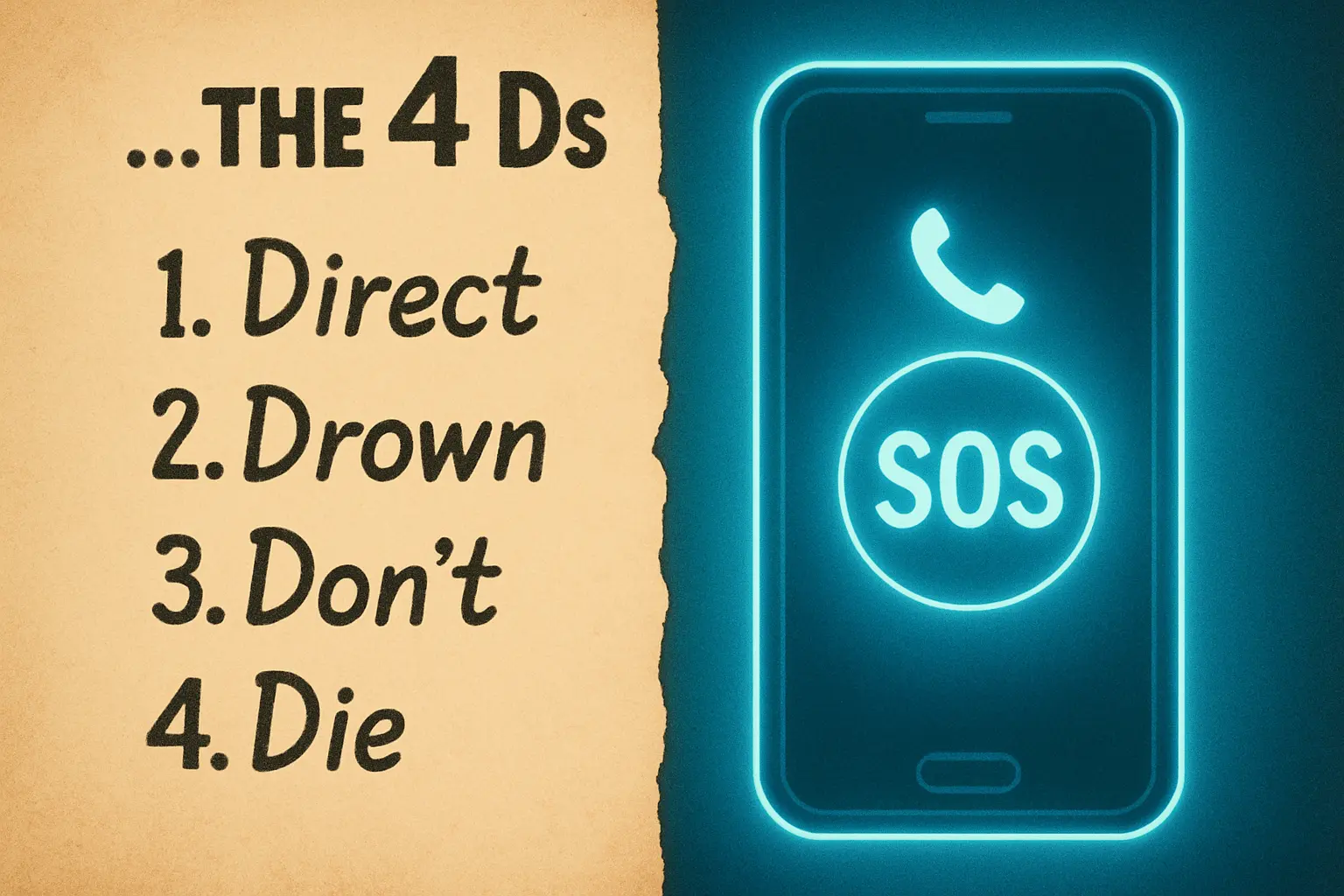
Before apps, there was a mnemonic — and it was good. The 4 Ds have anchored stop-smoking programs since the 1980s: Delay. Deep breathe. Drink water. Distract. Four moves, each aimed at a real mechanism of the craving, teachable in ten seconds. Modern app SOS tools are, honestly, the same playbook — upgraded with guidance, timing and memory. Comparing them isn’t about crowning a winner; it’s about understanding what the classic got right and what forty years of behavioral tech added.
What each D actually does
- Delay exploits the craving’s shape: the peak passes in 3–5 minutes whether you smoke or not. Waiting is winning — the insight behind the 3-minute rule.
- Deep breathe counters the adrenaline spike amplifying the urge; slow exhales lean on the parasympathetic brake.
- Drink water occupies mouth and hands (the ritual half of the addiction), interrupts the moment, and mild dehydration genuinely worsens craving restlessness.
- Distract starves the urge of attention — a craving observed in a vacuum grows; one competing with a task shrinks.
Where the classic struggles
The 4 Ds have one weakness, and it’s not the content — it’s the delivery. Mid-craving, you must remember the mnemonic, choose a D, self-pace the breathing, self-time the delay, and self-motivate the whole sequence — using exactly the depleted, tunnel-visioned brain the craving has hijacked. Cessation counselors have watched this failure for decades: patients who know the 4 Ds perfectly and, at minute one of a real craving, do none of them. Knowledge isn’t the bottleneck; execution under stress is.
What the app version adds
An SOS flow like iQuit’s shake-to-rescue is the 4 Ds with the execution problem solved:
- No recall needed. Shake the phone; the flow runs. The mnemonic is in the software now.
- Paced, not self-paced. The breathing is visually guided (box, 4-7-8 or belly), the delay is a timer, not an estimate.
- Escalation built in. If breathing isn’t enough, grounding, craving surfing and the virtual cigarette are one tap deeper — the classic has no “D didn’t work” branch.
- It remembers. Every survived craving is logged: trigger, intensity, what worked. That builds your success rate and feeds the trigger forecasts — the paper mnemonic forgets each battle the moment it ends.
Head to head
| Classic 4 Ds | App SOS flow | |
|---|---|---|
| Works with a dead battery | Yes — its superpower | No (though iQuit’s tools run offline) |
| Execution under stress | Depends on you | Guided, paced, timed |
| Escalation path | None | Grounding → surfing → virtual cigarette → quitline |
| Learning between cravings | None | Logs → success rate → forecasts |
| Cost | Free forever | Free (iQuit core) |
The verdict: learn one, carry the other
Memorize the 4 Ds — they’re the fallback that works on a mountain, at a funeral, with 2% battery. Then carry the guided version for the other 99% of cravings, where pacing, escalation and logging turn the same four moves into a system that gets smarter every time you use it. The free iQuit app puts the whole upgraded playbook behind one shake.
FAQ
What are the 4 Ds?
Delay, Deep breathe, Drink water, Distract — the classic in-the-moment craving method.
Do they still work?
Yes — each targets a real mechanism. Their weak point is execution under stress, not the content.
What do SOS apps add?
Guided pacing, built-in timing, escalation options, and logging that builds your success rate and forecasts.
Which should I use?
Both: memorize the 4 Ds as your offline fallback, carry the guided flow for everything else.
The 4 Ds, upgraded and one shake away: download iQuit free on Google Play.