
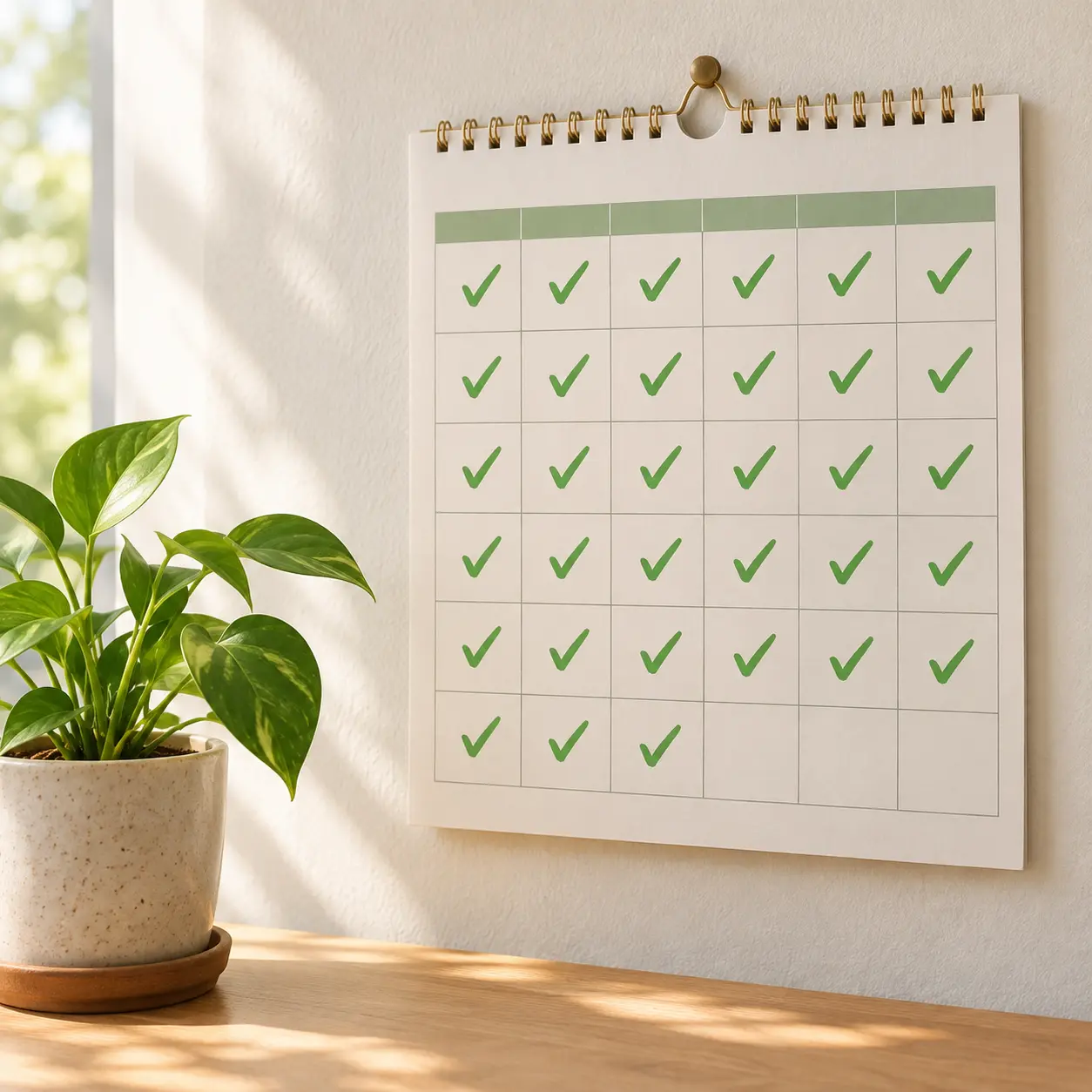
A quit smoking calendar turns a vague plan into 30 small, checkable days. Below you will find a week-by-week plan, a day-by-day table you can copy to paper, and a list of what to mark each day. It is built from the preparation steps on Smokefree.gov and the NHS, and it does not promise any result a calendar cannot deliver.
Why a calendar helps (and what it cannot do)
A calendar makes progress visible. Seeing a row of marked days gives you something to protect, and writing down cravings shows you patterns you would otherwise miss. The NHS Better Health page on quitting smoking includes first-person stories from people who said watching their progress and savings kept them going. One said she liked “seeing my progress.”
What a calendar cannot do is take away cravings. For that, health bodies point to medication and support. Smokefree.gov says medication can double your chances of quitting for good, and the NHS says free expert help from your local Stop Smoking Service can boost your chances of quitting by 3 times. Think of the calendar as the tracking layer on top of those tools, not a replacement for them.
If you have not chosen a quit date yet, read our guide to setting a quit date that actually sticks first, then come back and fill in the table below.
Week 0: get ready before day 1
Smokefree.gov tells people to pick a day in the next two weeks, giving enough time to prepare, and to choose a date that is not already likely to be stressful. Use that window to work through its preparation checklist:
- Remove reminders. Throw away cigarettes, matches and lighters on or before your quit day, clear out your home and car, and do laundry so clothes do not smell of smoke.
- Ask about medication. Ask your doctor whether nicotine replacement therapy or other quit medications are right for you.
- Practice a refusal. A short line such as “No, thanks, I quit” is enough.
- Build your team. Tell people your quit date and what kind of help you want.
- Change a routine. Smokefree.gov suggests changes such as a different route to work, a different place to eat lunch, or a walk instead of a smoking break.
- Plan rewards. Smokefree.gov recommends celebrating successes, big or small.
Also spend a few days learning your pattern. Our guide on tracking your smoking the week before you quit shows how, and Smokefree.gov suggests asking yourself in what places or situations you smoke more or less often, and who you are with when you smoke. If you are curious what a pack costs you, see how many cigarettes are in a pack by country before you do the math.
Smokefree.gov, the US government quit-smoking site, publishes a short video called “Quitting is a Journey,” which fits the idea behind a 30-day tracker.
Days 1 to 7: protect the streak
The goal this week is simple: do not smoke, even once, and get through the first hours with a plan. Smokefree.gov says the most important thing you can do on quit day is to not smoke, “not even once.” Mark every day, and write down your cravings as they come.
The NHS timeline gives you things to watch for. After 20 minutes your pulse starts returning to normal. After 8 hours oxygen levels are recovering and carbon monoxide in your blood has reduced by half. After 48 hours carbon monoxide has dropped to that of a non-smoker, and taste and smell are improving. After 72 hours breathing may feel easier as the bronchial tubes relax, and energy rises. You do not have to feel these things for them to be happening, but noting them can help motivation.
Cravings are temporary. Smokefree.gov says they “will fade over time the longer you stay quit,” and lists distractions such as water, something crunchy, 10 deep breaths, exercise, a call or text with someone supportive, or going somewhere smoking is not allowed. Our hour-by-hour nicotine withdrawal timeline explains what to expect.

Days 8 to 14: find your patterns
By week two the novelty has worn off and routine triggers show up: the morning coffee, the work break, the drive home. Use your calendar notes to find the top two or three. Smokefree.gov groups triggers into social situations, routine situations, emotions and withdrawal feelings, and suggests picking one situation and challenging yourself not to smoke during it, then moving on to another once the first feels manageable.
Practical moves from the Smokefree.gov plan include changing the route you take, changing where you eat, and taking a walk around the block instead of a smoking break. Write the change next to the trigger in your tracker so you can see whether it helped.
Days 15 to 21: protect your support
Support often fades around week three, just when people feel confident. Check in with your quit buddy or supporter. Smokefree.gov suggests being specific about what you need from them, for example “When I’m having a craving, it helps when you distract me from it.” If a supporter keeps smoking around you, the same page says you can ask people not to smoke around you, or at least not to offer you cigarettes.
The NHS says that from two weeks onward your circulation improves, with blood pumping to your heart and muscles much better over the 2 to 12 week window. Use your calendar to treat yourself: our guide to quit smoking rewards and milestones has ideas for celebrating the money you have saved.
Days 22 to 30: cross the 28-day line
Day 28 is the milestone the NHS highlights: reach it and you are 5 times more likely to quit for good. Mark it clearly. Days 29 and 30 matter too, because the point of a 30-day block is to hand over to the next one. At the end, review your notes: which triggers were hardest, which craving tools worked and what support you want in month two.
If you slip anywhere in this block, note it without punishing yourself. Smokefree.gov’s guidance for supporters says to avoid criticizing someone who slips and has a cigarette, and the same kindness applies to yourself. Work out what triggered it, plan for next time, and keep marking days. The calendar is a record, not a test.
What to mark each day
Keep the daily entry to about a minute. A useful minimum is:
- Smoke-free today? Yes or no. A tick is enough.
- Cravings. A tally mark for each one, plus the strongest time of day.
- Trigger. What set off the strongest craving: coffee, stress, alcohol, boredom, a person?
- What you did instead. One of the distractions that worked.
- Money not spent. Smokefree.gov’s quit plan has a savings calculator that uses your cigarettes per day and pack price.
- Mood and sleep. One word each. Smokefree.gov notes bad moods, poor sleep and strong cravings are common when you quit.
If you want writing prompts for the mood part, our 30 days of quit smoking journal prompts pair well with this tracker.
The 30-day tracker table
Copy this table into a document and print it, or draw it on a page. The left column is the day, the middle column is a suggested focus, and the right column is the box to fill in. The focus suggestions are planning ideas drawn from the preparation steps above, not medical advice.
| Day | Suggested focus | Smoke-free? Cravings? Trigger? Saved? |
|---|---|---|
| 1 | Quit day. Remove reminders, use your craving plan | |
| 2 | Water, deep breaths, walk after meals | |
| 3 | Expect strong urges. Contact your supporter | |
| 4 | Try a different break routine | |
| 5 | Note your top trigger so far | |
| 6 | Plan a smoke-free activity for the weekend | |
| 7 | Week 1 review. Reward yourself | |
| 8 | Pick one trigger to change | |
| 9 | Change your route or lunch spot | |
| 10 | Practice saying no, thanks | |
| 11 | Check in with your quit buddy | |
| 12 | Review your craving tally | |
| 13 | Plan for any social event ahead | |
| 14 | Week 2 review. Reward yourself | |
| 15 | Message a supporter with a specific ask | |
| 16 | Try a new distraction from your list | |
| 17 | Look at money saved so far | |
| 18 | Move one more routine | |
| 19 | Plan for stress at work or home | |
| 20 | Review sleep and mood notes | |
| 21 | Week 3 review. Reward yourself | |
| 22 | Prepare for the last stretch | |
| 23 | Choose one coping skill to keep | |
| 24 | Re-read your reasons for quitting | |
| 25 | Check in with your supporter | |
| 26 | Plan a celebration for day 28 | |
| 27 | Review your trigger list | |
| 28 | Day 28 milestone. Celebrate | |
| 29 | Write your month-two plan | |
| 30 | Month review. Extend the tracker |
We are not offering a downloadable PDF. The table above is built into this page, so you can print the page or copy the table into your own document.
How long do habits take?
You may hear that habits form in 21 days. The research is less tidy. In a study of everyday behaviors published in the European Journal of Social Psychology, 96 volunteers each picked an eating, drinking or activity behavior to repeat daily for 12 weeks. The time to reach 95% of their personal peak of automaticity ranged from 18 to 254 days, which the authors said highlights that it can take a very long time. The same study found that missing one opportunity to perform the behavior did not materially affect the habit formation process.
Two cautions. First, that study was about eating, drinking and exercise, not smoking, so it cannot tell you how long it takes to stop smoking. Second, the finding about a missed day is about building a new habit, not a statement that a cigarette is harmless. The sensible takeaway is that thirty days is a start, and that you should keep your tracker and supports going after it. See the study abstract. For more on the timeline of staying quit, our guide to staying motivated after you quit covers the months that follow.
Paper calendar or app
A paper calendar is cheap, visible and private. Stick it where you will see it, and keep a pen beside it. Its weakness is that it cannot count for you, and it is not with you when a craving hits on the bus.
An app can do the counting. iQuit is a free app on Google Play and the App Store that shows days smoke-free, cigarettes avoided and money saved, lets you log cravings with triggers and intensity, and has SOS tools such as breathing exercises, grounding and craving surfing. It also includes a health-recovery timeline, and streak shields and slip recovery help you restart after a slip. It is the calendar that counts itself. It is a support and tracking tool, not a medical treatment.
Frequently Asked Questions
What is a quit smoking calendar?
A quit smoking calendar is a day-by-day grid where you mark each smoke-free day and note cravings, triggers and money saved. This guide gives you a 30-day plan built from Smokefree.gov preparation steps. It is a tracking tool, not a treatment, and works best alongside a quit date and support.
How many days should my quit smoking calendar cover?
Thirty days is a practical first block because the NHS says reaching 28 days smoke free makes you 5 times more likely to quit for good (NHS Better Health). Many people keep tracking past day 30 and extend the grid month by month. Pick whatever length keeps you checking in.
What should I write on my calendar each day?
Mark whether you stayed smoke-free, how many cravings you had, what triggered the strongest one, what you did instead and how much money you did not spend. Smokefree.gov suggests writing down when and where you typically smoke to prepare for those situations. Keep it to one minute so you keep doing it.
What if I slip and smoke on a day in my 30-day plan?
Do not tear up the calendar. Mark the day honestly, note what triggered it and restart the next day. Smokefree.gov’s guidance for supporters says to avoid criticizing someone who slips and has a cigarette (Smokefree.gov), and the same kindness applies to yourself. Consider asking a pharmacist or quitline about extra support.
Is a printed calendar or an app better?
Neither is proven better than the other; choose the one you will open every day. Paper is simple and visible on a fridge. An app can count days and money for you and send reminders. Some people use both: paper for the big picture and an app for the in-the-moment craving log.
When does the habit part of smoking start to fade?
It varies a lot. In a study of everyday habits such as eating, drinking and exercise (not smoking), the time to reach near-peak automaticity ranged from 18 to 254 days (Lally et al.). Treat 30 days as a strong first step, not a finish line, and keep your supports in place.
Does iQuit work as a quit smoking calendar?
iQuit tracks days smoke-free, cigarettes avoided and money saved on a dashboard, lets you log cravings with triggers and intensity, and includes a health-recovery timeline. It is free on Google Play and the App Store. It is a tracking and support tool, not a medical treatment.
Let your calendar count itself
Choose your quit date, log every craving and watch days smoke-free and money saved add up. iQuit is free on Google Play and the App Store.


