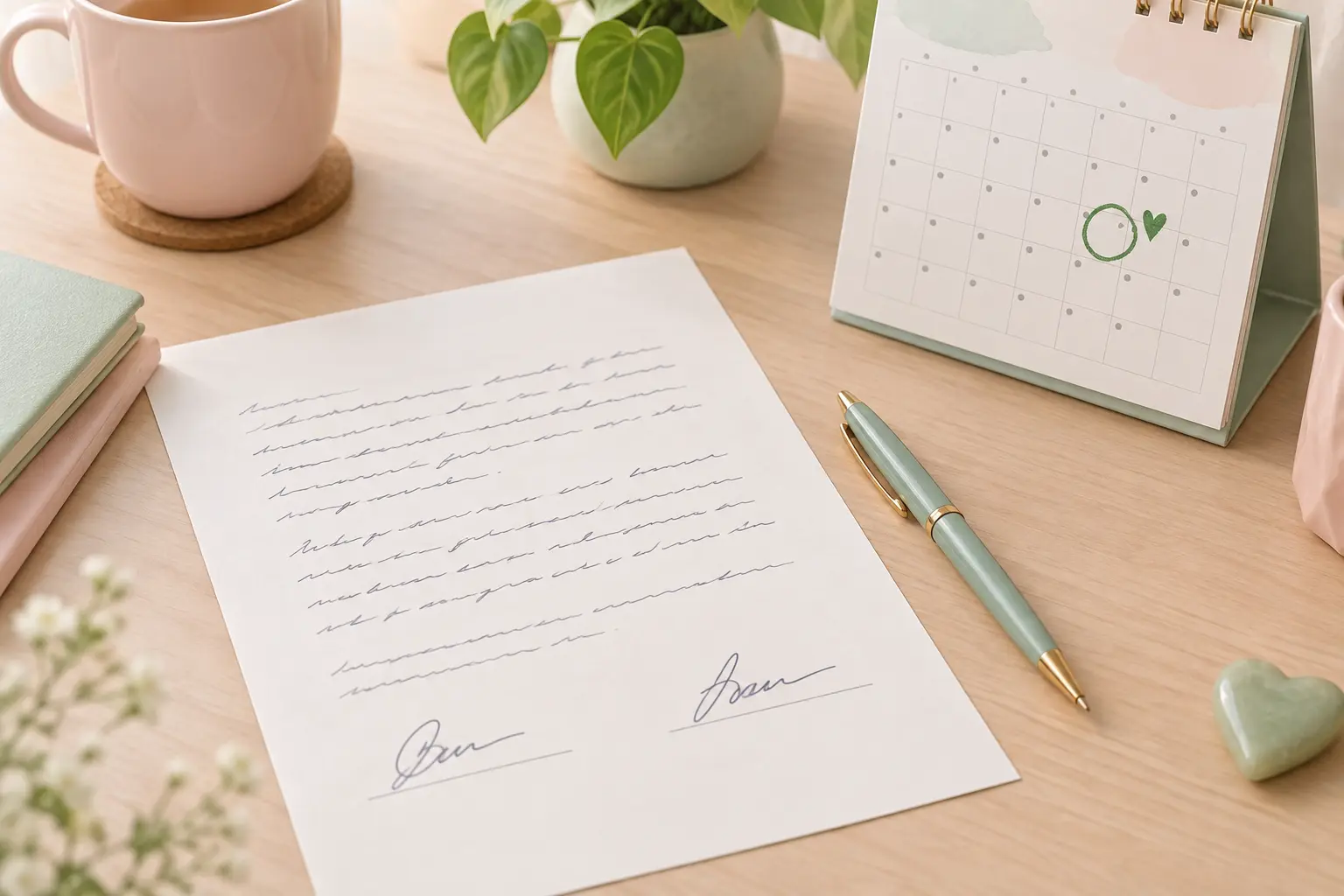
A quit smoking contract is a short written promise to yourself, signed and witnessed, that spells out your quit date, your reasons, what you will do when a craving hits and what happens if you slip. This page gives you a free template you can copy straight from the screen, explains how to fill in each line, and is honest about what the research does and does not say about commitment devices.
Why a Written Commitment Can Help
Most quit attempts begin with a private decision that is easy to quietly drop. Writing it down, naming a date and telling another person turns the decision into something you have to actively break. That is the idea behind a commitment device: you make it harder to back out later.
The evidence is worth describing carefully, because it is about contracts with something at stake, not about a free page of paper. In the CARES trial, smokers were offered a savings account in which they deposited money for six months, after which they took a urine test for nicotine and cotinine; “If they pass, their money is returned; otherwise, their money is forfeited to charity.” Of those offered it, “11 percent took up,” and those offered it “were 3 percentage points more likely to pass the 6-month test than the control group,” an effect that persisted in surprise tests at 12 months (Giné, Karlan and Zinman, 2010).
A trial in rural Thailand tested a commitment contract combined with team incentives, text message reminders and counseling against counseling alone. At 6 months, biochemically verified abstinence was 44.3% in the intervention group (58 of 131) and 18.8% in the control group (13 of 69), and the authors noted that self-reports at 14 months “suggest tapering of the treatment effect” (American Journal of Preventive Medicine, 2013). It is a single trial of a bundle of components, so it cannot tell you what a contract alone would do.
The wider picture comes from the Cochrane review of incentives for smoking cessation, 2025: financial incentives, which include self-deposits, were associated with higher long-term quit rates, with a pooled risk ratio of 1.52 (95% CI 1.33 to 1.74; 39 studies, 18,303 participants; high-certainty evidence). The review found “no clear difference in effect between trials offering low or high total value of incentives”, nor between those encouraging redeemable self-deposits and the rest. For a closer look at money-based approaches, see our guide to putting money on your quit.
What this means for you: a contract with money at stake has some trial support, while a free written contract is a reasonable planning tool that we cannot call proven. Use it because it organizes your plan and makes your commitment visible, not because it guarantees anything.
Your Free Quit Smoking Contract Template
Copy the text below into a document, a note on your phone or onto paper. Blanks are marked with underscores. It takes about ten minutes to fill in properly.
My Quit Smoking Contract
1. My commitment. I, ____________________ (name), am quitting smoking. My quit date is ____ / ____ / ________. From that day I will not smoke, not even one puff.
2. My reasons. I am quitting because: (a) ______________________________ (b) ______________________________ (c) ______________________________
3. My triggers. The three situations where I most want a cigarette are: (a) ______________________ (b) ______________________ (c) ______________________
4. My if-then plans. If ______________________ happens, then I will ______________________. If ______________________ happens, then I will ______________________.
5. My supporter. I will tell ____________________ about this contract and ask them to check in with me on days ____, ____ and ____.
6. My rewards. At 1 week I will ______________________. At 4 weeks I will ______________________. With the money I save I will ______________________.
7. If I slip. I will not treat it as the end. Within 24 hours I will write down what happened, tell my supporter, and restart my plan on ____ / ____ / ________. I will not tear up this contract.
Signed: ____________________ Date: ____________ Witness: ____________________
A plain-text copy keeps the template easy to edit and print on any device, so use it in whatever format helps you keep it somewhere you will see it.
How to Fill In Each Line
The structure follows the steps in the free quit plan builder at Smokefree.gov, Build Your Quit Plan, which walks through choosing a quit date, working out what smoking costs you, listing your reasons, knowing your triggers and setting yourself up for success.
- Quit date. The site advises: “Pick a day in the next two weeks. This will give you enough time to prepare. Pick a date that isn’t already likely to be a stressful one.” If you are unsure, our guide to how to set a quit date that sticks walks through the choice.
- Reasons. Be specific and personal. “My health” is fine, but “to climb the stairs to my daughter’s flat without stopping” is stronger. Smokefree.gov offers a starter list that includes health, family, money, setting a good example and taking back control.
- Triggers. The same page groups triggers into social situations, nicotine withdrawal, routine situations (coffee, finishing a meal, time on your phone) and emotions (stress, boredom, loneliness). Pick your top three.
- If-then plans. Write the response in advance, so you do not have to decide in the middle of a craving. For example: “If I finish a meal, then I will brush my teeth and take a short walk.”
Not sure the time is right yet? Our readiness quiz can help you judge where you are before you sign anything.
Choosing a Witness

A witness is someone who knows about the contract and agrees to check in. Choose with these questions in mind:
- Will they be honest and kind? You want encouragement, not lectures or policing.
- Are they reachable? A friend who answers a message within an hour is more useful than a relative you see once a month.
- Do they understand a slip is not a disaster? Show them the “If I slip” clause so they know how to respond.
- Is it someone who smokes? If so, ask them not to smoke around you, or pick someone else.
If you cannot think of anyone, a quitline coach or an online community can fill the role. Our guide to finding a quit smoking accountability partner explains how to recruit one and what to ask them to do.
Rewards and Consequences That Work
Rewards are the easier half of a contract to get right. Choose small rewards you can really enjoy that are not cigarettes, tie them to dates you will reach (1 week, 4 weeks) and pay for them with the money you would have spent on tobacco. The NHS says “Your goal is to reach 28 days smoke free” and that doing so makes you “5 times more likely to quit for good” (NHS Better Health), which makes the four-week mark a sensible reward point. Use our smoke-free days calculator to see how your days add up, and our one-month benefits guide for the first month’s milestones.
Consequences are trickier. The CARES design used a real financial consequence, a forfeited deposit, and the Cochrane review includes self-deposits. If you want that kind of commitment, a deposit given to someone you trust, or pledged to a cause you would hate to fund, is a version of it. But the review also found no clear difference between low and high amounts, so you do not need a large sum. Avoid consequences built on shame or public humiliation, which can make a slip harder to recover from rather than less likely.
If You Slip: Renegotiate, Do Not Tear It Up
The American Lung Association video below explains how to build a quit plan, including how to prepare for the moments that make you want to smoke.
Contracts fail in a particular way: one cigarette happens, the person decides the whole attempt is ruined and throws the page away. The “If I slip” clause exists to stop that.
- Stop at one. A single cigarette is a lapse, not a relapse, unless you let it become one.
- Write down what happened. Where were you, who were you with, what were you feeling, what had you not planned for?
- Tell your witness. The goal is to keep the plan out in the open.
- Add one new if-then plan for the situation that caught you out.
- Re-sign with a new quit date. Cross out the old date, write the new one and initial it. The contract is stronger for having been tested.
Nothing here is a license to smoke. It is a way to keep the quit attempt alive on the days that decide whether you stay quit.
Keeping It Visible Every Day
A contract in a drawer does nothing. Put a photo of it on your phone’s lock screen or favorites, stick the paper on the fridge or beside your bed, and reread the reasons section each morning for the first two weeks. Add your quit date and day count somewhere you will see it daily.
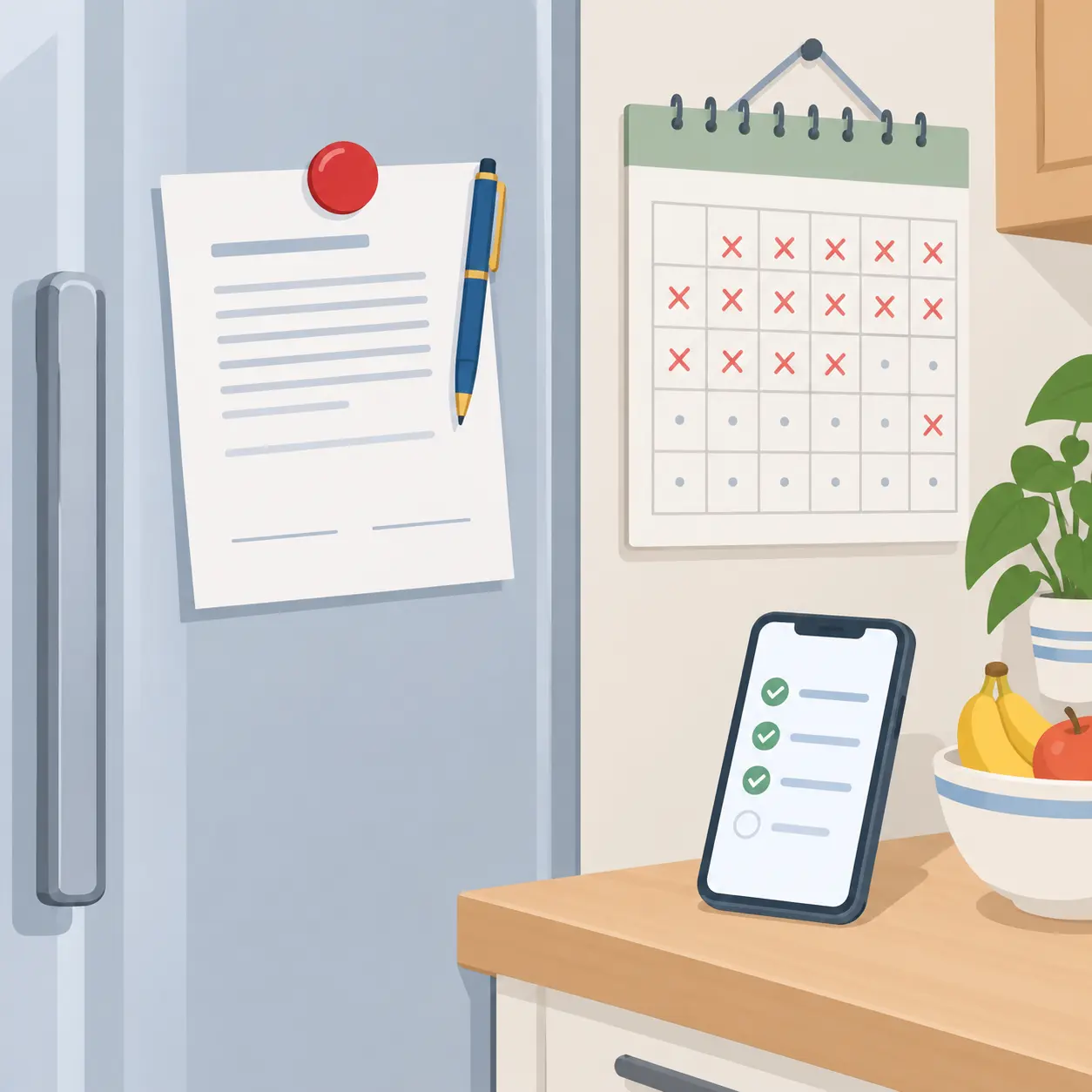
An app can help you keep the contract’s promises in view. iQuit is free on Google Play and the App Store, and its dashboard shows days smoke-free, cigarettes avoided and money saved, so your day-28 reward is never out of sight. The craving log records the triggers and intensity of each urge, which gives you real material for your if-then plans, and streak shields with slip recovery can help you restart after a slip, as your “If I slip” clause intends. Premium adds accountability circles. iQuit does not replace professional help, and works best alongside your doctor or a stop smoking service.
Frequently Asked Questions
What should a quit smoking contract include?
A quit date, your personal reasons, your top triggers, if-then plans for those triggers, a supporter, rewards and a clear plan for what to do if you slip. The free template above has a line for each of these, plus space for your signature and a witness.
Do quit smoking contracts work?
The evidence is for contracts with money at stake. In the CARES trial, smokers offered a deposit contract were 3 percentage points more likely to pass a 6-month test than controls (Giné et al., 2010). A free written contract has not been proven on its own.
Is a commitment contract the same as a financial incentive?
They overlap. The Cochrane review of incentives includes self-deposits, and found high-certainty evidence that incentives improve long-term quit rates (pooled RR 1.52, 95% CI 1.33 to 1.74). A written contract without money is a different, less-tested tool.
Who should witness my quit smoking contract?
Choose someone kind, honest and easy to reach, who understands that a slip is not a disaster. A friend or family member works well, and a quitline coach can fill the role if you cannot think of anyone.
What should I do if I break my quit smoking contract?
Do not tear it up. Stop at one cigarette, write down what triggered it, tell your witness, add a new if-then plan and set a new quit date on the same page. A slip is useful information for the next attempt.
When should I set my quit date in the contract?
Smokefree.gov advises picking a day in the next two weeks, which gives you time to prepare, and choosing a date that is not already likely to be stressful (Smokefree.gov, Build Your Quit Plan).
Can I use a contract together with medication or counseling?
Yes. The Thailand trial tested a contract alongside counseling, and a contract is a planning tool, not a treatment. Ask your doctor, pharmacist or quitline about nicotine replacement or medication in addition to your written plan.
Keep Your Contract in Your Pocket
iQuit is free on Google Play and the App Store. Track days smoke-free and money saved, log cravings with triggers, and let streak shields and slip recovery back up your contract.
Download iQuit Free on Google Play
Download on the App Store