
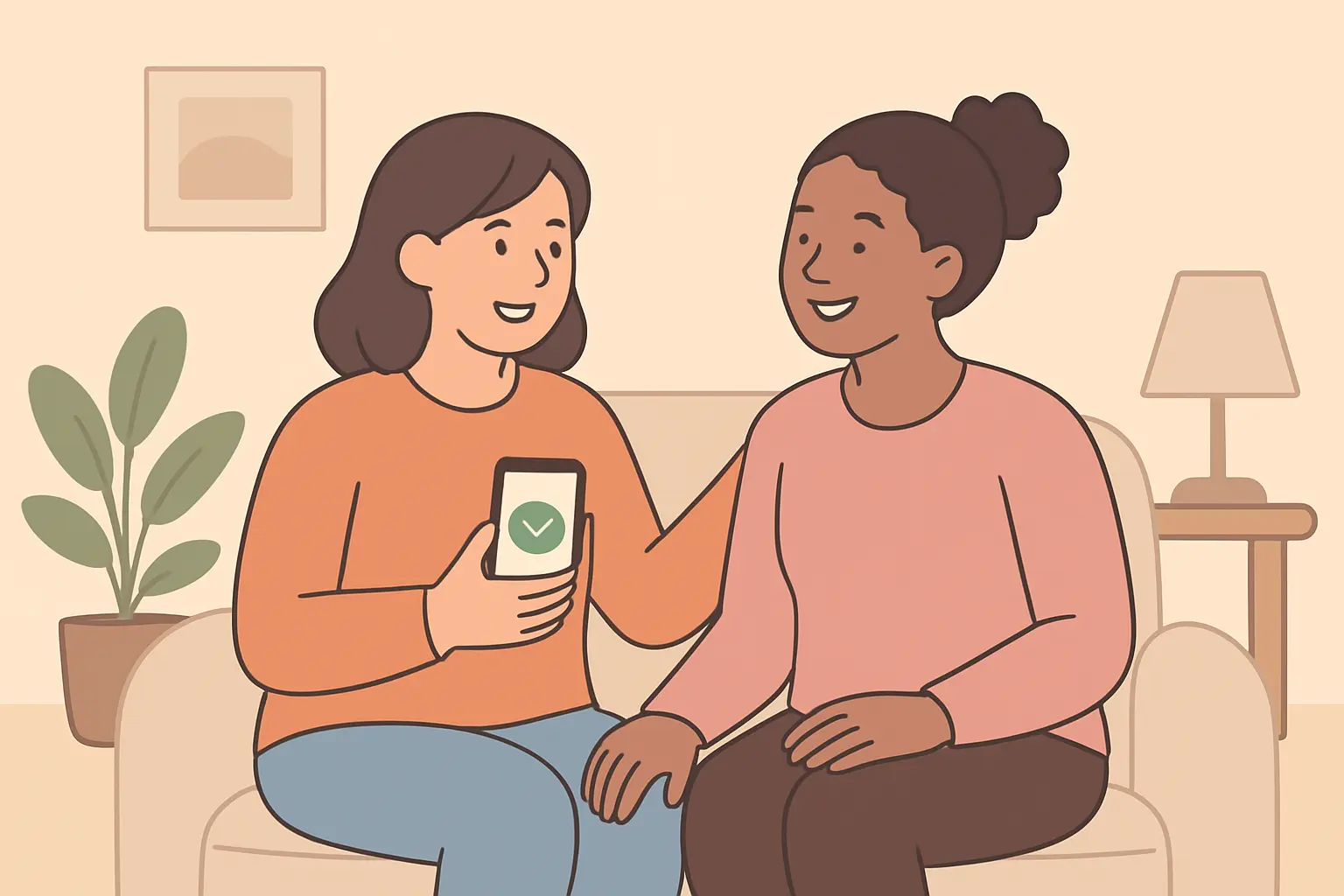
Deciding you need a quit smoking accountability partner is usually the moment willpower alone has stopped feeling like enough. You don’t need a whole program or a room full of strangers — you need one specific person who knows your quit date, checks in on a schedule, and will notice if you go quiet. Finding that person, and setting up the arrangement properly, is a five-minute conversation that most people never actually have.
What an Accountability Partner Actually Does
An accountability partner is not a therapist, a sponsor, or someone who has to be an expert on quitting. Their job is small and specific: know your quit date, know roughly how you’re doing, and ask. That’s it. The value isn’t in advice — it’s in the simple fact that someone else expects an update, which makes it slightly harder to quietly slide back into smoking without anyone finding out.
This is different from telling everyone you know that you’re quitting. A public announcement invites opinions, unsolicited advice, and sometimes judgment if things don’t go perfectly on schedule. A single designated partner is a private, low-drama arrangement: one person, a simple check-in, and an agreement that slips get reported rather than hidden. It works precisely because it’s small enough to actually maintain.
A 2025 randomized controlled trial of 162 adults trying to quit, published in the British Journal of Health Psychology, tested exactly this idea with a “buddy app” that paired quitters with a support contact. People in the buddy group reported higher daily confidence in their ability to resist smoking and were more likely to report getting support each day from their quit date through 20 days later, compared with a control group that only completed daily check-ins with no buddy. It’s worth being honest about the limits of that finding too: on the days support did happen, its amount and quality were actually rated slightly lower in the buddy group than in the control group, and by six months there was no measurable difference between groups. In plain terms — having a designated partner made people more likely to reach out and feel capable early on, but it didn’t automatically make the support itself better, and it wasn’t a guarantee of a lasting difference on its own. That’s a reason to be deliberate about the arrangement rather than assuming any partner will help by default.
Who to Ask (and Who Not To)
Good candidates: someone who checks their phone regularly, someone who won’t feel awkward asking “how’s it going,” and someone who can be honest without being harsh. It does not need to be your closest friend — sometimes a work friend, a sibling, or someone from an online support group who is also quitting is a better fit than a partner or parent who will worry too visibly.
Weaker candidates: a current smoker who might feel judged by your quitting (even if they’d never say so), someone who is only available sporadically, or someone who has tried and failed to help you quit before in a way that left both of you frustrated. None of these people are bad choices forever — they’re just a harder starting point.
It’s also worth thinking about time zones and daily rhythm, not just relationship closeness. A partner who is awake and reachable during your highest-risk hours — often mornings, evenings, or right after a meal — will be more useful than someone emotionally closer but asleep or unreachable when a craving actually hits. If your riskiest hours are unpredictable, say so up front, so your partner knows a message might land outside normal hours occasionally.
The Exact Ask, Word for Word
The reason most people never set this up is that the ask feels awkward in the abstract but is easy once it’s specific. Something close to this works:
“I’m quitting smoking on [date]. Would you be willing to check in with me for a couple of minutes most days for the first two weeks — just a quick ‘how’s it going’? I’ll be honest with you, including if I slip. I just don’t want to do this completely alone.”

Naming a concrete date and a concrete, time-bound ask (“two weeks,” “most days”) makes it far easier for someone to say yes than an open-ended “can you support me while I quit smoking,” which sounds like an unlimited, undefined commitment.
What to Agree: Cadence and Slips
Before day one, agree on two things out loud:
- How often you’ll check in. Daily for the first one to two weeks is common, tapering to a few times a week, then weekly once things feel steadier.
- What happens after a slip. Decide now, not in the moment, that a slip gets reported honestly and met with a plain “okay, what’s the plan for the next 24 hours” — not silence, and not a lecture. Deciding this in advance removes the shame-driven urge to hide a slip from your partner, which is usually what turns one cigarette into a full relapse.
This upfront agreement matters more than most people expect. Without it, a slip often becomes something you hide from your accountability partner out of embarrassment — which defeats the entire point of having one.
Ex-Smoker vs. Fellow Quitter vs. Non-Smoker
| Type | Strength | Watch for |
|---|---|---|
| A successful ex-smoker | Understands cravings from experience; hard to guilt-trip out of honesty | May unintentionally compare your quit to theirs |
| Someone quitting at the same time | Mutual accountability; both sides have something at stake | If one of you relapses, it can be discouraging for both |
| A supportive non-smoker | Steady, uninvolved perspective; nothing to project onto you | May not fully understand what a craving feels like |
There’s no single “best” type — the right fit is whoever will actually follow through on the check-ins you agreed to, consistently, for more than the first few days.
When a Group or App Works Better
A one-to-one partner isn’t the only option, and it isn’t always the best one. If you don’t have an obvious person to ask, or you’d rather not put the responsibility on one friend, an online support group spreads accountability across more people and runs on its own schedule — see quit smoking support groups online for how to find one that fits, or the NHS Better Health quit-smoking service for structured, professionally run support options. If you want the check-in built into your day automatically rather than depending on someone else remembering, a comparison of free quit-smoking apps and resources is worth reading alongside this piece, since a daily tracking habit inside an app can do some of the same accountability work a person would.
If you’d rather not tell your wider circle you’re quitting at all, a one-to-one partner or a private community is usually a better fit than announcing it publicly — see how to quit smoking privately, without telling anyone for how to get support without an announcement.
Making It Last Past Week 2
Accountability tends to fade exactly when both people assume the hardest part is over. Two things help it last: agreeing on a schedule that steps down instead of stopping (“daily for two weeks, then weekly through month three”) rather than assuming you’ll “just check in when needed,” and marking milestones together rather than only discussing problems. Telling your partner about a smoke-free week is as much a part of the job as telling them about a craving — see celebrating milestones and building motivation for ways to make those updates feel worth sending. And if a partner arrangement eventually fades out, that’s normal — the goal is bridging the hardest early stretch, which connects into the broader picture covered in staying quit long-term.

If your partner situation is complicated by a smoking household — for example, a partner who still smokes — the dynamics are different again; how to quit smoking when your partner still smokes covers that specific version of accountability and temptation living under one roof.
One more practical note: it’s fine to renegotiate the arrangement. If daily check-ins start to feel like a chore for either of you, say so and switch to a lighter schedule rather than letting the whole thing quietly fizzle out unspoken. An accountability partnership that both people can sustain honestly is worth far more than one that looks committed on paper but has actually stopped happening.
Frequently Asked Questions
Does having an accountability partner actually help you quit smoking?
A 2025 randomized trial of a buddy-app intervention (n=162) found it increased daily self-efficacy and the likelihood of reaching out for support in the first 20 days after a quit date, but did not improve support quality on its own and showed no group difference at 6 months (Berli et al., British Journal of Health Psychology, 2025). It helps most as a tool alongside your own plan, not as a guarantee by itself.
How do I ask someone to be my accountability partner without it being awkward?
Be specific: name your quit date, ask for a defined check-in schedule (like daily for two weeks), and say you’ll be honest including about slips. A concrete, time-limited ask is easier to say yes to than an open-ended request for support.
Should my accountability partner also be a smoker who’s quitting?
It can work well because you both have something at stake, but it isn’t required. A steady non-smoker or a successful ex-smoker can be just as effective, as long as they check in consistently.
What should we agree on before I quit?
Two things: how often you’ll check in, and exactly what happens if you slip. Deciding the slip response in advance — an honest report met with a plan, not a lecture — makes it far less likely a slip turns into hiding, and hiding into a full relapse.
What if I don’t have anyone to ask?
An online support group or a quit-smoking app with daily tracking can provide a version of the same accountability, spread across more people or built into a daily habit rather than resting on one person.
How long should the accountability arrangement last?
A stepped-down schedule tends to last longest: daily for the first one to two weeks, then a few times a week, then weekly through the first few months. It’s fine for it to naturally taper off once you feel steady.
Built-In Accountability, Every Day
iQuit’s moderated community and accountability circles (Premium) give you daily check-ins even on the days a human partner is unavailable, alongside streak shields and milestone achievements that make progress visible to share. Free on Google Play and the App Store.
Download iQuit Free on Google Play
Download on the App Store


