
How to quit smoking when your partner smokes comes down to one honest fact: you can still succeed, but you will have to do more of the work yourself, on purpose, from day one. Living with an active smoker does not make quitting impossible — it means your quit plan needs its own rules for the car, the balcony, and the after-dinner cigarette that isn’t yours anymore.
Can You Quit If Your Partner Still Smokes?
Yes. Thousands of people quit every year while sharing a home, a car, and a bed with someone who still smokes. It is harder than quitting alongside a partner who is also stopping, but “harder” is not the same as “unlikely.” The difference is that you cannot rely on the household simply becoming smoke-free by default — you have to build your own boundaries inside a home where cigarettes are still present.
The honest reframe is this: your partner’s smoking is not a reason to delay your quit date. It is a variable you plan around, the same way you’d plan around a stressful job or a social calendar full of drinking. It changes your tactics, not your odds of eventually succeeding.
What the Research Says About Partner Smoking and Relapse
A 2023 retrospective cohort study published in Tobacco Induced Diseases followed 456 partnered adults in Israel who had each filled a prescription for varenicline (a stop-smoking medication) and asked them, six to twelve months later, whether they had successfully quit. The results were stark: participants whose partner also stopped smoking during the process succeeded 76% of the time, compared with 39% among those with a non-smoking partner at baseline, and just 31% among those whose partner kept smoking throughout. After adjusting for other factors, having a partner who quit alongside you was associated with roughly 4.7 times higher odds of success than having a partner who never smoked in the first place (95% CI: 1.86–12.05).
That does not mean a solo quit is doomed — 31% still succeeded with an actively smoking partner, and this was one retrospective study of medication users in one country, not a universal law. What it does confirm is something most quitters already sense: shared smoking cues in the home are a real headwind, not a minor inconvenience. Knowing that in advance lets you plan around it deliberately instead of being surprised by it in week three.
This Mayo Clinic Minute explains why the smoke and residue your partner leaves behind — on clothes, furniture, and skin — is a health issue for both of you, not just a smell.
The Conversation to Have Before Your Quit Date
Have this conversation days before your quit date, not the morning of. Rushed conversations tend to sound like ultimatums, and ultimatums invite defensiveness. A calmer version covers four things:
- Your quit date and your “why.” Say it plainly: the date, and the one or two reasons that matter most to you.
- What you need from them, specifically. Not “be supportive” — something concrete, like “please smoke outside for the next month” or “don’t offer me one, even as a joke.”
- What you don’t need. Some people don’t want to be watched or quizzed about cravings. Say so.
- That this is about your health, not their habit. Naming the fact that you are not asking them to quit (unless they want to) keeps the conversation from turning into a confrontation about their choices.
Rules That Work (and the Ones That Start Fights)
Not every household rule survives contact with real life. Some patterns that tend to hold up, and some that tend to blow up:
| Rule | Tends to work | Tends to cause conflict |
|---|---|---|
| Where smoking happens | A single fixed outdoor spot, agreed in advance | “Just don’t do it near me” (too vague, gets tested) |
| Offering cigarettes | A flat “please don’t offer, even as a joke” rule | Assuming they’ll remember without being told |
| The car | Car becomes smoke-free for everyone, full stop | “Just crack a window” (smoke residue still transfers) |
| Talking about quitting | You bring it up when you want to; they don’t ask daily | Daily “how’s the quitting going?” check-ins |
| If you slip | Reset without commentary, log it, keep going | “I told you this wouldn’t work” reactions |
Rules that name a specific behavior (“smoke on the back step, not the front porch”) hold up better than rules that describe a feeling (“just be considerate”). Vague rules get tested by accident; specific ones don’t.
Removing the Cues You Share: Car, Balcony, After Dinner
Most couples who share a home also share three or four routines that are quietly built around a cigarette: the drive to work, the after-dinner cup of coffee, the balcony at the end of the day. You don’t need your partner to give up smoking to change your half of these routines.
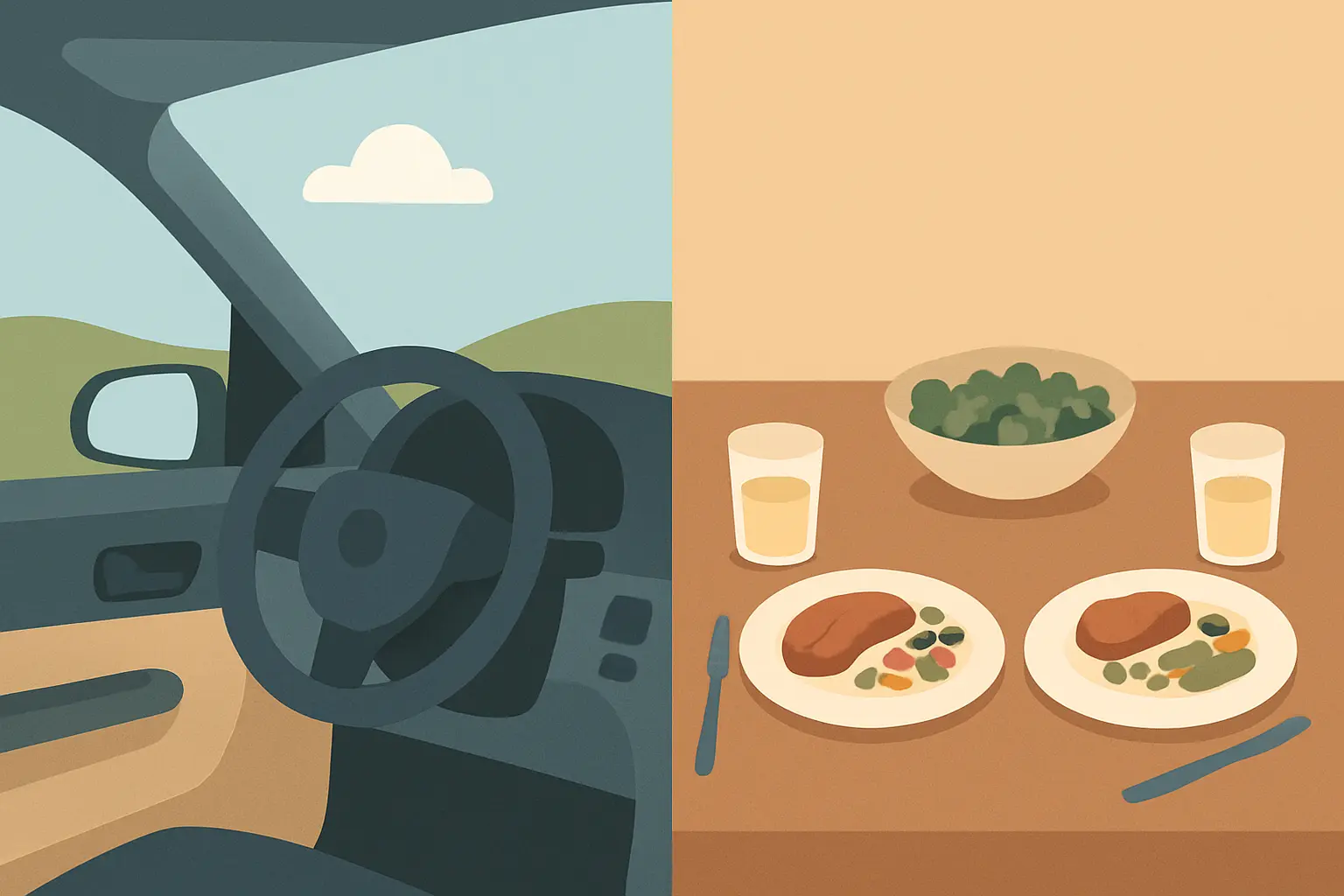
- The car. Agree the car is now smoke-free, even for a “quick one” with the window down. This is the easiest win because it’s a small, contained space you can both commit to.
- After dinner. If the cigarette used to follow the meal, change what follows the meal for you specifically — a short walk, doing the dishes, brushing your teeth early so the taste of a cigarette feels wrong.
- The balcony or porch. If it’s a shared space you used to occupy together while they smoked, decide whether you join without smoking, or step away and reconnect later. Either is fine — the point is deciding in advance instead of drifting into the old pattern.
- Coffee and alcohol. These pair with cigarettes for most smokers. Changing your coffee order, timing, or where you drink it can quietly break the link.
What to Do When They Smoke in Front of You
This will happen, probably in the first two weeks. Have a plan rather than improvising in the moment:
- Give yourself an exit. “I’m going to step inside for a few minutes” is a complete sentence. You don’t owe an explanation.
- Use the craving window. A craving typically peaks and fades within a few minutes; NHS guidance on staying smoke-free recommends knowing your triggers so you can manage them rather than being caught off guard. A short walk, a glass of water, or a breathing exercise can carry you through it.
- Name it once, calmly. “The smell is hard for me right now” is information, not an accusation. Say it once and move on rather than repeating it.
- Keep a craving log. Noting when and where this happens (same time each evening? same chair?) helps you spot the pattern and plan around it next time, rather than being surprised again.
An app-based craving log or an SOS breathing timer can help here specifically because the trigger is external and repeatable — you know roughly when it’s coming, so you can have a response ready before the craving hits rather than scrambling for one in the moment.
If They’re Not Ready — Quitting Anyway
Some partners will never quit, and that’s a fact you may have to make peace with separately from your own quit. A few things help when that’s the case:
- Decouple your success from theirs. Their smoking is not a referendum on your progress. Plenty of people quit permanently while living with a smoker for years.
- Protect the home’s air where you can. Smoking outdoors, away from open windows and air intakes, meaningfully reduces (though does not eliminate) household secondhand smoke exposure — worth asking for even if a full quit isn’t on the table yet.
- Build support outside the house. A friend, an online community, or a moderated support group gives you a place to talk through cravings that doesn’t rely on the person you live with understanding what you’re going through.
- Revisit the conversation later, without pressure. People’s readiness to quit changes. You can mention that you’re open to them joining you whenever they’re ready, without making your own quit conditional on it.
Frequently Asked Questions
Can I actually quit smoking if my partner still smokes?
Yes. A 2023 cohort study in Tobacco Induced Diseases found 31% of people quit successfully even when their partner kept smoking throughout — lower than the 76% success rate when both partners quit, but still a real, achievable outcome (Adler et al., 2023).
Does living with a smoker really lower my chances of quitting?
The same study found people with a non-smoking partner succeeded 39% of the time versus 31% with an actively smoking partner — a real but modest gap, not a guarantee of failure (Adler et al., 2023, Tobacco Induced Diseases).
Should I ask my partner to smoke outside?
It’s a reasonable request. The CDC states there is no safe level of secondhand smoke exposure indoors, and that comprehensive smoke-free rules are the only way to fully protect people who don’t smoke in a shared home.
What if my partner offers me a cigarette out of habit?
Ask them directly, once, to stop offering — even as a joke. Most partners will comply once they understand it’s a real trigger rather than routine politeness, not a lack of trust in your resolve.
Is thirdhand smoke (residue on clothes and furniture) actually a problem?
Yes — residue from tobacco smoke settles on surfaces, skin, and fabric and can linger long after the cigarette is out, which is why the car and shared furniture are worth addressing even if the person always “smokes outside” (Mayo Clinic).
What if we keep arguing about my quit attempt?
Bring specific, concrete requests instead of general complaints (“please smoke on the back step” rather than “be more considerate”) — specific rules are easier to keep and less likely to be tested by accident.
Should I wait until my partner is ready to quit too before I try?
No — waiting for someone else’s readiness is one of the most common reasons a quit date never happens. You can start now and leave the door open for them to join later.
Quit on Your Own Timeline
You don’t need your household to be smoke-free before you start — you need a plan for the parts of it that aren’t. If cravings tend to hit around a shared routine, iQuit’s craving forecasts learn your risky hours and nudge you before they arrive, and the moderated community gives you support that doesn’t depend on the person sharing your home. For more on rebuilding the routines around you, see how to set a quit date that actually sticks and relapse prevention strategies that hold up long-term.
If you’d rather keep your quit attempt to yourself for now, start with quitting smoking privately without telling anyone. And when someone offers you a cigarette — partner or otherwise — having a script ready to say no makes the moment far easier. If home doesn’t feel like enough support right now, an online quit-smoking community can fill that gap, and if secondhand smoke is a bigger concern in your household than one person’s habit, here’s how to act on secondhand smoke exposure for the whole family.
Quit at Your Own Pace, Even in a Mixed-Smoking Home
iQuit’s craving forecasts, streak shields, and moderated community are built for the days your household doesn’t make quitting easy. Free on Google Play and the App Store.
Download iQuit Free on Google Play Download on the App Store