
Most quit-smoking advice starts with “tell everyone” — announce your quit date, ask friends and family to hold you accountable, post it somewhere public. For a lot of people that works. For a meaningful number of others, it adds pressure they do not want: the fear of being watched, judged, or asked how it is going every day, especially after a previous attempt that did not stick. If you want to quit smoking privately, without telling anyone, that is a legitimate way to quit — it just needs a different plan. Part of what makes it more workable now is the growing set of digital tools transforming cessation, which support self-directed quitting without requiring anyone else’s involvement.
Why “Tell Everyone” Is the Default Advice — and When It Backfires
Public commitment is a well-known behavior-change lever: telling people creates social pressure to follow through, and a support network can offer encouragement during hard moments. That is real, and it is why nearly every quit-smoking guide leads with it.
But it assumes the social pressure will feel motivating rather than exposing. For someone who has quit and relapsed before, an audience turns every craving into a potential public failure, which adds anxiety on top of withdrawal rather than support. For someone who smokes secretly and whose family does not know at all, “tell everyone” is not even a realistic option — announcing the quit would mean announcing the habit first. And for people who simply process change privately, being asked “how’s the quit going?” daily can feel like pressure rather than encouragement, making the craving harder to sit with, not easier.
None of this means social support does not work on average — it does. It means the average recommendation does not fit everyone, and a private plan is not a lesser plan, just a different one.
Getting Accountability Without an Audience
Accountability does not require other people watching. Three private substitutes do most of the same job:
- An AI coach. Available any time of day without needing a human on standby, and without the social cost of admitting a craving or a slip to someone you will see again tomorrow. It cannot replace a close friend for every kind of support, but for the specific job of “someone to talk to right now, privately,” it fills the gap — see our guide on how AI quit coaching actually works.
- An anonymous community. Peer support without disclosure to anyone in your actual life — a moderated forum or in-app community where you are a username, not a name your family or coworkers would recognize.
- A written self-contract. A private, dated commitment to yourself, with specific triggers and a specific response planned for each. It sounds simple, but externalizing the plan onto paper (or into an app) rather than keeping it entirely in your head makes it easier to hold yourself to it, without needing anyone else to know it exists.
iQuit is built offline-first, which suits this kind of quitting: the craving tools, dashboard, and SOS exercises work without a connection, so you are not dependent on being somewhere you can explain. Read more on why iQuit works offline. If your situation involves quitting more than one substance privately, our guide on quitting tobacco and weed together applies the same private-accountability approach to a more complex quit.
Managing Visible Symptoms in Week One Without Explaining Them
The hardest part of a private quit is not the craving itself — it is that withdrawal produces visible symptoms other people notice, even if they do not know why. Nicotine withdrawal symptoms typically begin within hours of the last cigarette, peak in the first few days, and mostly settle within two to four weeks, according to the CDC’s guidance on quitting smoking. The most common ones in the first one to two weeks:
| Symptom | Why it happens | Discreet management |
|---|---|---|
| Irritability | Nicotine withdrawal affects mood regulation in the first days | Short breaks before responding to minor friction; a quick breathing exercise instead of a visible outburst |
| Increased appetite | Common as the body’s metabolism and reward system readjust | Keep a low-effort snack on hand rather than an obvious substitution ritual others might ask about |
| Coughing | Cilia in the airways reactivate and begin clearing built-up residue | Water and cough drops handle it without drawing attention or requiring an explanation |
| Restlessness or trouble concentrating | Common in the first 1–2 weeks as the brain adjusts to lower nicotine | Break tasks into shorter blocks; step away briefly rather than pushing through visibly frustrated |

None of these need an explanation if you would rather not give one — “just a bit tired” or “trying to drink more water” covers most questions without revealing the quit. They are also temporary: the CDC reports that coughing and shortness of breath decrease over the first one to twelve months as lung function recovers, and most of the acute irritability and restlessness fades well before that.
Handling Social Smoking Situations Without an Announcement
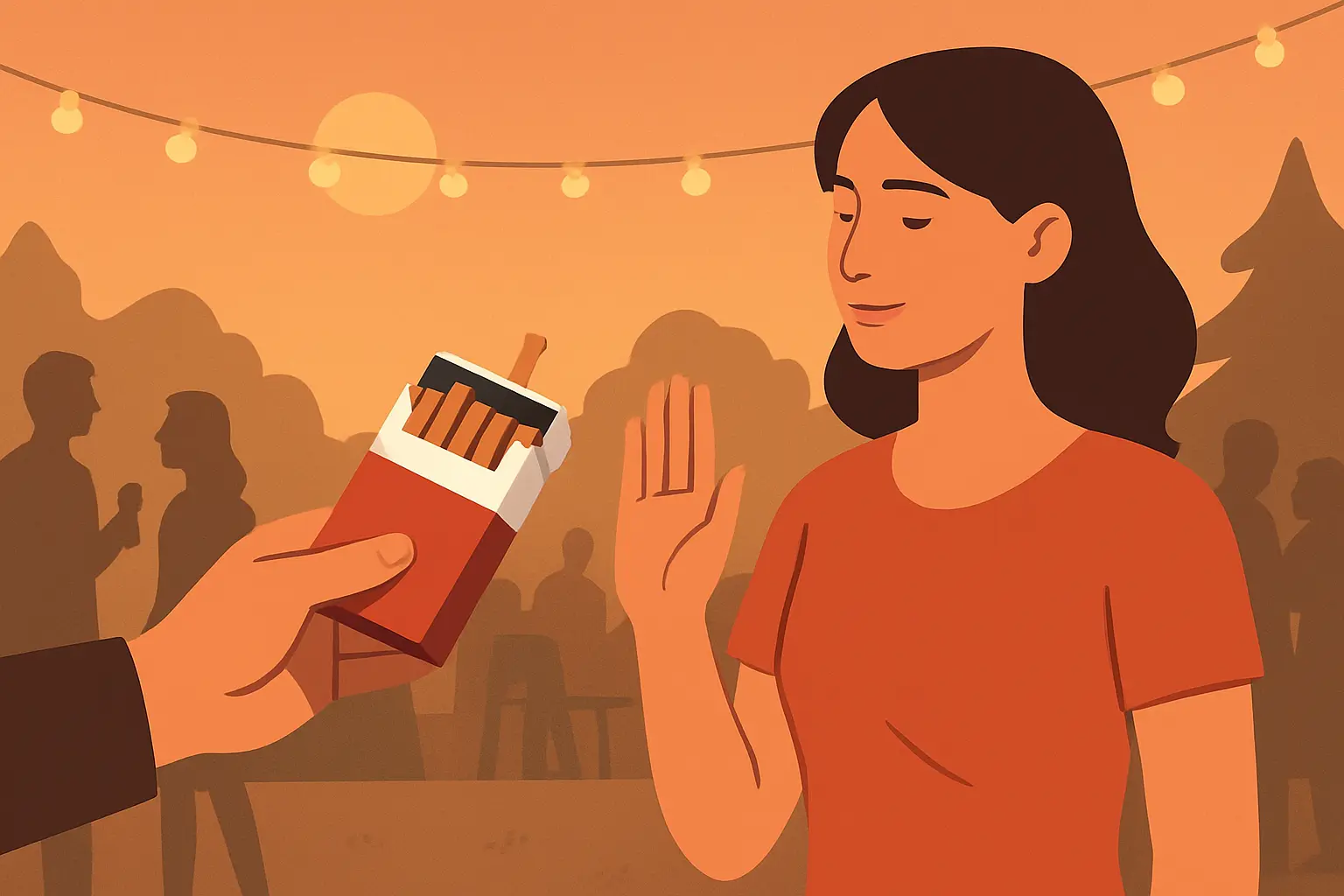
Declining a cigarette does not require explaining why. “No thanks, I’m good” is a complete sentence — it does not obligate you to mention quitting, and most people will not push past a calm, unhurried no. Our full breakdown of how to say no when offered a cigarette covers more specific scripts for recurring situations, like a smoke break with coworkers or a friend who always offers one at a bar — having a one-line response ready in advance, decided calmly beforehand rather than improvised under pressure, removes most of the awkwardness. You are not lying by not volunteering the reason; you are simply not making your health decisions a topic open for discussion. The same applies to a first smoke-free night out, one of the highest-pressure social settings — see surviving your first smoke-free night out for a fuller plan.
Using a Quitline or Text Support Anonymously
Quitlines are a private option many people overlook simply because the word “call” sounds like the opposite of discreet. In practice, quitline services are confidential by design — you are not asked to identify yourself to anyone in your life, and most offer text-based or app-based support alongside phone calls for people who would rather not talk out loud where someone could overhear. In the U.S., Smokefree.gov runs free text-message quit programs alongside the national quitline; in the U.K., the NHS quit smoking service offers the same kind of low-visibility support. iQuit includes quitline access for nine countries directly in the app, which means the number and the context are already there when you need it rather than something you have to search for mid-craving.
When to Eventually Tell Someone
A private quit does not have to stay private forever, and there is no fixed timeline for when to say something. A few signals worth noticing: you are struggling more than your private tools can handle and would benefit from in-person support; you have reached a milestone worth acknowledging and keeping it entirely to yourself feels isolating rather than protective; or someone close to you would reasonably need to know for a practical reason (a partner you live with, for instance). Telling one trusted person is a different decision than “telling everyone,” and it does not undo the value of having quit privately up to that point — it is simply adding a second layer of support once the first layer has done its job.
The Honest Caveat: Support Helps, But It Is Not Required
It would be dishonest to claim social support makes no difference — on average, having people around you who know and encourage the quit is associated with better outcomes than going in with zero support of any kind. This article is not arguing against support; it is arguing against the assumption that support has to be public, human, and immediate to count. An AI coach used consistently, an anonymous community checked daily, and a clear private plan are real support — they are simply not the version most quit-smoking advice defaults to describing.
If total isolation (no AI coach, no community, no plan, no tools at all) is the alternative to “telling everyone,” the honest answer is that quitting privately with real (if discreet) tools works better than quitting alone with nothing. The comparison that actually matters is not private versus public — it is supported versus unsupported. For a deeper look at the tradeoffs involved, see our comparison of quitting alone versus with a community.
iQuit’s free tier gives you all of this in one place — daily AI coach messages, a moderated anonymous community, and offline SOS tools — with nothing to explain to anyone. And if you eventually do want to bring someone into your quit, our guide on telling your family you’re quitting covers how to do it on your own terms, once you are ready.
Frequently Asked Questions
Can I successfully quit smoking without telling anyone?
Yes. Social support is associated with better average outcomes, but it is not a requirement for quitting successfully. Private substitutes — an AI coach, an anonymous community, and a written self-contract — can provide comparable accountability without disclosure to anyone in your life.
How do I explain withdrawal symptoms without revealing I’m quitting?
Most symptoms (irritability, coughing, restlessness) do not require an explanation at all. Vague, true statements like “a bit tired” or “trying to drink more water” cover most questions without revealing the quit, and most people will not press further after a calm, brief answer.
What is the best way to decline a cigarette without explaining why?
“No thanks, I’m good” is sufficient in nearly every social situation. Having this response ready in advance, rather than improvising under pressure, removes most of the awkwardness and does not obligate you to explain a quit attempt you would rather keep private.
Is an AI coach a real substitute for human accountability?
For the specific function of being available during a craving without social cost, yes — it fills a real gap. It does not replace every function a close friend serves, but for private, low-friction, any-time accountability, it is a genuine and effective substitute for many people.
How long do withdrawal symptoms that are noticeable to others usually last?
Most acute symptoms like irritability and restlessness peak in the first days after quitting and substantially ease within two to four weeks. Coughing and shortness of breath continue improving over one to twelve months as lung function recovers (source: CDC, Benefits of Quitting).
Can I use a quitline without anyone finding out?
Quitline services are confidential, and several offer text-message or online programs instead of phone calls — Smokefree.gov in the U.S. and the NHS quit smoking service in the U.K. both provide low-visibility options you can use without speaking out loud or naming anyone in your life.
Should I eventually tell someone even if I start out quitting privately?
There is no required timeline. Consider telling someone if you need in-person support your private tools cannot provide, if isolation starts to feel like a burden rather than a relief, or if a person you live with would reasonably need to know for practical reasons.
Does quitting privately reduce my chances of success compared to telling everyone?
Not inherently. The meaningful comparison is supported versus unsupported, not private versus public. A private quit with real tools (AI coaching, anonymous community, a clear plan) is a supported quit — it is quitting with zero support of any kind that most consistently predicts a harder attempt.
Quit on Your Own Terms
iQuit is offline-first and built for discretion — an AI coach, a moderated anonymous community, and craving tools that work without a connection. Free on Android via Google Play.