
SMART goals for quitting smoking turn a vague wish (“I should quit”) into steps you can actually track: each goal is Specific, Measurable, Achievable, Relevant and Time-bound. Below you will find 12 ready-to-copy examples, a way to measure them, a plan for slips and a weekly review you can finish in ten minutes.
What Are SMART Goals for Quitting Smoking?
SMART is a goal-setting framework used in coaching, education and workplaces. The letters are usually explained as below, although some versions swap “Achievable” for “Attainable” or “Realistic.”
| Letter | Question to ask | Weak version | SMART version |
|---|---|---|---|
| Specific | What exactly will I do? | “Smoke less” | “Skip the cigarette with my morning coffee” |
| Measurable | How will I count it? | “Try harder” | “Tick off each smoke-free day and log each craving” |
| Achievable | Can I do this with my current life? | “Never think about smoking again” | “Use a plan for each trigger on my list” |
| Relevant | Does it link to my own reason? | “Because I should” | “So I can keep up with my kids” |
| Time-bound | By when? | “Someday” | “Starting this Saturday, for 28 days” |
The benefit is practical. A goal you can measure gives you something to review, and a review gives you something to adjust. If you are still deciding whether to quit at all, start with our honest pros and cons list and come back here when the list tips your way. For the bigger picture of staying motivated, see the quit smoking motivation guide.
12 SMART Goal Examples for Quitting Smoking
Copy any of these and change the details so they fit your day. Each one is written as something you do, so there is no ambiguity about whether it happened.
Setting the quit
- Choose a stop date. “I will pick a quit date within the next two weeks, put it in my calendar tonight and tell one person.” Smokefree.gov advises: “Pick a day in the next two weeks. This will give you enough time to prepare. Pick a date that isn’t already likely to be a stressful one” (Smokefree.gov).
- Reach the 28-day mark. “I will have zero cigarettes for 28 days in a row, ending on [date].” The NHS says that if you reach 28 days smoke-free, “you’re 5 times more likely to quit for good” (NHS Better Health).
- Prepare the environment. “By the night before my quit date I will throw away or give away all cigarettes, lighters and ashtrays at home and in my car.”
Getting help
- Talk to a professional about medication. “This week I will ask a doctor or pharmacist about stop-smoking products and write down what they suggest.” Smokefree.gov says “medications can double your chances of quitting by helping you deal with symptoms of withdrawal.” That is a good reason to make this goal early.
- Book a counselor. “Before my quit date I will connect with a trained counselor by online chat or quitline.” Smokefree.gov lists this as a plan option: “Call a quitline to talk one-on-one with a trained counselor to help me quit.”
- Recruit support. “By Friday I will tell two people my quit date and ask each to check in with me once in the first week.” Our guide to using a quit smoking contract shows one way to make this formal.
Handling triggers and cravings
- Swap a routine. “For the first 14 days I will go for a 10-minute walk instead of the cigarette after dinner, at least 6 nights out of 7.”
- Plan for a craving. “Every time I get a craving I will drink a glass of water, wait before deciding, and write down the time and trigger.” Smokefree.gov lists “drinking a glass of water” and “taking 10 deep breaths” among its suggested distractions. Our if-then plans for quitting smoking show how to pre-decide your response.
- Prepare for a social trigger. “At the next party I will arrive with a non-alcoholic drink in hand, tell the host I have quit and step away from the smokers’ area when I notice an urge.” Smokefree.gov lists “being offered a cigarette” and “drinking alcohol or going to a bar” among common triggers.
Staying on course
- Protect the money. “Every Sunday I will move the money I did not spend on cigarettes into a separate pot, and by day 60 I will spend it on something I chose in advance.”
- Plan the slip. “If I smoke, I will write down what happened within 24 hours and restart my plan the same day.” More on this below.
- If you vape, count first. “For three days I will count every vaping session, then choose a stop date within the following two weeks and set one trigger goal for it.”
Making Goals Measurable
“Measurable” is where most quit plans fall apart, because people count nothing. Choose one or two numbers and keep them simple:
- Smoke-free days in a row. The cleanest measure, and the one the 28-day goal uses.
- Cravings logged and what triggered them. Smokefree.gov groups triggers into social situations, nicotine withdrawal, routine situations and emotions. Tagging each craving with one of those four categories shows you where to aim your next goal.
- Cigarettes avoided and money saved. Useful if you are building toward a reward. A figure you calculate from your own habit is more motivating than a statistic, and our guide on tracking your first 30 days on a calendar shows a paper version.
- Actions completed. “Talked to the pharmacist: yes or no” is measurable too.
A note on “cut down” goals
Reduction goals feel safer, and you may choose one, but the evidence leans toward a firm stop date. In a survey-based study of 27,390 adults in England who made a quit attempt, “people who choose to quit abruptly are more likely to quit successfully than people who choose to quit gradually,” with an odds ratio of 1.70 (95% CI 1.58 to 1.84), though that is observational data (Cox et al., 2026). A meta-analysis of three randomized trials with 1,607 participants, in which both groups used nicotine replacement, found a lower prolonged abstinence rate in the gradual group (relative risk 0.77) (Tan et al., 2019). If you prefer to taper, make the final goal a stop date, not an open-ended reduction. Our piece on which quit smoking method to choose helps compare the options.
Goals for Slips
A SMART plan should assume a slip might happen. Smokefree.gov says “setbacks are a normal part of the quitting process” and “most people need multiple quit attempts to quit for good—and that’s okay!”
Write the slip goal now, while you are calm:
- Specific: “If I smoke, I will stop at that one and write down the trigger.”
- Measurable: “I will log it within 24 hours.”
- Time-bound: “I will restart my goals the same day, not on Monday.”
- Relevant: “Because one slip does not erase the days I already put in.”
Common Goal-Setting Mistakes
Most failed quit goals share a few flaws, and all of them are fixable:
- The goal is a feeling, not an action. “Feel more in control” cannot be ticked off. “Walk for ten minutes after dinner” can.
- There is no date. Without a deadline, “soon” slides into next month.
- Too many goals at once. Quitting is already a big change, so avoid also launching a diet, a gym plan and a new job routine in week one.
- No plan for the hardest trigger. If your biggest trigger is alcohol or stress, one of your goals must address it directly. Our guide to the smoking stress relief myth can help you rethink the stress trigger.
- Perfection is the target. A goal that treats one slip as total failure breaks the first time life gets messy.
Putting it together: a one-page example
Here is an illustrative plan, not a prescription. Imagine someone who smokes after meals, with coffee and when stressed at work:
- Quit date: next Saturday (inside the two-week window), written in the calendar tonight.
- Help: ask a pharmacist about stop-smoking products on Tuesday; book a counselor chat before Saturday.
- Triggers: a ten-minute walk after dinner; water instead of the cigarette with coffee; a two-minute stretch break at work when stress rises.
- Measure: tick each smoke-free day; log every craving with its trigger.
- Slip rule: log it within 24 hours and restart the same day.
- Review: Sunday evening, ten minutes.
That is six lines. It is enough.
A 10-Minute Weekly Review
Pick the same time each week, such as Sunday evening. Ask five questions:
- Which goals did I hit?
- Which did I miss, and what was the trigger?
- What is one goal I can tighten (more specific or measurable)?
- What is one new goal for next week?
- Who do I need to update?
Keep the list short. Three active goals at a time is easier to follow than ten.
This short Smokefree.gov video walks through building a quit plan.
Turning Goals Into a Tracker
A goal that lives only in your head tends to fade. Put it where you will see it:
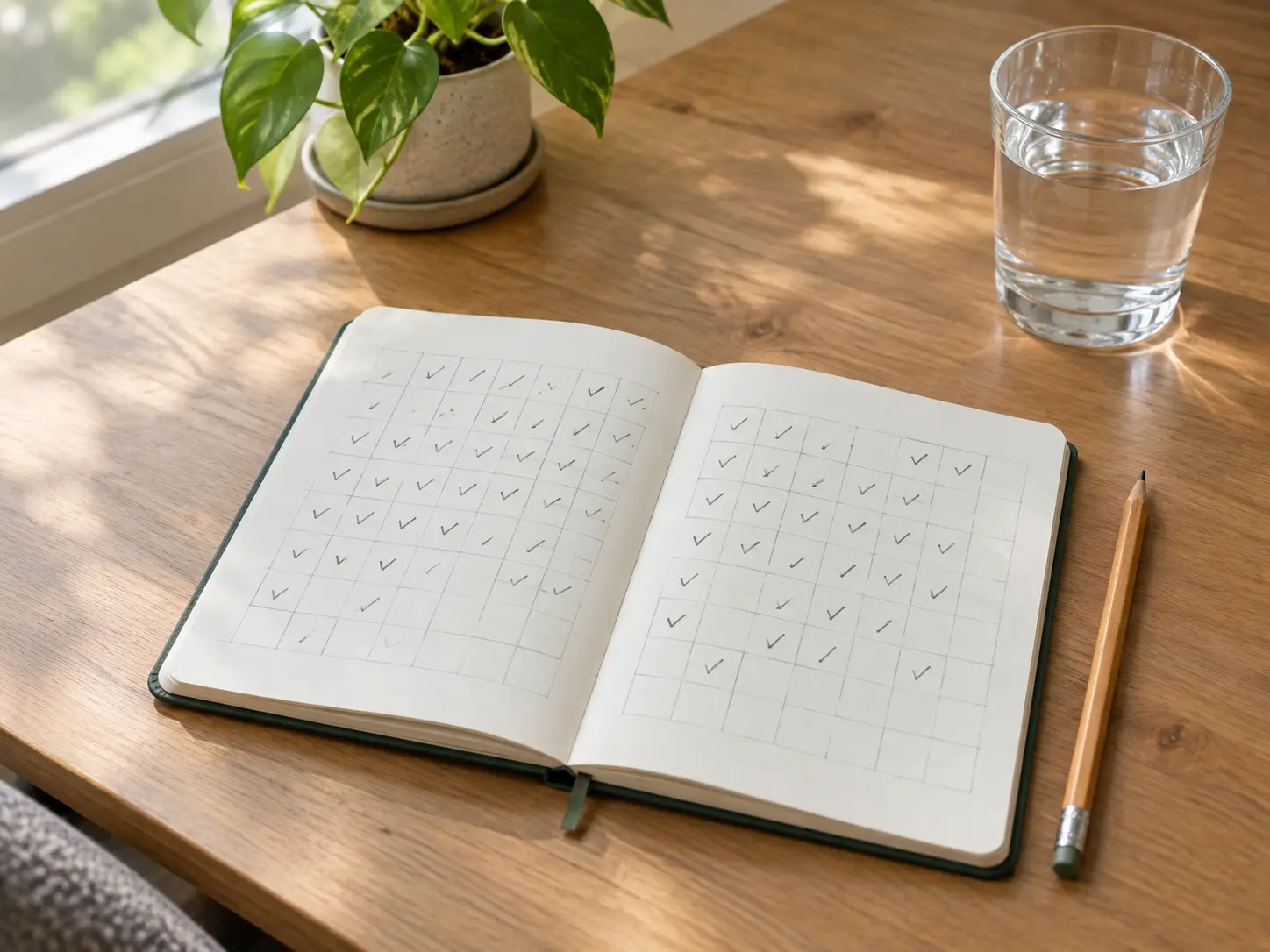
- Paper: a wall calendar with a tick for each smoke-free day.
- Spreadsheet: one row per day, columns for cravings, triggers and goals met.
- App: a quit app that counts for you and prompts you at the right moments.
Pick whichever you will actually open. The measure matters less than the habit of checking it. If you want a coach-style structure, our comparison of the best quit smoking apps explains what to look for.

Frequently Asked Questions
What are SMART goals for quitting smoking?
They are quit goals that are Specific, Measurable, Achievable, Relevant and Time-bound. Instead of “smoke less,” a SMART goal says exactly what you will do, how you will count it and by when, for example “no cigarettes for 28 days in a row, ending on a date you choose.” The framework is a planning tool, not a medical treatment.
How far ahead should I set my quit date?
Smokefree.gov advises picking a day in the next two weeks, which gives you enough time to prepare, and choosing a date that is not already likely to be stressful. Use the days before it to line up support, medication questions and a plan for your triggers (Smokefree.gov).
Why is 28 days a good goal?
The NHS says that if you reach 28 days smoke-free you are 5 times more likely to quit for good. It is a milestone that is long enough to matter and short enough to feel reachable, which makes it a natural time-bound target for the first month (NHS Better Health).
Is cutting down a good SMART goal?
It can be a stepping stone, but studies lean toward quitting on a set date. An observational study of 27,390 adults in England found abrupt quitters had higher odds of success (OR 1.70), and a meta-analysis of three trials found gradual quitting had a lower prolonged abstinence rate (RR 0.77). End any taper with a stop date (Cox, 2026; Tan, 2019).
What should my goal be if I slip?
Write it in advance: log what happened within 24 hours, note the trigger and restart your plan the same day. Smokefree.gov says setbacks are a normal part of the quitting process and most people need multiple quit attempts to quit for good, so a slip is a reason to adjust, not to stop (Smokefree.gov).
How many goals should I set at once?
Two or three active goals are easier to follow than a long list. A common mix is one stop-date goal, one support goal and one trigger goal. Review them weekly and replace the ones you have met. There is no research-backed ideal number, so choose what you will actually track.
Do medications belong in a SMART quit plan?
Yes, as an action goal, such as “talk to a pharmacist or doctor this week.” Smokefree.gov says medications can double your chances of quitting by helping you deal with withdrawal symptoms. Which product suits you is a decision for a health professional (Smokefree.gov).
Track Your Goals Every Day
Goals work best when you can see them move. iQuit shows your days smoke-free, cigarettes avoided and money saved, lets you log every craving with its trigger and intensity, and offers daily missions and achievements to keep each week’s goals in view. iQuit is free to download on Google Play and the App Store.
Download iQuit Free on Google Play Download on the App Store