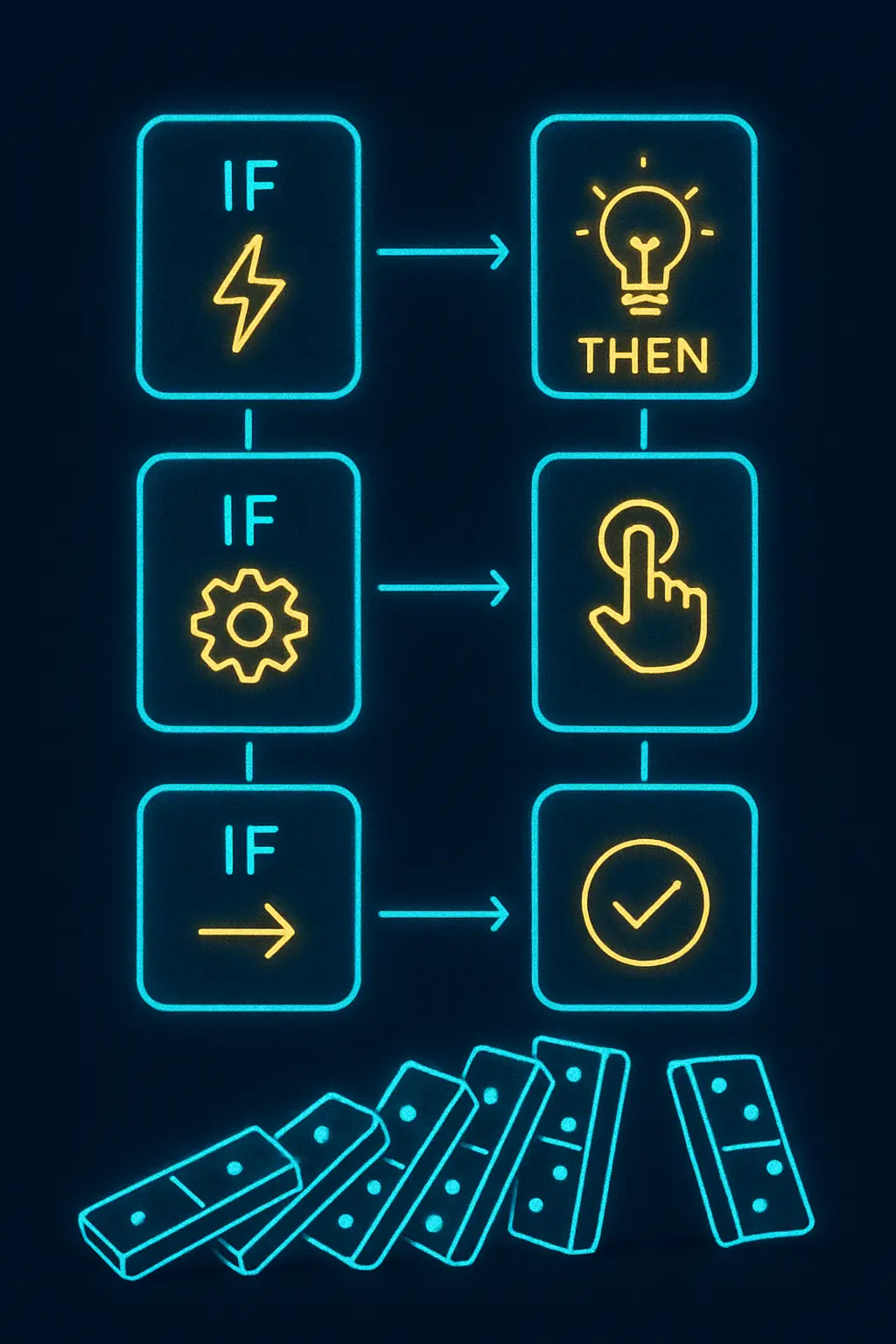
“I’ll really try not to smoke” is a wish. “IF I crave after dinner, THEN I immediately brush my teeth” is a machine. The difference has a name — implementation intentions — and one of the most replicated findings in behavior-change psychology behind it: Gollwitzer’s meta-analysis of ~94 studies found if-then planning produces a medium-to-large jump in follow-through versus goals alone. The mechanism is beautifully unfair: by pre-deciding your response, you hand the work to the trigger itself. The situation fires the plan. Willpower never gets consulted.
Why live decisions lose and pre-decisions win
Every craving moment is a courtroom, and in-the-moment you is the worst possible judge: stressed, depleted, flooded with withdrawal, and negotiating with a brain that wants one specific verdict. An if-then plan moves the trial to a better courtroom — calm, motivated, pre-quit you — and leaves only execution for the hard moment. Execution is cheap; deliberation is expensive. That’s the entire trick, and it’s why the effect replicates from dieting to exercise to smoking cessation.
The 7 if-then plans every quitter should write
- The morning: IF I wake and want a cigarette, THEN I drink the full glass of water on my nightstand before anything else. (The wake-up urge is your dependence speaking — pre-empt it first.)
- After meals: IF I finish eating, THEN I brush my teeth or start the dishes within two minutes. (The strongest daily cue gets the fastest scripted response.)
- The stress spike: IF something makes me furious or panicked, THEN I step away and run one round of box breathing before responding to anything.
- Drinking: IF I have a drink in hand, THEN it lives in my smoking hand all night. (Small, mechanical, ruthlessly effective — see the night-out survival plan.)
- The offer: IF someone holds out a pack, THEN I say “I’m off them” — the exact words, pre-loaded, no speech.
- The big wave: IF a craving passes 7/10, THEN I open the SOS flow and let it run — not “I’ll cope somehow,” but that button, that sequence.
- The slip: IF I smoke one, THEN I destroy the rest of the pack and log it in the app immediately. Pre-deciding the slip response is the single most protective plan on this list — it’s the difference between a lapse and a relapse.
Writing rules that actually fire
- Specific beats noble. “IF stressed THEN be strong” fires nothing. The IF must name a recognizable moment; the THEN must be one concrete action.
- Write them down, once, before day one. The act of writing is the installation. Review the list at week one and swap anything that never fired.
- One plan per trigger. Competing THENs for the same IF cancel out. Your trigger map tells you which IFs you actually need.
An app that runs your if-thens for you
The free iQuit app is, structurally, an if-then engine: IF you shake the phone, THEN the SOS sequence runs; IF your logged trigger hour approaches, THEN a heads-up arrives before the craving; IF you log a slip, THEN the recovery plan and check-ins fire automatically. Write your seven personal plans in the journal at setup, and let the app hold the machinery that in-the-moment you shouldn’t have to operate.
FAQ
What’s an if-then plan?
A pre-written trigger→response rule (“IF X, THEN I do Y”) that lets the situation launch the action instead of live willpower.
Does it really work?
Meta-analyses across ~94 studies show medium-to-large gains in follow-through — one of psychology’s most replicated effects.
How many should I write?
Five to eight, covering your real danger scenarios. Precision beats quantity.
What’s the most important one?
The slip plan — pre-deciding your response to one cigarette is what keeps it from becoming twenty.
Install your if-thens where they’ll fire: download iQuit free on Google Play.