

Someone holds out a pack, or nods toward the door for a smoke break, and suddenly you’re improvising in front of people whose opinion you care about. Knowing how to say no to a cigarette before that moment arrives — not scrambling for words in it — is what actually makes refusal feel natural instead of awkward. This isn’t about willpower in the abstract. It’s about having a specific line ready, graded to the relationship and to how much you want to explain, so the decision is already made before anyone asks.
Why “Just Be Assertive” Isn’t Enough Advice
Most quitting advice stops at “be assertive” or “stay strong,” which is true and almost useless in the moment. Assertiveness isn’t a personality trait you either have or don’t — it’s a rehearsed skill, built from specific words said out loud in advance so they’re available under pressure instead of invented on the spot. Refusal-skills training has been a core part of structured cessation and prevention programs for decades precisely because knowing you should say no and having a ready sentence to say are two different things. The gap this article fills is the sentence itself: what to actually say, graded by who’s asking and how much you want to disclose, plus the specific comebacks for when a plain “no” doesn’t end it.
It’s also worth understanding why this is harder with people you actually like than with strangers. Declining a cigarette from someone you barely know carries almost no social cost — you’ll likely never see them again. Declining from a close friend or a partner who still smokes carries a much bigger one: it can feel like drawing a line between who you were together and who you are now, which is exactly what makes the moment loaded even when the words themselves are simple. Naming that dynamic in advance makes it easier to recognize the discomfort for what it is, rather than mistaking it for a sign you’re making the wrong call. If crowded social settings are where this keeps coming up, it’s worth reading alongside why friends make you want to smoke, which covers the psychology behind why refusal is hardest around people you like. And if you’re navigating all of this without wanting your quit attempt to be public knowledge at all, quitting privately without telling anyone covers how to keep declining discreet.
The One-Word Decline
For acquaintances, coworkers, or anyone you don’t need to explain yourself to, the goal is a fast, neutral no that doesn’t invite a conversation:
- “No thanks, I’m good.”
- “I’m alright, thank you.”
- A simple shake of the head with a smile, no words needed.
The key is tone, not content: flat, pleasant, final. Said with hesitation or an apologetic look, even “no thanks” can read as an opening for negotiation. Said plainly, it usually closes the topic in under two seconds.
The Deflection
When you’d rather not discuss quitting at all — a work event, someone you don’t know well — redirecting the moment works better than declining head-on:
- “Not right now, but did you try the food over there?”
- “I’m good, actually heading to grab a drink — want to come?”
- Simply stepping toward a different conversation or activity as you decline.
Deflection works because it gives the other person something else to focus on immediately, so the offer doesn’t hang in the air waiting for a fuller answer.
The Honest Version
With closer friends or family, a brief honest answer usually serves you better than a deflection, because it sets an expectation for future offers too:
- “I quit, actually — feeling good about it, so I’ll pass.”
- “Trying to stay smoke-free, but thanks for offering.”
- “I’m three weeks in — don’t want to mess that up.”
This version does more work over time than the other two: said once, clearly, it usually means the same person won’t offer again. It also invites support rather than pressure from people who are actually on your side — and being open with the people closest to you is one of the practical steps the NHS stop-smoking guidance recommends for exactly this reason.
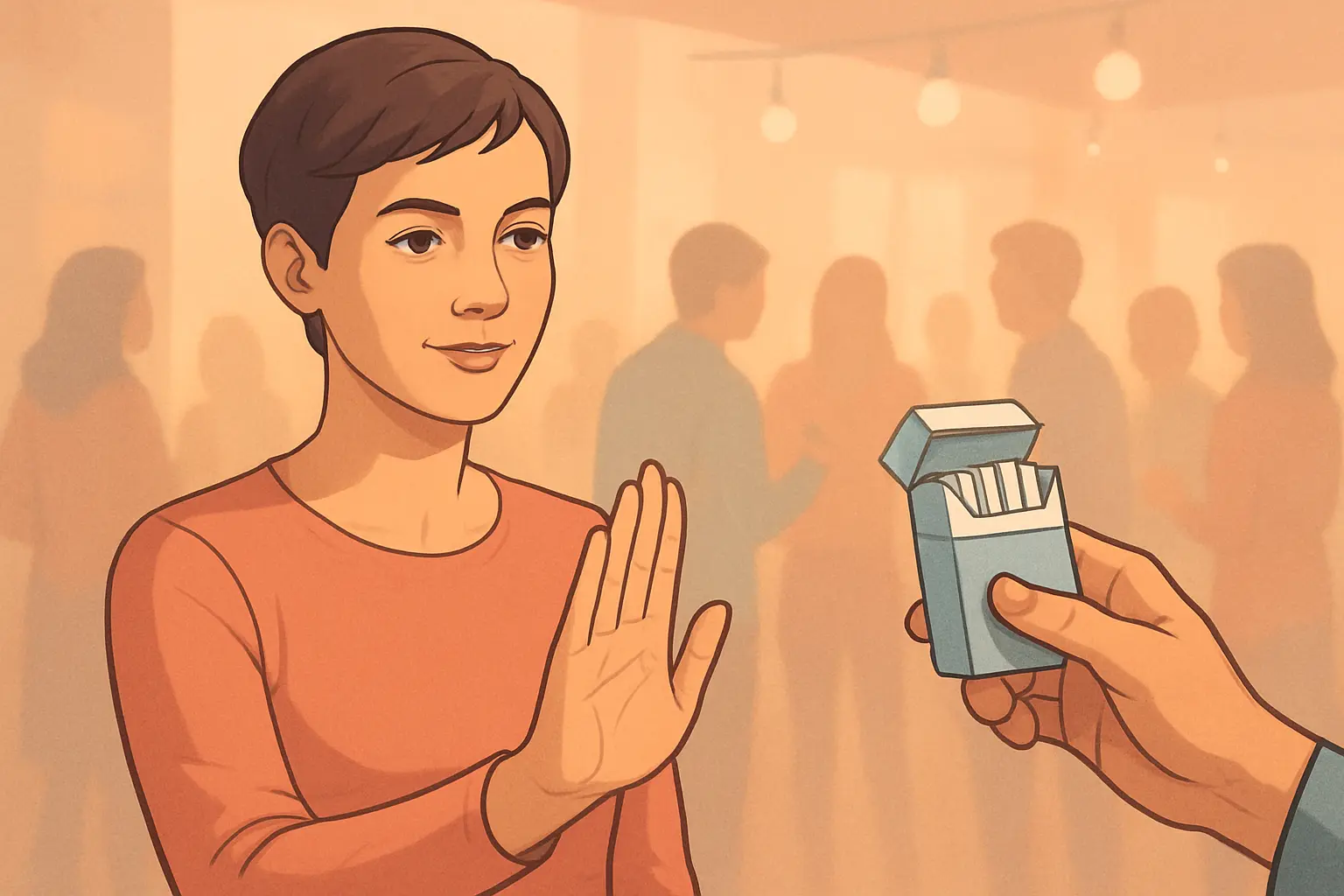
When Someone Keeps Pushing: Four Common Follow-Ups
A plain no ends most offers. The harder moment is what comes after, when someone pushes back. Having a ready response for the four most common lines removes the need to think on your feet while also holding your ground.
| What they say | What to say back |
|---|---|
| “Come on, just one.” | “That’s exactly why I’m not having one — there’s no such thing as just one for me.” |
| “You’ve done so well, you’ve earned it.” | “That’s kind of you to say, and it’s actually why I’m not going to risk it now.” |
| “You’re no fun since you quit.” | “Ha, fair — I’ll make up for it in other ways tonight.” |
| “I’ll stop offering when you’re really quit.” | “I am really quit — you can stop offering now, and I mean that kindly.” |
The pattern across all four: acknowledge what they said briefly, then restate the boundary without over-explaining. Long justifications tend to invite more debate, not less — a short, warm, repeated line (a technique sometimes called the “broken record” method in assertiveness training) is harder to argue with than a paragraph of reasons.
The Pre-Rehearsal Drill
The single biggest difference between people who navigate this smoothly and people who cave under pressure isn’t willpower — it’s whether the words were ever said out loud before the moment arrived. A short drill before a known trigger event (a party, a work happy hour, a visit to friends who smoke):
- Pick one line from each category above — your one-word decline, your deflection, your honest version.
- Say each one out loud, alone, at a normal conversational pace, at least twice.
- Pick one comeback for the pushback you’re most likely to get from the specific people you’ll be with.
- Decide in advance which version you’re using tonight, rather than choosing in the moment.
This is a specific application of if-then planning — deciding “if offered, then I’ll say X” before the situation happens rather than during it. Research on this kind of implementation intention consistently finds it improves follow-through more than general willpower or intention alone, because it removes the need to improvise a decision while under social pressure. For the broader version of this technique across quitting generally, see if-then plans that improve follow-through. If the event in question is your first big night out since quitting, surviving your first smoke-free night out covers the rest of the evening beyond just the refusal moment.
The Craving That Can Follow a Successful “No”
Saying no is often the easy part; the ten minutes afterward can be harder. Declining doesn’t automatically switch off the urge — it just wins you the moment, and the craving itself may still need somewhere to go. This is normal and temporary. Craving surfing — treating the urge as a wave that rises, peaks, and passes on its own, usually within a few minutes, rather than something that has to be resolved immediately — tends to work better here than trying to think your way out of it. If declining is a recurring part of your week rather than a one-off, the complete craving toolkit collects the fastest options — box breathing, grounding, urge surfing — in one place so you’re not searching for them mid-conversation, and the CDC’s free quit-smoking resources include quitline numbers for the nights when a technique isn’t enough on its own. Whichever month you’re navigating this in, the timing itself matters less than having the script ready; if you’re weighing when to start this whole process, choosing the right month to quit is a useful companion piece.
What to Do With Your Hands Instead
Part of what makes an offered cigarette hard to decline isn’t the nicotine — it’s the prop. Smoking gave hands something to do and a reason to step outside or away from a conversation. Having a physical substitute ready removes some of that pull before it even involves a decision:
- Hold a drink — non-alcoholic if alcohol is itself a trigger for you.
- Keep something small to fidget with in a pocket (a coin, a worry stone, a pen).
- Step outside anyway, without a cigarette, if fresh air or a change of scene was really what you wanted.
The full breakdown of alternatives is in what to do with your hands after quitting smoking. And if a slip does happen despite all of this, it’s worth knowing in advance that one cigarette doesn’t erase your progress — a lapse is a moment to respond to with a plan, not a reason to spiral. iQuit’s slip-recovery flow and streak shields are built around exactly that: a single hard moment doesn’t have to reset the whole quit, and its SOS tools give you a rehearsed 60-second response for the moment right after you’ve said no and the urge is still there.
Frequently Asked Questions
What’s the simplest way to say no to a cigarette?
A short, flat “no thanks, I’m good” said without hesitation is usually enough to close the offer. Tone matters more than wording — confident and pleasant reads as final, while an apologetic tone can invite further pushing.
Do I have to tell people I quit smoking?
No. Disclosure is optional and can be matched to the relationship — a deflection works fine for acquaintances, while a brief honest explanation tends to work better with close friends and family since it usually prevents repeat offers.
What do I say if someone keeps pushing after I say no?
Acknowledge what they said briefly, then repeat your boundary without adding a long justification. Short, warm, and repeated tends to end pushback faster than an extended explanation, which can invite more debate.
Why does rehearsing a refusal in advance actually help?
It removes the need to invent a response while already under social pressure. This is a specific form of if-then planning, a well-studied technique that consistently improves follow-through on difficult decisions compared with relying on willpower alone.
How do I handle being offered a cigarette at a party where I don’t know people well?
A deflection tends to work best in low-familiarity settings — declining briefly and redirecting to a different topic or activity, rather than explaining your quit, keeps the moment light and moves the conversation along.
What should I do with my hands if I always smoked in social settings?
Holding a drink, keeping a small object to fidget with, or simply stepping outside without a cigarette can all substitute for the physical habit a cigarette used to fill, separate from the nicotine itself.
What if I accept a cigarette despite planning not to?
A single slip does not undo months of progress. Treating it as information about what to plan for differently next time, rather than a verdict on your willpower, is what research on relapse prevention consistently recommends.
Rehearse Your Line, Then Let iQuit Back You Up
iQuit’s SOS tools give you a ready 60-second response the moment an urge hits — right after you’ve said no and need something else to do with your hands.