
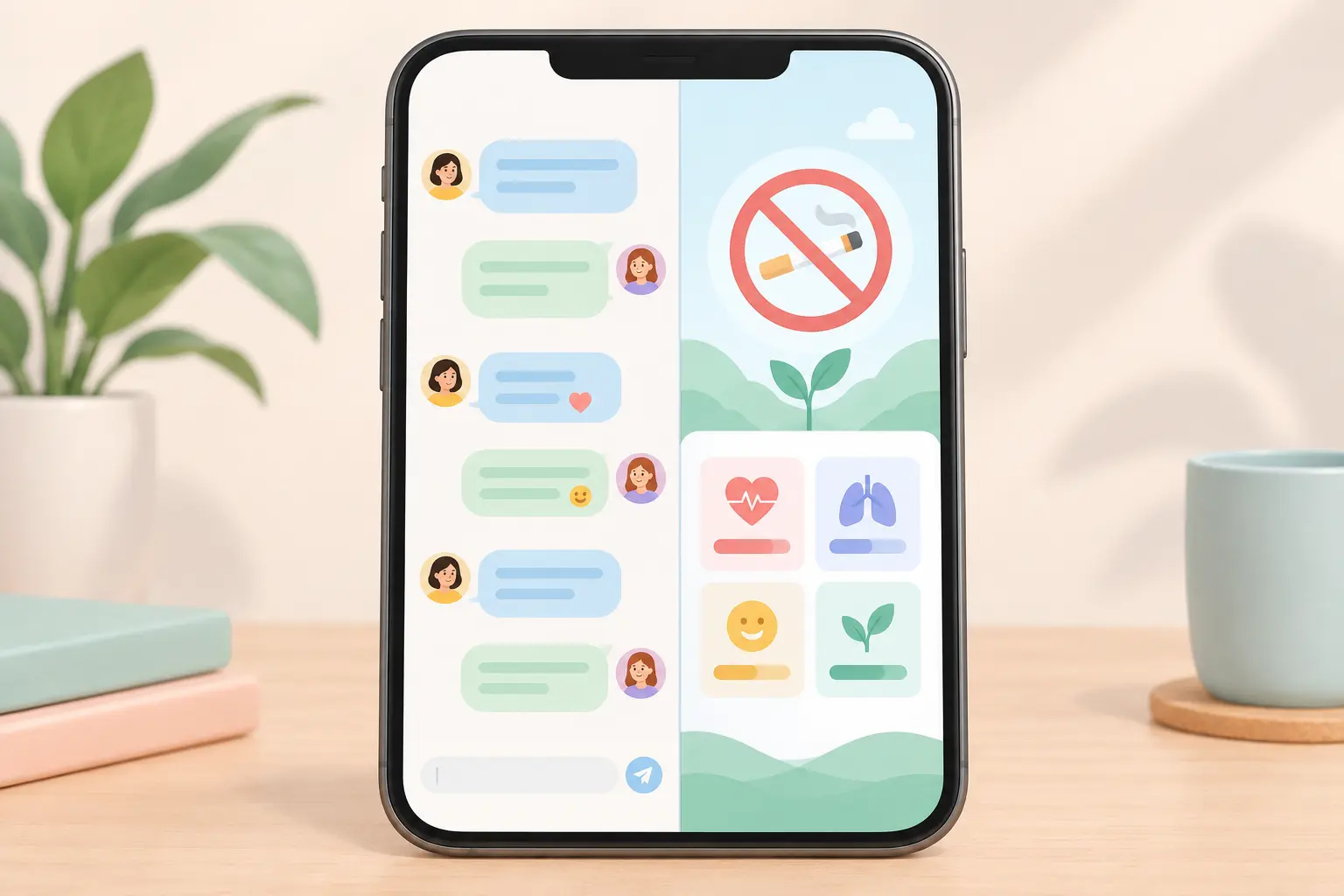
A quit smoking text message program sends encouragement and tips to your phone, usually for free, on a schedule built around your quit date. This guide explains how programs like SmokefreeTXT work, which ones exist, what the Cochrane evidence says about texts and apps, and how the two compare so you can pick one or use both.
How Text Message Quit Programs Work
The model is simple: you enroll, tell the program your quit date, and it sends scheduled messages before and after that date. Take SmokefreeTXT, run by the US National Cancer Institute’s Smokefree.gov. Its page describes a program for “Adults in the United States who are ready to quit smoking,” where you “text QUIT to 47848” and then “receive daily text messages to support you in quitting smoking.” It adds: “The program lasts for 6-8 weeks. You can opt out at any time by texting STOP” (Smokefree.gov, SmokefreeTXT).
The FAQ gives the timing in more detail: the “text program will start up to two weeks before your quit date and last for six weeks following your quit date.” On cost, it says “There is no additional fee for this service. However, message and data rates may apply,” so a plan without unlimited texting could cost you something (Smokefree.gov, text messaging FAQs).
A feature worth knowing about is the on-demand keywords. For SmokefreeTXT, texting CRAVE to 47848 gets “a reminder of why you shouldn’t pick up that cigarette,” MOOD sends a positive message on a rough day, and SLIP offers encouragement after a lapse: “You don’t have to start from the beginning!” Because programs, keywords and short codes change, always confirm them on the program’s own page before you text.
The Main Programs by Country
Most of the best-documented free text programs are American. Here are the Smokefree.gov programs, with eligibility and sign-up text taken from its pages (Smokefree.gov, text messaging programs and Smokefree.gov, text messaging FAQs):
| Program | Who it is for | How to sign up |
|---|---|---|
| SmokefreeTXT | Adults in the United States ready to quit | Text QUIT to 47848 |
| SmokefreeTXT for Teens | Teens ages 13 to 17 in the United States | Text QUIT to 47848 (Teens program) |
| SmokefreeNATIVE | Native American people in the United States | Text NATIVE to 47848 |
| SmokefreeVET | Veterans with VA health care benefits | Text VET to 47848 |
| SmokefreeMOM | Pregnant women who want to cut back and quit | Text MOM to 47848 |
| Practice Quit and Daily Challenges | Smokers who want to build skills before quitting (1 to 7 days) | Text GO to 47848 |
Outside the US the picture is thinner, and we only list what we could verify. In British Columbia, Canada, QuitNow BC lists “Text and email tips programs” among its free supports, alongside phone and live chat coaching (QuitNow BC); see our guide to free quit smoking help in Canada versus the US for the Canadian options. In Australia, the Quit site lists a quitline on 13 7848, but we did not find a text program on the page, so we have not listed one. We did not verify a UK or Irish text program either. If you live elsewhere, ask your local quitline whether it offers text support.
Truth Initiative’s free EX Program, developed with Mayo Clinic, includes “text message support” alongside quit plans and a community (Truth Initiative). Its youth-focused text program is reviewed in our This Is Quitting review.
What the Messages Actually Say
It helps to know what you are signing up for. The Smokefree.gov FAQ shares samples. A SmokefreeTXT message reads: “Cravings can be triggered by seeing other people smoking. Spend time in places where smoking isn’t allowed. Try malls, museums, or the movies.” A Daily Challenges message reads: “Day 6- Delay your 1st cig (or the next one) by an hour today. Make a plan and stick to it.” SmokefreeVET messages are written for veterans and speak to deployment-era smoking habits.
In other words, the content is practical, short and behavioral: avoid the trigger, delay the cigarette, try again after a slip. That is useful if you respond to prompts and reminders, and less useful if you want a conversation or data about your own pattern. The program also checks back later: the FAQ says Smokefree will “follow up one, three, and six months after the programs end to see how you’re doing.”
Limits and Practical Issues
Text programs are simple, which is their strength and their limit:
- Location. SmokefreeTXT says “Messages are only deliverable to US phone numbers,” and the FAQ notes you must “use a supported mobile phone carrier in the United States.” Outside the US you will need a local equivalent.
- Age and eligibility. You must be at least 13 to sign up, and several programs are limited to specific groups, such as veterans with VA health care benefits.
- Fixed length. SmokefreeTXT runs 6 to 8 weeks. Cravings can come back months later, and the program will not be there unless you enroll again.
- No tracking. Texts do not count your days, cigarettes avoided or money saved.
- Limited two-way help. You can text keywords for a response, but you cannot chat through a trigger or record what set one off.
- Carrier rates. There is “no additional fee” from the program, but “message and data rates may apply,” so check your plan.
On privacy, the FAQ says the information you give at sign-up is used “to enroll you in the program, personalize your experience, and allow us to understand our users better,” and that “No information is used for commercial purposes.” As always, read the privacy policy of any program before you enroll.
What the Evidence Says About Texts and Apps
The key source is the Cochrane review of mobile phone text messaging and app-based interventions, 2019 (26 studies, 33,849 participants; searches to October 2018). Its findings, in its own words:
- “There was moderate-certainty evidence, limited by inconsistency, that automated text messaging interventions were more effective than minimal smoking cessation support (RR 1.54, 95% CI 1.19 to 2.00; I2 = 71%; 13 studies, 14,133 participants).”
- Text messaging added to other support was also more effective than that support alone (RR 1.59, 95% CI 1.09 to 2.33; 4 studies, 997 participants), again with moderate certainty.
- For apps: “The evidence comparing smartphone apps with less intensive support was of very low certainty.” The pooled result “provided no evidence that smartphone apps improved the likelihood of smoking cessation (RR 1.00, 95% CI 0.66 to 1.52; 5 studies, 3079 participants).”
Read that carefully. It does not say apps do not work: it says the trials then available were too few, too inconsistent and too imprecise to tell. The review also notes that the apps in those trials may differ from the apps you can download today. It also does not say texts are a cure: “moderate certainty” and wide inconsistency mean the benefit varies between programs. The fair summary is that text programs have the stronger evidence base, and that app evidence is still catching up.
Texts vs an App: Side by Side
| Feature | Text program | Quit smoking app |
|---|---|---|
| How help arrives | Pushed to you on a schedule, plus keyword replies | You open it when you want, any time |
| Phone needed | Any phone that can text | A smartphone |
| Cost | No additional fee for SmokefreeTXT; carrier rates may apply | iQuit is free to download on Google Play and the App Store; optional Premium |
| Tracking | None | Days smoke-free, cigarettes avoided, money saved |
| Craving tools | Keyword replies such as CRAVE and SLIP | SOS breathing and grounding, virtual cigarette, craving log |
| Duration | Fixed: 6 to 8 weeks for SmokefreeTXT | As long as you keep the app |
| Evidence (Cochrane 2019) | Moderate certainty of benefit | Very low certainty of benefit |
The big practical difference is who starts the conversation. A text program reaches you whether or not you remember it exists, which suits people who forget to open apps. An app waits until you open it, which suits people who want help at the exact moment a craving hits and who like seeing progress.
This short video from the Smokefree.gov channel introduces SmokefreeTXT.
Using Both Together
Nothing stops you from enrolling in a free text program and installing an app. In fact the Cochrane review found that text messaging added to other support was more effective than that support alone, which is a reason to layer them rather than choose.
iQuit is free on Google Play and the App Store. Where a text program sends on a schedule, iQuit’s AI coach is there when you open it, with free daily messages. The SOS tools, a craving log that records triggers and intensity, streak shields and slip recovery, and a dashboard of days smoke-free, cigarettes avoided and money saved cover what a text stream cannot. iQuit does not diagnose or treat any condition and works best alongside a quitline, doctor or stop smoking service. For a wider comparison, see the best free quit smoking apps and resources, the best quit smoking apps for Android and our complete guide to quit smoking apps. For how a government-built app compares, read the quitSTART app review.
Which Should You Choose?
- You forget to open apps, or want a very low-effort start: a text program, if you are eligible.
- You want help at 2 a.m. and like seeing progress: an app.
- You are a US veteran, a teen, a Native American smoker or pregnant: look at the Smokefree.gov program built for your group.
- You live outside the United States: ask your local quitline about text support, and use an app in the meantime.
- You are serious about quitting: use both, and add a quitline or doctor.
Whichever you choose, set a quit date, because the programs are built around one. And if you slip, treat it as information: the SLIP keyword exists for exactly that moment.
Frequently Asked Questions
What is a quit smoking text message program?
It is a free or low-cost service that sends encouragement and tips by text, usually timed around your quit date. SmokefreeTXT, run by the National Cancer Institute, sends daily messages and lasts 6 to 8 weeks (Smokefree.gov).
How do I join SmokefreeTXT?
If you are an adult in the United States, text QUIT to 47848 or sign up on the Smokefree.gov page. You can opt out at any time by texting STOP, and message and data rates may apply (Smokefree.gov, SmokefreeTXT).
Do text message programs work?
The 2019 Cochrane review found moderate-certainty evidence that automated text messaging beat minimal support for quitting (RR 1.54, 95% CI 1.19 to 2.00; 13 studies, 14,133 participants), with benefit varying between programs (Cochrane, CD006611).
Are apps better than texts for quitting?
The same Cochrane review found very low certainty evidence for smartphone apps (RR 1.00, 95% CI 0.66 to 1.52; 5 studies), so it could not show a benefit. That reflects limited trials up to October 2018, not proof that apps fail.
Do text programs cost money?
Smokefree.gov says there is no additional fee for its text programs, but message and data rates from your carrier may apply, so check your plan before you enroll (Smokefree.gov, text messaging FAQs).
What are the SmokefreeTXT keywords?
On Smokefree.gov, CRAVE sends a craving reminder, MOOD sends a positive message and SLIP sends encouragement after a lapse. Text the keyword to 47848, and confirm current keywords on the program page.
Can I use a text program and an app together?
Yes. The Cochrane review found that text messaging added to other support was more effective than that support alone (RR 1.59, 95% CI 1.09 to 2.33; 4 studies, 997 participants), so combining tools is reasonable.
Add On-Demand Support With iQuit
iQuit is free on Google Play and the App Store. Open it for an AI coach reply, SOS craving tools, a craving log and your days smoke-free, any time a craving hits.
Download iQuit Free on Google Play
Download on the App Store


