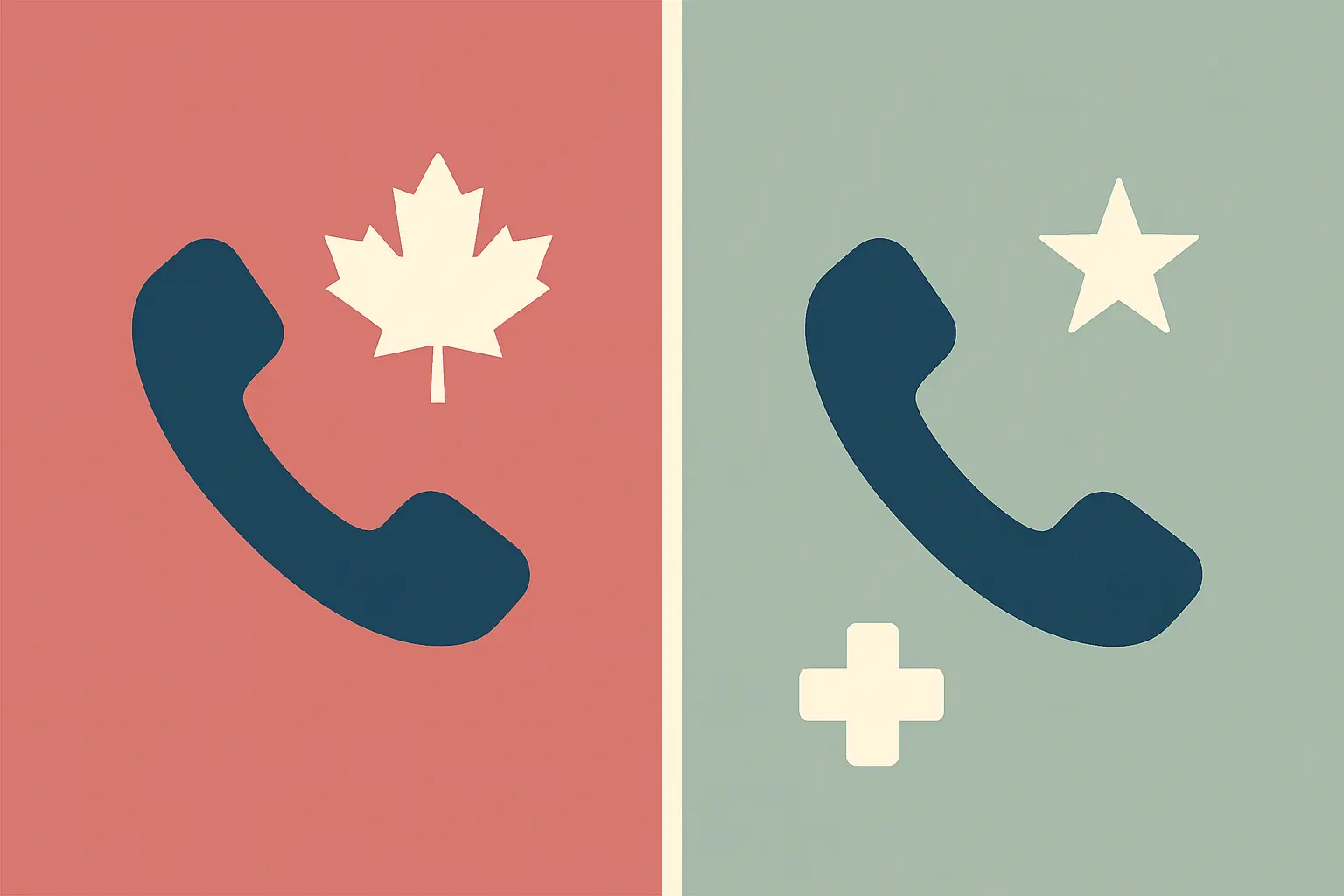
If you are looking for free quit smoking help Canada offers and wondering how it stacks up against the United States, the honest summary is that both countries give you a free coach on the phone, and after that the two systems diverge sharply. Canada routes you through your province. The US routes you through your insurance. Everything below comes from a government page we opened on September 16, 2026, and where a rule could not be verified we say so instead of guessing.
What free covers in each country
Free means something different on each side of the border, and the difference is structural rather than generous or stingy.
| Canada | United States | |
|---|---|---|
| National phone line | 1-866-366-3667, a toll-free quit coach line listed by Health Canada | 1-800-QUIT-NOW (1-800-784-8669), routing to your state quitline |
| Other language lines | Not listed on the federal page | Spanish, Chinese, Korean and Vietnamese lines published by the CDC |
| Texting | Not listed on the federal page | Text QUITNOW to 333888; SmokefreeTXT on 47848 |
| Who runs the service | Each province and territory, under its own name | Each state, reached through one national number |
| Free medication route | Provincial drug programs, rules set province by province | Insurance coverage as a preventive service, plus some state programs |
The practical consequence is that a Canadian reader’s first question is which province they live in, and an American reader’s first question is what insurance they have.
Canada: the national line and provincial services
Health Canada maintains a page of provincial and territorial quit services, last modified on November 7, 2024. It gives one national number, described as a toll-free line where you can talk to a quit coach: 1-866-366-3667.
Below that it names a service for every jurisdiction. Alberta has AlbertaQuits. British Columbia has QuitNow. Manitoba, New Brunswick, Ontario, Prince Edward Island and Saskatchewan each run a Smokers’ Helpline. Newfoundland and Labrador has Smokers’ Help, the Northwest Territories has the NWT Quitline, Nova Scotia has Tobacco Free Nova Scotia, Nunavut has Nu Quits, Quebec runs iQuitnow through Tobacco Free Quebec, and Yukon publishes its help through the territorial government site.
One limitation is worth flagging, because other articles fill it with invented detail. That federal page lists service names and websites, not individual provincial phone numbers. If you want your province’s direct line, take it from your own provincial service rather than from a third-party list, and check the hours while you are there.
Free nicotine replacement in Canada

This is where Canada has something the US does not offer as a walk-in service, and British Columbia is the clearest published example. The province’s BC Smoking Cessation Program page, last updated on May 22, 2026, sets out the terms precisely.
- What is covered. Nicorette gum in ultra fresh mint, 2 mg and 4 mg; Nicorette lozenges in mint, 2 mg and 4 mg; and Nicoderm patches at Step 1 21 mg, Step 2 14 mg and Step 3 7 mg.
- How much. In the page’s own words, each calendar year from January to December you can receive PharmaCare coverage for one continuous course of treatment of up to 12 weeks, which it puts at 84 days.
- What you need. You must be enrolled in the provincial Medical Services Plan. For the nicotine replacement part, the page states plainly that you do not need a prescription and can likely get the products the same day.
- Prescription medicines. Bupropion, under the Zyban brand, and varenicline generics are covered depending on which PharmaCare plan you are on, and those do need a prescriber.
The important caveat: those are British Columbia’s rules, not Canada’s. Other provinces run their own programs with their own limits, and we did not verify each one page by page in this session. Check your own provincial health site before assuming the same 12 weeks applies. If you want the fuller national picture of who still smokes and where, our breakdown of Canadian smoking statistics for 2026 sets the context.
The US: 1-800-QUIT-NOW and state quitlines
The American system funnels every state through a single memorable number. The CDC’s quit-smoking page, last reviewed on September 27, 2024, publishes 1-800-QUIT-NOW (1-800-784-8669) along with four dedicated language lines: 1-855-DÉJELO-YA (1-855-335-3569) in Spanish, 1-800-838-8917 in Chinese, 1-800-556-5564 in Korean and 1-800-778-8440 in Vietnamese. The CDC describes quitlines as providing free coaching over the phone.
Alongside that runs the National Cancer Institute’s own line. Its smokefree.gov craving guidance gives 1-877-44U-QUIT (1-877-448-7848), open Monday to Friday from 9:00 a.m. to 9:00 p.m., plus a LiveHelp online chat.
Individual states then layer their own offers on top. New York, for instance, publishes its Quitline as 1-866-NYQUITS (1-866-697-8487), free and confidential in English and Spanish, with texting on (716) 309-4688 and a chat service. Other state quitlines advertise free nicotine replacement starter kits, but those offers differ so widely that you should confirm yours by calling rather than trusting any list.
US insurance coverage: what is actually guaranteed
The guaranteed part of American free help is not a program, it is a line item. HealthCare.gov’s list of covered preventive services for adults includes tobacco use screening for all adults and cessation interventions for tobacco users. The general rule it states is that in most cases you will not pay a copayment or coinsurance for covered preventive services, even if you have not met your deductible.
Two qualifications matter. The page notes that zero cost is not guaranteed in every case, and the protection applies with in-network providers. So the treatment is free through your plan rather than free at the point of walking into a pharmacy, which is a genuinely different experience from British Columbia’s arrangement.
Medicaid and Medicare each have their own cessation rules, and we could not open either program’s official benefit page in this session, so this article does not state what they cover. Ask your plan directly, or ask the quitline coach, who will know your state’s current arrangement. The New York State health department does note on its own page that Medicaid and most health insurance plans cover smoking cessation.
Text and web programs compared
Texting is the clearer offer of the two countries, and it is the American side that publishes it.
- United States. The CDC lists Text QUITNOW to 333888, with a Spanish version on the same shortcode, plus the quitSTART app. The National Cancer Institute runs SmokefreeTXT, joined by texting QUIT to 47848.
- Canada. The federal provincial-services page does not list a national texting service. Several provincial programs run their own, so check your province’s site rather than assuming there is none.
- Web coaching. Both countries offer it. Health Canada points to an online quit planner and a cigarette cost calculator; the NCI offers a live chat with a counselor on weekdays.
Text programs suit people who will not phone a stranger, which is a larger group than most services admit. If you are weighing formats rather than countries, our comparison of online programs versus in-person support covers what each one actually changes.
What neither country gives you

Both systems are built around a conversation you schedule, and there are three gaps that follow from that.
- The 11pm craving. The National Cancer Institute’s line runs weekdays until 9:00 p.m. Quitline hours vary elsewhere, and none of them exist to be called during a four-minute urge on a Sunday night.
- Data about your own pattern. A coach can ask what triggers you, but neither system records your cravings for you between calls, which is the information that makes the next conversation useful.
- The months after the program ends. British Columbia’s covered course tops out at 12 weeks a year, and counseling episodes are similarly bounded. Relapse risk does not stop on that schedule.
These are gaps rather than failures. Free services deliberately concentrate on the parts that need a human being.
Building a free stack that works
The version that covers a whole week, in either country, looks the same.
- Make the call once. 1-866-366-3667 in Canada, 1-800-QUIT-NOW in the US. A coach will tell you what your province or state currently funds, which is the fastest way past every out-of-date web page.
- Get the medication sorted early. In British Columbia that is a pharmacy visit with no prescription. In the US it is a conversation with your plan or provider about the preventive-services benefit. Our comparison of the NRT options covers which product to ask for.
- Add texting if calls are not for you. Free, and it reaches you rather than waiting for you.
- Cover the hours nobody staffs. A free app handles the late-evening craving that no quitline is open for.
- Collect the rest. Our free resource directory, the round-up of free services and helplines and the free app comparison cover what else costs nothing.
Free quit help FAQ
Is there a free quit smoking helpline in Canada?
Yes. Health Canada’s provincial and territorial quit services page, last modified November 7, 2024, lists 1-866-366-3667 as a toll-free number where you can talk to a quit coach. It also names a service for every province and territory, from AlbertaQuits and QuitNow in the west to Nu Quits in Nunavut and iQuitnow in Quebec.
Can I get free nicotine patches in Canada?
It depends on your province. British Columbia’s published program covers one continuous course of up to 12 weeks, or 84 days, each calendar year, including Nicoderm patches at 21 mg, 14 mg and 7 mg, and states that no prescription is needed if you are enrolled in the provincial Medical Services Plan. Other provinces set their own rules, so check your own provincial health site.
What is the US free quit smoking number?
1-800-QUIT-NOW, which is 1-800-784-8669, connects you to your state quitline for free phone coaching. The CDC also publishes 1-855-DÉJELO-YA (1-855-335-3569) in Spanish, 1-800-838-8917 in Chinese, 1-800-556-5564 in Korean and 1-800-778-8440 in Vietnamese. The National Cancer Institute runs a separate line on 1-877-44U-QUIT, weekdays 9:00 a.m. to 9:00 p.m.
Does US health insurance have to cover quitting smoking?
HealthCare.gov lists tobacco use screening for all adults and cessation interventions for tobacco users among the covered preventive services, and states that in most cases you will not pay a copayment or coinsurance for such services even before meeting your deductible. It also notes that zero cost is not guaranteed in every case and that this applies with in-network providers, so confirm with your own plan.
Which country gives more free help overall?
Neither wins outright. Canada’s provincial drug programs can put nicotine replacement in your hand without a prescription, which the US does not offer as a walk-in service. The US publishes more free channels centrally: four additional language lines, a national texting shortcode and a free app, all from one number. What you get depends far more on your province or plan than on the border.
Is there a free quit smoking texting service?
In the US, yes: the CDC lists Text QUITNOW to 333888, with a Spanish version on the same number, and the National Cancer Institute runs SmokefreeTXT, joined by texting QUIT to 47848. Health Canada’s provincial services page does not list a national Canadian texting service, though individual provinces may run their own, so check your provincial site.
What does Medicaid or Medicare cover for quitting?
We could not open either program’s official benefit page while researching this article, so we are not going to state numbers we did not verify. New York State’s health department does say on its own page that Medicaid and most health insurance plans cover smoking cessation. Ask your plan directly, or ask a quitline coach, who will know your state’s current arrangement.
Do I have to give up free help if I move between the two countries?
The phone and medication parts are tied to residency, so a provincial drug program or a state quitline will follow the address rather than the person. Free apps, texting programs and online tools generally do not care where you are. Plan the tied parts around the move and keep the untied parts running through it.
Cover the hours no quitline is open
iQuit’s free core gives you SOS breathing and grounding, craving logging with triggers and intensity, and a dashboard of days smoke-free and money saved, in whichever country you are in. Free on Google Play and the App Store.
Download iQuit Free on Google Play
Download on the App Store