
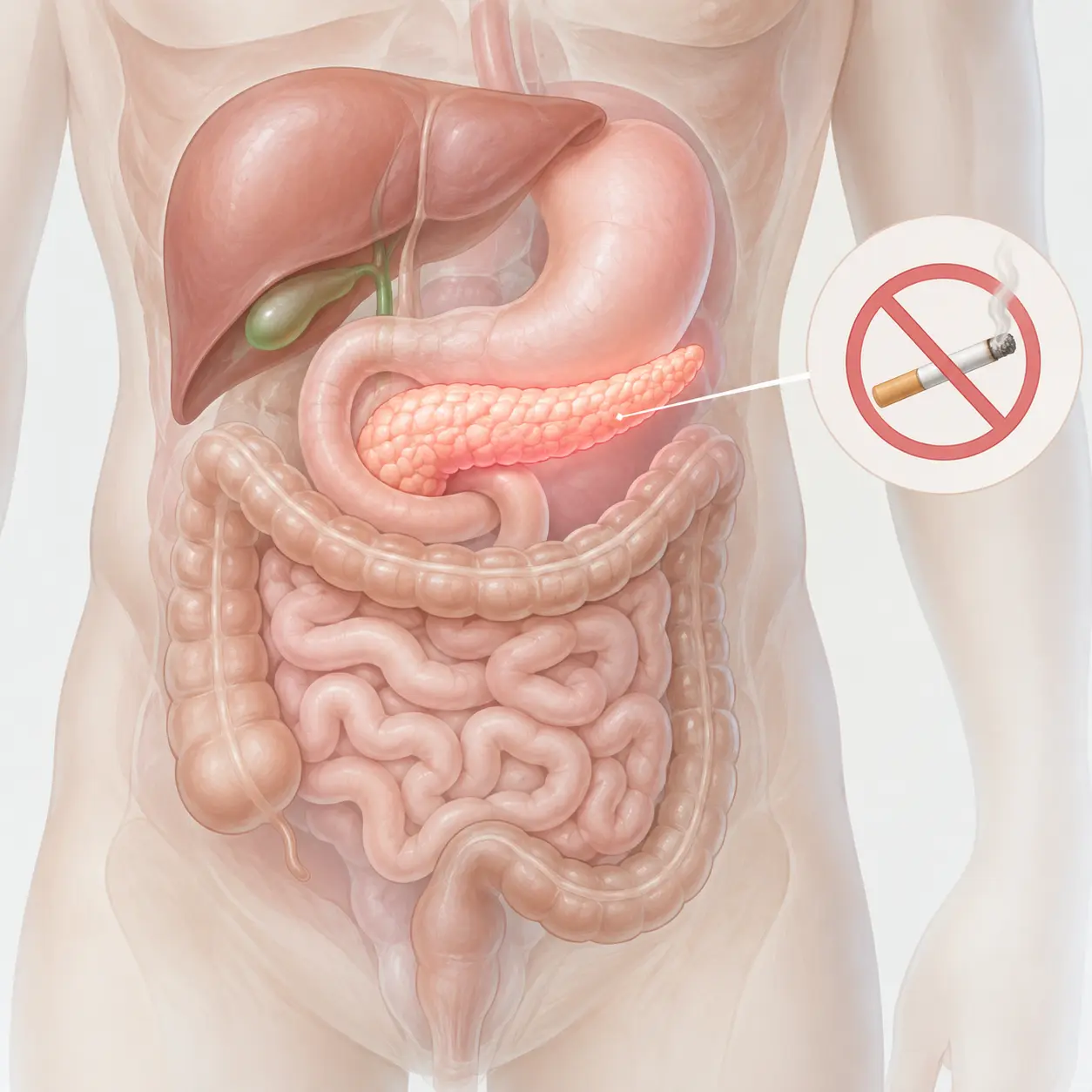
If you or someone close to you has been told to stop drinking and smoking after a pancreas attack, the advice is not just routine. Smoking and pancreatitis are linked in large studies, and the link holds even after researchers account for alcohol. This guide explains what the evidence shows about risk, recurrence and progression, where it is still uncertain, and what quitting can realistically do.
Acute vs chronic pancreatitis
The pancreas sits behind your stomach. It makes digestive enzymes and hormones such as insulin. Pancreatitis means it has become inflamed, and doctors split it into two main types.
The NHS describes acute pancreatitis as a serious condition where the pancreas suddenly becomes swollen and painful, which needs urgent treatment in hospital. It says the most common causes are gallstones and drinking a lot of alcohol. Most people recover fully, though some develop complications, and if you keep getting acute pancreatitis it can develop into chronic pancreatitis.
The NHS describes chronic pancreatitis as a long-term condition where the pancreas is inflamed, scarred and painful. There is no cure, and the NHS notes it mainly affects adults and is more common in people who drink or smoke a lot.
| Feature | Acute | Chronic |
|---|---|---|
| What it is | Sudden swelling and pain | Long-term inflammation, scarring and pain |
| Most common causes | Gallstones, heavy drinking | Heavy drinking; also linked to smoking |
| Outlook | Most recover fully; can recur | No cure; damage usually worsens over time |
| Smoking advice | Stop smoking to help prevent a repeat | Giving up can help slow the damage |
Smoking as a risk factor in its own right
For years the story was that pancreatitis was an alcohol disease and smoking was along for the ride, because people who drink often smoke. Researchers wanted to know whether smoking adds risk by itself.
A 2019 systematic review and meta-analysis in Pancreatology pooled ten prospective studies. For acute pancreatitis, the summary relative risk was 1.49 for current smokers, 1.24 for former smokers and 1.39 for ever smokers, each compared with never smokers. Results were similar for chronic pancreatitis. The authors also found a dose-response pattern: the relative risk was 1.30 for every 10 cigarettes smoked per day (Aune 2019, PubMed).
| Group | Relative risk | 95% confidence interval |
|---|---|---|
| Current smokers | 1.49 | 1.29 to 1.72 |
| Former smokers | 1.24 | 1.15 to 1.34 |
| Ever smokers | 1.39 | 1.25 to 1.54 |
A relative risk of 1.49 means about a 49% higher chance than a never smoker, not a 49% chance of getting pancreatitis. Most smokers never develop it. These are group averages from observational studies, so they show a consistent association rather than proof in any one person.
The authors concluded that smoking increases the risk of acute and chronic pancreatitis. Notice that former smokers sit between current smokers and never smokers in the table. That fits the idea that risk is lower once you stop, though the study design cannot show how fast it falls.
Smoking plus alcohol
Alcohol and tobacco travel together, which makes it hard to separate them. A 2010 review in Nature Reviews Gastroenterology and Hepatology concluded that smoking confers a strong, independent and dose-dependent risk of pancreatitis that may be additive or multiplicative when combined with alcohol (Yadav and Whitcomb 2010, PubMed).
In practice that means cutting only one habit may leave a lot of risk on the table. If you drink and smoke, the two are often tied together by the same triggers: the pub, the after-dinner glass, the balcony. Our guides on the link between smoking and alcohol and on how to drink without smoking walk through that overlap.
Recurrence and progression
After a first attack of acute pancreatitis, the worry is a second one. The NHS says that if you have had acute pancreatitis once it is possible to get it again, and lists drinking less alcohol or none, stopping smoking and eating a healthy, low-fat diet as things that help stop it coming back.
A 2025 retrospective study in Pancreatology followed 501 patients with acute pancreatitis from three tertiary hospitals in Korea for up to 60 months. Of these, 164 (32.7%) had a recurrence and 71 (14.2%) progressed to chronic pancreatitis. In the analysis, smoking was a significant risk factor for recurrence (hazard ratio 4.09) and for progression to chronic pancreatitis (hazard ratio 2.50). The authors concluded that smoking and alcohol cessation are important to prevent recurrent and chronic disease (Park 2025, PubMed).
Treat those hazard ratios with care. The study was retrospective, drawn from hospital records, and smoking status is often unevenly recorded. It supports the same message as the larger meta-analysis but should not be read as a precise prediction for your own recurrence risk.
Is there proof that quitting prevents recurrence?
Not from a randomized trial that we could find. The 2010 review above suggested that smoking cessation may help slow progression from acute to chronic pancreatitis. A European trial called REAPPEAR was designed to test whether a combined education and cessation program for smoking and alcohol prevents recurrent acute pancreatitis, but the published paper is the trial protocol, not results (Ocskay 2022, PubMed). So the case for quitting rests on consistent observational evidence and clinical guidance, not on a finished trial.
The pancreatic cancer link
Pancreatitis and pancreatic cancer share some risk factors, and smoking is one of them. The American Cancer Society says the risk of pancreatic cancer is about twice as high among people who smoke compared with people who have never smoked, and that about 25% of pancreatic cancers are thought to be caused by cigarette smoking. It also says it is never too late to stop smoking, since the risk will drop once a person stops (American Cancer Society).
The NHS adds that people with chronic pancreatitis also have a higher risk of getting pancreatic cancer. That does not mean pancreatitis will turn into cancer for most people, but it is one more reason doctors push smoking cessation after a diagnosis. For the wider cancer picture, see what cancers smoking causes and the risk data.
Quitting after an attack
If you are recovering from a pancreatitis episode, nicotine cravings may feel even harder to handle. You may be tired, in pain and anxious. If you went without cigarettes in hospital, the first stretch of withdrawal may already be behind you. Our guide to the stages of nicotine withdrawal explains what comes next.
Johns Hopkins Medicine has a short interview with a gastroenterologist on how pancreatitis is treated, which is a helpful companion to your own care team’s advice.
Practical steps worth taking
- Tell your care team you smoke and want to stop. Ask which medicines or support they can offer. Choices about nicotine replacement or prescription medicine are for you and your clinician.
- Treat alcohol and tobacco as one plan. The NHS recommends cutting or stopping alcohol after acute pancreatitis. If drinking is a smoking trigger, plan for that overlap.
- Expect blood sugar questions. The pancreas makes insulin, and chronic pancreatitis can lead to a form of diabetes, according to the NHS. Our piece on blood sugar recovery after quitting covers the type 2 side.
- Keep going after a slip. One cigarette is a setback to learn from, not a reason to give up the plan.

The free iQuit app can support the day-to-day side of this. You can log each craving with its trigger and intensity, which makes it easy to see whether a drink, a meal or stress sets them off. The SOS tools, including breathing exercises and a virtual cigarette, give you something to do while a craving passes, and the health-recovery timeline shows your progress. iQuit supports quitting; it does not treat pancreatitis or any other condition. For a broader view of what changes in your body, read our complete health recovery guide.
What the evidence cannot tell you
Be clear-eyed about the limits. Almost everything above comes from observational studies, which find patterns in groups but cannot prove that smoking caused any one person’s pancreatitis. Gallstones, heavy drinking, genes, medicines and other conditions all play a role, and the NHS lists several of them.
It also cannot tell you how much of the extra risk disappears, or how quickly. Former smokers in the meta-analysis still had a higher risk than never smokers, but a lower one than current smokers. Doctors cannot predict recovery for any individual, and nobody should treat a hospital stay as a reason to feel guilty. What you can say is that stopping smoking is advised by the NHS after both acute and chronic pancreatitis, and that it removes one of the few risk factors you can change.
If you get sudden, severe tummy pain, the NHS says to get urgent help: ask for an urgent GP appointment or get help from NHS 111 if the pain does not go away or keeps coming back, or you have a high temperature, and call 999 or go to A&E if the pain spreads to your back or you have a fast heartbeat or trouble breathing. Do not wait for it to pass.
Frequently Asked Questions
Does smoking cause pancreatitis?
Smoking is linked to a higher risk, not a sure outcome. A 2019 meta-analysis of ten prospective studies found a relative risk of acute pancreatitis of 1.49 in current smokers. Gallstones and heavy drinking are the most common causes, per the NHS (Aune 2019; NHS).
Is smoking a risk factor even if I do not drink?
Yes, evidence points that way. A 2010 review concluded smoking confers a strong, independent and dose-dependent risk of pancreatitis that may be additive or multiplicative with alcohol. Independent means it is not explained by drinking alone (Yadav and Whitcomb 2010).
Will quitting smoking stop pancreatitis from coming back?
No one can promise that. The NHS lists stopping smoking among the steps that help prevent another attack of acute pancreatitis, but we found no published randomized trial results for a quitting program. Quitting lowers one risk factor you can control (NHS; Ocskay 2022 protocol).
Does quitting help chronic pancreatitis?
The NHS says that if you have chronic pancreatitis and smoke, giving up can help slow down the damage to the pancreas. It also says the damage usually gets worse over time and cannot be reversed, so stopping is about slowing it (NHS).
How much does smoking raise the chance of a second attack?
In a 2025 retrospective study of 501 patients, smoking was a significant risk factor for recurrence (hazard ratio 4.09), and 32.7% had a recurrence overall. It was a hospital-records study, so treat the figure as a signal, not a personal forecast (Park 2025).
Is there a link between smoking, pancreatitis and pancreatic cancer?
Yes, indirectly. The NHS says people with chronic pancreatitis have a higher risk of pancreatic cancer, and the American Cancer Society says smokers have about twice the risk of never smokers. It says the risk drops after a person stops smoking (NHS; American Cancer Society).
When should I get urgent help for stomach pain?
The NHS says to ask for an urgent GP appointment or get help from NHS 111 for sudden, severe tummy pain that does not go away or keeps coming back, or comes with a high temperature, and to call 999 or go to A&E if pain spreads to your back or you have a fast heartbeat or difficulty breathing (NHS).
Get Support to Quit Smoking
iQuit is free and helps with the daily work of staying smoke-free: a smoke-free day counter, craving logging with triggers, SOS tools for strong urges and a health-recovery timeline. It supports your plan alongside your medical care.


