
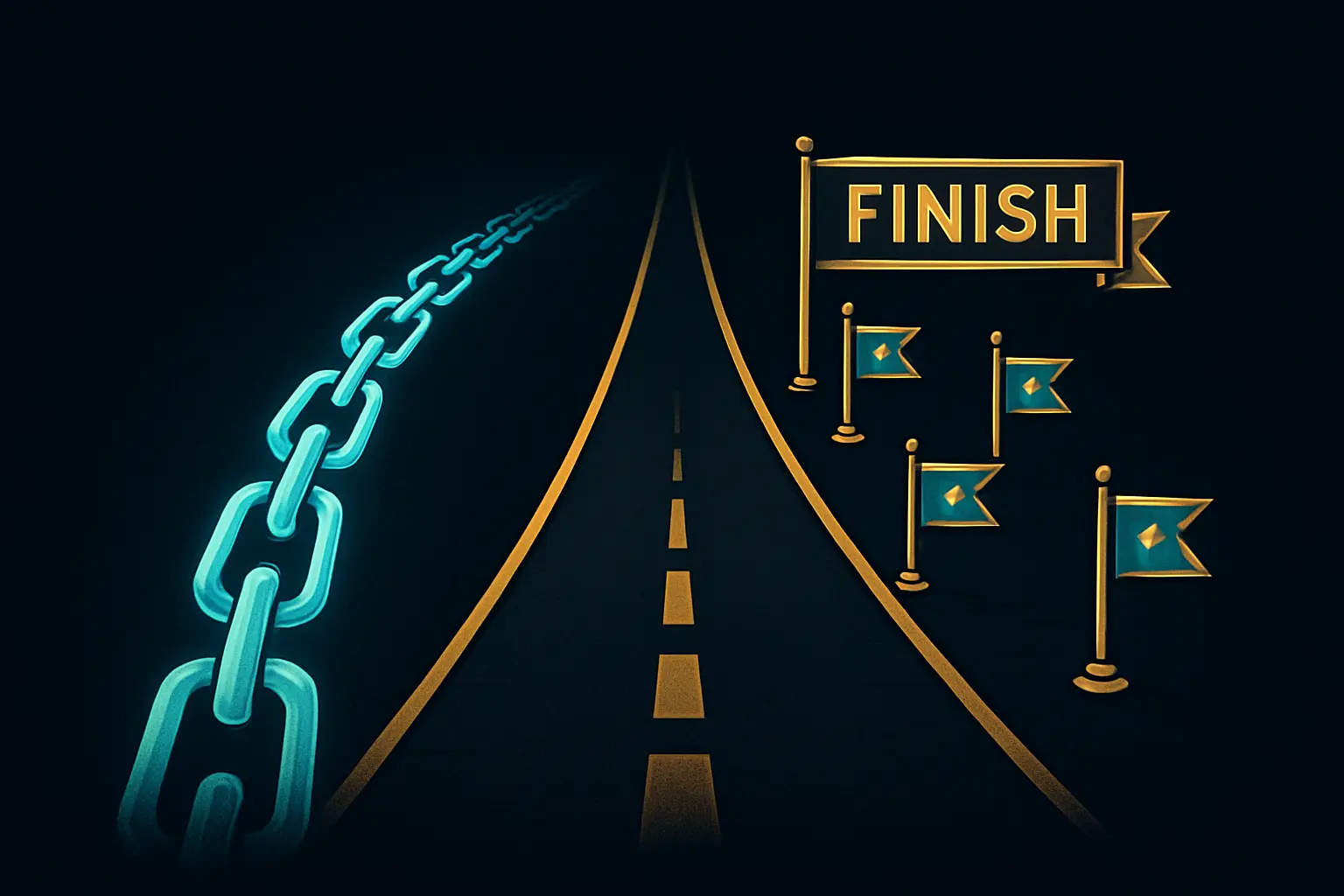
Every quit app gamifies; the interesting question is how. Two models dominate: the streak — one unbroken number that grows forever — and the challenge — a time-boxed program with daily prompts and a finish line. They pull on different psychological levers, fail in different ways, and behavior research has something to say about both. If you’re choosing a quit tool (or wondering why yours isn’t holding your attention), this is the comparison that matters.
The streak: identity in a number
What it does well. A streak converts abstinence — the absence of a behavior, psychologically invisible — into a visible, growing possession. Day 47 is a thing you have. That feeds loss aversion (the motivation to protect what’s accumulated) and, more importantly, the identity shift — “I’m a person with a streak” drifts toward “I’m a non-smoker,” which is the strongest known predictor of lasting quits.
Where it fails. Two places. First, the slip cliff: a hard reset converts one cigarette into total loss, triggering the abstinence-violation spiral — the full argument is in streak reset vs streak shield. Second, the drift: past day 60, a bare number stops generating daily engagement. It’s a monument, not a game.
The challenge: structure with a finish line
What it does well. “Never smoke again” is shapeless; “complete these 7 days” has edges. Behavioral research consistently finds proximal goals sustain effort better than distal ones, and daily prompts convert intention into default action. A challenge also offers what streaks structurally can’t: a fresh start. Blew last month? A new challenge begins clean — and fresh-start moments measurably boost behavior change.
Where it fails. The ending. Completion day delivers a badge and then… silence. Without a next structure, the post-challenge week is a documented motivation cliff. Challenges also reward doing (prompts completed) which is not identical to not smoking — a gap sloppy designs fall into.
Head to head
| Streak | Challenge | |
|---|---|---|
| Psychological lever | Loss aversion, identity | Proximal goals, structure, fresh starts |
| Best phase | Month 2 onward — the long game | Weeks 1–4 — when days need shape |
| Failure mode | Slip cliff; late-stage drift | Post-completion cliff |
| Slip handling | Catastrophic if rigid; fine with shields | Forgiving by design (next challenge) |
The answer the research points to: both, layered
The models are complements, not rivals. A streak provides the continuous identity spine; challenges provide episodic structure exactly where the quit is hardest. This is how the free iQuit app is built: a continuous streak protected by up to three slip-absorbing shields (recharged by journaling), with six time-boxed XP challenges — the 7-Day Shield through the 21-Day Habit Breaker — running on top, plus achievement badges across six categories for the collector’s itch. Week one, the challenge carries you; month three, the streak does; and a slip breaks neither.
FAQ
Do streaks actually help?
Yes — visibility, loss aversion and identity — provided a slip doesn’t zero them. Shields fix the failure mode.
Are challenges better for beginners?
For the first weeks, usually — daily prompts and a finish line beat shapeless resolve while withdrawal is loud.
What about the post-challenge motivation cliff?
Chain challenges (Shield → Habit Breaker) and keep a streak running underneath as the through-line.
Is gamification childish for something this serious?
The levers — loss aversion, proximal goals, reward acknowledgment — are the same ones cigarettes exploited 20 times a day. Reclaiming them is strategy, not decoration.
Run both engines: download iQuit free on Google Play — streak, shields and the 7-Day Shield challenge from day one.