
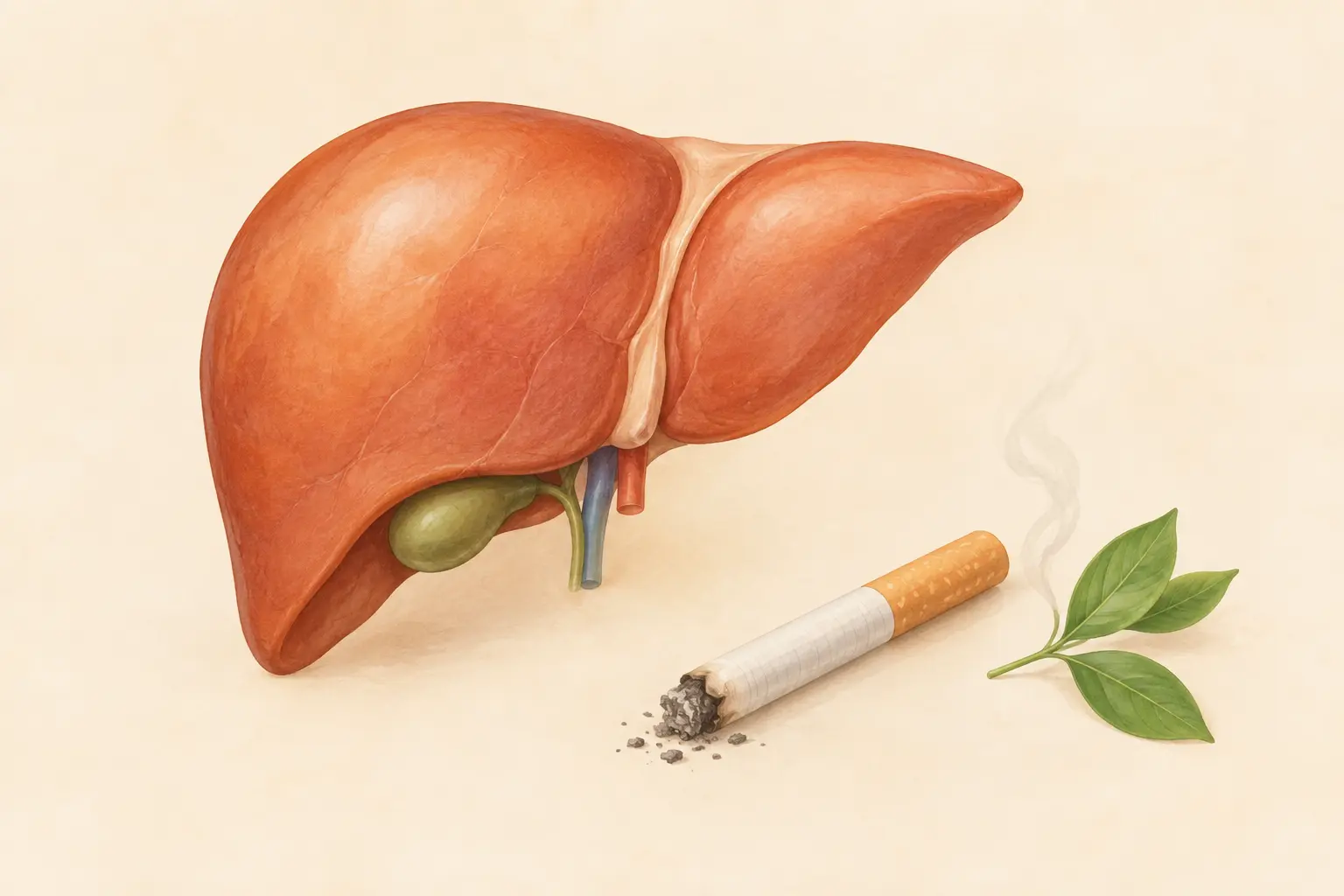
Yes, smoking affects your liver, though mostly indirectly and with more nuance than the lungs. If you are asking does smoking affect your liver, the best summary is this: a major 2022 review in the Journal of Hepatology concluded that clinical evidence shows smoking negatively affects fatty liver disease, fibrosis progression, liver cancer development and outcomes in advanced liver disease. Most of that evidence is observational, and some results, such as fatty liver after quitting, are less straightforward than you might expect. This guide walks through each one and says plainly where the evidence stops.
Short answer: yes, indirectly
The liver processes almost everything you swallow or breathe in. It also tends to fail quietly, so many people only learn about a problem from a routine blood test. The review by Marti-Aguado and colleagues notes that a history of smoking is seen in approximately 40% of patients with liver disease. It describes oxidative stress and cancer-promoting signals among the mechanisms, and concludes that smoking cessation could improve treatment response, support fibrosis regression and reduce liver cancer risk (Marti-Aguado 2022, PubMed).
Notice the wording: could improve, potential causal role. The review is cautious because much of the human evidence cannot separate smoking from other things that cluster with it, such as drinking, weight and diet. The sections below keep that caution in view.
| Question | What studies show | Main caveat |
|---|---|---|
| Fatty liver (NAFLD/MASLD) | Smoking is linked to incidence and severity | Former smokers did not have lower prevalence than current smokers in one meta-analysis |
| Fibrosis (scarring) | Linked to faster progression | Review-level evidence; no trial data in this article |
| Liver cancer | Smoking increases risk | Hepatitis B and C raise risk 12.5-fold and 11.2-fold in one umbrella review |
| Medicine processing | Tobacco smoke induces a liver enzyme (CYP1A2) | Reverses after quitting; matters for specific drugs |
Smoking and fatty liver disease
The NHS describes non-alcoholic fatty liver disease (also called metabolic dysfunction-associated steatotic liver disease, or MASLD) as a common condition where fat builds up in the liver. It usually causes no symptoms. The NHS lists things to do if you have it, including eating a balanced diet, exercising, limiting alcohol and not smoking.
The Marti-Aguado review concluded that smoking negatively impacts the incidence and severity of fatty liver disease. But a 2023 systematic review and meta-analysis in BMJ Open adds a surprise. It pooled 28 cross-sectional studies with 4,465,862 participants and found the prevalence of fatty liver in former smokers was 13% higher than in current smokers (risk ratio 1.13). The authors concluded that prevalence in former smokers was at least not lower than in current smokers, and that this was partly related to weight gain after quitting (Zhang 2023, PubMed).
How to read that surprising result
It does not mean quitting causes fatty liver. The authors themselves note that cross-sectional studies cannot establish cause. Snapshot studies like these also cannot rule out that some people quit because they were already unwell, which is one more reason to be careful with the number. What the result does suggest is that weight gain after quitting is worth managing, because excess weight is itself a fatty liver risk. The NHS lists being overweight among the main risk factors for the condition.
The practical takeaway is not to avoid quitting. It is to quit and keep an eye on food and activity at the same time. Our guide on blood sugar recovery after quitting with type 2 diabetes covers a closely related metabolic question.
The Ottawa Hospital has a short explainer from a hepatologist on how fatty liver disease is caused, diagnosed and treated.
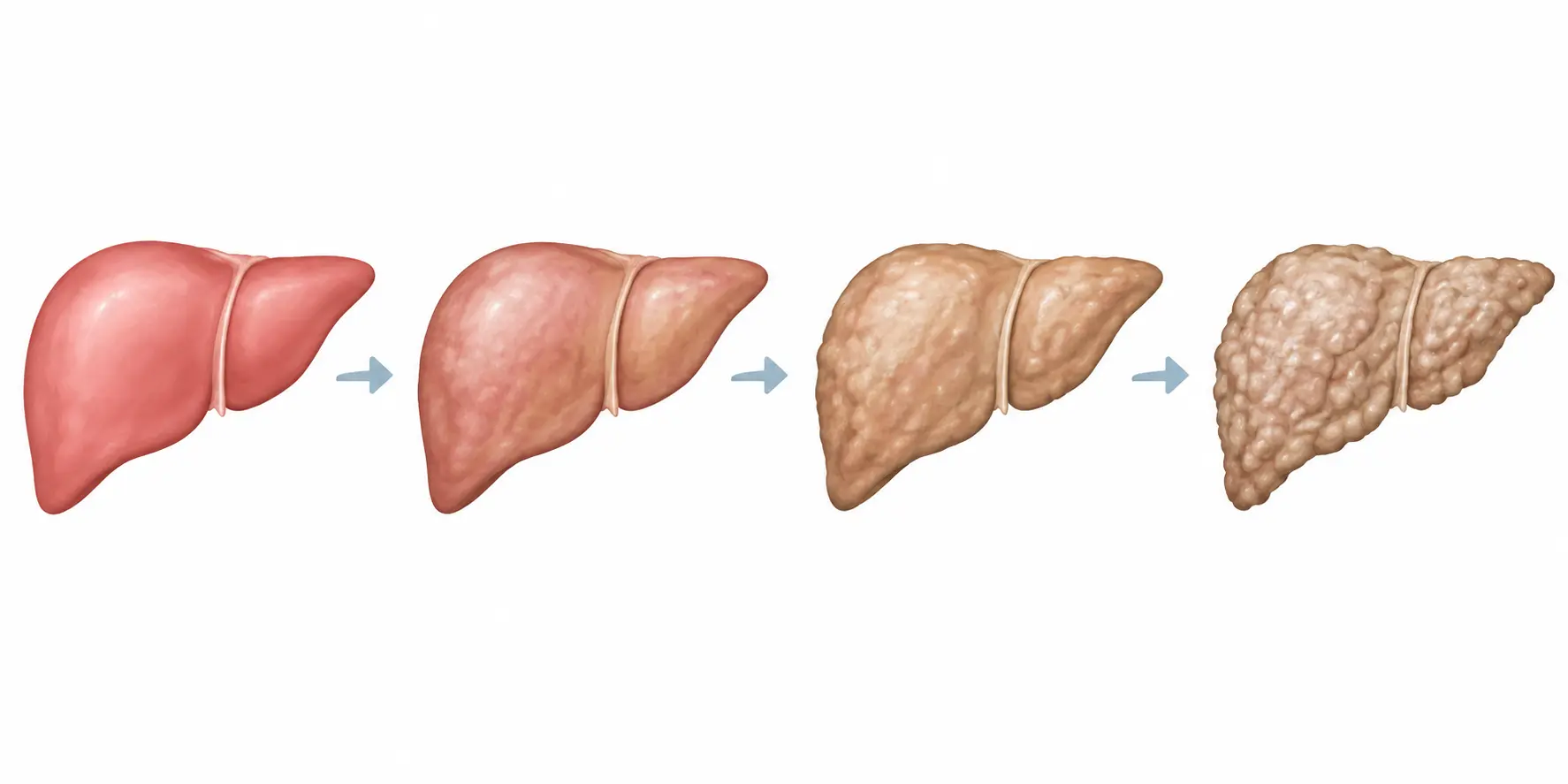
How fatty liver progresses: the four NHS stages
Understanding the stages makes the smoking research easier to place. The NHS says non-alcoholic fatty liver disease has 4 stages. Most people only have the first, which does not usually cause any problems, and a small number progress to later stages with more serious liver damage. It adds that lifestyle changes can help prevent that progression.
| Stage | What it means |
|---|---|
| 1. Fatty liver (steatosis) | Fat has built up but there is no damage to the liver |
| 2. Steatohepatitis (MASH, formerly NASH) | Fat has caused inflammation; not yet seriously damaged, but it could get worse |
| 3. Fibrosis | There is damage, but the liver usually still works well; the aim is to stop further damage |
| 4. Cirrhosis | Severe damage that affects how well the liver works |
The NHS advises that people with the condition have check-ups at least once a year and tests every 2 to 3 years to monitor it, and that anyone with fibrosis or cirrhosis needs to see a liver specialist in hospital. If you think you could have fatty liver, or you have several of the risk factors it lists, such as being overweight, having type 2 diabetes or high blood pressure, the NHS says to see a GP.
This is where smoking matters. The 2022 review links smoking with both the severity of fatty liver and the progression of fibrosis, which means the habit may push someone along the stages faster than they would otherwise travel. Because early stages produce few symptoms, the time to act is before anything hurts.
Smoking and liver scarring
Fibrosis means scar tissue replacing healthy liver tissue. Advanced fibrosis is called cirrhosis. The 2022 review concluded that cigarette smoking negatively impacts fibrosis progression in chronic liver disease, and that promoting smoking cessation could improve rates of fibrosis regression. It also notes that smoking promotes cardiovascular disease and cancers outside the liver in people with steatohepatitis and in transplant recipients (Marti-Aguado 2022, PubMed).
We could not retrieve the individual studies behind the hepatitis-specific claims, so this article does not give numbers for how much faster scarring progresses in smokers with hepatitis B or C. If you live with hepatitis or cirrhosis, your hepatology team can tell you what applies to your situation.
Liver cancer risk
The American Cancer Society states that smoking increases the risk of liver cancer. It adds that people who smoked and stopped have a lower risk than those who still smoke, but both groups have a higher risk than those who never smoked.
A 2025 umbrella review in Annals of Medicine pulled together 175 meta-analyses and 101 risk factors for hepatocellular carcinoma. It found that hepatitis B and C infections increase risk 12.5-fold and 11.2-fold, while smoking, obesity, fatty liver disease, diabetes and others also increase risk. Its conclusion highlights that lifestyle habits such as smoking and alcohol use significantly increase risk, underlining the importance of cessation (Wang 2025, PubMed).
For context, viral hepatitis is a major risk factor in that review, and many other factors contribute too. That does not make smoking harmless; it means smoking is one preventable factor among several. For the wider list of cancers, see what cancers smoking causes and the risk data.
Enzyme induction and medicines
There is another way smoking affects the liver, and it has nothing to do with disease. Tobacco smoke speeds up a liver enzyme called CYP1A2, which helps process a number of medicines. A 2024 scoping review in Frontiers in Pharmacology, written about diabetes drugs, states that the induction of CYP1A2 by tobacco smoke is clinically relevant given its role in metabolizing numerous drugs, and that the induction is reversible after cessation (scoping review, PMC).
In plain terms, if you take certain medicines, your dose may have been set while you smoked. After you stop, the enzyme settles back and the same dose can have a stronger effect. We explain which medicines are involved and why the pharmacist matters in our guide to quitting smoking and medication dose changes. Tell your prescriber or pharmacist when you set a quit date.

Smoking and alcohol
Most liver conditions have alcohol in the picture somewhere, and smoking and drinking often go together. The umbrella review lists both smoking and alcohol use as lifestyle factors that significantly increase liver cancer risk. If you drink, treating the two habits as one plan can be easier than tackling them separately, and our guide on the smoking and alcohol link explains why. Our companion article on smoking and pancreatitis covers another organ where the two combine.
What quitting changes
Here is a fair summary of what the evidence supports and does not:
- Liver cancer risk: lower in former smokers than in current smokers, according to the American Cancer Society, though not as low as in never smokers.
- Medicine processing: the CYP1A2 effect is reversible after quitting, so some dose reviews are needed.
- Scarring and outcomes: reviewers suggest cessation could help fibrosis regression and outcomes, but we found no trial numbers to quote.
- Fatty liver: quitting is advised by the NHS, but watch weight, since former smokers did not show lower fatty liver prevalence in pooled data.
For the wider timeline of benefits across the body, see our health recovery timeline data and the complete recovery guide.
The free iQuit app can help you keep going. The dashboard counts smoke-free days, cigarettes avoided and money saved, which you can set against savings goals, and it includes disease-risk insights for 11 conditions. Craving logging and SOS tools help with the hard moments. iQuit supports quitting; it does not diagnose or treat liver disease, so keep your regular check-ups.
Frequently Asked Questions
Does smoking damage the liver?
A 2022 review concluded that clinical evidence shows smoking negatively affects fatty liver disease, fibrosis progression and liver cancer development. Most evidence is observational, so it shows association rather than proof in any one person (Marti-Aguado 2022).
Does smoking cause fatty liver disease?
It is linked to worse fatty liver, but excess weight is a major driver, per the NHS. A 2023 meta-analysis of 28 cross-sectional studies found fatty liver was not less common in former smokers, partly because of weight gain (Zhang 2023; NHS).
Does smoking increase the risk of liver cancer?
Yes. The American Cancer Society says smoking increases liver cancer risk. A 2025 umbrella review found hepatitis B and C raise risk 12.5-fold and 11.2-fold, and that smoking is a preventable contributor too (American Cancer Society; Wang 2025).
Does quitting smoking lower liver cancer risk?
It appears to. The American Cancer Society says people who smoked and stopped have a lower risk than those who still smoke, but both groups have a higher risk than people who never smoked (American Cancer Society).
Can smoking change how my medicines work?
Yes, for some. Tobacco smoke induces the liver enzyme CYP1A2, which helps process numerous drugs, and the effect is reversible after quitting. Tell your prescriber or pharmacist when you stop so doses can be reviewed (PMC scoping review 2024).
Will quitting smoking reverse liver scarring?
No one can promise that. A 2022 review says promoting cessation could improve fibrosis regression, but it does not quantify this. Whether scarring improves depends on the cause and stage, so ask your liver team (Marti-Aguado 2022).
Should I worry about weight gain after quitting if I have fatty liver?
It is worth planning for. A 2023 meta-analysis linked higher fatty liver prevalence in former smokers partly to weight gain after quitting. The NHS advises a balanced diet, regular exercise and not smoking together (Zhang 2023; NHS).
Quit Smoking and Protect Your Liver
iQuit is free and shows your smoke-free days, cigarettes avoided and money saved, with disease-risk insights for 11 conditions and SOS tools for cravings. It supports your quit alongside your regular medical care.


