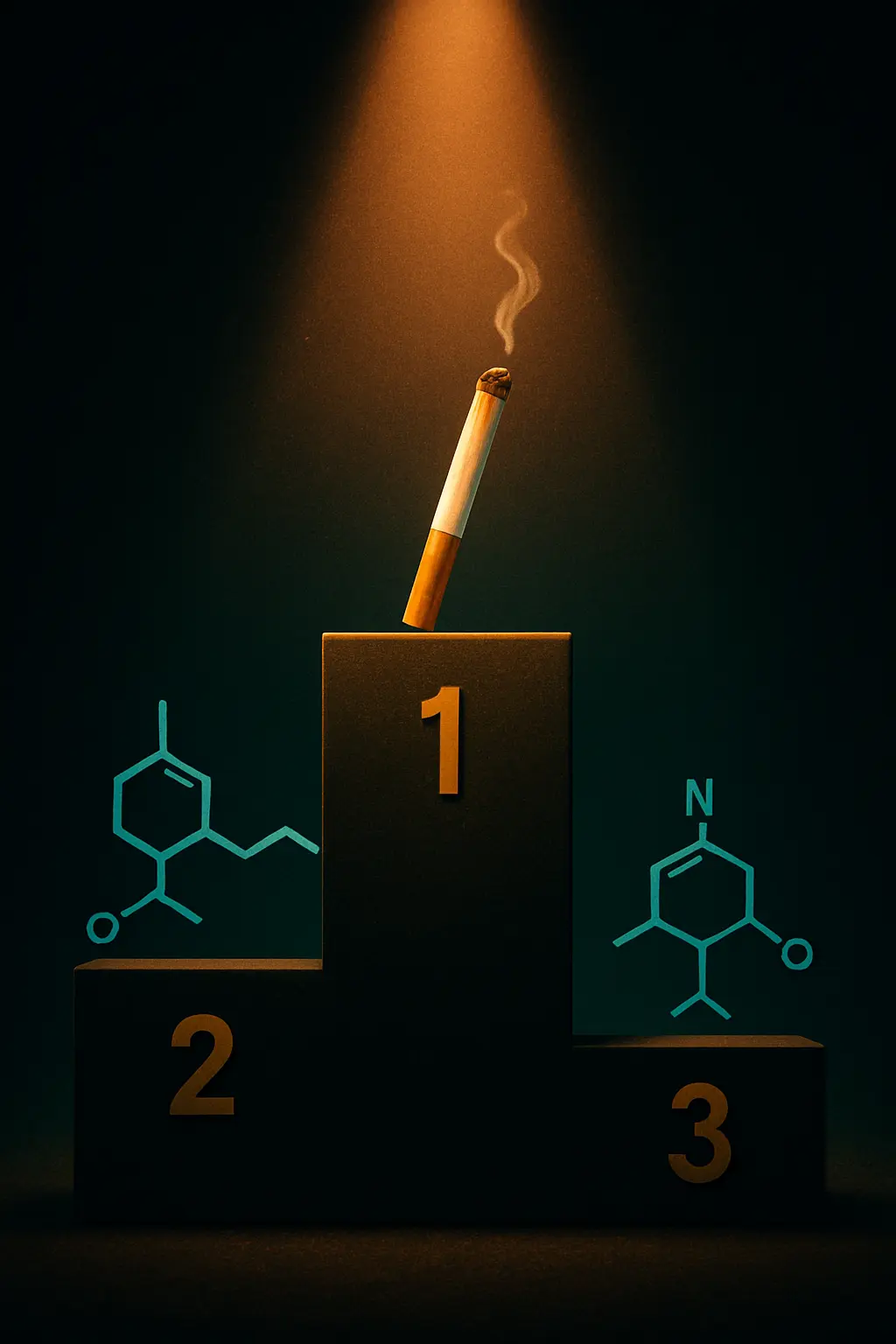
When addiction experts rank substances by grip — not glamour — nicotine keeps landing in shocking company: alongside heroin and cocaine, above alcohol, in another galaxy from caffeine. In the classic Henningfield and Benowitz assessments, nicotine topped or tied the dependence dimension: how hard it hooks, how hard it releases, how reliably users relapse. Roughly one in three people who experiment with cigarettes becomes dependent — among the highest capture rates ever measured. If you’ve struggled to quit, this page is your context: you weren’t weak; you were fighting one of the strongest dependence machines chemistry has produced.
The rankings, honestly presented
Substance-harm rankings measure different things, so precision matters. On intoxication and acute lethality, nicotine ranks low — nobody crashes a car from a cigarette, nobody overdoses on a pack. But on dependence — capture rate, withdrawal reliability, quit difficulty, relapse — the expert assessments are consistent:
| Substance | Dependence grip (expert consensus) | Capture rate (users → dependent) |
|---|---|---|
| Nicotine (smoked) | Highest tier | ~32% |
| Heroin | Highest tier | ~23% |
| Cocaine | High | ~17% |
| Alcohol | Moderate-high | ~15% |
| Cannabis | Moderate | ~9% |
| Caffeine | Mild | Common but shallow |
Capture figures from the landmark US epidemiological analyses (Anthony et al.); they vary by cohort but the ordering is robust — cigarettes convert experimenters into dependents more reliably than heroin does.
Why cigarettes specifically are the perfect trap
- Delivery speed. Smoked nicotine hits the brain in ~10 seconds — faster reward equals harder wiring, the mechanism the dopamine-loop article unpacks. Patches deliver the same molecule with a fraction of the addictiveness, and slower oral formats like snus sit somewhere in between — our look at whether snus is safer than smoking works through where it lands on both the addictiveness and health-risk questions.
- Dose frequency. A pack a day = ~200 puffs = 200 daily reinforcement events, each stamping the surrounding context as a future cue. No other substance trains its users that many times per day.
- Engineering. Ammonia chemistry to speed nicotine delivery, ventilation holes, flavor design — the modern cigarette is an optimized drug-delivery device, refined for decades.
- Social camouflage. Legal, portable, workday-compatible. Nothing interrupts the 200-rep schedule — until you try to.
What the ranking means for your quit
Three reframes fall straight out of the data. Past “failures” become normal: against a heroin-tier dependence, the multiple-attempt statistics read as expected physics, not personal defect. Tools become rational: nobody expects willpower alone to beat top-tier dependence — support roughly doubles success, and NRT/medication add more; using them is calibration, not cheating. And victory is still the norm: most Western countries now hold more ex-smokers than smokers. The strongest capture machine ever built loses millions of customers a year — to people with a plan.
Fight a heavyweight with heavyweight tools
The free iQuit app is built on precisely this premise: dependence this strong deserves engineering on the quitter’s side — craving forecasts before your trigger hours, an SOS toolkit for the peaks, slip recovery for the stumbles, and an AI coach that’s seen every round of the fight. You bring the decision; the app brings the cornermen.
FAQ
Is nicotine really heroin-tier?
On the dependence dimension, expert rankings say yes; on intoxication and overdose danger, no — its harm is chronic, not acute.
What share of smokers are addicted?
About a third of those who ever experiment become dependent — the highest capture rate measured.
Why are cigarettes worse than patches for addiction?
Speed: 10 seconds to the brain versus hours. Same molecule, different weapon.
Does high addictiveness mean quitting is hopeless?
The opposite — ex-smokers outnumber smokers. It means use real tools, not just resolve.
Bring engineering to the fight: download iQuit free on Google Play.