
How much is a pack of cigarettes in 2026? About $10.15 on average across the United States — but that single number hides an enormous range: smokers in Missouri pay around $8.01 a pack, while smokers in New York pay $14.83. The gap is almost entirely down to one thing — how much excise tax your state charges — and that gap is exactly why where you live can be the biggest single driver of what quitting would save you.
How Much Is a Pack of Cigarettes on Average in 2026?
The average retail price of a pack of cigarettes in the US is $10.15, according to the Campaign for Tobacco-Free Kids’ state cigarette tax rates and rank fact sheet (updated 25 June 2026, using Orzechowski & Walker’s Tax Burden on Tobacco data). That average sits on top of a wide spread: the least expensive state charges $8.01 a pack, and the most expensive charges $14.83 — a difference of $6.82 for the exact same product, purely because of where the sale happens.
This spread matters more than it might seem. A price difference this large changes the math on the cheapest way to quit smoking significantly — the same nicotine replacement course or app subscription pays for itself far faster for a smoker in a high-tax state than a low-tax one.
It also means “how much is a pack of cigarettes” genuinely doesn’t have one national answer. Retailers set shelf prices based on wholesale cost, competition, and local minimum-pricing laws on top of the tax layers below, so even two neighboring towns in different states can show a several-dollar gap for the identical brand and pack size. Any single average figure, including the $10.15 headline above, is a useful benchmark rather than what you’ll actually see at the specific register nearest you.
Cheapest and Most Expensive States
| State | Average pack price | State excise tax (rank) |
|---|---|---|
| Missouri (cheapest) | $8.01 | $0.17 — lowest of all 51 jurisdictions |
| Kentucky | $9.01 | $1.10 (38th) |
| West Virginia | $9.19 | $1.20 (36th) |
| Tennessee | $9.21 | $0.62 (43rd) |
| US average | $10.15 | $2.06 average state tax |
| Utah | $10.78 | $2.20 (20th) |
| California | $11.78 | $2.87 (16th) |
| Maine | $12.19 | $3.50 (8th), raised 5 January 2026 |
| Illinois | $12.37 | $2.98 (15th) |
| Massachusetts | $13.28 | $3.51 (7th) |
| Maryland | $13.47 | $5.00 (2nd) |
| Rhode Island | $13.72 | $4.50 (3rd) |
| Washington, DC | $14.03 | $4.50 (3rd) |
| New York (most expensive) | $14.83 | $5.35 — highest in the US, plus $1.50 in New York City |
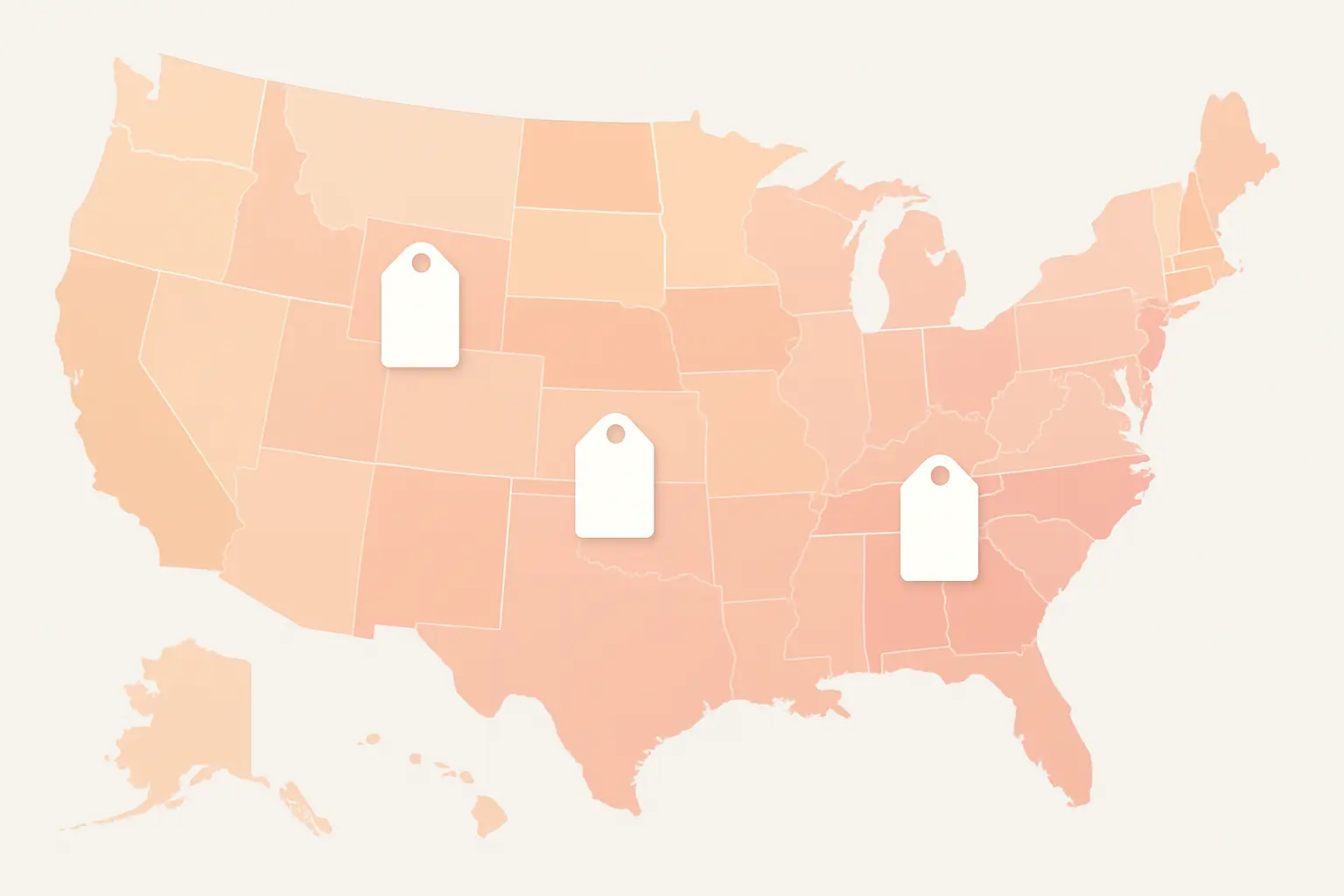
The pattern in that table is hard to miss: the four cheapest states listed all sit near the bottom of the tax rankings, and every state above $13 a pack charges at least $3.50 in state tax. Georgia has the second-lowest state tax in the country at just 37 cents a pack, and Missouri’s 17-cent rate has not been raised since October 1993, according to the Campaign for Tobacco-Free Kids’ tobacco tax research — which is a large part of why the price gap between the cheapest and most expensive states has widened rather than closed over the past three decades.
How Much of the Price Is Tax
Every US pack carries a federal excise tax of $1.01 on top of whatever the state and local governments charge, so the final shelf price is really three layers stacked together: federal tax, state tax, and — in some cities — local tax. In New York, the $5.35 state tax plus the $1.01 federal tax already accounts for more than $6 of a $14.83 pack before sales tax. In Missouri, the same federal $1.01 plus a 17-cent state tax comes to $1.18 of an $8.01 pack, so product cost and retailer markup make up the overwhelming majority of the price.

This is also why cigarette prices don’t track inflation evenly across the country. When a state raises its excise tax — as Maine did on 5 January 2026, taking its rate to $3.50 a pack and moving it to 8th highest in the country — the retail price jumps immediately and directly, independent of what tobacco itself costs to produce or distribute. Rates move in the other direction only rarely: Missouri’s 17-cent rate dates from October 1993, and Georgia’s 37 cents from July 2003. Because 48 states and DC have passed 150 separate cigarette tax increases since 2002, the state-by-state ranking above is a snapshot rather than a fixed order — a state near the middle of the pack today can move toward the high-tax end within a single legislative session.
Worth putting alongside the tax figure: the Campaign for Tobacco-Free Kids estimates nationwide smoking-caused health care costs at $20.52 per pack sold — roughly double the average retail price, and about ten times the average state tax. Whatever a pack costs at the register, it is not what a pack costs.
City and County Taxes That Stack on Top
More than 700 local jurisdictions levy their own cigarette tax on top of the state rate, and in a handful of places those local layers dominate the final price. The Campaign for Tobacco-Free Kids’ combined state-local cigarette tax ranking puts Chicago at the top: a $1.18 city tax plus a $3.00 Cook County tax plus Illinois’ $2.98 state tax comes to $7.16 per pack in combined excise tax alone, before the federal $1.01 or any sales tax. New York City is second at $6.85 ($1.50 city plus $5.35 state), and Philadelphia adds $2.00 on top of Pennsylvania’s $2.60.
- Chicago: $1.18 city + $3.00 Cook County + $2.98 Illinois = $7.16
- New York City: $1.50 city + $5.35 New York State = $6.85
- Philadelphia: $2.00 city + $2.60 Pennsylvania = $4.60
- Several Colorado towns and counties (Glenwood Springs, Carbondale, Eagle County, Summit County): $4.00 local + $2.24 state = $6.24
This is why a state-level average can still understate what you personally pay. If you buy in one of these jurisdictions, your real pack price is well above your state’s published average — and correspondingly, your savings from quitting are larger than any state-level calculator will tell you.
UK, Canada, Australia, and Ireland
Outside the US, several English-speaking countries tax tobacco even more aggressively as a deliberate public health lever. The UK combines a fixed duty per cigarette with an additional percentage of the retail price, so tax accounts for the large majority of what a UK smoker pays for a typical 20-pack — pushing UK prices well above the US national average in most side-by-side comparisons. Canada and Ireland both layer federal and provincial or national tobacco duties on top of VAT/GST, and Australia has repeatedly raised its tobacco excise specifically as a quit-smoking lever, making it consistently one of the most expensive countries in the world to buy cigarettes.
If you want the full annual personal-spending picture rather than just the per-pack price, the true cost of smoking per year by country breakdown covers what that adds up to across a full year in each of these markets.
Why Price Rises Trigger Quit Attempts
Public health research consistently finds that raising the price of cigarettes reduces both how much current smokers consume and how many people smoke at all — and that younger smokers and lower-income smokers respond most strongly to a price increase, because a bigger share of their income is on the line with every pack. This is a large part of why tobacco excise tax is one of the most-used levers in tobacco control policy worldwide: it is one of the few interventions that changes behavior automatically, without requiring the smoker to seek out help first. The World Health Organization’s tobacco fact sheet lists raising taxes among the core measures countries use to drive tobacco use down.
The WHO explains the same logic behind health taxes on tobacco in this short briefing.
In practice, a state tax increase (like Maine’s January 2026 jump to $3.50 a pack) or a personal cost shock — a new baby, a rent increase, simply doing the weekly math — is one of the most common triggers that pushes a smoker from “thinking about quitting” to actually setting a date. If a price jump is what got you here, the quit smoking money saved calculator turns your specific state’s price into a running daily, weekly, and yearly savings total.
What a Pack-a-Day Habit Costs at Your State’s Price
Multiply your state’s per-pack price by 365 and the number gets uncomfortable fast. At the national average of $10.15, a pack-a-day habit runs about $3,705 a year. In Missouri, at $8.01 a pack, the same habit costs roughly $2,924. In New York, at $14.83, it climbs to about $5,413 — a $2,489 annual difference for the identical habit, before factoring in any of the smoking-related healthcare costs that tend to show up later. The exact figure for your own habit, brand, and state is best worked out with the real numbers on money saved when you quit, which breaks the math down by country and brand rather than a single national average.
Where the price gap by state matters most is in how fast quitting pays for itself. A month of nicotine patches or a year of Premium app access costs a fixed dollar amount regardless of where you live — but in a high-price state, that fixed cost is recovered in days; in a low-price state, it takes a little longer, though it still pays for itself well within the first month for most smokers. Smoking prevalence itself also varies enormously by smoking rates by state, and price is one of the clearest reasons why: the states with the cheapest cigarettes in the table above are, almost without exception, also the states where the most people still smoke.
Frequently Asked Questions
How much does a pack of cigarettes cost in 2026?
The average price of a pack of cigarettes in the US is $10.15, according to the Campaign for Tobacco-Free Kids (June 2026, using Orzechowski & Walker Tax Burden on Tobacco data). Prices vary widely by state because of differing excise taxes, from $8.01 in Missouri to $14.83 in New York.
What state has the cheapest cigarettes?
Missouri has the lowest cigarette prices in the country at about $8.01 a pack, driven by its excise tax of just 17 cents — the lowest of any state, unchanged since October 1993 — according to the Campaign for Tobacco-Free Kids. Georgia has the second-lowest state tax, at 37 cents per pack.
What state has the most expensive cigarettes?
New York has the highest cigarette prices in the US at about $14.83 a pack, with a state excise tax of $5.35 — the highest in the nation — plus an additional $1.50 local tax in New York City. Washington, DC ($14.03) and Rhode Island ($13.72) are next, both charging $4.50 in state-level excise tax.
How much of the price of a pack of cigarettes is tax?
It depends heavily on the state. Every pack carries a federal excise tax of $1.01. On top of that, the average state tax is $2.06, ranging from 17 cents in Missouri to $5.35 in New York. In New York City, state plus city excise tax alone comes to $6.85 a pack, before the federal tax or sales tax (Campaign for Tobacco-Free Kids, 2026).
Which US city has the highest cigarette tax?
Chicago, at $7.16 per pack in combined state and local excise tax: $1.18 in city tax, $3.00 in Cook County tax, and $2.98 in Illinois state tax. New York City is second at $6.85. Neither figure includes the $1.01 federal excise tax or any sales tax (Campaign for Tobacco-Free Kids, 2026).
Are cigarettes more expensive in the UK than the US?
Generally yes. The UK taxes tobacco through a combination of a per-cigarette duty and a percentage of the retail price, and tax makes up the large majority of what a UK smoker pays per pack — pushing typical UK pack prices well above the US national average of $10.15.
Does a higher cigarette price actually make people quit?
Public health research consistently finds that price increases reduce both the number of cigarettes smoked and the smoking rate, with the effect strongest among younger smokers and lower-income smokers, who are more sensitive to price changes than long-term heavier smokers. That is why tobacco excise tax is one of the most-used tobacco control levers worldwide.
See What Your State’s Price Is Actually Costing You
iQuit’s free money tracker uses your local pack price and habit to show exactly what you’re spending — daily, weekly, and yearly — and what quitting gets back, from day one. iQuit is free on Google Play and the App Store.