

If you vape, you already know it isn’t free — but most vapers have never actually run the numbers. How much money do you save quitting vaping depends almost entirely on what you vape (disposables burn through cash fastest) and how often, so this guide builds the real math from current retail prices rather than a single guess, and gives you a weekly, monthly, yearly and five-year total for four common usage patterns.
What Vaping Actually Costs: Disposables vs Pods vs Refillable
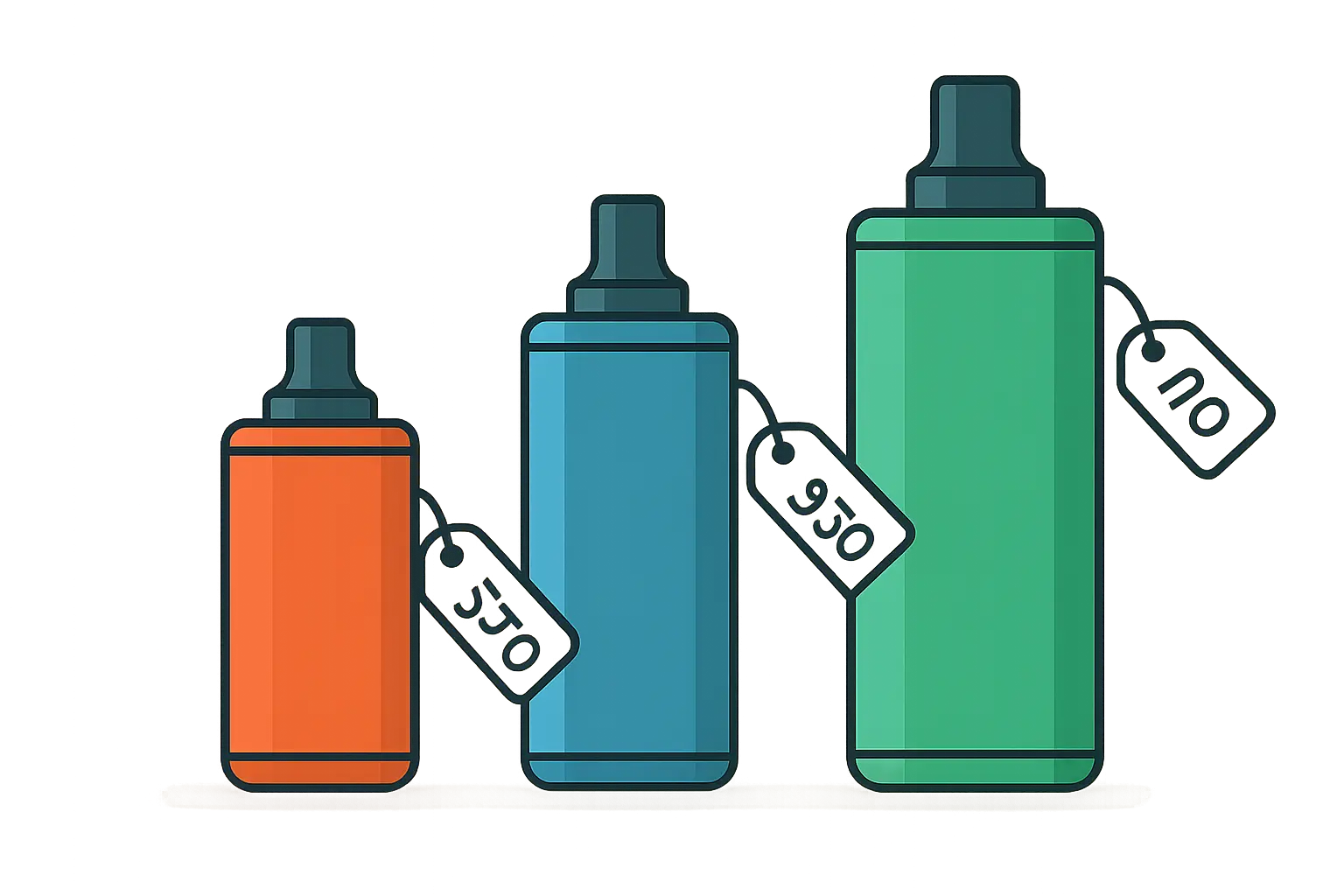
Every vaping cost article on this site until now has worked in cigarette-pack units. Vapers spend differently, so the units have to change too. Retail pricing gathered this month from vaping industry pricing guides and retailer price breakdowns puts disposables in three practical bands:
- ~5,000-puff disposables (e.g. Lost Mary BM5000): roughly $10–$14 each.
- ~10,000-puff disposables (e.g. Oxbar, SKE Crystal): roughly $13–$18 each.
- ~20,000-puff disposables (e.g. Geek Bar Pulse X): roughly $16–$25 each.
Refillable “open pod” systems work differently: you pay $20–$40 once for the device, then buy 30ml bottles of nicotine salt e-liquid at roughly $10–$18 each as you go — live listings from a major US e-cigarette retailer show entry-level devices from $9.99 to about $20. There is no single “average vape spend” published by any health body, so every figure below is built from these named retail ranges, not a manufacturer or government average — treat it as illustrative, not exact.
Prices also move with capacity, not just brand name. A 600-puff disposable — the smaller, pocket-sized style that was common a few years ago — is now the cheapest option on the shelf at roughly $6–$8, while the newest 40,000-plus-puff devices sit at the top of the market around $20–$30. Most vapers who buy “whatever’s at the counter” end up somewhere in the middle of this range without ever comparing it to what a smaller or larger device would have cost for the same number of puffs, which is one reason two people who vape “about the same amount” can have very different monthly bills.
Work Out Your Own Number in 60 Seconds
You don’t need the totals below if you’d rather do this yourself:
- Count what you actually go through in a week — devices, pods, or bottles, not what the label says “should” last.
- Multiply by the real price you pay (not the manufacturer’s list price — check your last few receipts or the retailer app).
- Multiply that weekly figure by 52 for a year, or by 260 for five years.
If you’d rather not do the arithmetic by hand, iQuit’s built-in money-saved dashboard does exactly this calculation automatically once you enter your own device and price — more on that in the tracking section below.
Two counting mistakes are worth avoiding. The first is using the manufacturer’s advertised puff count instead of how long a device actually lasts you — puff counts are measured under standardized lab conditions that rarely match real inhaling habits, so a device rated for 5,000 puffs might realistically last you four days instead of a week. The second is forgetting to count devices you buy but don’t finish; a half-used disposable left in a drawer is still money spent, even if it isn’t money “used.”
Weekly, Monthly, Yearly and Five-Year Totals
Using the midpoint of each price band above, here is what four common usage patterns cost. “Refillable” assumes two 30ml bottles a week and treats the device cost as spread over its first eight weeks of use.
| Usage pattern | Week | Month | Year | 5 years |
|---|---|---|---|---|
| Light (1× ~5,000-puff disposable/week) | $12 | $52 | $624 | $3,120 |
| Average (2× ~5,000-puff disposables/week) | $24 | $104 | $1,248 | $6,240 |
| Heavy (1× ~20,000-puff disposable every 4 days) | $36 | $155 | $1,866 | $9,328 |
| Refillable pod system (2× 30ml e-liquid/week + device) | $32 | $137 | $1,651 | $8,255 |
Two things stand out. First, “average” disposable use already crosses $1,000 a year — a number most vapers underestimate because each purchase feels small. Second, a refillable system isn’t automatically cheaper than disposables at moderate use; it only wins clearly against heavy disposable use, and only if you actually use the bottles you buy rather than letting them sit half-finished.
It also helps to see the five-year figure next to something concrete rather than as an abstract lump sum. At the “average” usage row, $6,240 over five years is roughly the price of a reliable used car, or several years of a modest emergency fund built one week at a time. At the “heavy” row, $9,328 starts to approach a year of rent in many mid-sized US cities. None of these totals require quitting overnight to matter — even cutting a heavy disposable habit down to the “average” row saves close to $600 a year without eliminating vaping entirely, which is one reason a gradual reduction plan can still produce a meaningful number long before a full quit date.
Vaping vs Smoking: Which Costs More
Vapers who switched from cigarettes sometimes assume they’ve already solved the cost problem. That isn’t guaranteed — it depends on your pack price and your vaping pattern. In high-tax cigarette markets, even a moderate disposable habit can end up cheaper than smoking; in lower-priced cigarette markets, a heavy disposable habit can quietly cost more than the pack-a-day habit it replaced. The comparison only works if you use your own real numbers on both sides, not a generic “vaping is cheaper” assumption.
For a side-by-side breakdown using the same real-price method for cigarettes, see is vaping cheaper than smoking. If you smoked before you vaped, the cigarette-based savings math in how much money do you save when you quit smoking uses the same weekly-to-five-year structure as this page, just built from pack prices instead of device prices — useful if your own history includes both habits and you want one consistent comparison rather than two different methodologies.
Hidden Costs: Devices, Coils, Chargers, Replacements
The prices above only cover consumables. Vapers on refillable systems also replace:
- Coils — used inside refillable tanks and pods, typically replaced every 1–3 weeks depending on use, at a few dollars each.
- Chargers and cables — lost or damaged USB-C cables are a recurring small cost that rarely gets counted.
- Device replacement — batteries degrade; most open-system devices are realistically replaced every 6–18 months, not kept indefinitely.
- Accessories — cases, drip tips and spare batteries add up in small increments that don’t show on a per-device price tag.
None of these are large individually, but they are exactly the kind of cost that disappears from a mental estimate and reappears in a bank statement. A reasonable rule of thumb: budget an extra 10–15% on top of the device or e-liquid totals above to cover the accessories you’ll inevitably replace, rather than assuming the sticker price on your main purchase is the whole story.
There’s also a behavioral cost that doesn’t show up on any receipt. Multiple small purchases spread across a month are psychologically easier to ignore than one large annual bill would be — a $12 disposable feels trivial in the moment, even though 104 of them a year does not. Seeing the annualized total in one place, rather than as a string of small transactions, is often what actually changes someone’s mind about their spending, independent of any health consideration.
What the Money Is Worth Over a Year
Numbers on a page are abstract; a year of an average $1,248 disposable habit is a flight plus spending money, several months of a car payment, or a meaningful dent in a credit card balance. A heavier $1,866-$2,000-a-year habit is close to a used-car down payment. The exact comparison matters less than picking one specific thing you actually want — vague “savings” rarely survive a bad week, but a named goal tends to.

Tracking It So the Number Keeps Working
The hardest part of vaping-cost math isn’t the arithmetic, it’s remembering to update it. iQuit‘s real-time money-saved dashboard tracks days smoke-free, devices avoided and money saved in your own currency from the moment you set your quit date and your own device cost — no need to re-run the calculation weekly. It pairs with savings goals, so the number in the app can point at the same “flight” or “down payment” goal above rather than sitting as an abstract total. iQuit is free to download on both the Google Play and App Store.
If disposables specifically are your main habit, the step-by-step plan in how to quit disposable vapes covers the practical side of stopping, while how to quit vaping step by step covers refillable and pod systems too. If you’re using an app to support the quit itself rather than just the math, how iQuit supports vape cessation covers the craving-support side. For context on how common vaping is right now, vaping statistics 2026 has current prevalence and quit-rate data, including that 60% of current adult vapers in Great Britain are ex-smokers, not people who started with vaping.
Frequently Asked Questions
How much does the average vaper spend per year?
There is no official “average vaper spend” figure published by a health body. Based on current US retail prices for disposables (vaping industry pricing guides, 2026), a moderate two-disposables-a-week habit runs about $1,250 a year; a heavier habit or daily refillable use can reach $1,650-$1,900 a year. Your own number depends entirely on your device and how often you replace it.
Is a refillable pod system cheaper than disposables?
Only at heavier usage levels. At light-to-moderate use, disposables and a two-bottle-a-week refillable habit land in a similar cost range once the device price is amortized. Refillable systems pull ahead of heavy disposable use, where a $16-$25 disposable every few days adds up faster than 30ml e-liquid bottles at $10-$18 each (retailer pricing, 2026).
Is vaping cheaper than smoking cigarettes?
It depends on both habits. A light disposable-vape user can spend less than a pack-a-day cigarette smoker, but a heavy disposable habit or a two-pod-a-day refillable habit can cost as much as smoking, sometimes more. Run both numbers with your own real prices rather than assuming vaping is automatically cheaper — see the full comparison in is vaping cheaper than smoking.
What hidden costs do vapers usually miss?
Coil replacements, charging cables, and periodic device replacement are the three most commonly missed costs on a refillable system. None are large individually — typically a few dollars at a time — but because they don’t appear on the headline “per bottle” or “per device” price, they are easy to leave out of a mental cost estimate.
How do I calculate my own vaping cost accurately?
Count what you actually buy in a typical week (not the label’s estimated lifespan), multiply by what you actually paid on your last few receipts, then multiply the weekly figure by 52 for a year. Manufacturer puff-count estimates are usually optimistic, so a receipt-based count is more accurate than a device-label estimate.
Does quitting vaping save money even after buying NRT or an app?
Yes for most usage levels. iQuit is free to download, so it adds no cost to the comparison. Nicotine replacement therapy has its own cost, but NRT is typically used for a limited number of weeks, while vaping costs recur indefinitely — so even a moderate vaping habit’s annual cost (around $1,250 at the usage levels modeled above) usually outweighs a short course of NRT.
See Your Own Vaping Savings Add Up in Real Time
iQuit’s free money-saved dashboard tracks your real device cost automatically from your quit date, in your own currency, alongside craving support and health milestones — free on Google Play and the App Store.
Download iQuit Free on Google Play
Download on the App Store