Nobody plans to quit smoking on three hours of broken sleep. If you are looking for how to quit smoking with a newborn in the house, you are attempting the hardest thing at the worst moment, and you know it. This guide is written for that, not for a version of you with time and a clear head.
There is no lecturing in it. You are already doing the thing that matters most, which is taking it seriously. What follows is what the NHS and the American Academy of Pediatrics actually say about smoke and babies, and a plan that survives a night feed.
Why now is harder, and better, than any other time
Harder is obvious: no sleep, no routine, no spare capacity, and a stress level that would make anyone reach for something familiar. Better is less obvious but real. The reason to quit is in the room, the old routine has already been demolished, and most of the usual cues have gone with it. The coffee at the desk, the drive to work, the Friday drink: none of them are happening right now anyway. That is an unusual opening.
The NHS is also clear that it is not too late to matter. Stopping smoking once your baby is born still helps protect them against sudden infant death syndrome, breathing problems, ear infections and hearing loss, and behavioral problems. The same page says you are up to 3 times more likely to stop successfully with NHS support; your midwife, health visitor or GP can refer you, and the helpline is 0300 123 1044.
Secondhand and thirdhand smoke with a newborn
This is the part most people think they solved by smoking outside. The actual wording is more demanding than the folk version.
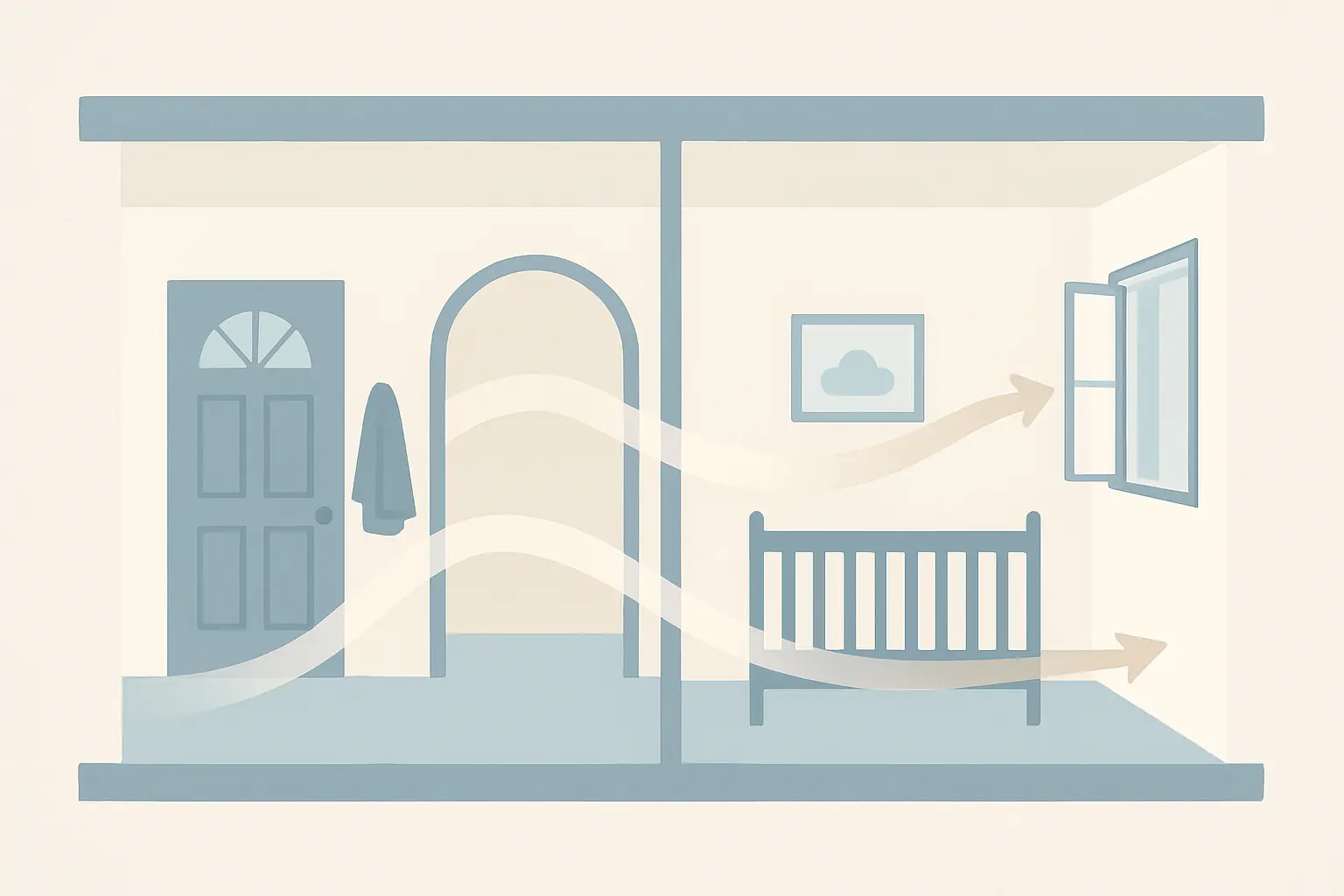
The NHS describes secondhand smoke as a lethal cocktail of more than 5,000 irritants, toxins and cancer-causing substances, most of it invisible and odorless. It states plainly that opening windows and doors, or smoking in another room, does not protect people, and that smoke can linger for hours even with a window open. Children are more affected because their airways, lungs and immune systems are less developed, and those in a household where someone smokes are more likely to develop asthma, chest infections like pneumonia and bronchitis, meningitis, ear infections, and coughs and colds.
Then there is the residue. The NHS puts it in one sentence: even if you smoke outside, chemicals from the smoke can stay on your clothes and affect the people around you. The American Academy of Pediatrics gives that a name, saying its research found thirdhand smoke is also harmful: the toxins left behind where people have smoked, found in walls, in car upholstery, or in a child’s hair after a caregiver smokes near them. The same page adds that children whose parents smoke only outside are still exposed, and that the best way to eliminate it is to quit.
That gives you a hierarchy rather than a pass or fail:
| Step | What it does | What it does not do |
|---|---|---|
| Quitting completely | Removes the exposure at source, including the residue on clothes and furniture | Nothing left over |
| Nobody smokes indoors or in the car, ever | Removes the largest and most concentrated exposure | Does not remove residue carried in on clothes and hair |
| Smoking outside only, changing the outer layer afterwards | Reduces what comes back in on clothing | Does not remove it, and does not address hair or skin |
| Smoking in another room with a window open | Very little; the NHS says this does not protect people | Does not stop smoke spreading through the house or lingering for hours |
Two rules follow, worth saying out loud to everyone in the house: nobody smokes indoors, and nobody smokes in the car. In the UK the car rule is also the law, banned since 2015 in any private vehicle carrying someone under 18. Our guide to the health risks of secondhand smoke and the data on exposure go further.
Smoke, sleep and what the NHS says about SIDS
This section stays close to the source, because scaring people helps nobody and vague advice helps nobody either.
The NHS says the cause of sudden infant death syndrome is not known, but that certain things can increase the risk, including exposing a baby to cigarette smoke or sleeping with them on a sofa or chair. It is more likely in the first 6 months, and can affect babies up to 12 months old.
Its advice for anyone who smokes, or lives with a smoker, is specific:
- Do not smoke around your baby, and do not let anyone smoke in the same room as your baby.
- Do not share a bed with your baby if you or your partner smoke, drink alcohol, or take drugs or medicine that make you drowsy. The NHS breastfeeding pages repeat this, adding that co-sleeping is known to increase the risk of SIDS.
- Do not sleep on a sofa or in an armchair with your baby. This is the one that catches exhausted parents during night feeds.
The rest of the NHS safer-sleep advice applies whether or not anyone smokes: baby on their back, feet to the foot of the cot, a separate cot or Moses basket in your room for every sleep for at least the first 6 months, a firm flat mattress, nothing in the cot that could cover their face, and a room between 16C and 20C.
This short film from an NHS trust walks through safer sleep for a newborn.
The 3am feed and the cigarette that used to go with it
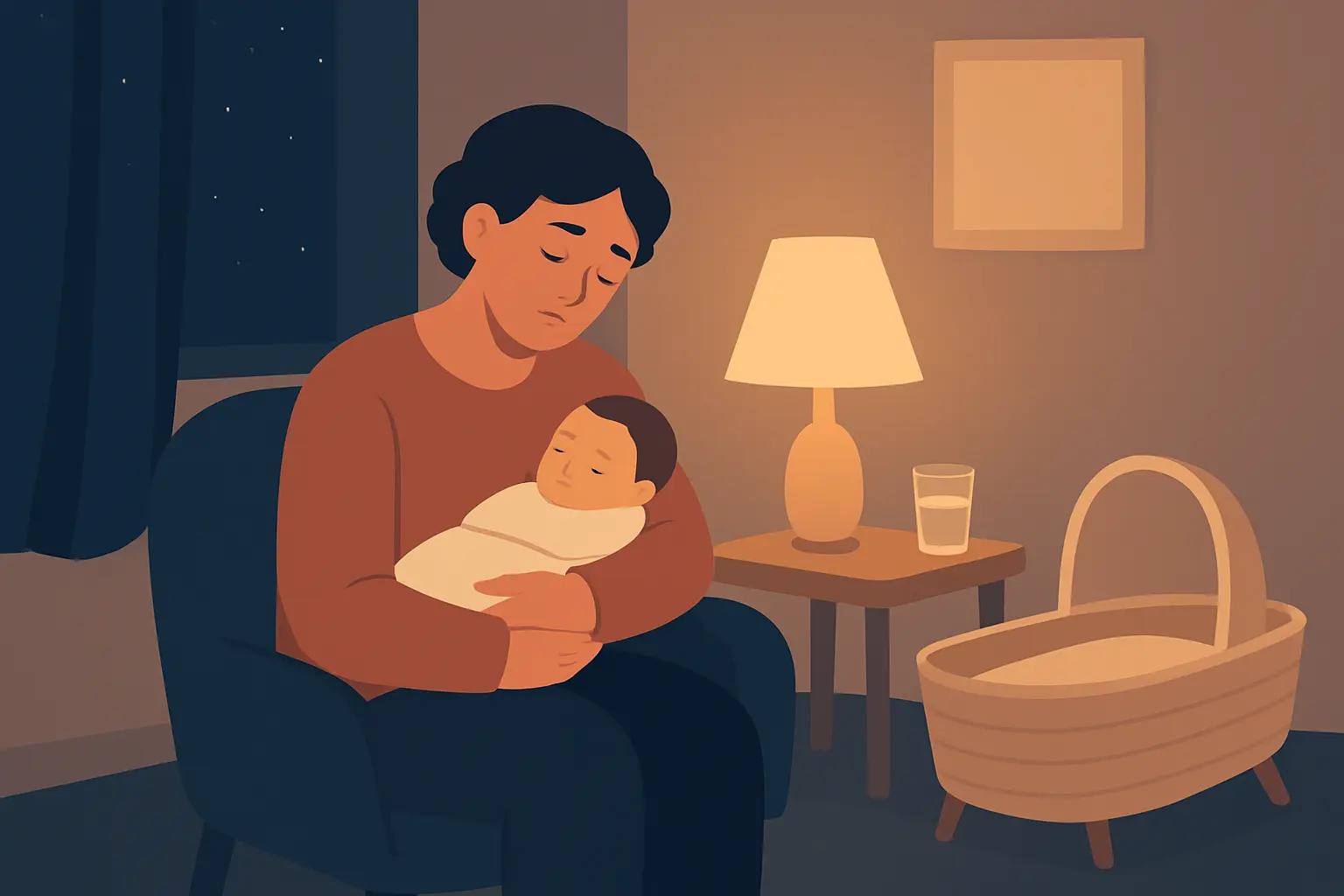
Almost every parent who smokes has the same story. The house is silent, the baby has finally settled, you are awake anyway, and five minutes outside is the only thing in the day that belongs to you. Do not try to beat that with willpower at 3am. Decide what happens instead now, while you can think:
- Put the fast-acting product where the packet used to live, beside the chair you feed in, not in a drawer downstairs.
- Keep the five minutes. Step outside without smoking, or stand at an open door. The break was never only about nicotine, and deleting it makes the night worse.
- Give your hands and mouth something. Water, a warm drink, gum. The hand-to-mouth habit is separate from the nicotine, and at 3am it is often the louder one.
- Have a two-minute technique ready. Our guide to grounding exercises that calm cravings in minutes covers things you can do one-handed while holding a baby.
- Do not go back to sleep on the sofa. Whatever you do with the craving, that rule is separate and it is not negotiable.
This is where an app earns its place, because at 3am there is nobody to tell. iQuit logs each craving with its trigger and intensity, counts the days and the money, and its SOS craving tools work offline and one-handed. It is free on Google Play and the App Store.
Quitting on no sleep: what to lower your expectations to
Most quit advice assumes a functioning adult with a routine. You have neither, and pretending otherwise is how people conclude they have failed. So change the unit: not a smoke-free month, but a smoke-free next hour, then the one after that.
- Drop everything optional. No new exercise plan, no diet, no life admin. This is the one thing.
- Do not taper your NRT while sleep-deprived. Stay where you are and step down when the baby sleeps longer.
- Eat and drink on a schedule. Hunger and thirst are indistinguishable from a craving when you are this tired.
- Take the phone appointment. Local NHS stop smoking services are free, and where you cannot attend in person you may be able to join by phone or online.
- Count differently. Seven separate hard hours you got through is a good week, whatever the calendar says.
And if you slip, that is information, not a verdict. Note which hour it was, put the patch on in the morning, and carry on. The one thing not to do is decide the whole attempt is over, because with a newborn the next clear-headed moment to restart may be months away.
NRT and breastfeeding, briefly
This question stops a lot of parents before they start, so here is what the NHS says, in its own terms.
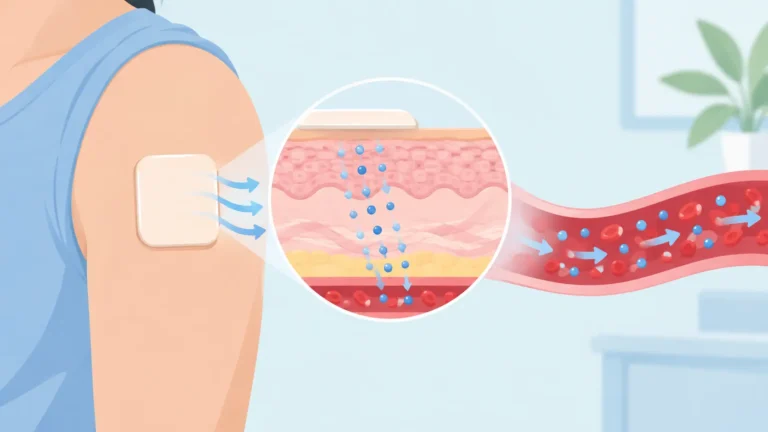
A small amount of nicotine from NRT passes into breast milk, but less than from smoking, and NRT is a safer choice than exposing your baby to secondhand smoke. It increases your chance of quitting, especially alongside support from your local service, and it is free with a prescription while you are pregnant and for a year after the birth, in formats including patches, gum, lozenges, nasal spray and inhalators. The tablets bupropion, cytisinicline and varenicline are not usually recommended if you are breastfeeding.
Two more things from the same page: if you are finding it hard to quit, it is important not to stop breastfeeding, and if you do smoke, avoid smoking before a feed to limit the nicotine in your milk.
For the detail, see our dedicated article on nicotine patches and gum while breastfeeding and our comparison of NRT options. Ask your midwife, health visitor, pharmacist or stop smoking adviser first, because they can match the format to your feeding pattern.
When your partner still smokes
A quit inside a household with one smoker left is a different problem, and it is worth treating as shared logistics rather than a moral question. What to agree, ideally this week:
- Nobody smokes indoors or in the car. Not by a window, not in the bathroom, not in the doorway.
- An outer layer comes off before picking the baby up, and hands get washed. That is about the residue the NHS and AAP describe, not fussiness.
- Cigarettes live out of your line of sight and are never offered to you, even as a joke.
- Neither of you bed-shares if either of you smokes. The NHS advice covers both parents.
- They get the helpline number too. Two people quitting is easier than one quitting next to a smoker.
Our guide to quitting when you live with a smoker covers the harder version of this conversation, including what to do when they are not ready.
Visitors, grandparents and the house rule
The first weeks bring a stream of people through the house, some of whom smoke and most of whom want to hold the baby. An explicit rule saves you twenty awkward conversations. Say it once, early, to everyone, in the same words: our house and car are smoke-free, and if you have had a cigarette please wash your hands and let a layer come off before a cuddle. Put it in the group message with the visiting times so it is not a confrontation at the door. A few things make it land better:
- Make it a rule about the house, not a judgement about the person. It applies to everyone, including you.
- Give the reason once. Smoke lingers for hours and residue travels on clothes; most people have never been told.
- Have somewhere for them to go. A step, a garden, an ashtray by the gate. A rule with nowhere to comply gets broken.
- Vaping counts as indoors too. The NHS says the risks of passive smoking with cigarettes do not apply to e-cigarettes and that any risk to bystanders appears small, but adds that as a precaution it is best not to vape around babies and children.
The first two weeks, realistically
Here is what a realistic fortnight looks like.
| When | The only jobs |
|---|---|
| Before you stop | Make the house and car smoke-free. Tell your midwife or health visitor you want to quit and ask for the local service. Get your NRT in the house. |
| Days 1 to 3 | Expect the worst of it now. Keep the night break, without the cigarette. Do nothing else. |
| Days 4 to 7 | Fix the specific hour that keeps catching you. Send the house rule to visitors. Take the phone appointment with the stop smoking service. |
| Week 2 | Do not step down your NRT yet. Add one small thing back: a walk with the pram at the hour you used to smoke. |
| Throughout | Eat, drink water, and accept help with anything that is not the baby or the quit. |
Two weeks in you will not feel finished, and that is normal. What you will have is a smoke-free house, a baby whose exposure is a fraction of what it was, and a quit old enough to be worth protecting. For the bad nights, keep our quit smoking motivation quotes on your phone.
Quitting With a Newborn FAQ
Is it safe to smoke outside and then hold my newborn?
It is much better than smoking indoors, but it is not exposure-free. The NHS says chemicals from smoke can stay on your clothes and affect people around you, and the American Academy of Pediatrics says children whose parents smoke only outside are still exposed, and that the best way to eliminate it is to quit (NHS, AAP).
Does opening a window make smoking indoors safe?
No. The NHS states that opening windows and doors, or smoking in another room, does not protect people, and that smoke can linger in the air for hours after a cigarette even with a window open. Limiting it to one room still lets smoke spread through the house (NHS).
What is thirdhand smoke?
The American Academy of Pediatrics describes it as the smoke left behind, the harmful toxins that remain where people have smoked, which can be found in walls, in car upholstery, or in a child’s hair after a caregiver smokes near them. The AAP says its research found thirdhand smoke is also harmful (AAP).
Can I use nicotine patches while breastfeeding?
The NHS says a small amount of nicotine from NRT passes into breast milk, but less than from smoking, and that NRT is a safer choice than exposing your baby to secondhand smoke. It is free on prescription while pregnant and for a year after the birth. Ask your midwife, health visitor or pharmacist which format suits you (NHS).
Should I stop breastfeeding if I cannot quit?
No. The NHS is direct about this: if you are finding it hard to quit smoking, it is important not to stop breastfeeding, because breastfeeding still protects your baby from infections and provides nutrients they cannot get from formula. It also advises avoiding smoking before a feed (NHS).
Can I bed-share if I have quit but my partner still smokes?
The NHS advice is not to share a bed with your baby if you or your partner smoke, so it covers both of you rather than only the person smoking. It also says never to sleep on a sofa or in an armchair with your baby, which is the one exhausted parents most often do by accident (NHS).
Is vaping around a baby acceptable?
The NHS says the risks of passive smoking with cigarettes do not apply to e-cigarettes, and that the limited evidence available suggests any risk to bystanders is small relative to tobacco. It also says that as a precaution it is best not to vape around babies and children, partly because young children copy adults (NHS).
Is it too late to quit now that the baby is born?
No. The NHS says stopping smoking once your baby is born still helps protect them against sudden infant death syndrome, breathing problems, ear infections and hearing loss, and behavioral problems. It also says you are up to 3 times more likely to stop successfully with NHS support (NHS).
Something for the 3am craving
iQuit counts your smoke-free days and the money saved, logs each craving with its trigger so you can see which hours are hardest, and its SOS craving tools work one-handed while you are holding a baby. Free on Google Play and the App Store.
Download iQuit Free on Google Play
Download on the App Store