To use 1-800-QUIT-NOW, call 1-800-784-8669 from any US phone. You are routed to your state’s free quitline, where a trained coach asks about your smoking, health and insurance, helps you set a quit date, and books follow-up coaching calls. Many states also mail free nicotine patches, gum or lozenges to eligible callers.
This guide walks you through every step of using 1-800-QUIT-NOW, from the five minutes of prep that make your first call easier to what to do in the days between coaching sessions. If you are comparing support options, our breakdown of the quit smoking app vs quitline explains how the two fit together. Here, we focus on the practical walkthrough.
At a glance
- Total time: 5 minutes of prep, 15–30 minutes for the first call, 10–20 minutes per follow-up call
- Difficulty: Easy
- Cost: Free
- You need: A phone, your insurance card (if you have one), a list of medications, and a rough idea of how much you smoke
What 1-800-QUIT-NOW Is (and What It Is Not)
1-800-QUIT-NOW is a single national phone number that connects you to the free tobacco quitline run by your state. It is not one call center. When you dial, the system recognizes your area code and sends you to your state’s provider, so the services you get depend on where you live.
According to the CDC’s quitline page, quitlines offer free, confidential coaching over the phone, and coaches can help you get quit-smoking medicine through your insurer or community programs. The CDC also notes that coaches may provide medications for free and may be able to send an initial two-week supply to your home. Quitlines are described as proven to increase your chances of quitting and staying quit.
What a quitline is not: it is not an emergency line, it is not a prescribing service (coaches cannot write prescriptions for varenicline or bupropion), and it will not judge you. Coaches talk to people who have tried and failed many times. That is normal.
Before You Call 1-800-QUIT-NOW: 5-Minute Prep
You can call with zero preparation, and the coach will still help. But a few minutes of prep makes the first call shorter and gets you to free medication faster.
Step 1: Gather four things (5 minutes, easy)
- Your smoking numbers. Roughly how many cigarettes (or vape pods, cigars, pouches) you use per day, and how soon after waking you have the first one. That “time to first cigarette” helps the coach pick a nicotine dose.
- Your insurance card, if you have one. Medicaid, Medicare and many private plans cover quit medications, and the coach may steer you toward coverage that gives you more than the quitline’s free supply.
- A list of current medications and health conditions, especially heart problems, pregnancy, or recent heart attack or stroke. These affect which free products you can get.
- Your calendar. Have a few possible quit dates in mind, ideally within the next two to four weeks, and know when you can take short follow-up calls.
Step 2: Pick a quiet 30-minute window
The first call involves intake questions plus plan-building. Choose a time when you can talk privately without rushing, such as a lunch break in your car or after the kids are in bed.
How to Use 1-800-QUIT-NOW Step by Step
Here is the full process from dialing to your quit date. Each step can be read on its own.
Step 3: Dial 1-800-784-8669 (1 minute, easy)
Call from your own phone so the routing picks your state. If you are calling from a cell phone with an out-of-state area code, tell the first person you speak to which state you live in; they can transfer you. Hours vary by state, and many quitlines take calls seven days a week with extended hours. If you call after hours, leave a message or request a callback.
Step 4: Complete the intake (10–15 minutes, easy)
An intake specialist or coach collects basic details: your name, age, ZIP code, contact number, how you heard about the quitline, and your tobacco use. This is also when your eligibility for free nicotine replacement therapy (NRT) is checked. Answer honestly; nobody reports your answers to your employer or insurer.
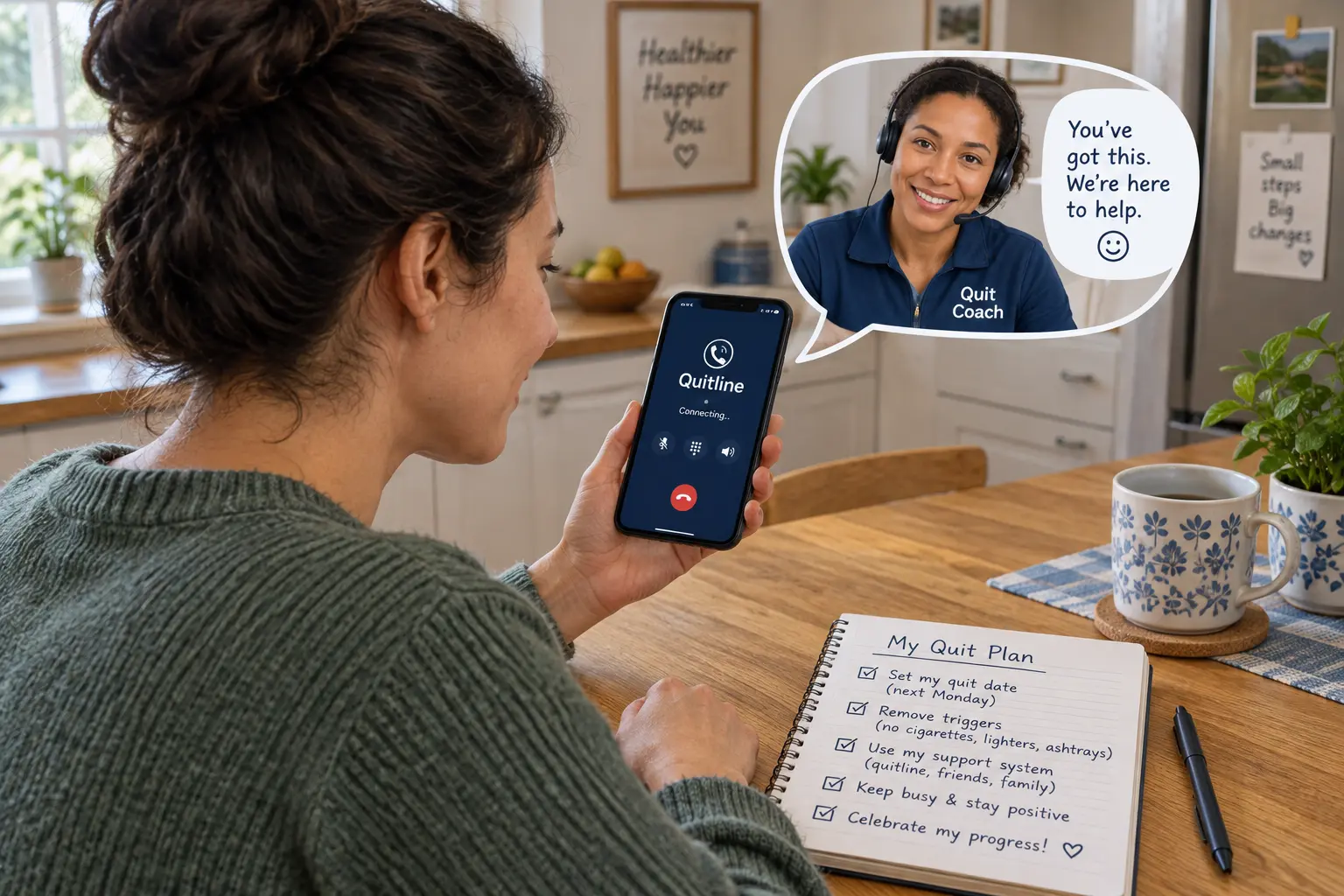
Step 5: Build your quit plan with the coach (10–15 minutes, moderate)
The coach asks what kind of help you want and what happened in past attempts, then suggests a program that fits. Together you will:
- Set a quit date.
- Identify your top three triggers (coffee, driving, stress at work, after meals).
- Choose one or two coping actions for each trigger.
- Decide on medication: free NRT from the quitline, a prescription from your doctor, or both.
If you want a deeper framework to bring to the call, our how to quit smoking step by step plan lays out the eight weeks around a quit date.
Step 6: Confirm your free NRT order (2 minutes, easy)
If you qualify, the coach confirms the product (patch, gum, lozenge or a combination), strength and shipping address. Ask how long delivery takes so you can time your quit date for after it arrives.
Step 7: Book your follow-up calls (2 minutes, easy)
Before hanging up, schedule your next call. Many programs time one call close to your quit date, when cravings and doubts peak. Save the number and your coach’s name in your phone.
Step 8: Start your quit date with medication on hand
Begin NRT on your quit day (or before, if your coach recommends a pre-quit start), and follow the package directions. Keep your follow-up call even if you slipped. Coaches expect slips and will help you reset.
What the Quit Coach Will Ask You on 1-800-QUIT-NOW
Knowing the questions takes the anxiety out of the first call. Expect most of the following, in some order:
| Question area | Typical questions | Why they ask |
|---|---|---|
| Tobacco use | What do you use? How much per day? How soon after waking? | Sets your NRT strength |
| Past attempts | Have you tried before? What worked? What made you go back? | Avoids repeating what failed |
| Readiness | Do you want to quit in the next 30 days? | Matches you to the right program |
| Health | Are you pregnant? Any heart conditions? Current medications? | Safety screen for free NRT |
| Insurance | Do you have Medicaid, Medicare, private or no insurance? | Eligibility and referrals to covered medicines |
| Home and support | Does anyone else smoke at home? Who can support you? | Plans for environmental triggers |
| Contact preferences | Best times to call? OK to text? | Schedules your coaching calls |
You can skip any question you are not comfortable answering, although leaving out health details may limit the free medication you can receive.
Free NRT From 1-800-QUIT-NOW: Eligibility by State
Free nicotine replacement is the most valuable perk of calling, but it is also where the most confusion lives. Because each state funds its own quitline, the rules differ. There is no single national list, and state budgets change from year to year, so the coach on your call is the definitive source for your state.
What we can say reliably is which factors states use to decide:
| Eligibility factor | How it usually works |
|---|---|
| Age | Most states provide NRT only to adults 18 and older. Teens are offered coaching instead. |
| Enrollment in coaching | Many states require you to complete the intake or first coaching call before NRT ships. |
| Insurance status | Some states give NRT to everyone; others prioritize uninsured callers or people on Medicaid and refer insured callers to their plan. |
| Health screening | Pregnant or breastfeeding callers, and people with recent heart events, are usually asked to check with a doctor first. |
| Supply length | The CDC notes coaches may send an initial two-week supply; some states offer longer courses, sometimes in stages. |
| Product choice | Patches are the most common; many states also offer gum or lozenges, and some offer combination therapy. |
If your state’s free supply runs out or you do not qualify, there are other routes. Our guide on how to get free nicotine patches covers insurance coverage, pharmacy programs and low-cost options. The American Lung Association also maintains a state tobacco cessation coverage database that shows what Medicaid and state employee plans cover where you live.
How to maximize your free NRT
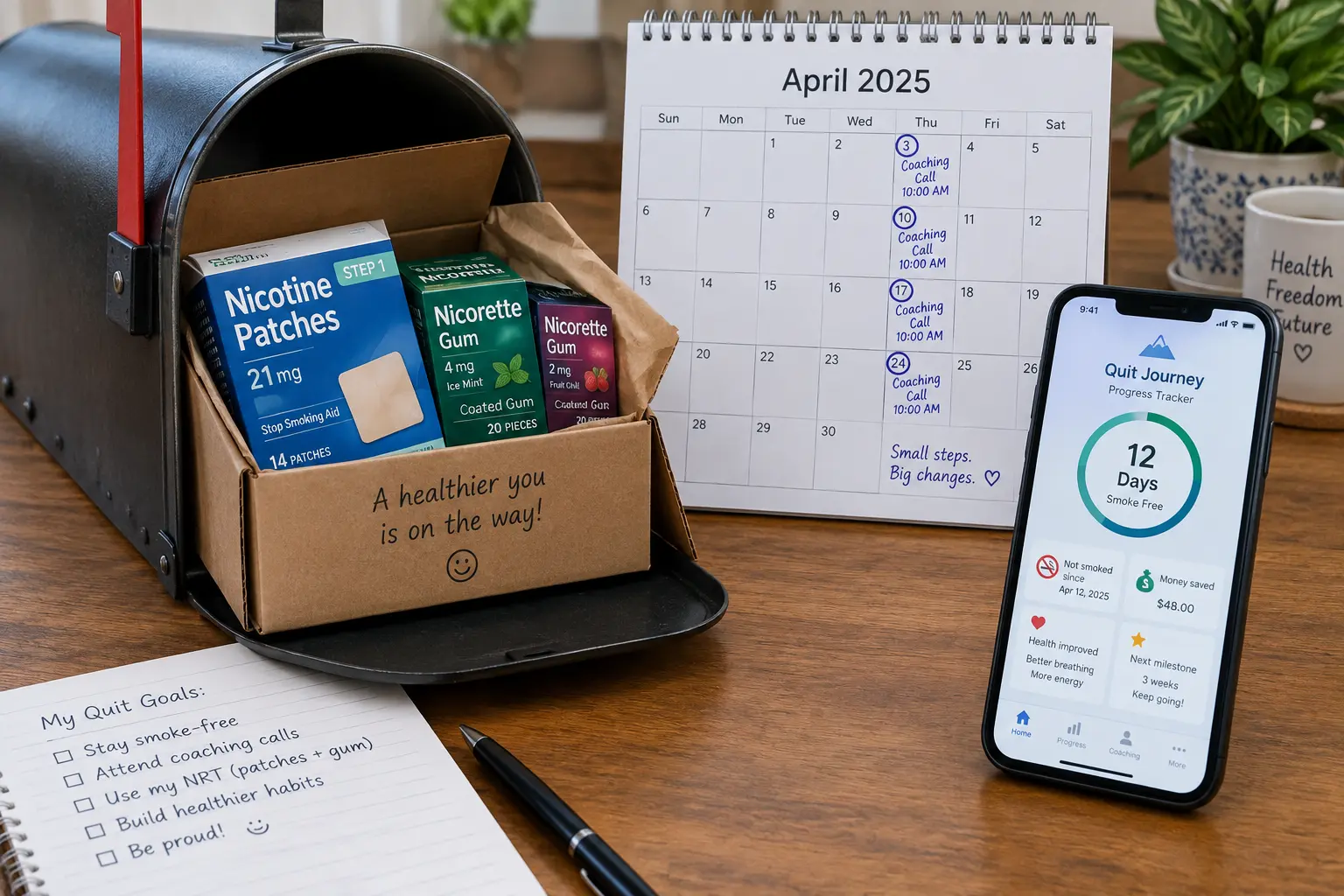
- Ask about combination therapy. Using a patch for steady nicotine plus gum or lozenges for breakthrough cravings works better than one product alone, according to the CDC’s guide to quit-smoking medicines.
- Time the delivery. Set your quit date a few days after the expected delivery.
- Ask about refills at each call. Some states send more product in stages if you stay engaged with coaching.
- Use your insurance too. If you have coverage, a prescription can extend treatment beyond the quitline’s supply.
Scheduling Your 1-800-QUIT-NOW Coaching Calls
Coaching is where most of the benefit comes from, so treat the calls like appointments. Most state programs offer a series of scheduled sessions over several weeks to a few months; the exact number varies by state and program.
Step 9: Space calls around your highest-risk days
A practical schedule looks like this:
- Call 1 (intake): one to three weeks before your quit date.
- Call 2: a day or two before your quit date, to finalize your plan and check your NRT arrived.
- Call 3: within the first week after quitting, when withdrawal is usually strongest.
- Calls 4 and beyond: spaced out over the next weeks to prevent relapse.
Step 10: Protect the call time
Put each session in your calendar with a reminder. If you need to reschedule, call back as soon as possible instead of skipping. Missing several calls in a row can end your enrollment in some states, and you would need to re-enroll.
Step 11: Prepare three bullet points before each call
Coaching calls are short. Arrive with: (1) your hardest moment since the last call, (2) what you did about it, and (3) one question. This turns a general check-in into targeted problem-solving.
What to Do Between Calls: Pairing the Quitline With iQuit
The quitline gives you an expert for 15 minutes every week or two. The other 99% of the time you are on your own. That gap is where an app helps, and it is the reason quitline coaches commonly point callers to apps and texting programs as extra support.
Step 12: Log cravings the moment they hit (30 seconds each)
Each time you crave a cigarette, note the time, intensity and trigger in iQuit. After a week you will see patterns, such as cravings clustering after your morning coffee or on your commute. Share these with your coach; it is far more useful than “it’s been hard.”
Step 13: Watch your milestones and savings
iQuit counts smoke-free days and money saved and shows health recovery milestones as they pass. On a rough day, seeing a concrete number can be the nudge that keeps you going until your next call.
Step 14: Use a craving tool instead of waiting for your coach
Cravings typically peak and pass within minutes. When one hits between calls, open iQuit’s SOS tools for guided breathing or grounding, drink a glass of cold water, take a short walk, or use your fast-acting NRT (gum or lozenge). Then log it.
Step 15: Bring your app data to the next session
Open your stats before the call. If your log shows evenings are your weak point, your coach can help you build an evening plan. If you slipped, iQuit treats it as data rather than resetting everything, and the log shows what led up to it.
Used this way, the quitline and the app are complementary: the coach gives structure and accountability, and the app keeps you supported every hour in between.
Other Quitline Numbers and Formats
1-800-QUIT-NOW is the main English line, but it is not the only free option. The CDC lists these national language lines:
| Language | Number |
|---|---|
| English | 1-800-QUIT-NOW (1-800-784-8669) |
| Spanish | 1-855-DÉJELO-YA (1-855-335-3569) |
| Mandarin and Cantonese | 1-800-838-8917 |
| Korean | 1-800-556-5564 |
| Vietnamese | 1-800-778-8440 |
Other free channels include:
- National Cancer Institute counselors: 1-877-44U-QUIT (1-877-448-7848), plus online LiveHelp chat via Smokefree.gov.
- Veterans: the VA’s quitline at 1-855-QUIT-VET (1-855-784-8838).
- Text and web programs: many state quitlines offer online enrollment, web chat and text-message coaching if you prefer not to talk on the phone. Ask about these on your first call.
If you live outside the US
1-800-QUIT-NOW only works in the United States. Canada, the UK, Ireland and Australia run their own free services. For example, see our guide on how to quit smoking in Australia, which covers Quitline 13 7848 and subsidized NRT.
Troubleshooting Common 1-800-QUIT-NOW Problems
“I was put on hold or got voicemail”
Leave your name, number and best times to call back. Quitlines return calls. You can also try enrolling online through your state’s quitline website, which often lets you pick a callback time.
“I don’t qualify for free patches”
Coaching alone still helps. Ask the coach what you do qualify for, then check your insurance; most plans cover at least some quit medication. Pharmacies also sell store-brand NRT for less than name brands.
“I slipped and smoked”
Call anyway. A slip is information, not failure. Your coach will help you figure out what triggered it and adjust the plan, and many quitlines let you re-enroll if you need to start over.
“I’m not ready to quit yet”
You can still call. Some programs offer support for people who want to cut down first or who are thinking about quitting in the future.
“I want a prescription medication”
Coaches cannot prescribe, but they can explain the options. Ask your doctor, a telehealth service or, in some states, a pharmacist about varenicline or bupropion, and use the quitline for coaching alongside it.
Frequently Asked Questions About 1-800-QUIT-NOW
Is 1-800-QUIT-NOW really free?
Yes. Coaching through 1-800-QUIT-NOW is free and confidential. Your call is routed to your state quitline, which pays for the service. Free medication depends on your state’s eligibility rules.
What happens when I call 1-800-QUIT-NOW?
You are connected to your state quitline. A coach asks about your tobacco use, past quit attempts, health and insurance, then helps you set a quit date, build a plan and schedule follow-up coaching calls.
Can I get free nicotine patches from 1-800-QUIT-NOW?
Often, yes. Many state quitlines mail free patches, gum or lozenges to eligible adults who enroll in coaching. The CDC notes coaches may be able to send an initial two-week supply. Eligibility varies by state, age, health and insurance.
How long is the first quitline call?
Plan for about 15 to 30 minutes for the first call, which includes intake questions and building your plan. Follow-up coaching calls are usually shorter.
Do I have to quit right away if I call?
No. You can call before you are ready to quit. The coach will help you choose a quit date, usually within the next few weeks, and prepare for it.
Is there a Spanish-language quitline?
Yes. Spanish speakers can call 1-855-DÉJELO-YA (1-855-335-3569). There are also national lines in Mandarin, Cantonese, Korean and Vietnamese.
Can 1-800-QUIT-NOW help me quit vaping?
Yes. Most state quitlines now coach people who vape or use other nicotine products, not only cigarette smokers. Free NRT for vaping depends on state rules.
Can I use a quit app and the quitline together?
Yes. The quitline gives you scheduled coaching, and an app such as iQuit tracks smoke-free days, cravings and money saved between calls, which gives you concrete data to discuss with your coach.
This guide is for general information and does not replace advice from your doctor or pharmacist. Quitline services and eligibility rules vary by state and may change.