Australia has some of the strongest free quit-smoking support in the world, but it is spread across a few different services, which makes the practical question harder than it should be. This guide covers how to quit smoking in Australia using the Quitline, NRT, and the local rules that shape what you can access — so you can build one plan instead of piecing it together from separate websites.
The Australian Route in One Page
If you only take one thing from this guide: start with Quitline. It is free, it is confidential, and it connects you to a trained counsellor who builds a plan with you rather than handing you a leaflet. From there, most people layer in NRT from a pharmacy and, if needed, a prescription medicine from their GP. The sections below cover each piece, plus the vaping rules that trip a lot of people up. If you have compared free support in other countries, our look at free quit-smoking help in Canada versus the US and our explainer on NHS stop smoking services in the UK show how the Australian model compares — broadly, Australia’s Quitline sits closer to the UK’s free-service model than the more fragmented US picture.
Quitline: What a Call Involves
Quitline’s own description of the service is direct: you “speak directly with a trained quit specialist,” and counsellors “are available to provide immediate support, personalised quit plans, and answer all your questions” (Quit.org.au). The call is confidential, and you can use it whether this is your first attempt or your fifth — the service explicitly frames repeat attempts as normal, noting that “quitting can take practice” and people are “more likely to get there with the right support.”
Quitline: 13 7848, available across Australia.
Most callers are offered more than a single conversation. Typical Quitline support includes an initial planning call, a small number of scheduled follow-up calls timed around your quit date and the first few weeks after it, and the option to keep calling back if a specific week is harder than expected. You don’t need to have a quit date set before you call — talking through whether you’re ready, and when, is part of what the service is for.
| Service | What it offers | Cost |
|---|---|---|
| Quitline (13 7848) | Personalised quit plan, counselling, follow-up calls | Free (standard call charges may apply from some phones) |
| Pharmacy consultation | NRT format and strength advice | Free advice; product cost varies, some PBS-subsidised |
| GP visit | Prescription medicines, health review before quitting | Bulk-billing availability varies by clinic |
| Aboriginal Quitline (aql.org.au) | First Nations counsellors, culturally tailored resources | Free |

Cancer Institute NSW’s “Never Give Up Giving Up” quit-smoking campaign, licensed from Cancer Council Victoria, on the reality of repeated quit attempts.
NRT in Australia and What Is Subsidised
Nicotine patches, gum, lozenges and mouth spray are all available in Australia and, per Quit’s own guidance, “come in different strengths,” with patches used as a slow, all-day option and gum or lozenges layered on top for cravings (Quit.org.au). Quit’s guidance also notes that “nicotine gum or nicotine lozenges are often used with nicotine patches to help you cope with cravings,” which describes combination NRT — a steady-release patch alongside a faster-acting product for moments when a craving spikes despite the patch.
Most pharmacies stock several brands and strengths side by side, and staff are used to helping first-time buyers choose. If you have never used NRT before, it’s worth asking the pharmacist directly which strength suits how many cigarettes you currently smoke a day, rather than guessing from the packaging alone. This short conversation at the counter is free, and it is one of the easiest ways to avoid starting on a strength that is either too weak to help or stronger than you need.
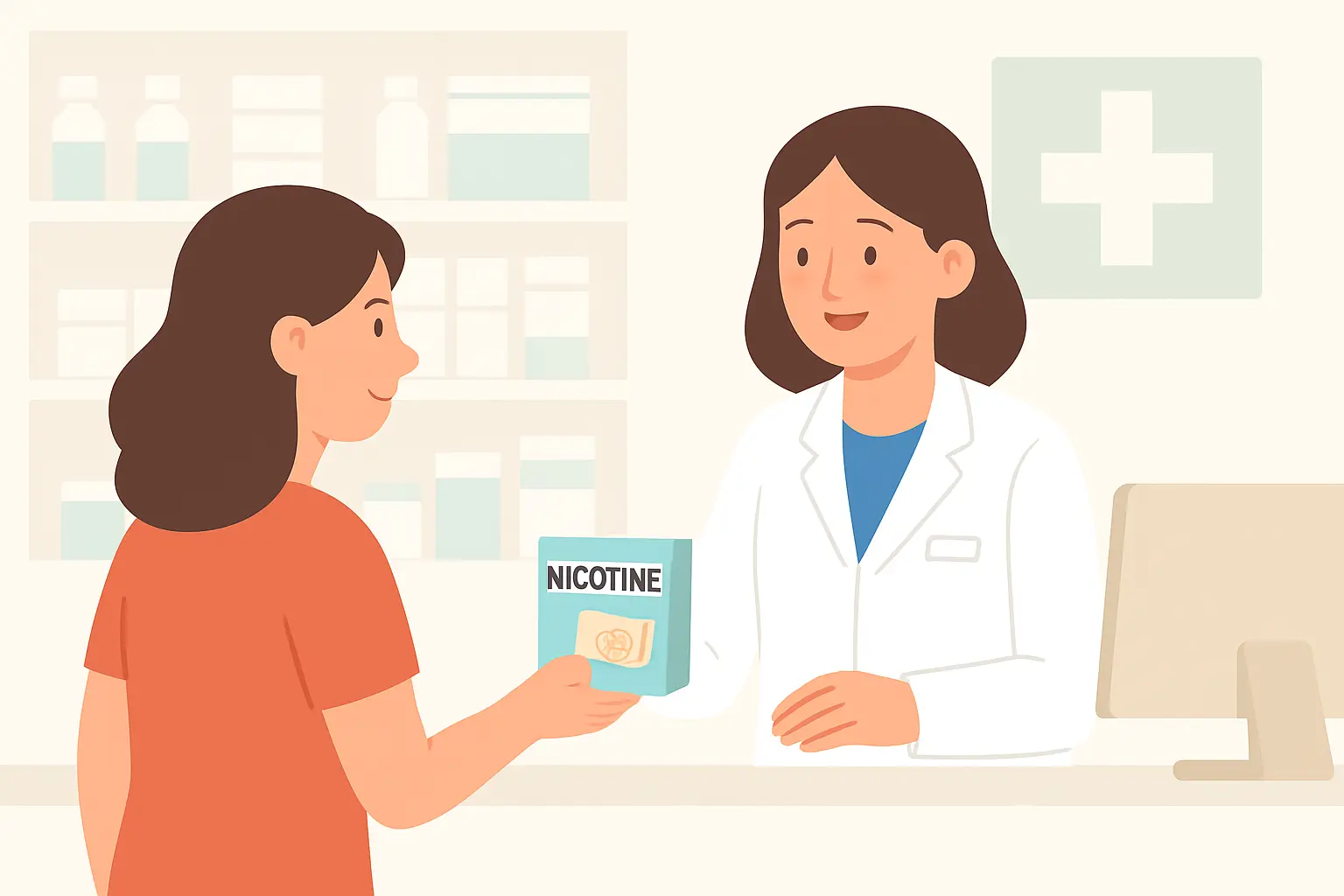
On subsidy specifically: some NRT and prescription cessation medicines can be subsidised through the Pharmaceutical Benefits Scheme (PBS), but which products and what you pay depends on your circumstances and can change — the reliable way to check is to ask your pharmacist directly or search the current listing on pbs.gov.au before you buy, rather than relying on last year’s price or an average quoted by an international site. Our comparison of NRT options covers how the formats differ if you are choosing for the first time, and what a pack of cigarettes costs is a useful baseline for comparing against any NRT spend.
Prescription Medicines and Your GP
If NRT alone hasn’t worked before, prescription stop-smoking medicines are available through a GP visit. This is a genuine medical decision — your GP will look at your health history before prescribing, and dosing isn’t something to self-manage. Quitline counsellors can also help you think through whether a GP conversation makes sense as part of your plan, so you don’t have to sort out the medical route alone.
It’s worth bringing a specific list to that appointment: what you’ve tried before (patches, gum, cold turkey), how long each attempt lasted, and what triggered any relapse. That history helps a GP judge whether NRT alone is likely to be enough this time, or whether a prescription option is worth discussing — the same way it would for any other treatment that hasn’t fully worked in the past.
Vaping Rules in Australia
Vaping rules in Australia have changed more than once in recent years, and they are stricter than in the US or UK. As Quit’s own information page puts it plainly: “In Australia, vapes can only be sold in pharmacies to help people quit smoking,” and “adults can buy limited supplies after talking to a pharmacist” (Quit.org.au). Beyond that pharmacy-access framework, specific thresholds and prescription requirements have been updated by the Therapeutic Goods Administration in recent years, so if a vape is part of your quit plan, confirm the current rules with your pharmacist rather than with an overseas guide or an online vape retailer — the settings that apply in the US or UK do not apply here. Our comparison of prescription vapes versus NRT in Australia goes deeper on how the two routes compare if you are weighing them against each other.
What It Costs and What You Save in AUD
Cigarette prices in Australia are among the highest in the world due to tobacco excise, which is part of why quitting has an outsized financial payoff here compared with many other countries. Rather than quote a single national average that goes stale quickly, track your own numbers: your actual daily spend, multiplied out to a week and a month, gives a more useful figure than any national average — and it’s the number that will actually change your decisions. Our companion piece on smoking statistics in Australia has the current national rates and trends if you want the bigger picture alongside your own numbers.
| Period | How to calculate |
|---|---|
| Per week | Cigarettes per day × price per cigarette × 7 |
| Per month | Weekly figure × 4.3 |
| Per year | Monthly figure × 12, minus any ongoing NRT spend |
Aboriginal and Torres Strait Islander Services
Quitline services across Australia include First Nations counsellors, described by Quit as being “ready to empower mob who want to quit smoking or vaping” (Quit.org.au — First Nations peoples). There is also a dedicated platform, Aboriginal Quitline (aql.org.au), built with community input, alongside culturally tailored resources delivered in part through the national Tackling Indigenous Smoking (TIS) program, which supports community-based smoking and vaping cessation work specifically for Aboriginal and Torres Strait Islander communities.
Your First Week
- Before day 1: Call Quitline (13 7848) and set a quit date with a counsellor. Ask them to schedule your first follow-up call for around day 3, when cravings are typically at their strongest.
- Day 1: Start your chosen NRT from the pharmacy, following the pharmacist’s guidance on format and strength. Remove cigarettes, lighters and ashtrays from your home and car.
- Days 2–3: Use your scheduled Quitline follow-up to talk through the hardest moments. If you haven’t been offered one, call back and ask for one — it’s part of the service.
- Days 4–7: Track your daily savings in AUD as a concrete, growing number rather than an abstract idea, and note which times of day are still generating cravings so you can plan around them in week two.
If you slip during this first week, a single cigarette does not undo the quit attempt. Quitline counsellors specifically expect this and can help you get back on track the same day rather than treating it as a reason to start over from scratch next month.
Track Your Quit in AUD
iQuit lets you set your currency to AUD so your money-saved tracker, craving log and health milestones all reflect your actual Australian quit — alongside the free national support above, not instead of it. Our dedicated look at using a quit-smoking app alongside Quitline in Australia covers how the two work together in more detail.
Frequently Asked Questions
What is the Quitline number in Australia?
Quitline is 13 7848, available nationally and free to call. It connects you to a trained quit specialist who can build a personalised quit plan and offer ongoing follow-up support (Quit.org.au).
Can I buy a vape without a prescription in Australia?
Vapes in Australia are pharmacy-access products rather than general retail items — Quit’s own guidance states adults can buy limited supplies after talking to a pharmacist. Specific thresholds have changed in recent years, so confirm the current rule with a pharmacist rather than an overseas source.
Is NRT free or subsidised in Australia?
Some products can be subsidised through the PBS, but eligibility and pricing vary and are updated periodically. Ask your pharmacist what applies to you, or check the current PBS listing before you buy, rather than relying on a fixed number from an old source.
Is there Quitline support for Aboriginal and Torres Strait Islander people?
Yes. Quitline services include First Nations counsellors nationally, and a dedicated platform, Aboriginal Quitline (aql.org.au), was built with community input. Culturally tailored resources are also delivered through the national Tackling Indigenous Smoking program.
Do I need to see a GP to quit smoking in Australia?
No — Quitline and pharmacy NRT are both accessible without a GP visit. A GP becomes relevant if you want a prescription stop-smoking medicine or have health conditions that make NRT choice more complicated.
Track Your Australian Quit
iQuit works alongside Quitline and NRT — set your currency to AUD and watch your savings, cravings and health milestones add up from day one. Free on Google Play and the App Store.
Download iQuit Free on Google Play
Download on the App Store