

If you have just bought one, you want to know how to use nicotine mouth spray properly, because the technique is not obvious and a few mistakes make it work badly. This guide follows the official product information for Nicorette QuickMist 1mg/spray, the mouth spray licensed in the UK, so every instruction and limit below comes from the label wording rather than from guesswork.
That matters, because this is “label territory.” The short version: prime it, spray into your open mouth avoiding your lips, do not inhale, and stay within the daily maximum. The details follow, along with side effects, how to wind down, and how to pair the spray with a patch. If you are still deciding between products, our nicotine spray vs gum comparison covers the choice.
What the nicotine mouth spray is
A nicotine mouth spray is a form of nicotine replacement therapy (NRT). Each spray of Nicorette QuickMist delivers 1 mg of nicotine into the mouth, where it is absorbed through the lining. According to its product information (the summary of product characteristics, or SmPC, published on the electronic medicines compendium), it relieves or prevents craving and nicotine withdrawal symptoms in nicotine dependence, such as those arising from the use of tobacco or electronic cigarettes.
Two details help you choose it. The SmPC says absorption from the mouth spray is more rapid than from nicotine gum or lozenge, so relief of cravings should start faster. And a placebo-controlled study of regular vapers found that 82.6% of people using the spray had at least a 50% reduction in momentary urges to vape in the two hours of follow-up, compared with 55.1% on placebo. Our guide to the fastest-acting NRT products shows where the spray sits among the others.
It is meant for adults and children over 12. The SmPC says it is contraindicated in children under 12.
Is it sold in the US?
Smokefree.gov’s guide to NRT lists the patch, gum, lozenge, inhaler and nasal spray, and no mouth spray. I also searched the US FDA drug label database and found no label for a nicotine mouth spray. So if you are in the US, you may not be able to buy it; ask a pharmacist what is available. Read the Smokefree.gov NRT guide for the US options.
Priming a new spray
A new spray must be primed before first use. The SmPC says to prime the pump for first-time use, and also if you have not used the spray for 2 days.
- Point it away. Aim the spray safely away from you and any adults, children or pets nearby.
- Press 3 times. Press the top of the QuickMist with your index finger three times until a fine spray appears.
- Expect a small loss. The SmPC notes that priming reduces the number of sprays you get from the bottle.
Each mouthspray contains at least 150 sprays, according to the SmPC. If you prime often, that number will drop, so do not leave the bottle unused for days between cravings and then waste sprays re-priming.
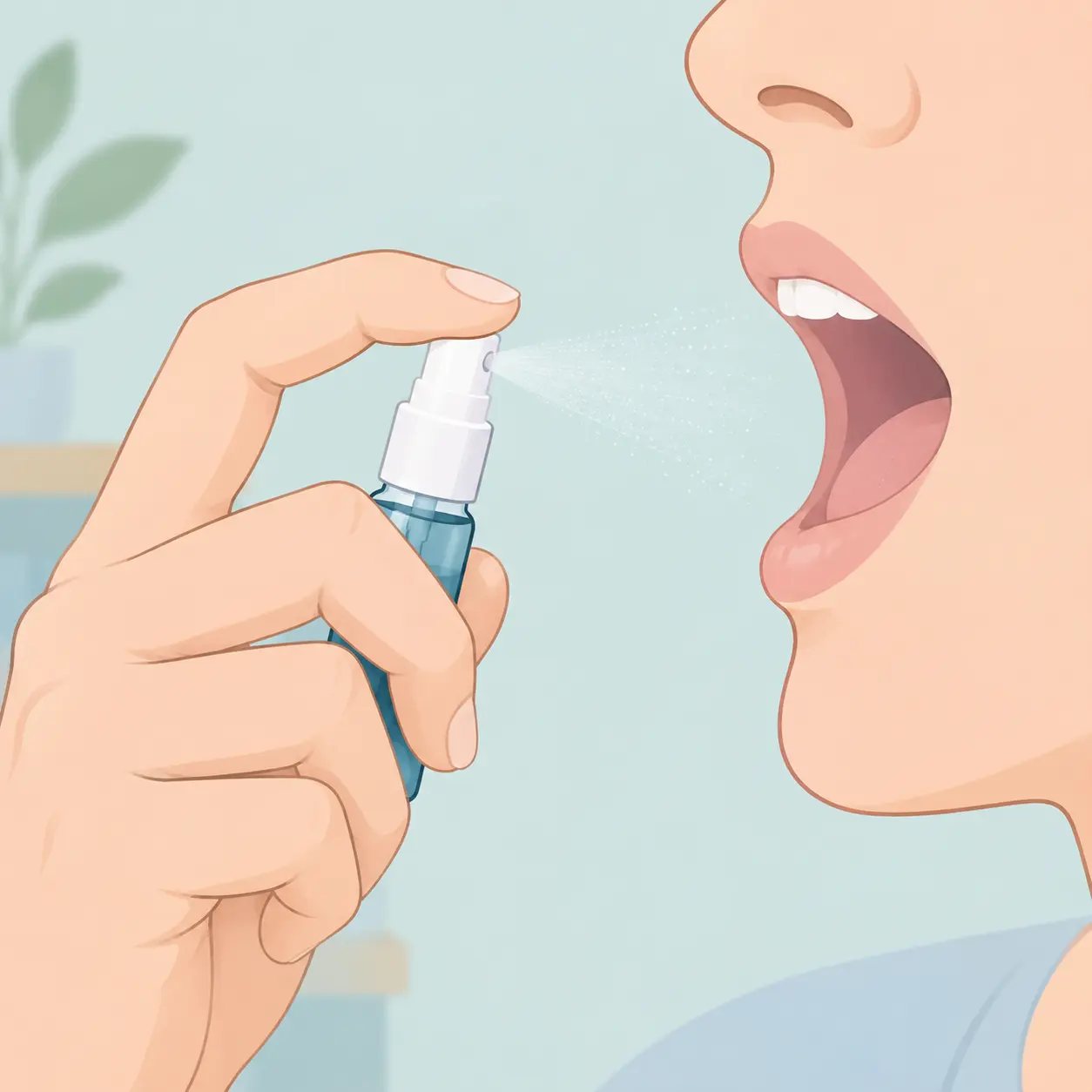
The correct technique, step by step
The technique is the part most people get wrong. These steps come straight from the SmPC directions.
- Check you are primed. If not, prime first.
- Point the nozzle close to your open mouth. Aim it as close to the open mouth as possible.
- Press once. Release one spray into your mouth, avoiding your lips.
- Do not inhale while spraying. This avoids getting spray down your throat.
- Hold off swallowing. For best results, do not swallow for a few seconds after spraying.
- Do not eat or drink while using it. The SmPC says not to eat or drink when administering the spray.
Take care not to spray your eyes. If the first spray does not control the craving within a few minutes, the SmPC says a second spray should be used.
How many sprays, and the daily maximum
This is the section to read twice. The limits are in the label for a reason.
| Situation | What the SmPC says |
|---|---|
| Starting a craving | Use 1 or 2 sprays when you would normally have smoked or vaped, or if cravings emerge. |
| If the first spray is not enough | Use a second spray if cravings are not controlled within a few minutes. If 2 sprays are required, later doses may be 2 consecutive sprays. |
| Typical use | Most smokers will require 1 to 2 sprays every 30 minutes to 1 hour. |
| Per hour | You may use up to 4 sprays per hour. |
| Per dosing episode | Do not exceed 2 sprays. |
| Per 24 hours | Do not exceed 64 sprays (4 sprays per hour over 16 hours). |
The SmPC also explains how to use it as a quit plan. People who are willing and able to stop immediately should initially replace all their cigarettes or e-cigarettes with the spray, and, as soon as they are able, reduce the number of sprays until they have stopped completely. People aiming to reduce should use it between smoking or vaping episodes to prolong the intervals without smoking or vaping. The SmPC also says you should make every effort to stop smoking or vaping completely during treatment.
Note that these figures are for this particular product. I could not find mouth-spray dose rules for other brands, and the SmPC is the document to check.
How long to use it and how to stop
The SmPC does not set a fixed weeks-long schedule for the spray; it tells you to reduce the number of sprays as soon as you are able, until you have stopped completely. For how long to keep going overall, the NHS guide to stop-smoking products says many people do not use stop-smoking products for long enough, which can cause cravings to return, and gives general advice to use NRTs and other products for at least 12 weeks, or longer if needed.
If you have quit smoking or vaping but are having difficulty stopping the spray itself, the SmPC recommends contacting your pharmacist or doctor for advice. That is a normal situation, and it is what the pharmacist is there for.

Common mistakes
Based on the directions above, these are the errors worth avoiding.
- Skipping the priming. An unprimed pump may not deliver a proper spray.
- Inhaling. The SmPC says not to inhale while spraying, to avoid spray going down your throat.
- Spraying onto your lips. The directions say to avoid the lips.
- Swallowing straight away. The SmPC says not to swallow for a few seconds for best results.
- Eating or drinking at the same time. It says not to.
- Exceeding the limits. Do not go beyond 2 sprays per episode, 4 per hour or 64 per day.
- Waiting until the craving is huge. The SmPC says to use it when the urge is felt, or to prevent cravings in situations where they are likely.
Side effects and what helps
The SmPC says that during the first few days of treatment, irritation to the mouth and throat may be experienced, and hiccups are particularly common. It adds that tolerance is normal with continued use, and that very commonly occurring adverse events started in the first 2 to 3 weeks of using the spray and declined afterward.
Practical ways to cope, based on the directions rather than on extra claims, are to make sure you are not inhaling, to avoid swallowing right after a spray, and to avoid exceeding the limits. If symptoms are troublesome, speak to a pharmacist or doctor. Rare allergic reactions are possible, and you can report suspected side effects through the MHRA Yellow Card scheme in the UK.
Who should ask first
The SmPC says a healthcare professional should make a risk-benefit assessment for people with conditions such as underlying cardiovascular disease, diabetes mellitus and a history of seizures. It also says use during pregnancy should only be initiated after advice from a healthcare professional. Keep the spray away from children: the SmPC warns that doses tolerated by adult and adolescent smokers or vapers can produce severe toxicity in children that may be fatal. It should not be stored above 30°C.
Using the spray with a patch
The NHS recommends two kinds of nicotine rather than one. It says the best approach is to combine a fast-acting source of nicotine, like a mouth spray, with a slow-acting source like a patch, which eases you out of dependence without tipping you into withdrawal. The spray covers the cravings that break through, and the patch provides the background.
That combination is the heart of combination NRT, which our combination vs single NRT comparison explores. The NHS also says that combining nicotine-free medicines with NRTs makes you over 5 times more likely to quit for good, which is a conversation for your doctor or stop smoking service, and our comparison of NRT options helps you prepare for it. For the lozenge version of this guide, see how to use nicotine lozenges correctly.
Where iQuit fits
iQuit is a quit-smoking app, free on Google Play and the App Store. Use its craving log to record each craving with its trigger and intensity, and its craving forecasts to spot your riskier times so you keep the spray within reach before they arrive. The SOS tools, such as breathing exercises and craving surfing, give you something to do in the few minutes the spray takes to work. It does not replace the spray or advice from your pharmacist.
Frequently Asked Questions
How many sprays of nicotine mouth spray can I use per day?
For Nicorette QuickMist 1mg, the SmPC says you may use up to 4 sprays per hour, no more than 2 per dosing episode, and no more than 64 sprays in any 24 hours (4 per hour over 16 hours). Most smokers need 1 to 2 sprays every 30 minutes to an hour. (Nicorette QuickMist SmPC)
Do I need to prime the nicotine mouth spray?
Yes. The SmPC says to prime a new spray before first use, and again if you have not used it for 2 days. Point it away from people and pets and press the top 3 times until a fine spray appears. Priming reduces the number of sprays in the bottle. (Nicorette QuickMist SmPC)
Should I inhale when I use nicotine mouth spray?
No. The SmPC says to spray into your open mouth, avoiding your lips, and not to inhale while spraying, so the spray does not go down your throat. For best results, do not swallow for a few seconds, and do not eat or drink while using it. (Nicorette QuickMist SmPC)
What are the side effects of nicotine mouth spray?
The SmPC says mouth and throat irritation can occur in the first few days and hiccups are particularly common. Tolerance is normal with continued use, and very common adverse events began in the first 2 to 3 weeks and declined. Speak to a pharmacist if symptoms trouble you. (Nicorette QuickMist SmPC)
Can I use nicotine mouth spray with a nicotine patch?
Yes. The NHS says the best approach is to combine a fast-acting nicotine source such as a mouth spray with a slow-acting source such as a patch. This eases dependence without tipping you into withdrawal. Ask a pharmacist to help you choose strengths. (NHS)
Can I use nicotine mouth spray to quit vaping?
The SmPC lists use in nicotine dependence from tobacco or electronic cigarettes, and a placebo-controlled study in vapers reported 82.6% on the spray versus 55.1% on placebo with at least a 50% reduction in urges to vape. The NHS also names QuickMist as the approved NRT for quitting vaping in the UK. (SmPC, NHS)
Is nicotine mouth spray available in the US?
Smokefree.gov lists patches, gum, lozenges, inhalers and nasal spray, and I found no US FDA drug label for a nicotine mouth spray. It may not be available there, so ask a US pharmacist which fast-acting NRT forms are sold. Do not import products without advice. (Smokefree.gov, FDA label database)
Pair the Spray With a Craving Plan
The spray handles the craving in front of you. iQuit helps with the rest: a craving log for triggers and intensity, craving forecasts that flag your riskier times, SOS tools such as breathing exercises and craving surfing, and streak shields that help you restart after a slip. It is free on Google Play and the App Store and does not replace the spray or your pharmacist’s advice.


