
Is pipe smoking safer than cigarettes? In a large study of exclusive pipe smokers, the answer is somewhat lower risk, but still a serious risk. Pipe smokers in that study faced much higher death rates from several cancers, heart disease and lung disease than men who never used tobacco. If you are weighing a switch from cigarettes to a pipe, the evidence says it is a smaller step than it looks, and quitting is the only route that removes the risk.
The Short Answer: Lower Than Cigarettes, Far From Safe
The most useful evidence comes from a 2004 paper in the Journal of the National Cancer Institute. Researchers followed U.S. men enrolled in the American Cancer Society’s Cancer Prevention Study II, comparing exclusive pipe smokers with men who never used any tobacco product. The authors report that the risks “were generally smaller than those associated with cigarette smoking and similar to or larger than those associated with cigar smoking” (Henley et al., 2004).
Two things are true at once. Pipe smoking was not as deadly as cigarette smoking in that cohort. It was also strongly linked to death from lung, throat and other cancers, from heart disease and from chronic lung disease. The American Cancer Society puts it plainly: “Cigarettes, cigars, and pipes can all cause cancer. There is no safe form of tobacco smoke” (American Cancer Society). The World Health Organization agrees: “All forms of tobacco use are harmful, and there is no safe level of exposure to tobacco” (WHO).
This article is about pipe tobacco specifically. For cigars see our guide to cigars vs cigarettes: which is safer, and for water pipes see our hookah and shisha health guide. Those are different products with their own evidence.
The Study Behind the Numbers
It helps to know what the main study is and what it is not, because every figure below comes from it.
- Who: a cohort of 138,307 U.S. men, including 15,263 who reported in 1982 that they currently or formerly used only pipes, and 123,044 who reported never using any tobacco product.
- How long: 18 years of follow-up, during which 23,589 of the men died.
- What it measured: death, not just diagnosis, from tobacco-related cancers and other diseases.
- Limits: men only, enrolled in 1982, with pipe use self-reported at a single point in time. The authors also note that pipe smoking had declined since the 1960s but was still common regionally, especially among older people.
The results are expressed as relative risk (RR). An RR of 5.00 means that current pipe smokers died from that cause at five times the rate of men who never used tobacco. It does not mean five times the chance of ever getting the disease. All figures below are taken from the paper’s abstract, which you can read in full on PubMed.
Cancer Risks: Lung, Mouth, Throat and More
Compared with never users of tobacco, current pipe smokers had a higher risk of death from every tobacco-related cancer the study reported.
| Cause of death | Relative risk | 95% confidence interval |
|---|---|---|
| Larynx cancer | 13.1 | 5.2 to 33.1 |
| Lung cancer | 5.00 | 4.16 to 6.01 |
| Oropharynx cancer (back of mouth and throat) | 3.90 | 2.15 to 7.08 |
| Esophagus cancer | 2.44 | 1.51 to 3.95 |
| Pancreas cancer | 1.61 | 1.24 to 2.09 |
| Colorectal cancer | 1.41 | 1.15 to 1.73 |
The larynx figure has a wide confidence interval, which means the estimate is less precise, but even the lower end of the range is above five times the risk. The study also found that lung cancer risk rose with “number of pipes smoked per day, years of smoking, and depth of inhalation.” More pipe, more years and deeper inhalation all meant more risk.
For a fuller picture of which cancers tobacco causes and how large the risks are for cigarette smokers, see our article on what cancers smoking causes: risk data.
Heart and Lung Disease Risk
The same cohort looked beyond cancer. Current pipe smokers, compared with never users, had higher death rates from:
- Chronic obstructive pulmonary disease (COPD): RR 2.98 (95% CI 2.17 to 4.11)
- Coronary heart disease: RR 1.30 (95% CI 1.18 to 1.43)
- Cerebrovascular disease (including stroke): RR 1.27 (95% CI 1.09 to 1.48)
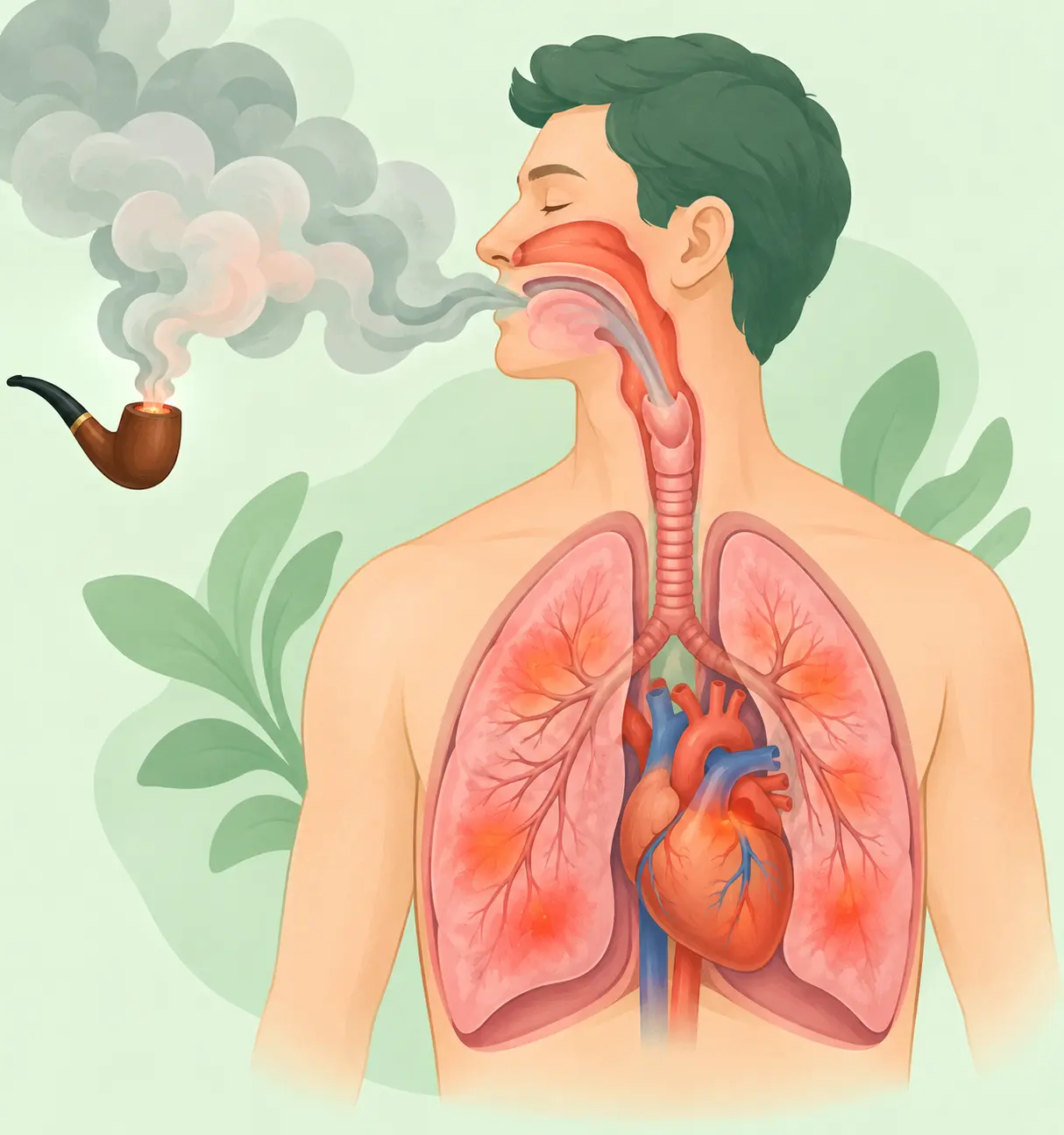
The heart and stroke figures look modest next to the cancer numbers, but they are still clear increases over never users. The COPD result is the biggest of the three: nearly three times the death rate of never users. Together, these results show that the harm from pipe smoking is not limited to cancer.
Inhaling vs Not Inhaling
Many pipe smokers believe that because they do not draw smoke deep into the lungs, they avoid the danger. The research gives a mixed answer.
On the lung side, the pipe cohort found that lung cancer risk increased with depth of inhalation, so inhaling makes lung risk worse. But the mouth, tongue, throat and larynx are exposed to smoke whether or not you inhale. The National Cancer Institute makes this point in its cigar fact sheet: “All cigar and cigarette smokers, whether or not they inhale, directly expose their lips, mouth, tongue, throat, and larynx to smoke and its toxic and cancer-causing chemicals” (National Cancer Institute). That page is about cigars, not pipes, but the pipe cohort’s 3.90 relative risk for oropharynx cancer and 13.1 for larynx cancer are consistent with the same kind of exposure.
Nicotine is part of the picture too. The NCI notes for cigars that “Even if the smoke is not inhaled, high levels of nicotine … can still be absorbed into the body,” including through the lining of the mouth. That page is about cigars, but the same route of absorption is one reason a pipe smoker who does not inhale may still become dependent on nicotine and still face the mouth and throat risks.
Watch: Can You Get Lung Cancer Without Inhaling?
The question of whether not inhaling protects you comes up for pipes and cigars alike. UCLA Health addresses it in this short video, which is about cigars but covers the same non-inhaling reasoning.
Switching From Cigarettes to a Pipe
This is the decision many readers are really making. Here is what the evidence does and does not tell you.
| Question | What the evidence says |
|---|---|
| Is pipe risk lower than cigarette risk? | Generally yes in this cohort: pipe risks were “generally smaller” than cigarette risks. |
| Is pipe risk close to never-user risk? | No. Every cancer, heart and lung outcome reported was higher than for never users. |
| Is pipe risk lower than cigar risk? | No. It was “similar to or larger than” cigar risk. |
| Does the study show that switching reduces risk? | No. It compared exclusive pipe smokers with never users. It did not follow cigarette smokers who switched. |
The last row matters most. The cohort did not test the switch, so no one can promise that moving from cigarettes to a pipe cuts your risk by any particular amount. The study looked only at exclusive pipe users. What the data does show is that a pipe leaves you well above the risk of someone who never used tobacco.
If your goal is to cut cigarette smoking, a switch also keeps you using tobacco and nicotine. Our are light cigarettes safer than regular article covers a similar trap: a product that feels gentler without removing the danger.
Quitting Pipe Tobacco
The encouraging finding in the cohort is that the risk is not fixed. The authors report that lung cancer risk showed “decreases with years since quitting.” The longer a former pipe smoker stays off tobacco, the lower the lung cancer risk.

Quitting a pipe has its own challenges. The ritual of filling, lighting and tending the bowl can become a daily anchor that cravings attach to, separate from the nicotine itself. Practical steps include:
- Pick a quit date and tell someone who will check in with you.
- Clear out the equipment so the ritual is not sitting on a shelf.
- Replace the ritual with something for your hands and mouth at the times you usually smoke.
- Talk to a clinician or pharmacist about stop smoking medicines. The NCI notes that “limited research has been completed to determine the usefulness of NRT for people who smoke cigars” and does not address pipe smokers specifically, so personal advice matters.
The NHS has a good starting point for any tobacco user at its quit smoking pages. For a broader look at what works, see our guide on how to quit smoking in 2026, the complete evidence-based guide, and our overview of quit smoking success rates.
Using iQuit for the Ritual Cravings
iQuit is free on Google Play and the App Store. For pipe smokers, the useful parts are the craving log, where you record each craving with its trigger and intensity so you can see when the ritual hits hardest; SOS support with breathing and grounding exercises for the moment itself; and the dashboard that shows days smoke-free and money saved. Streak shields and slip recovery help you pick up again after a slip. iQuit does not treat any condition, and it does not replace advice from a clinician.
Frequently Asked Questions
Is pipe smoking safer than cigarettes?
In a large American Cancer Society cohort, pipe smoking risks were generally smaller than cigarette risks and similar to or larger than cigar risks. But pipe smokers still had much higher death rates from lung, throat and other cancers than never users, so it is not a safe alternative (Henley et al., 2004).
Does pipe smoking cause lung cancer?
Yes. Current exclusive pipe smokers had a relative risk of 5.00 for lung cancer death compared with never tobacco users, and lung cancer risk rose with pipes per day, years of smoking and depth of inhalation. Risk fell with years since quitting (Henley et al., 2004).
Is pipe smoking safe if you do not inhale?
No. Not inhaling may lower lung exposure, but the mouth, throat and larynx are still exposed. The pipe cohort had relative risks of 3.90 for oropharynx cancer and 13.1 for larynx cancer. The NCI makes the same exposure point for cigars (Henley et al., 2004; National Cancer Institute).
Is a pipe less harmful than a cigar?
Not according to the main cohort. The authors found pipe smoking risks were similar to or larger than cigar smoking risks, and concluded that pipe smoking confers a risk of tobacco-associated disease similar to cigar smoking (Henley et al., 2004).
Does pipe smoking raise heart disease risk?
Yes. Current pipe smokers had a relative risk of 1.30 for coronary heart disease death and 1.27 for cerebrovascular disease death, plus 2.98 for COPD death, compared with never tobacco users. These come from a cohort of U.S. men followed for 18 years (Henley et al., 2004).
Can you get addicted to pipe tobacco?
Pipe tobacco is a nicotine product, and the WHO says nicotine is highly addictive. The NCI notes for cigars that nicotine can be absorbed through the lining of the mouth even if smoke is not inhaled. If you struggle to go without it, you may be dependent (WHO; National Cancer Institute).
Does the risk drop after you quit a pipe?
In the cohort, lung cancer risk decreased with years since quitting, so stopping helps and earlier is better. The study did not report a single time to normal risk, so ask your doctor about your own situation (Henley et al., 2004).
Can nicotine replacement help me quit a pipe?
Possibly, but evidence is thin. The NCI says limited research has been completed on nicotine replacement for cigar smokers. Ask a doctor or pharmacist about NRT, counseling or quitlines, and use whichever support you will actually stick with (National Cancer Institute).
Quit Tobacco, Not Just Switch It
Make Your Quit Plan Today
Switching products keeps the nicotine habit alive. iQuit helps you log cravings and their triggers, see your days smoke-free and money saved, and use SOS support when the ritual craving hits. Free on Google Play and the App Store.
Download iQuit Free on Google Play
Download on the App Store