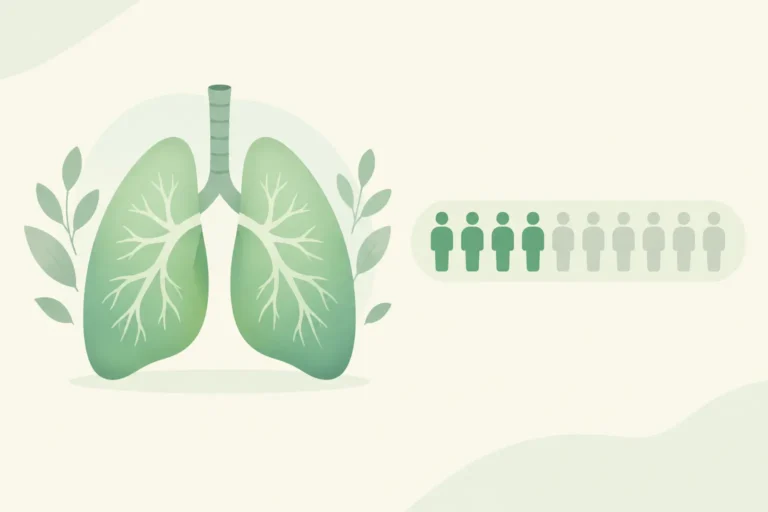
Are cigars safer than cigarettes? No — despite the popular belief that not inhaling makes cigars a lower-risk habit, regular cigar smoking carries serious risks of its own: a single large cigar can hold as much tobacco as an entire pack of cigarettes, and cigar smokers face elevated rates of cancer of the mouth, throat, esophagus, larynx and lung. The “safer” reputation survives mostly because occasional cigar smokers really do have lower risk than daily cigarette smokers — but that’s a difference in frequency and inhalation depth, not proof cigars themselves are safe.
Are cigars safer than cigarettes? The short answer
| Factor | Cigarette | Cigar |
|---|---|---|
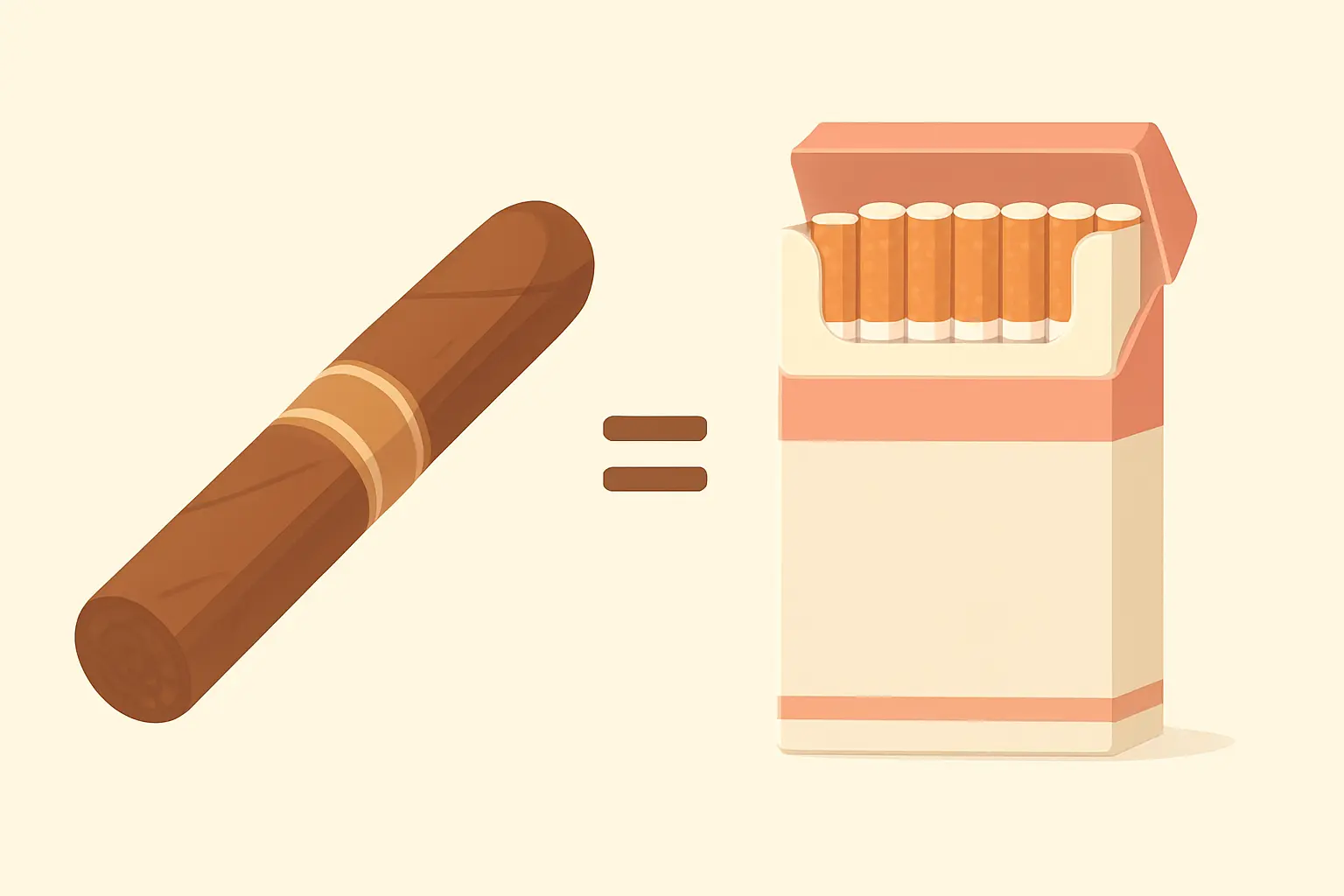
| Tobacco per unit | Less than 1 gram | 5 to 20 grams in a large cigar — as much as a pack of cigarettes |
| Nicotine available | One cigarette’s worth | A single cigar can potentially provide as much nicotine as a pack of cigarettes |
| Typical inhalation | Deep, into the lungs | Often shallower — but not always |
| Tar per gram of tobacco smoked | Lower | Higher — more cancer-causing tar per gram |
| Nitrosamines in the smoke | Lower | Higher concentrations than cigarette smoke |
| Cancer sites elevated | Lung, plus oral and throat | Oral cavity, larynx, esophagus and lung; possibly pancreas |
Figures in this table are from the National Cancer Institute’s cigars fact sheet and the CDC’s cigars page, both linked below.
The honest answer is: cigars are a different risk profile, not a lower one. According to the CDC, cigar smoke contains the same toxic, cancer-causing compounds found in cigarette smoke, and the agency is explicit that “using any commercial tobacco product is unsafe” (CDC, cigars). Understanding what’s actually in cigarette smoke is a useful baseline for seeing why cigar smoke isn’t meaningfully cleaner, and the pattern echoes what we found comparing hookah to cigarettes: a different delivery method rarely means a genuinely safer one.
Nicotine and tobacco per cigar vs. per cigarette
The size difference is the fact most people underestimate. A cigarette contains less than a gram of tobacco. A large cigar contains between 5 and 20 grams — which is why the National Cancer Institute states that a single cigar can potentially provide as much nicotine as a whole pack of cigarettes (NCI, cigar smoking and cancer). How much of that nicotine actually reaches your bloodstream depends on how you smoke it, but the reservoir sitting in your hand is an order of magnitude larger than a cigarette’s.
Cigar wrappers are also made from tobacco leaf rather than paper, which adds an absorption route cigarettes don’t have: nicotine can cross the lining of the mouth from direct contact with a wet wrapper, independent of how deeply the smoke is drawn. That is one reason cigar smokers who genuinely never inhale can still become dependent. For context on cigarette-level nicotine dosing, see our breakdown of how much nicotine is in one cigarette.
Mayo Clinic’s specialists explain how nicotine dependence itself works, which is the part that carries across from cigarettes to cigars regardless of the product.
“I don’t inhale”: what the data shows
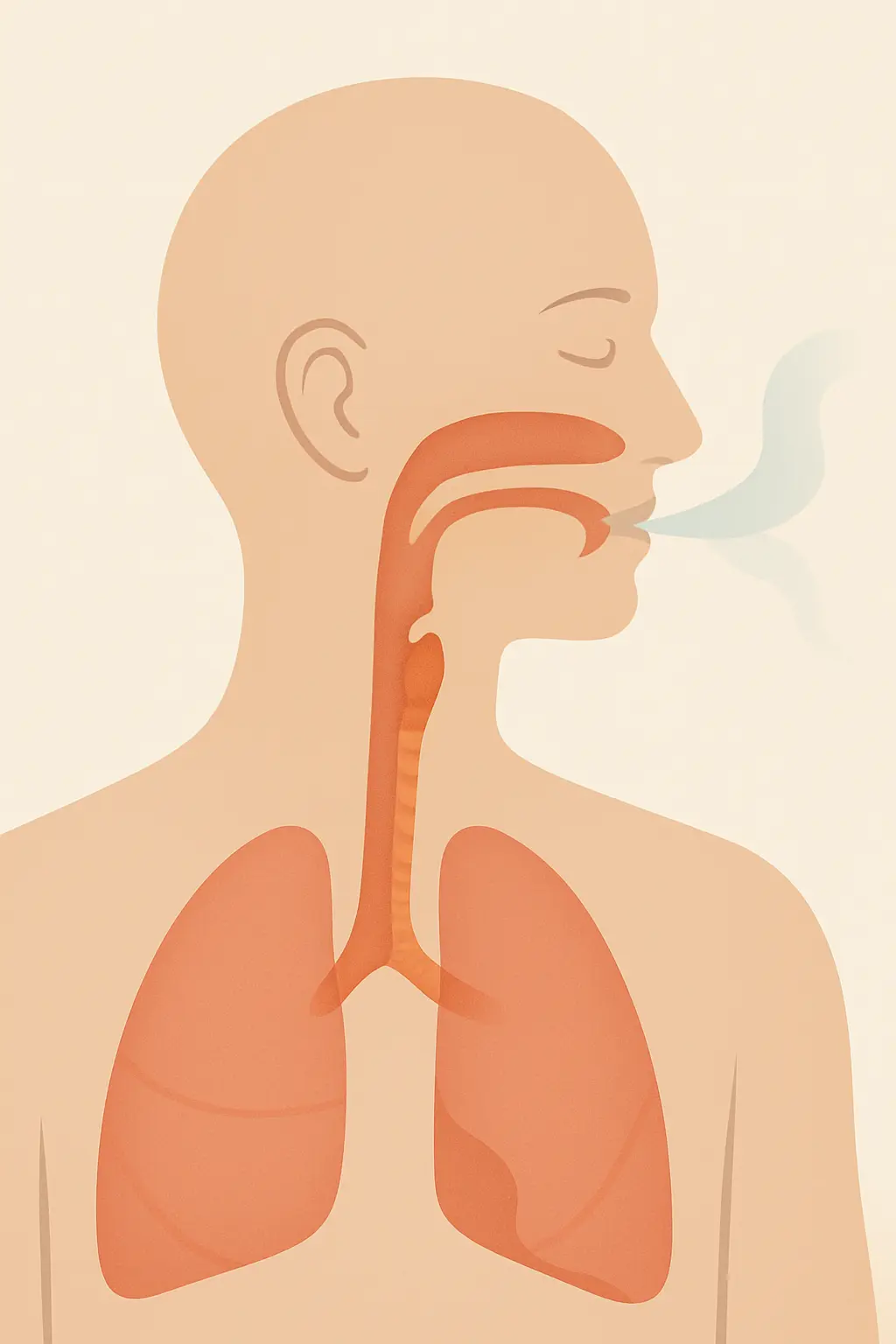
Many cigar smokers genuinely inhale less deeply than cigarette smokers, and this is the real basis for cigars’ safer reputation — not a marketing myth entirely, but a partial truth. Shallower inhalation and lower smoking frequency both reduce lung cancer risk specifically compared with a pack-a-day cigarette habit. But the NCI is direct about the limit of that protection: although most cigar smokers do not inhale, they still have higher rates of these diseases than people who do not smoke cigars, because every smoker exposes the lips, mouth, tongue, throat and larynx to smoke and its toxic chemicals — which is why oral and esophageal cancer risks are similar for cigar and cigarette smokers. Our broader smoking and cancer statistics cover how this compares across tobacco products more generally.
Cancer risk: mouth, throat, esophagus, lung
Regular cigar smokers face substantially elevated risk across several cancer sites tied specifically to oral and throat exposure. The NCI lists cancer of the oral cavity, larynx, esophagus and lung as caused by cigar smoking, and notes it may also cause cancer of the pancreas. Cigar smoke releases thousands of chemicals as it burns, dozens of which are known to cause cancer (MD Anderson Cancer Center). This is the central fact that undercuts the “cigars are safer” belief: the cancers most associated with cigar smoking are exactly the ones inhalation depth doesn’t protect against.
Two chemistry findings make the comparison worse rather than better. Per gram of tobacco smoked, there is more cancer-causing tar in cigars than in cigarettes, and nitrosamines — a well-characterized group of tobacco carcinogens — occur at higher levels in cigar smoke than in cigarette smoke. So the “cigars are gentler” framing does not hold up even for someone who genuinely never inhales deeply; the smoke itself is more concentrated, and the mouth and throat meet all of it.
Cigarillos and little cigars: cigarettes in disguise
Cigarillos and little cigars are frequently smoked the way cigarettes are smoked — several per day, inhaled deeply, often flavored to appeal to younger or newer users. A little cigar is typically about the same size as a cigarette and usually includes a filter, and cigarillos hold roughly 3 grams of tobacco rather than a large cigar’s 5 to 20. When a “cigar” product is used with cigarette-like frequency and inhalation, its risk profile shifts toward cigarette-like risk. Treating cigarillos as a lower-risk alternative to cigarettes is one of the more consequential misconceptions in this space, since products classified as “cigars” for regulatory or tax reasons are often used exactly like cigarettes in practice. Smokeless alternatives like snus face a similar “is it actually safer” question, with a different but equally nuanced answer.
The occasional-cigar question
Risk scales with frequency and depth of exposure, so an occasional cigar — a handful of times a year, at a celebration — carries meaningfully lower absolute risk than a daily cigarette habit or daily cigar use. That said, “occasional” is doing a lot of work in that sentence: the lower risk observed for infrequent cigar smokers doesn’t extend to weekly or daily use, where cumulative exposure to the same carcinogenic compounds builds the same way it does with cigarettes. There is no dose of regular tobacco use, cigar or cigarette, that current evidence describes as risk-free.
It is also worth being honest about drift. Cigar use is unusually easy to under-count because it is not a daily ritual with a pack to empty — “a few times a year” is a memory, not a record, and memories of pleasant occasions tend to compress. The practical test is simple: write down the date every time you smoke one for six months, then count. People who discover the real number is two or three times what they assumed are the rule rather than the exception.
If you want to quit cigars: what’s different
Quitting cigars follows the same evidence-based playbook as quitting cigarettes — NRT, behavioral support, and tracking triggers — but the trigger pattern is often different: cigars are more frequently tied to specific occasions, social settings, or rituals (a drink, a celebration, a particular friend group) rather than the all-day automatic smoking pattern cigarettes create. That makes cigar quitting sometimes easier to plan around, because the triggering occasions are identifiable in advance, but also easier to underestimate, since an occasional habit doesn’t create the same daily withdrawal pressure that makes cigarette quitting feel urgent. Our broader guide to tobacco harm reduction covers where cigars sit on the risk continuum relative to other tobacco products, and if cigars have been a bridge from or to another product, our guide to hookah and waterpipe smoking covers a comparable occasion-driven habit.
A plan for an occasion-driven habit
A generic quit-smoking template assumes daily use and daily withdrawal. For a cigar habit built around events, the plan needs to be built around events too.
| Step | What to do | Why it matters for cigars specifically |
|---|---|---|
| 1. Map the occasions | List every setting where a cigar has appeared in the last year — poker nights, golf, weddings, holidays, a specific bar | Your triggers are calendar entries, not times of day, so they can be seen coming weeks ahead |
| 2. Decide before the invitation | Choose your answer for each listed occasion now, while you are not standing in one | The decision made in the moment, with a drink in hand, is the one that fails |
| 3. Plan the hands and the mouth | Have something to hold and something to sip; a fast-acting NRT form if you are also nicotine-dependent | Much of a cigar’s pull is ritual — the object, the pause, the company |
| 4. Brief one person | Tell one person who will be there that you are not smoking tonight | Cigar use is highly social, so social accountability works better here than it does for solitary smoking |
| 5. Log every occasion afterwards | Record whether you smoked and what made it easy or hard | Turns an unmeasurable habit into data you can act on before the next event |
Frequently Asked Questions
Are cigars actually safer than cigarettes?
No. Cigar smoke contains the same cancer-causing chemicals as cigarette smoke, with higher nitrosamine levels and more cancer-causing tar per gram of tobacco smoked, and regular cigar smokers face elevated risk of cancer of the oral cavity, larynx, esophagus and lung. The lower risk sometimes seen in occasional cigar smokers reflects lower frequency, not a safer product.
Does not inhaling a cigar protect you from cancer?
Only partially, and mainly for lung cancer. The National Cancer Institute notes that although most cigar smokers do not inhale, they still have higher rates of these diseases than people who do not smoke cigars, because the lips, mouth, tongue, throat and larynx are exposed to the smoke either way — giving cigar and cigarette smokers similar oral and esophageal cancer risks.
How much nicotine is in a cigar compared with a cigarette?
A cigarette contains less than one gram of tobacco, while a large cigar contains between 5 and 20 grams. The National Cancer Institute states that a single cigar can potentially provide as much nicotine as a pack of cigarettes. Nicotine can also be absorbed through the tobacco-leaf wrapper on contact with the mouth, not only through inhaled smoke.
Are cigarillos safer than regular cigars or cigarettes?
Not meaningfully. Cigarillos hold about 3 grams of tobacco and little cigars are typically the size of a cigarette, often with a filter, and both are frequently smoked with cigarette-like frequency and inhalation depth. That pushes their real-world risk profile toward cigarette-level risk.
Is smoking one cigar occasionally actually risky?
Occasional cigar use (a few times a year) carries meaningfully lower absolute risk than daily cigarette or cigar smoking, since risk scales with frequency and cumulative exposure. That said, no level of regular tobacco use is described as risk-free by current evidence, and occasional use has a tendency to become more frequent over time.
Can you get addicted to cigars if you never inhale?
Yes. Nicotine crosses the lining of the mouth, so it reaches the bloodstream from smoke held in the mouth and from contact with the tobacco-leaf wrapper, without ever reaching the lungs. Absorption is slower than from inhaled smoke, but a large cigar holds far more tobacco than a cigarette, so total exposure across one sitting can be substantial.
Does NRT work for quitting cigars?
Nicotine replacement therapy is licensed and studied primarily for cigarette smoking, but withdrawal is driven by nicotine regardless of the product, so a pharmacist or stop-smoking service can advise on whether and how it fits your pattern. For occasion-driven cigar use, planning around specific events usually matters more than daily dosing, because there is no all-day withdrawal to cover.
Keep an occasional habit visible
iQuit’s free craving log records each urge with its trigger and intensity, so “occasional” stays an honest number instead of quietly becoming a daily one — with SOS breathing and grounding tools for the moments a cigar habit is tied to. Available on Google Play and the App Store.