Ask a UK public health official and a US public health official about vaping, and you’ll get two different answers to the same question. Tobacco harm reduction is the idea sitting behind that gap: the theory that some nicotine products carry far less risk than a burning cigarette, and that moving smokers toward those products — even if they don’t quit nicotine entirely — can save lives. It’s not a fringe idea, and it’s not universally accepted either. Here’s what it actually means, where the evidence stands, and where it can quietly work against you.
The Definition in One Paragraph
Tobacco harm reduction applies a principle used across public health — from needle exchanges to seatbelts — to nicotine: since abstinence isn’t achievable for every user right away, reducing the harm of continued use is worth pursuing as a step, not a failure. In practice, that means encouraging someone who smokes and isn’t ready or able to quit nicotine entirely to switch to a product that delivers nicotine with dramatically less of the toxic combustion byproducts that cause cancer, heart disease and lung disease — while still working toward full cessation as the end goal. Crucially, the concept only applies to people who already smoke; it says nothing about starting nicotine use in the first place, which is why every major framing of harm reduction pairs it with strong protections against youth uptake.
The Risk Continuum, Rung by Rung
Not all nicotine products carry the same risk, and lining them up matters more than treating “nicotine” as one monolithic danger.
| Rung | Product | Why it sits here |
|---|---|---|
| Highest risk | Cigarettes, roll-your-own tobacco | Combustion produces tar, carbon monoxide and thousands of chemicals |
| High risk | Cigars, hookah and waterpipe smoking | Still combusted; often heavier per-session exposure |
| Reduced dependence, same smoke | Very low nicotine cigarettes | Same smoke toxins, far less nicotine dependence |
| Lower risk (non-combusted, heated) | Heated tobacco products | Heats rather than burns tobacco, fewer combustion toxicants — see our heated tobacco vs vaping comparison |
| Lower risk (non-combusted) | Vaping / e-cigarettes | No combustion; see the full picture in is vaping worse than smoking |
| Lowest risk (nicotine only) | Snus, nicotine pouches, NRT (gum, patch, lozenge) | No inhaled smoke or vapor at all — see what is snus and nicotine pouch statistics |
| No risk from nicotine product | Complete abstinence | The actual end goal of any quit attempt |
Why the UK and WHO Positions Differ
This is where harm reduction gets genuinely contested, not just technical. The UK’s Office for Health Improvement and Disparities commissioned an independent review, summarized by researchers at King’s College London, which concluded that while vaping is not risk free — particularly for people who have never smoked — it “poses a small fraction of the health risks of smoking in the short to medium term.” One of the report’s authors, Dr Debbie Robson, said that “helping people switch from smoking to vaping should be considered a priority” if England is to reach a smoke-free 2030. England’s Deputy Chief Medical Officer, Dr Jeanelle DeGruchy, put it more bluntly still: “if the choice is between smoking and vaping, choose vaping. If the choice is between vaping and fresh air, choose fresh air.”

The World Health Organization takes a considerably more cautious line. Its position is that “e-cigarettes as consumer products have not been proven to be effective for cessation at the population level,” and it points countries instead toward “tried and tested interventions, such as brief advice from health professionals, national toll-free quit lines and mobile and digital cessation services.” Where a country does pursue a cessation strategy using e-cigarettes, WHO says access should be clinically controlled and the products “should be regulated as medicines, rather than their sale permitted as consumer products.”
The CDC’s public messaging sits closer to WHO’s caution than to the UK’s endorsement. It states flatly that “e-cigarette aerosol is NOT harmless ‘water vapor’” and warns that “it is difficult to know which substances e-cigarettes contain” — noting that some products marketed as containing zero percent nicotine have been found to contain nicotine.
Neither side disputes the core physics — combustion is worse than no combustion. The disagreement is about messaging risk: the UK worries more about smokers who won’t otherwise quit; the US and WHO worry more about a new generation taking up nicotine through products marketed as low-risk. That youth-protection worry is also what’s behind the UK’s own disposable vape ban — even a country that actively promotes vaping for smokers still moved hard against the products most likely to attract teenagers. And regardless of which country’s framing you follow, a nicotine cap on cigarettes themselves — covered in our piece on very low nicotine cigarettes — sits at a different point on this same continuum debate.
What the Evidence Supports (and What It Doesn’t)
Strip away the policy disagreement and the underlying science is more settled than the headlines suggest:
- Supported: non-combusted nicotine products expose users to dramatically fewer toxicants than cigarette smoke — this part isn’t seriously disputed by any major health authority.
- Supported: complete switching (not dual use) from cigarettes to a lower-risk product reduces exposure to carcinogens and combustion byproducts measurably.
- Not supported: that any nicotine product, including vapes and pouches, is risk-free — nicotine itself has cardiovascular and dependence effects, and long-term data on newer products is still accumulating.
- Not supported: that harm reduction products reliably lead to full cessation for most users — many settle into long-term use of the lower-risk product instead of quitting nicotine entirely.
Harm Reduction vs Cessation: Are They in Conflict?
Only if you treat them as competing goals instead of a sequence. Cessation — stopping nicotine entirely — remains the outcome with the largest health benefit, and it’s the outcome every major health authority, UK included, still recommends as the goal. Harm reduction doesn’t argue against that; it argues that for smokers who won’t or can’t get there directly, an intermediate step that cuts risk substantially is better than no step at all. The tension only appears when harm reduction becomes the final stop rather than a bridge — which is exactly the scenario that undermines its own logic.
Dual Use: The Trap That Cancels the Benefit
The single biggest way harm reduction fails in practice is dual use — continuing to smoke cigarettes while also vaping, using pouches, or using another reduced-risk product, rather than switching completely. Dual use keeps combustion exposure in the picture, which is where almost all of the serious health risk lives. Someone who smokes five cigarettes a day and vapes the rest hasn’t cut their risk by 50%; they’ve kept a meaningful share of the cigarette-specific harm while adding a second nicotine habit on top.
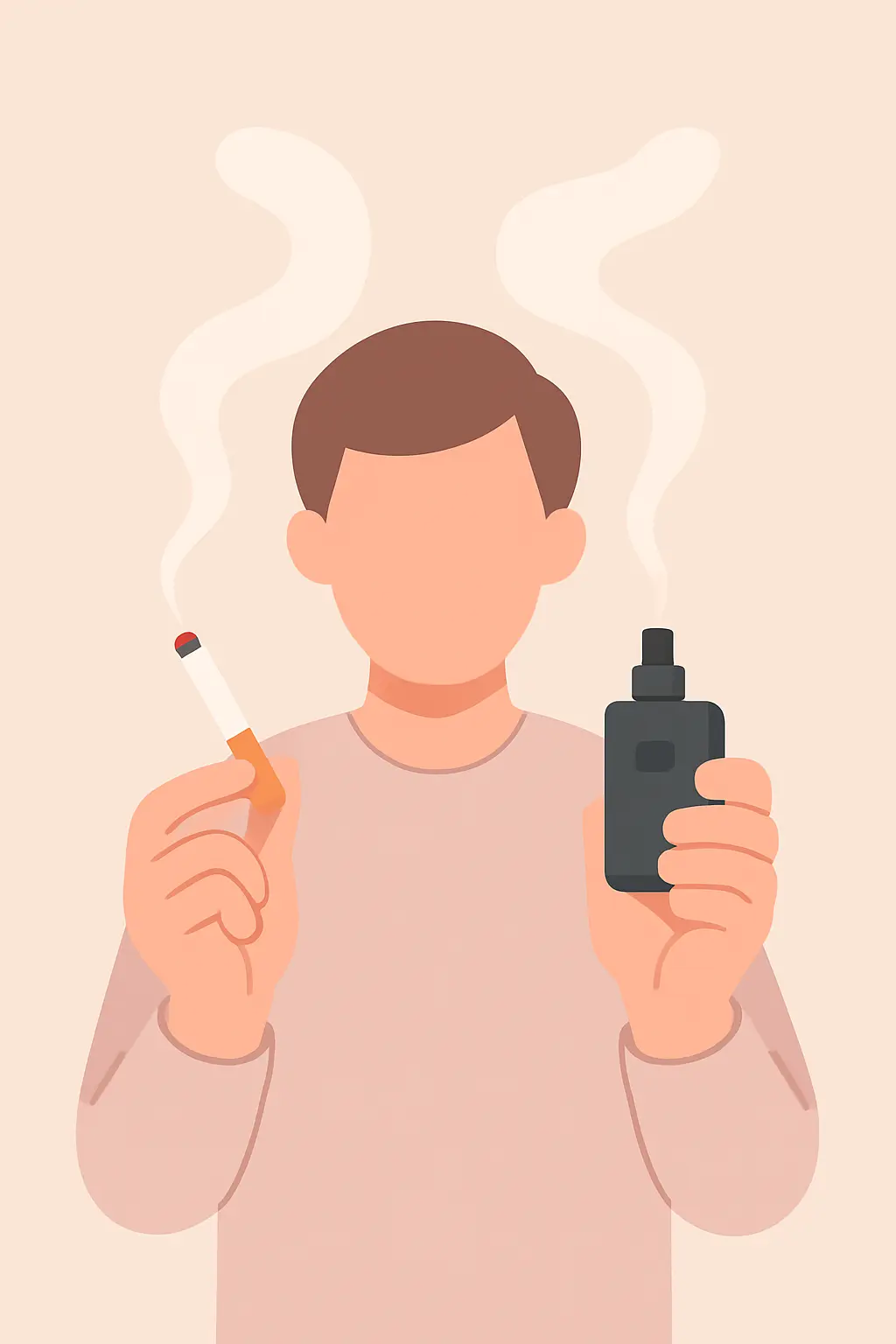
This is the single most important practical rule in harm reduction: it only works as a full switch, not a partial one. If a lower-risk product isn’t replacing cigarettes entirely within a defined timeframe, it’s not functioning as harm reduction — it’s just adding a second source of nicotine. It’s also worth knowing before you start that some people find the replacement product harder to put down than the cigarettes were, a pattern we look at in is vaping harder to quit than smoking.
A Four-Week Full-Switch Plan
“Switch completely” is easy to say and vague to act on. Here is a concrete four-week shape that keeps a switch from quietly turning into dual use. Adjust the pace to your own situation — the sequence matters more than the exact days.
| Week | What you’re doing | What you’re watching |
|---|---|---|
| Week 1 | Use the replacement product freely. Don’t try to cut cigarettes yet — get the nicotine level right first. | Whether the product actually satisfies a craving. If it doesn’t, the strength or format is wrong, and no amount of willpower will fix that. |
| Week 2 | Remove cigarettes from the two easiest situations — usually indoors and in the car. | Which cigarettes you genuinely miss, as opposed to the ones that were just routine. |
| Week 3 | Cut down to the hardest one or two cigarettes a day only: typically the first of the morning and the one with alcohol. | Total nicotine across both products. If it’s climbing, you’re stacking habits rather than swapping them. |
| Week 4 | Stop buying cigarettes. Full switch — replacement product only. | Whether anything is being kept “just in case”. A single emergency pack is how dual use restarts. |
Then set the second date, the one most people never set: when you intend to come off the replacement product too. Without it, the bridge becomes the destination.
How to Use Harm Reduction as a Route, Not a Destination
- Set a full-switch deadline. Decide upfront how long you’ll use a lower-risk product alongside cigarettes before cutting cigarettes out completely — weeks, not months.
- Pick one lower-risk product, not several. Splitting nicotine intake across cigarettes, vapes and pouches makes tracking dependence harder, not easier.
- Track total nicotine exposure, not just cigarette count, so a “reduction” isn’t just nicotine intake shifting to a second product.
- Treat the reduced-risk product as a step toward full cessation, with an actual quit method — NRT tapering, behavioral support, or medication — planned for the end of that step.

None of this requires a clinician to get started, but it’s worth mentioning a switch plan at your next appointment, especially if you have an existing heart or lung condition — the same conversation covered in more depth on talking to your doctor about quitting applies just as well to a harm-reduction plan as to a straight quit attempt.
Whether you’re mid-switch or planning one, the honest test is whether cigarettes are actually disappearing. The iQuit app treats harm reduction as a quit method in its own right, alongside cold turkey, gradual and scheduled reduction, and its craving log records the trigger and intensity behind every urge — so you can see whether the pull of cigarettes is genuinely fading or simply being covered over.
Harm Reduction FAQ
What is tobacco harm reduction?
It’s the strategy of moving smokers who can’t or won’t quit nicotine immediately toward far less dangerous nicotine products — vapes, pouches, or NRT — instead of continuing to smoke cigarettes, on the way toward eventual full cessation.
Does the UK recommend vaping to quit smoking?
Yes, for smokers. A review commissioned by the UK’s Office for Health Improvement and Disparities, summarized by King’s College London, found vaping “poses a small fraction of the health risks of smoking in the short to medium term,” and one of its authors said helping smokers switch “should be considered a priority.”
Why is the WHO more cautious about vaping than the UK?
WHO states that e-cigarettes as consumer products have not been proven to be effective for cessation at the population level, and prefers brief advice from health professionals, quit lines and digital cessation services. Where a country does use them for cessation, WHO says they should be regulated as medicines rather than sold as consumer products.
What does the CDC say about e-cigarette aerosol?
The CDC states that e-cigarette aerosol is not harmless water vapor, and that it is difficult to know which substances an e-cigarette contains — some products marketed as containing zero percent nicotine have been found to contain nicotine.
Is dual use (smoking and vaping) better than smoking alone?
Dual use keeps combustion exposure in the picture, which carries most of the serious health risk, while adding a second nicotine source. It cancels most of harm reduction’s benefit — the strategy only works as a full switch away from cigarettes, not a partial one.
Is harm reduction the same as quitting?
No. Harm reduction is an intermediate step that lowers risk without necessarily ending nicotine use. Complete cessation remains the outcome with the largest health benefit and is still the recommended long-term goal.
Does harm reduction apply to someone who has never smoked?
No. Harm reduction is aimed at people who already smoke and are looking to reduce risk while working toward cessation. For someone who has never used nicotine, every major health authority agrees the lowest-risk choice is simply not to start with any product.
Are nicotine pouches or snus part of harm reduction?
Yes. Because they involve no combustion and no inhaled smoke or vapor, pouches and snus sit toward the lower-risk end of the nicotine product continuum, similar to NRT, though they are not risk-free and still carry dependence potential.
How long should a switch take before it counts as a full switch?
Weeks rather than months, with a date written down. A practical shape is four weeks: get the replacement dose right, remove cigarettes from the easy situations, cut to the hardest one or two a day, then stop buying cigarettes entirely — and set a second date for coming off the replacement.
Make Sure Your Switch Is Actually a Switch
iQuit supports harm reduction as one of its quit methods, logs every craving with its trigger and intensity, and counts your smoke-free days, cigarettes avoided and money saved — so progress shows up as progress, not as a second habit hiding behind the first. Free on Google Play and the App Store.