
Nicotine lozenges look like an easy purchase until you reach the shelf and see two boxes with nothing different except a number: 2 mg or 4 mg. The label answers the question with a single rule tied to your first cigarette of the day, not to how heavily you smoke overall — and picking the wrong one is one of the most common reasons people say lozenges “didn’t work” for them.
The 30-minute rule on the label
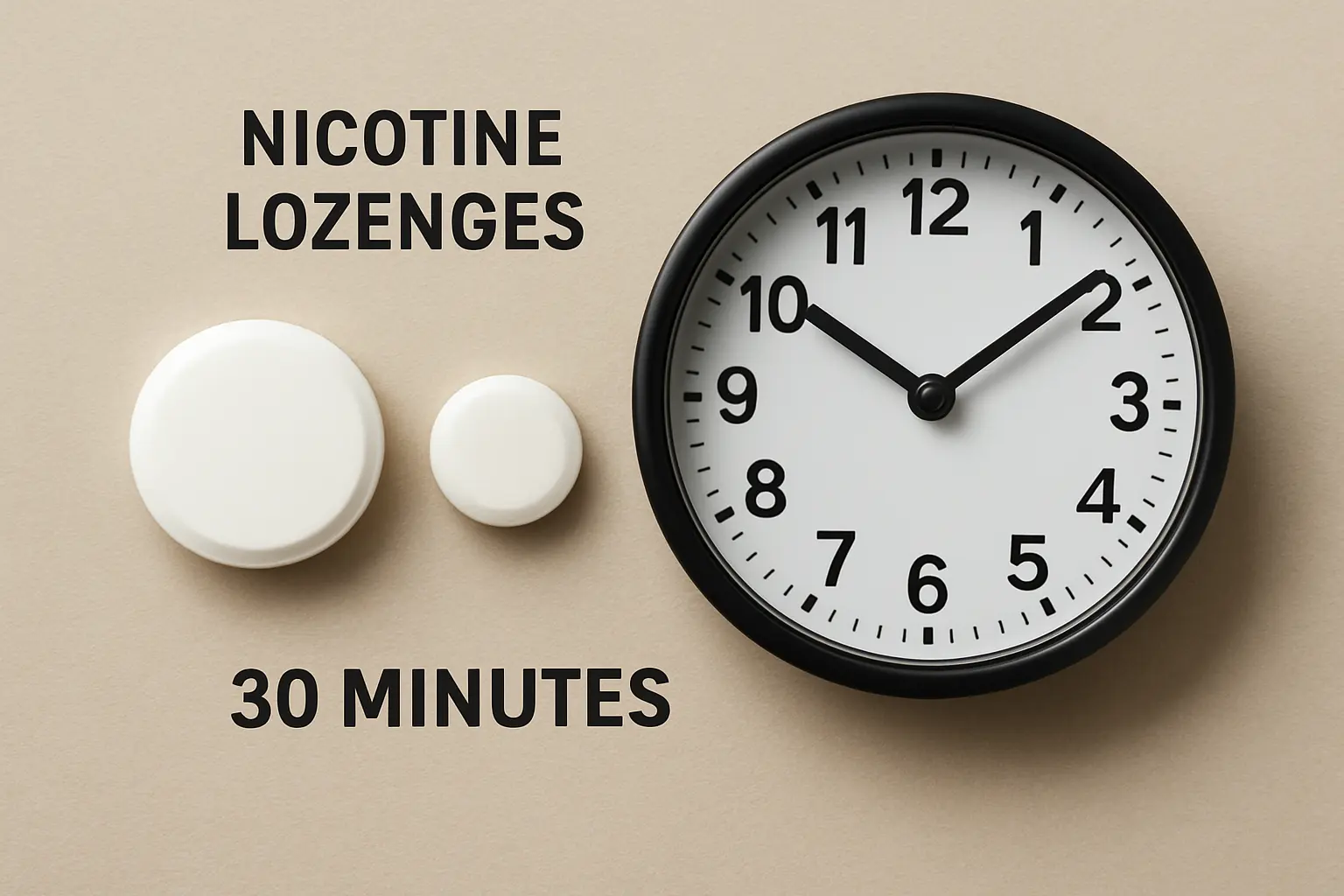
Every FDA-registered nicotine lozenge in the US, generic or brand-name, uses the same wording. A generic label filed with the FDA’s DailyMed database puts it plainly: “if you smoke your first cigarette more than 30 minutes after waking up, use 2 mg nicotine lozenge” and “if you smoke your first cigarette within 30 minutes of waking up, use 4 mg nicotine lozenge.” Nicorette’s own product page uses the identical rule for its lozenges: “For 2 mg: If you smoke your first cigarette more than 30 minutes after waking, use 2 mg lozenges. For 4 mg: If you smoke your first cigarette within 30 minutes of waking, use 4 mg lozenges.”
This time-to-first-cigarette question is a recognized proxy for how dependent your body is on nicotine — it is not asking how many cigarettes you smoke per day, which is the question used to size nicotine patch strength instead. Two people who both smoke a pack a day can land on different lozenge strengths depending purely on how soon after waking they light up, which is why the rule is worth checking honestly rather than assuming your pack-a-day habit automatically means 4 mg.
| First cigarette | Strength | Available as |
|---|---|---|
| More than 30 minutes after waking | 2 mg | Regular, Mini, generic store-brand |
| Within 30 minutes of waking | 4 mg | Regular, Mini, generic store-brand |
2 mg vs 4 mg: who each is for
The 2 mg lozenge is for smokers whose first cigarette comes later in the morning — a sign of comparatively lower physical dependence. The 4 mg lozenge is for smokers who reach for a cigarette within half an hour of getting up, which the label treats as a marker of a stronger habit that needs a bigger initial dose to blunt withdrawal. Choosing the lower strength when you actually qualify for 4 mg is the single most common reason people report that “the lozenge didn’t do anything” — under-dosing leaves real withdrawal symptoms unaddressed.
It is worth being honest with yourself here rather than picking the smaller number because it sounds gentler. If your habit genuinely fits the 4 mg description, starting on 2 mg usually means reaching for extra lozenges to compensate, which can push you toward the label’s daily maximum faster without ever quite catching up to the craving. The label’s own logic assumes you start at the strength that matches your actual smoking pattern, then step down on the same schedule regardless of which strength you started on.
For a side-by-side view of every NRT format rather than just lozenges, see our full comparison of NRT options, and if you want the complete format-by-format breakdown including sprays and inhalers, this guide to gum vs patch vs lozenge vs inhaler goes deeper.
Mini lozenge vs regular lozenge
Nicorette also sells a smaller “Mini Lozenge” alongside its regular and Coated lines, in the same 2 mg and 4 mg strengths with the identical 30-minute rule and the same 12-week schedule — the size is a convenience difference, not a dosing difference. Nicorette’s own marketing claims its Mini Lozenge “relieve[s] cravings in 3 minutes,” a company-reported figure measured against placebo for the 4 mg version specifically, not an independently verified figure, and not necessarily faster than the regular lozenge at the same strength.
Checked on Nicorette’s own store on 2026-09-19, a 20-count box of the 4 mg Mini Lozenge and the 2 mg Mini Lozenge were both priced at $12.49, and an 81-count box of either strength was $43.99 — strength does not change the price, only the count does.
The US Centers for Disease Control and Prevention (CDC) demonstrates correct lozenge technique in this short video — letting it dissolve slowly rather than chewing it, which matters for either strength or size.
How many a day, and the maximum
The label sets both a floor and a ceiling. To get the intended effect, the generic FDA label recommends using “at least 9 lozenges per day for the first 6 weeks” — using far fewer than that is another common way people under-treat their own cravings and then blame the product. At the other end, the same label warns: “Do not use more than 5 lozenges in 6 hours. Do not use more than 20 lozenges per day.” Using one after another without a break is also discouraged on the label because of hiccups, heartburn, or nausea.
You also should not eat or drink for 15 minutes before or during use, since food and acidic drinks (coffee, juice, soda) can reduce how much nicotine you absorb through the lining of your mouth. If you are used to drinking coffee first thing in the morning, that habit and your morning lozenge will compete for absorption unless you space them out — worth planning around if your first cigarette (and now your first lozenge) happens close to your first cup.
Nine lozenges a day at the low end of the label’s own guidance, for six weeks, is a real cost to plan for. Checked on Nicorette’s own store on 2026-09-19, an 81-count box of Mini Lozenges at either strength was $43.99, which works out to roughly $0.54 per lozenge — meaning nine lozenges a day would cost around $4.90 a day during the heaviest-use weeks, before the schedule tapers down and the daily count (and cost) falls.
The 12-week step-down schedule
Whichever strength you start on, the label lays out the same taper: one lozenge every 1–2 hours for weeks 1–6, stretching to every 2–4 hours for weeks 7–9, then every 4–8 hours for weeks 10–12, at which point you stop. The strength itself (2 mg or 4 mg) does not usually change mid-course the way patch strength does — you use the same strength throughout the 12 weeks unless a healthcare provider tells you otherwise.
What happens if you pick the wrong strength
Picking 2 mg when the label’s own rule says you qualify for 4 mg typically means the lozenge does not fully blunt your cravings, which can make it feel like NRT “doesn’t work” for you specifically — when the real issue is under-dosing. Going the other way, using 4 mg when 2 mg was indicated is less commonly a safety problem at label doses, but can bring on more of the label’s listed side effects (hiccups, mouth or throat irritation, nausea) without added benefit. If you are unsure which side of the 30-minute line you fall on, use your honest average over the last week or two rather than your best day.
Lozenge vs gum for the same smoker
Lozenges and gum use the identical 2 mg/4 mg, 30-minute decision rule and a similar step-down cadence, so the choice between them often comes down to preference rather than dependence level: lozenges dissolve passively and can be used without drawing attention, while gum requires active chewing and a “chew and park” technique. For a full breakdown of which fast-acting format suits which situation, see our comparison of the fastest-acting NRT options and the wider NRT format comparison.
Combining a lozenge with a patch
Some smokers use a patch for steady, all-day nicotine and a lozenge for breakthrough cravings on top of it — a combination approach that clinicians sometimes recommend for heavier smokers, though you should confirm with a pharmacist or doctor before combining any two NRT products rather than assuming it is automatically fine at any strength. If you are still deciding on the patch side of that combination, our guide to comparing patch brands covers the strength and step-down question for patches specifically, which follows a cigarettes-per-day rule rather than the lozenge’s time-to-first-cigarette rule — the two products are sized using different questions even when used together.
Log every craving, not just the ones you lose
Whichever strength you land on, iQuit’s free craving log lets you record the trigger, the time, and the intensity — so you can see in your own data whether you actually picked the right strength. It’s free on both app stores.
Download iQuit Free on Google Play Download on the App Store
Frequently Asked Questions
How do I know if I need the 2 mg or 4 mg lozenge?
Check how soon after waking you usually smoke your first cigarette. More than 30 minutes: use 2 mg. Within 30 minutes: use 4 mg. This is the rule printed on FDA-registered nicotine lozenge labels, generic and brand-name alike.
Is the Mini Lozenge weaker than the regular lozenge?
No. Mini Lozenges come in the same 2 mg and 4 mg strengths as regular lozenges, follow the same dosing rule, and are simply smaller and marketed as more discreet.
How many nicotine lozenges can I use in a day?
FDA labeling caps use at 20 lozenges per day and no more than 5 within any 6-hour window. For best results in the first 6 weeks, labels recommend using at least 9 a day.
Can I chew the lozenge like gum?
No. The label instructs you to let it dissolve slowly in your mouth, occasionally moving it from side to side, and specifically says not to chew or swallow it.
What if I pick the wrong lozenge strength?
Choosing 2 mg when you qualify for 4 mg often leaves cravings under-treated. Choosing 4 mg when 2 mg was indicated is not typically dangerous at label doses but can increase side effects like hiccups or nausea without extra benefit.
How long is the full lozenge treatment course?
Labels lay out a 12-week taper: roughly every 1-2 hours for weeks 1-6, every 2-4 hours for weeks 7-9, and every 4-8 hours for weeks 10-12, at the same strength throughout.
Should I eat or drink while using a lozenge?
Labels advise avoiding food and drink for 15 minutes before and during use, since it can interfere with how much nicotine your mouth absorbs.
Can I use a lozenge and a nicotine patch together?
Some people combine a steady patch with an on-demand lozenge for breakthrough cravings, but check with a pharmacist or doctor first rather than combining products on your own without guidance.
Does the lozenge strength change during the 12-week course?
No, unlike patches, the lozenge strength you start on generally stays the same throughout the 12 weeks; what changes is how often you use it, tapering from every 1-2 hours down to every 4-8 hours.