If you’ve searched nicotine patch success rate statistics before spending money on a box of patches or gum, you’ve probably run into the same headline everywhere: NRT “doubles your chances” of quitting. That’s true, but it’s a relative number, not a percentage of people who actually stop smoking — and the difference matters if you’re deciding what to buy.
The headline number and what it hides
The most-cited evidence on NRT comes from the Cochrane Collaboration, an independent network that pools randomized trials into systematic reviews. Its 2018 update (Hartmann-Boyce et al., Nicotine replacement therapy versus control for smoking cessation) combined 133 trials with 64,640 participants and found that any form of NRT raised the risk ratio of quitting to 1.55 (95% confidence interval 1.49–1.61) compared with placebo or no treatment.
Cochrane’s own plain-language summary of that result reads: “The chances of stopping smoking were increased by 50% to 60%.” That is the actual sentence Cochrane publishes — and notably, Cochrane does not attach an absolute quit-rate percentage to it. A risk ratio tells you how much more likely NRT users were to quit relative to a control group in the same trials; it does not, by itself, tell you what percentage of NRT users succeeded. Any article that states a specific “X% of NRT users quit” figure as if Cochrane published it is going further than the source actually goes.
Patch, gum, lozenge, inhaler, spray: the numbers by product
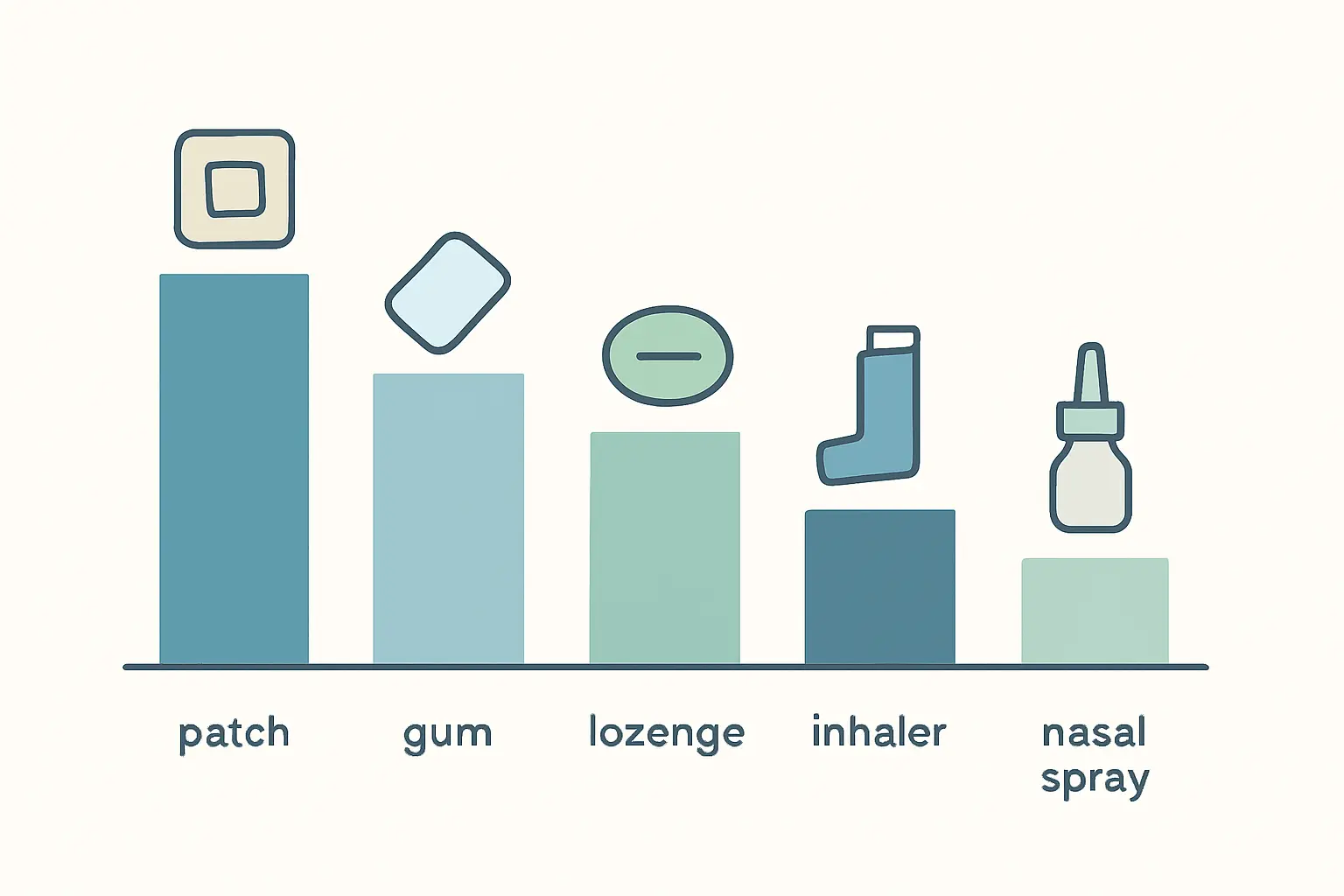
The same 2018 Cochrane review broke its pooled result down by product type. Each risk ratio below compares that specific product to a placebo control in the trials available:
| Product | Risk ratio (95% CI) | Trials / participants |
|---|---|---|
| Nicotine gum | 1.49 (1.40–1.60) | 56 trials, 22,581 |
| Transdermal patch | 1.64 (1.53–1.75) | 51 trials, 25,754 |
| Oral tablets / lozenges | 1.52 (1.32–1.74) | 8 trials, 4,439 |
| Nicotine inhalator | 1.90 (1.36–2.67) | 4 trials, 976 |
| Nicotine nasal spray | 2.02 (1.49–2.73) | 4 trials, 887 |
Two things stand out. First, patches and gum — the two most widely sold forms — sit close together and close to the overall average. Second, the inhalator and nasal spray show higher point estimates, but with far fewer trials and participants behind them, so their confidence intervals are wider and the true effect is less certain. A product having the highest number in this table doesn’t automatically mean it works best for you; it may just mean it has been tested less often.
A stop-smoking clinical lead from County Durham & Darlington NHS Foundation Trust walks through how the different NRT options work.
What “doubles your chances” means in real terms
“Doubles your chances” is a rounding-up of “increases by 50–60%,” and it is a comparison between two groups in the same trial conditions — usually adults who were already motivated to quit, often with some brief advice included in both arms. It does not mean that if you personally have, say, a 10% chance of quitting unaided, NRT guarantees you a 20% chance. Individual odds depend on how much you smoke, how long you’ve smoked, your stress levels, and how consistently you use the product — none of which a pooled risk ratio can capture for one person.
What the number does support is a simple decision rule: across tens of thousands of trial participants, using licensed NRT correctly made quitting more likely than not using it, by a wide and statistically solid margin. Cochrane rates this evidence as high-certainty, meaning further research is very unlikely to overturn the direction of the effect, even if exact numbers shift slightly between updates.
Combination NRT vs. single NRT
A newer Cochrane review (Theodoulou et al. 2023, Different doses, durations and modes of delivery of nicotine replacement therapy, 68 studies, 43,327 participants) asked a more specific question: does pairing a fast-acting form — gum, lozenge, spray — with a steady-dose patch beat using just one product? The answer, rated high-certainty, was yes: combination NRT produced a risk ratio of 1.27 (95% CI 1.17–1.37) over single-form NRT, from 16 studies covering 12,169 participants.
The same review found:
- Starting NRT before your quit day (“preloading”) rather than on the day itself was linked to a modest additional benefit (RR 1.25, 95% CI 1.08–1.44, 9 studies).
- Higher-dose patches (42/44 mg) performed about as well as standard-dose patches (21/22 mg) — the evidence didn’t show a clear extra benefit from going stronger (RR 1.09, 95% CI 0.93–1.29, not statistically significant).
- A 21 mg patch outperformed a 14 mg patch in one large trial (RR 1.48, 95% CI 1.06–2.08), suggesting under-dosing a patch is a real risk.
- Fast-acting NRT alone and patches alone performed similarly to each other when compared head-to-head (RR 0.90, 95% CI 0.77–1.05) — neither format has been shown to beat the other on its own.
Put together, the clearest, best-supported upgrade from the data isn’t a specific brand — it’s pairing a patch with a fast-acting product, at an adequate dose, rather than relying on one product at a low dose. For a side-by-side of what that looks like in practice, see our combination NRT vs. single NRT comparison.

Why real-world rates run lower than trial rates
Trial participants are not a random sample of everyone who tries to quit. Most NRT trials recruit adults who are already motivated, screen out people with certain health conditions, and often provide a baseline level of behavioral support to every arm of the study — including the placebo group. That baseline support alone raises quit rates above what an average unsupported quit attempt looks like outside a trial.
Outside a trial, people also use NRT differently: they may under-dose out of caution, stop early because of mild skin or mouth irritation, use it inconsistently around social smoking triggers, or buy less than they need because of cost. None of this shows up in a risk ratio calculated from people who, by definition, stayed in a structured study. This is a well-recognized gap in cessation research generally, not something specific to NRT — real-world “effectiveness” is consistently harder to demonstrate than trial “efficacy” for most quitting aids.
Adherence: the biggest lever you control
Across the studies above, the comparisons that moved the numbers most were dosing and duration, not brand: an adequate patch strength beat an inadequate one, and combining a patch with a fast-acting product beat either alone. None of the reviewed trials found that a specific consumer brand outperformed another brand at an equivalent dose and format — the active ingredient and the way it’s delivered are what the evidence tracks, not packaging.
In practice, this means the highest-leverage decisions are: use the product for the full recommended course rather than stopping once a craving passes, use an adequate dose rather than the lowest one “just to try it,” and add a fast-acting product for sudden cravings if you’re only using a patch. For the products themselves, see our comparison of NRT options and our guide to the fastest-acting NRT formats for cravings that hit hard and fast.
What raises your odds most for the same money
NRT is a pharmacological aid — it reduces withdrawal and craving intensity, but it doesn’t address the habit loops, triggers, and moments of boredom or stress that make cigarettes feel automatic. Free tools that log cravings, track streaks, and offer a distraction in the exact minute an urge hits can sit alongside NRT rather than instead of it. The iQuit app was built around that gap: it doesn’t claim to replace NRT or improve on any of the trial results above, but it gives you a free day counter, craving logging with your specific triggers, and SOS breathing and craving-surfing tools for the moments a patch alone doesn’t cover.
If your overall plan is still forming, our quit-method success rate comparison lines NRT up against cold turkey, prescription medication, and combined approaches so you can see where NRT fits before you buy anything. Our broader roundup of quit-smoking success rate statistics covers the same territory with additional context on how researchers define a “successful” quit.
Methodology: where these numbers come from
The figures in this article come from two Cochrane Database of Systematic Reviews entries: Nicotine replacement therapy versus control for smoking cessation (Hartmann-Boyce et al., 2018, CD000146.pub5) and Different doses, durations and modes of delivery of nicotine replacement therapy for smoking cessation (Theodoulou et al., 2023, CD013308.pub2), both accessed via their published abstracts. Cochrane reviews pool randomized controlled trials using a fixed-effect or random-effects meta-analysis and report a risk ratio with a 95% confidence interval; “abstinence” in these trials generally means continuous or point-prevalence abstinence verified at six months or later, biochemically validated where trials reported it. The UK’s National Institute for Health and Care Excellence (NICE guideline on tobacco dependence, NG209, published November 2021, last updated February 2025) recommends offering licensed stop-smoking pharmacotherapy, including NRT, to people who smoke and want support to quit. No absolute national “percentage of NRT users who quit” statistic was located in any source checked for this article, and none is asserted here.
Frequently Asked Questions
Does NRT really double your chance of quitting?
Cochrane’s review found NRT raises the odds of quitting by 50–60% compared with no NRT (risk ratio 1.55, 133 trials). “Doubling” is a common rounding of that relative increase — it describes the trial comparison, not a guaranteed personal outcome (Cochrane, CD000146.pub5, 2018).
What percentage of people who use NRT actually quit smoking?
No major review publishes a single absolute figure for this, because quit rates vary heavily by trial population, follow-up length, and support provided. Cochrane itself states the result only as a relative risk increase, not an absolute percentage (Cochrane evidence summary, CD000146).
Which NRT product has the best success rate: patch, gum, or lozenge?
Patches (RR 1.64) and gum (RR 1.49) have the most trial evidence behind them and sit close to the overall average effect. Inhalers and nasal sprays show higher point estimates but are based on far fewer trials, so their results are less precise (Cochrane, CD000146.pub5, 2018).
Is combination NRT (patch plus gum) more effective than one product alone?
Yes. A 2023 Cochrane review found combining a patch with a fast-acting form like gum or lozenge produced a risk ratio of 1.27 over using a single form, based on 16 studies and 12,169 participants, rated high-certainty evidence (Theodoulou et al., CD013308.pub2, 2023).
Does a higher-dose nicotine patch work better than a standard dose?
A 42/44 mg patch performed about the same as a standard 21/22 mg patch in the trials reviewed (RR 1.09, not statistically significant). However, a 21 mg patch clearly beat a 14 mg patch in one large trial, suggesting under-dosing is a bigger risk than over-dosing (Theodoulou et al., CD013308.pub2, 2023).
Why do real-world quit rates seem lower than the statistics in studies?
Trial participants are typically pre-screened, motivated volunteers who often receive some structured support in every study arm, including placebo groups. Outside a trial, people may under-dose, stop early, or use NRT inconsistently, none of which is captured in a pooled risk ratio from a controlled study.
Is it safe to start NRT before my quit date?
Nine trials in the 2023 Cochrane review tested “preloading” — using NRT before quit day while still smoking — and found a moderate-certainty benefit (RR 1.25, 95% CI 1.08–1.44). Follow product labeling and speak with a pharmacist or doctor about your specific health situation before changing how you use NRT (Theodoulou et al., CD013308.pub2, 2023).
Track your quit, whichever NRT you choose
iQuit is a free companion app for your quit attempt: log cravings and triggers, watch your smoke-free streak grow, and use SOS breathing and craving-surfing tools in the moments NRT alone doesn’t cover. It does not replace medical advice or NRT itself — it supports the habit-change side of quitting.
Download iQuit Free on Google Play
Download on the App Store