Using a quit smoking app with a stop smoking service is not a choice between the two. The service gives you a trained adviser, medicines and a breath test. The app gives you something to do at eleven on a Tuesday night when the next appointment is five days away. This guide sets out exactly what each one is good at, what to bring to a session, and how to set both up in the same week without doubling your workload.
What a Stop Smoking Service Actually Does
Start with the part that matters most: the NHS states that with professional or expert help you are three times more likely to quit for good, and that local Stop Smoking Services are free (NHS Better Health). No app has a claim anywhere near that, and any app that implies otherwise is selling you something.
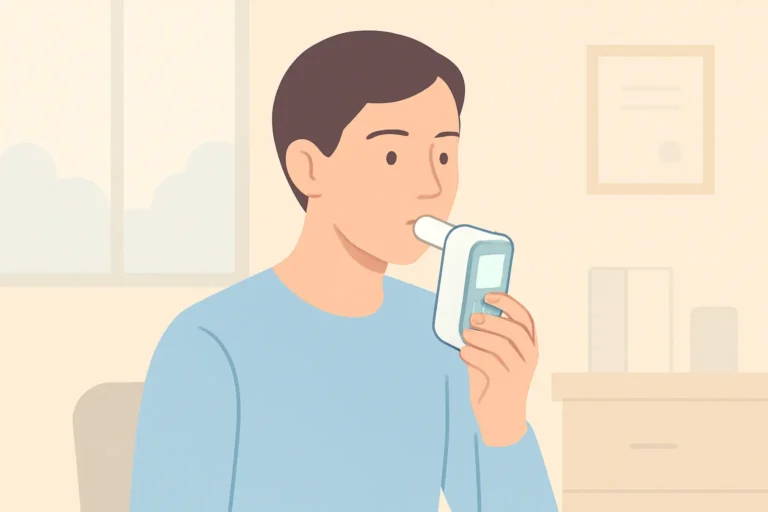
According to the NHS, an adviser can give expert advice and encouragement, run one-to-one or group sessions in person, by phone or online, help you choose nicotine replacement products or other stop smoking medicines, support you if you are using your own vape to quit, and measure your carbon monoxide level with a monitor. Stop smoking services usually offer support for up to 12 weeks in total.
The NHS page on stop smoking services adds the practical detail. Treatments made easy and affordable include nicotine replacement such as patches or gum, and medicines such as varenicline, cytisinicline and bupropion. Sessions might be at a GP surgery, a pharmacy, a high street shop or a mobile bus clinic. Your GP, pharmacist or health visitor can refer you, or you can phone the service yourself. At the first session you talk about why you smoke and what you have tried, agree a quit date, and are offered a breath test.
Outside England, the NHS points to Help Me Quit in Wales, NHS inform in Scotland and Quit Kit in Northern Ireland. In the United States, the CDC directs smokers to free telephone coaching on 1-800-QUIT-NOW (1-800-784-8669), with a Spanish line on 1-855-DÉJELO-YA (1-855-335-3569). Our directory of free services, helplines and apps covers the rest.
This short film from Public Health Scotland shows what that support looks like in practice.
What Happens Between Appointments
Here is the arithmetic that explains why people pair the two. A weekly appointment is one hour. A week is one hundred and sixty-eight. Everything that decides whether you are still quit at the next session happens in the other hundred and sixty-seven.
That is not a criticism of the service. It is how the service is designed: a trained adviser, a plan and a medicine, applied by you, in your own life, between visits. The problem is that by the time you sit down again, the week has blurred. You remember that Thursday was hard. You do not remember that three of your five worst cravings came between four and six in the afternoon, or that two of them followed a particular meeting.
What the App Covers That the Adviser Cannot
An app is not clever. It is simply present, which turns out to matter at three in the morning. Four things genuinely belong to it.
- The moment itself. Breathing exercises, grounding techniques, distraction tips and craving timers are one tap away when a craving arrives, rather than five days away.
- The record. Every craving logged with its trigger and intensity, plus mood alongside it, builds the evidence your memory will not.
- The counters. Days smoke-free, cigarettes avoided and money saved in your own currency, running continuously rather than being recalculated once a week.
- The recovery from a slip. Streak shields and slip recovery record a slip without wiping out the progress behind it, which makes people more likely to admit one rather than quietly drop out.
It also works offline, which matters on a commute or in a building with no signal. We cover why that design choice was made in offline-first design. And if your service runs remotely, our comparison of online versus in-person support is worth reading before you choose a format.
What the Adviser Covers That No App Can
This is the more important list, and it is worth being blunt about it.
| Task | Stop smoking service | Quit app |
|---|---|---|
| Choosing and prescribing stop smoking medicines | Yes, with a trained adviser or prescriber | No, and it should never try |
| Supplying nicotine replacement affordably | Yes | No |
| Measuring carbon monoxide in your breath | Yes, with a CO monitor | No |
| Adjusting a plan that is not working | Yes, in person and weekly | Only within what you tell it |
| Support at two in the morning | No | Yes |
| Logging every craving with its trigger | Not in real time | Yes |
| Continuous counters and milestones | No | Yes |
| Accountability to another person | Yes | Only through a community, which is not the same |
Read the first three rows again if you are tempted to use an app instead of a service. Medicines, nicotine replacement and CO readings are the components with the strongest evidence behind them, and an app supplies none of them. iQuit does not prescribe anything, does not measure carbon monoxide and is not a medication reminder. It says so here rather than leaving you to find out.
Booked your first appointment? Start logging cravings now, so you arrive with a week of real data rather than an impression. iQuit is free on Google Play and the App Store, and works alongside whatever your adviser recommends.
Bringing Your Craving Log to a Session
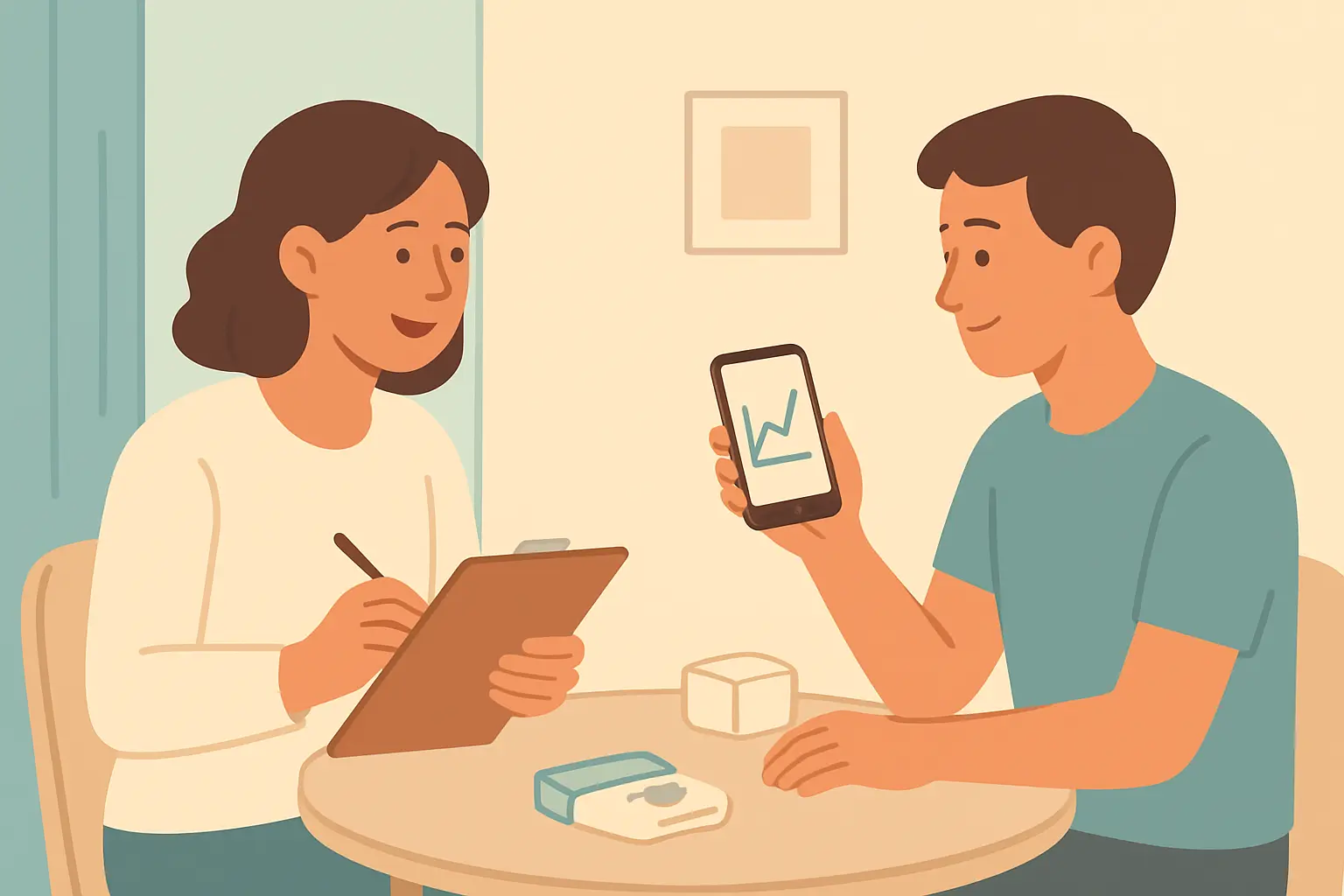
Advisers work from what you tell them. Most people tell them a feeling. If you arrive with a week of logged cravings instead, the same appointment does considerably more work.
- Open the craving log before you go in, not while you are sitting down.
- Find the pattern, not the total. The useful sentence is which hours and which situations repeat, not how many cravings you had.
- Bring the mood entries too. A run of low days is something an adviser can act on, and it matters more if you are taking a stop smoking medicine.
- Be honest about slips. Log them and show them. An adviser cannot adjust a plan around a slip they never hear about.
- Note what the SOS tools did and did not fix. If breathing works at your desk but not in the pub, that is a specific problem with a specific answer.
- Write down one question. Appointments are short and the question you meant to ask is the one you forget.
CO Readings and Your In-App Timeline
The carbon monoxide monitor is the one measurement in this whole process that neither you nor an app can fake, and it is quietly the most motivating thing in the room. The NHS explains that your CO level drops to the same level as a non-smoker just 48 hours after your last cigarette.
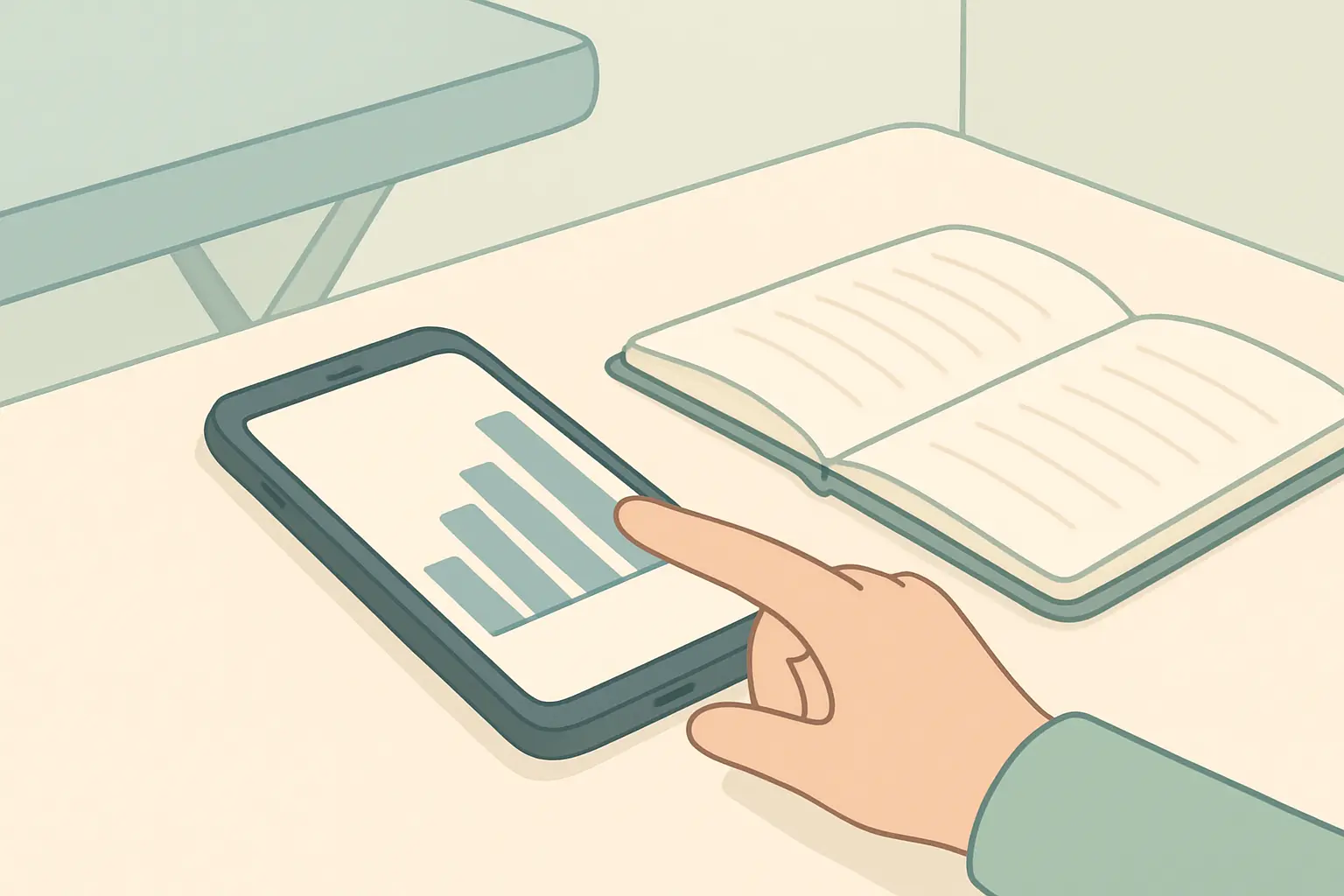
That gives you two independent records that should agree. The CO reading is an objective measurement taken at the clinic. The app’s timeline and day counter are a running record built from your quit date. When they line up, the number on the monitor stops being a clinic ritual and becomes a check on something you already believe.
A practical habit: note each CO reading in the app’s journal on the day you take it, with the date. Over the weeks of your program that gives you a short series you and your adviser can look at together, rather than a number you half-remember from a fortnight ago.
When the Structured Support Ends
The intensive part of a stop smoking service is finite. The NHS says stop smoking services usually offer support for up to 12 weeks in total, with information and professional support during the first few months you stop smoking. At some point that structured support ends, and that transition is where a lot of quit attempts quietly come apart.
Three things help.
- Do not stop logging on the day the appointments stop. Keep the craving log running for at least a month afterwards, even if entries become rare.
- Keep your medicine course going as prescribed. Finishing the course is a clinical question for your prescriber, not something the end of your appointments decides.
- Know how to get back in. Save the helpline number and the referral route now, while you have it in front of you. Needing a second attempt is ordinary, not a failure.
If cost is what is stopping you from continuing with any support, our list of free resources and tools covers what is available without paying, and our look at whether Premium is worth it is honest about when the free tier is enough.
Setting Both Up This Week
The whole pairing takes one phone call and about ten minutes of setup.
- Contact the service first. Ask your GP or pharmacist for a referral, or phone your local service directly. Availability and waiting times vary, so this is the step with a lead time.
- Install the app the same day and enter your real cigarettes a day, pack price and currency.
- Start logging cravings immediately, even before your quit date. A baseline week is the most useful thing you can bring to a first appointment.
- Agree your quit date with the adviser, then set exactly that date in the app so both records match.
- Follow the adviser on medicines, not the app, and never adjust a dose because of something you read in a tracker.
- Diary your appointments and do a five-minute log review the evening before each one.
If you are setting up on an iPhone, the ten-minute version of the app setup is in our guide to iQuit for iPhone, and the wider field is covered in the 2026 app round-up.
App and Service FAQ
Can a quit app replace a stop smoking service?
No. The NHS states that with professional or expert help you are three times more likely to quit for good, and the service is free. An app cannot prescribe medicines, supply nicotine replacement or measure carbon monoxide. Use the app between appointments, not instead of them (NHS Better Health).
What does a stop smoking adviser actually offer?
The NHS says advisers give expert advice and encouragement, run one-to-one or group sessions in person, by phone or online, help you choose nicotine replacement or stop smoking medicines, support you if you are using your own vape, and measure your carbon monoxide level with a monitor.
How long does the support last?
The NHS says stop smoking services usually offer support for up to 12 weeks in total, with information and professional support during the first few months you stop smoking. Exactly how sessions are spaced varies by local service.
Should I tell my adviser I am using an app?
Yes, and bring the craving log with you. Advisers work from what you report, so a week of logged triggers, intensities and mood entries gives them far more to work with than a general impression of how the week went. It also makes slips easier to raise.
Does iQuit track my carbon monoxide reading automatically?
No. iQuit does not connect to a CO monitor or any other device. You can note each reading in the journal yourself on the day it is taken, which gives you a short series to look at with your adviser, but the measurement itself only happens at the service.
How do I find a stop smoking service?
In England, your GP, pharmacist or health visitor can refer you, or you can phone the local service. The NHS points to Help Me Quit in Wales, NHS inform in Scotland and Quit Kit in Northern Ireland. In the United States, the CDC directs smokers to free phone coaching on 1-800-QUIT-NOW (1-800-784-8669).
What if I slip while I am on the program?
Log it with its trigger and tell your adviser at the next session. Streak shields and slip recovery in the app record a slip without erasing your progress, which makes it easier to keep going. Never stop a prescribed medicine because of a slip without speaking to your prescriber.
Is the app useful once my appointments finish?
That is arguably when it matters most. Keep the craving log running for at least a month after the structured support ends, keep the counters visible, and save the helpline number so you know how to get back in if you need a second attempt. Needing one is ordinary.
Keep the Service. Add the Days in Between.
iQuit logs cravings with triggers and intensity, keeps a mood journal beside them, and runs your days smoke-free and money saved continuously, so you arrive at each appointment with real data. It is not a substitute for your adviser or your medicines. Free on Google Play and the App Store.
Download iQuit Free on Google Play
Download on the App Store