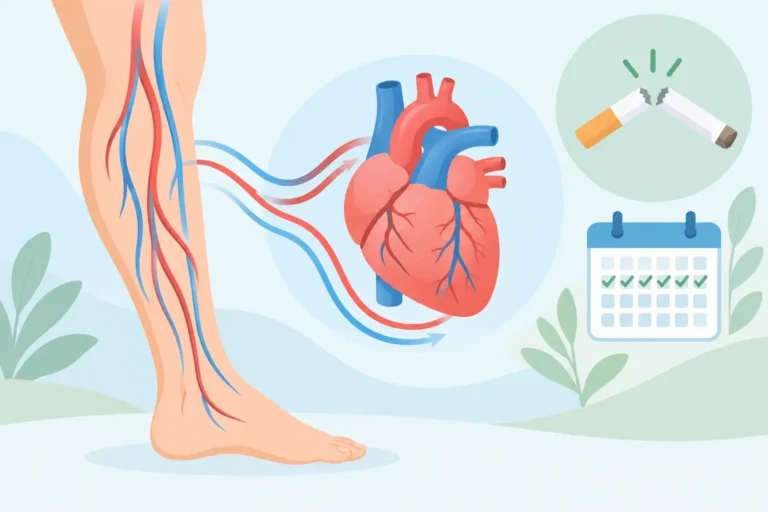
If you smoke and menopause is approaching, or already making life uncomfortable, you may have wondered whether the two are connected — and whether quitting now would actually change anything. Searching quitting smoking menopause hot flashes usually means weighing a hard habit change against symptoms that already feel hard enough. The honest evidence gives you a real, dated reason to act, without promising instant relief.
Does smoking make menopause worse?
The most directly documented answer comes from The Menopause Society, the leading US medical authority on menopause, which states plainly: “Both current and past cigarette smoking also increases the risk of hot flashes.” That single sentence covers a lot: it means the effect is not limited to people smoking right now during menopause — a smoking history earlier in life is also associated with a higher risk of hot flashes later.
The Menopause Society’s clinical guidance lists quitting smoking among the first-line lifestyle measures recommended for managing hot flashes, alongside keeping the body cool, regular exercise, and relaxation techniques such as paced breathing. That places quitting smoking in the same practical category as other everyday changes doctors actually recommend — not a vague “healthy lifestyle” gesture, but a specific, named intervention.
It is worth being precise about what this does and does not claim. Being listed as a risk factor and a recommended lifestyle measure is meaningfully different from being a proven treatment with a guaranteed effect size. What it does establish is that smoking status is not a neutral detail your doctor ignores when discussing menopause symptoms with you — it is specifically named, specifically discussed, and specifically actionable in a way many other risk factors at this life stage are not.
Earlier menopause in smokers
There is a well-established, broadly accepted association between smoking and reaching menopause earlier, tied to the idea that tobacco toxins can accelerate the loss of egg follicles in the ovaries. A 2026 genetic analysis looking specifically at primary ovarian insufficiency — a more severe, earlier form of ovarian failure — found only a suggestive, not statistically significant, link to cigarettes-per-day using Mendelian randomization (a method for testing causality using genetic data). The researchers were direct about the limits of their own finding, writing that “moderate effects cannot be excluded” even though this specific analysis did not prove causation for that specific condition.
That nuance matters: the broader, well-documented association between heavier smoking and somewhat earlier average menopause age is not the same claim as “smoking causes premature ovarian failure” — the evidence is stronger for the general pattern than for that specific, more severe condition. Either way, earlier menopause is generally associated with a longer stretch of reduced oestrogen exposure, which is part of why bone density (covered below) is a long-term consideration, not just an immediate symptom question.
Hot flashes and night sweats: what the data shows
Hot flashes and night sweats — together known clinically as vasomotor symptoms — affect up to 80% of women during the menopause transition, according to The Menopause Society, and last a mean of seven to ten years. That is a long average window, which is one reason even a modest risk factor like smoking is worth addressing rather than dismissing as minor.
| Question | What the evidence shows |
|---|---|
| How common are hot flashes at menopause? | Up to 80% of women (The Menopause Society) |
| How long do they typically last? | A mean of 7 to 10 years |
| Does smoking increase the risk? | Yes — both current and past smoking, per The Menopause Society |
| Is quitting a recommended management step? | Yes — listed among first-line lifestyle measures |
What happens to symptoms when you quit
Here is the honest limitation in the evidence: being a documented risk factor is not the same as a documented cure. The Menopause Society’s material supports smoking as a risk factor for hot flashes and quitting as a recommended lifestyle measure — it does not promise that quitting will make existing hot flashes disappear on a specific timeline, and no credible source makes that promise either. If you are already having hot flashes, quitting removes one contributing factor going forward; it is not positioned as a fast, standalone fix for symptoms already under way.
That is a genuinely fair trade-off to walk into with clear eyes: quitting is worth doing for this reason among several others, but it should sit alongside — not replace — the other management options your doctor discusses with you if hot flashes are significantly affecting your life.
It is also worth noting what smoking does not appear to do here: there is no fetched evidence that smoking is a uniquely dominant driver of hot flash severity compared with other established factors like body weight, genetics, and the natural pace of hormonal decline. Framing it as one modifiable factor among several — rather than the single explanation for how rough your particular experience of menopause is — keeps expectations realistic while still making the case for quitting on its own merits.
Quitting, HRT, and clot risk
Hormone replacement therapy (HRT) is the most effective treatment for bothersome hot flashes, and this is exactly where quitting smoking intersects with treatment choices in a concrete way. According to the NHS, “HRT tablets can increase the risk of blood clots, but the risk is still very low,” while “HRT patches, sprays and gels do not increase the risk of blood clots” in the same way. Separately, the NHS lists smoking as one of several independent risk factors for deep vein thrombosis (DVT), alongside taking HRT itself and the combined contraceptive pill.
None of this means HRT is off-limits if you smoke — plenty of smokers and ex-smokers use HRT safely under medical guidance, and patch, spray, or gel forms specifically sidestep the tablet-related clot signal. It does mean this is a genuinely useful, specific question to bring to a prescriber: “given that I smoke (or recently quit), is a non-tablet form of HRT a better starting point for me?” That is a much more useful conversation than avoiding HRT altogether out of general worry, and it is entirely a prescriber’s call to make with your full history in front of them.
Quitting before starting HRT is not a strict requirement in every case, and a prescriber may reasonably decide the benefit of controlling severe hot flashes outweighs waiting for a quit attempt to succeed first. What matters is that both facts — your smoking status and any HRT you are considering — are on the table together in that conversation, rather than treated as two separate, unrelated decisions.

Bone density: the long-term reason
Menopause itself accelerates bone density loss as oestrogen falls, and smoking is independently linked to weaker bones and a higher fracture risk — a combination that makes the years around menopause a genuinely important window for quitting, even setting hot flashes aside entirely. The full detail on the mechanism and risk numbers is covered in smoking and bone density, but the short version relevant here is that earlier menopause (potentially linked to heavier smoking, as covered above) means more years of lower oestrogen exposure — and bone protection is one of the clearest, most measurable long-term reasons to quit at this life stage rather than “eventually.”

Managing both at once
Quitting smoking during menopause is genuinely harder for some women, not easier — hormonal shifts can affect mood and stress tolerance right when you are trying to break a long-standing habit. A few practical notes worth keeping in mind:
- Expect withdrawal irritability and hot flashes to sometimes overlap in how they feel — having a plan for both (breathing techniques, layered clothing, a cool room) covers both bases at once
- Weight changes are a common worry during both menopause and quitting; the specific evidence-based approach is covered in preventing weight gain when you quit rather than trying to manage it by instinct
- If you are also tracking hormonal changes earlier in the transition, how quitting affects your menstrual cycle and hormones covers the perimenopausal period specifically
- Milestones help: many women find the six-month smoke-free mark is where cravings and mood both noticeably stabilize, which is worth knowing in advance if the first weeks feel like too much on top of menopause symptoms
The wider evidence-based health benefits of quitting cover the cardiovascular and cancer-risk reductions that matter especially in the post-menopausal years, when baseline cardiovascular risk already rises for every woman regardless of smoking history.
Frequently Asked Questions
Does smoking make menopause symptoms worse?
Yes, for hot flashes specifically. The Menopause Society states that both current and past cigarette smoking increase the risk of hot flashes, one of the most common and disruptive menopause symptoms.
Do smokers go through menopause earlier?
There is a well-documented general association between heavier smoking and somewhat earlier average menopause age, thought to relate to accelerated loss of ovarian follicles. A 2026 genetic study found only a suggestive, non-significant link specifically to primary ovarian insufficiency, a more severe condition, so the evidence is stronger for the general pattern than for that specific outcome.
Will quitting smoking stop my hot flashes?
Not necessarily, and not immediately. Quitting is a documented, recommended risk-reduction and lifestyle measure, but no credible source promises it will resolve hot flashes already under way on a specific timeline. It removes one contributing factor rather than acting as a standalone cure.
Can I take HRT if I smoke?
Often yes, under medical guidance. HRT tablets carry a small increased clot risk, while patches, sprays, and gels do not increase clot risk the same way. Smoking is a separate, independently listed risk factor for blood clots, so it is worth specifically asking your prescriber whether a non-tablet HRT form suits your situation.
Why does bone density matter for smokers going through menopause?
Menopause itself accelerates bone density loss as oestrogen falls, and smoking is independently linked to weaker bones. If smoking is also associated with somewhat earlier menopause, that combination means more cumulative years of lower oestrogen exposure, making quitting a meaningful long-term protective step.
Is quitting smoking during menopause harder than usual?
Many women find it more challenging, since hormonal shifts affecting mood and stress tolerance can overlap with nicotine withdrawal. Planning for both at once — rather than treating them as separate problems — tends to work better than tackling either in isolation.
One less variable to manage
iQuit’s mood and symptom journal helps you track patterns across withdrawal and menopause together, so you can see what is actually connected to what.
Download iQuit Free on Google Play
Download on the App Store