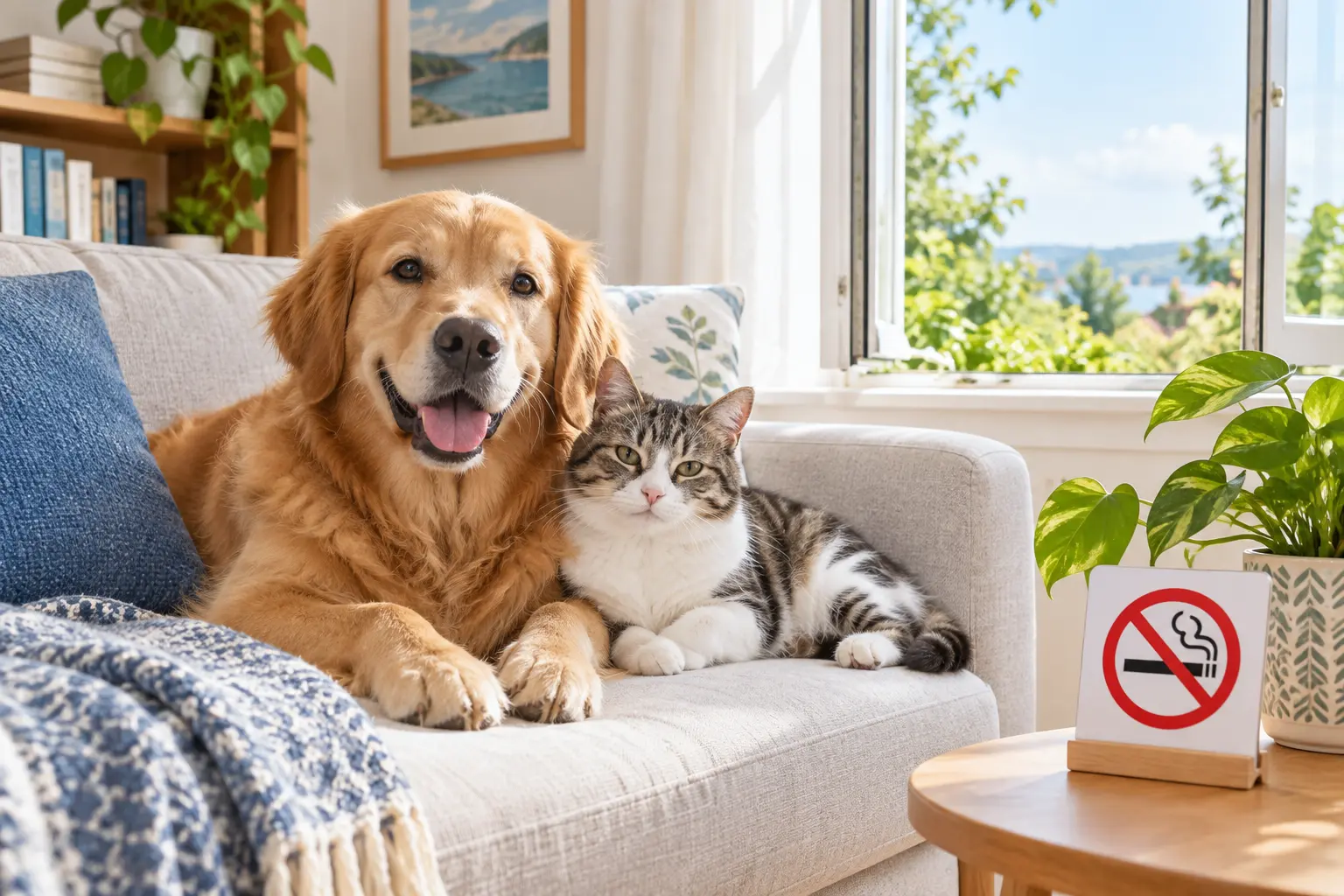
If you are asking is secondhand smoke bad for dogs (or cats), the honest answer is that the evidence points toward harm but is thinner than for people. This guide goes through what the studies actually found, what they could not show, how nicotine poisoning from butts and other products fits in, and what you can do today.
Short answer
Pets breathe the same smoky air you do, often at floor level and for many hours a day. Researchers have measured nicotine byproducts in pets’ bodies and studied whether smoke exposure is linked to disease. A 2026 scoping review concluded that, despite some inconsistencies, available evidence supports the harmful effects of secondhand smoke in pets. The same research is also honest about its limits: most studies are small, many rely on owner surveys, and results differ between dogs and cats.
We give numbers only where we opened the study. We do not inflate percentages. For the broader family picture, see our guide to secondhand smoke dangers for families, kids and pets, and for the human comparison, whether secondhand smoke is worse than smoking.
Dogs: what the studies show
Dog research is inconsistent. A 1992 case-control study of lung cancer in pet dogs, published in the American Journal of Epidemiology, found only a weak relation for exposure to a smoker in the home (odds ratio 1.6, 95% confidence interval 0.7 to 3.7). Because that interval includes 1.0, the result could be chance. The authors noted that risk seemed restricted to breeds with short and medium length noses, again with a wide interval, and described the findings as inconclusive.
A 2018 owner-survey study of 135 dogs with primary lung carcinoma and two control groups, in the Journal of Small Animal Practice, did not identify an association between secondhand smoke and primary lung cancer. Its authors noted that a definitive association has not been found in dogs and that limitations may have prevented detecting one. In short: for dogs, we cannot say smoke causes lung cancer, and we also cannot say it is safe.
VSEC, a veterinary emergency center, has a video titled “Cigarette and Nicotine Poisoning in Pets.” It covers a related risk, which we discuss further below.
Cats: lymphoma findings
The strongest single study is in cats. In a 2002 case-control study in the American Journal of Epidemiology, researchers compared 80 cats with malignant lymphoma with 114 cats with kidney disease at a Massachusetts veterinary teaching hospital. Owners reported the level of household smoking two years before diagnosis. After adjustment, cats with any household smoke exposure had a relative risk of malignant lymphoma of 2.4 (95% CI 1.2 to 4.5), and cats exposed for five or more years had a relative risk of 3.2 (95% CI 1.5 to 6.9). Risk rose with the duration and quantity of exposure. The authors concluded that passive smoking may increase the risk. See the abstract.
Caveats matter. This was one hospital, owners recalled exposure in hindsight, and the comparison group had kidney disease. A relative risk is not the same as saying 2.4 times as many cats will get lymphoma. Still, it is a consistent signal that is worth taking seriously, especially because the exposure is one you can remove.

What the latest review says
A 2026 scoping review in Tobacco Prevention and Cessation, Secondhand smoke and e-cigarette aerosol exposure in dogs and cats, analyzed 26 eligible articles. Of 11 studies on cancers, respiratory and cardiovascular diseases in dogs and cats, over half reported statistically significant associations with secondhand smoke. Biomarkers such as cotinine, a nicotine byproduct, were identified in serum, urine, fur and amniotic fluid, which confirms that pets absorb what is in the air. The review found no eligible studies on e-cigarette aerosol in pets, so we cannot say anything about vaping and pets from that source.
The authors also noted that awareness of secondhand smoke risks to pets may motivate owners to adopt smoke-free behaviors. That is the practical angle of this guide: you do not need certainty about the size of the risk to decide that less smoke around your pet is better.
Birds and small pets
People often ask about birds, rabbits, guinea pigs and other small animals. We did not find a source we could open and cite for those species, so we are not going to make claims about them. If you keep a small animal, ask your veterinarian. As a general principle, the same steps (no smoking indoors, no butts or nicotine products within reach) cost nothing and cannot hurt.
Cigarette butts and nicotine poisoning
Secondhand smoke is one risk; swallowing nicotine is another. A review in Tobacco Control, Tobacco and cigarette butt consumption in humans and animals, noted that nicotine in cigarette butts may cause vomiting and neurological toxicity. It also found that although reports of human and animal exposures number in the tens of thousands, severe toxic outcomes from butts are rare. Rare is not never: a 2016 case report described a fatal pericardial effusion in a dog after it ate cigarette butts. That is a single case, but it shows why butts should never be within reach.
The same logic applies to other nicotine products: gum, patches, lozenges, pouches and e-liquid. We did not find a source quantifying amounts that harm pets, so we will not give any numbers. Treat every nicotine product like a medication that must be stored out of reach. Our guide to nicotine poisoning symptoms and how much is too much covers the human side.
If your pet may have swallowed nicotine: call your veterinarian or the ASPCA Animal Poison Control Center. The ASPCA lists its number as (888) 426-4435, says it is available 24 hours a day, 365 days a year, and notes a consultation fee may apply. Do not wait for symptoms to appear.
Is smoking outside enough?
Many owners step outside to smoke. That is better than lighting up beside a pet, but we did not find a study testing whether outdoor smoking protects pets, so we cannot say it removes the risk. The cotinine found in pets’ fur suggests exposure is not limited to the moment smoke is in the air. Practical reasoning (not research): smoke and residue travel on clothes, hands and hair, and pets sit on your lap and sleep on your bed. The only way to remove the exposure is to stop smoking.
A smoke-free home plan
- No smoking indoors or in the car. Start today, even if you have not set a quit date.
- Keep nicotine out of reach. Cigarettes, butts, gum, patches, pouches and e-liquid belong in a closed cabinet.
- Empty ashtrays often and use a lidded outdoor container, not an open one.
- Wash hands and change clothes before cuddling your pet, as a stopgap.
- Save the vet number and the ASPCA line in your phone.
- Set a quit date. Our guide to setting a quit date walks you through it.
Quit for your pet (and for you)
Smokefree.gov’s quit plan builder lists reasons to quit that you can tick, and one of them is “for my pets.” Reasons matter, because they help in the hard moments. If a pet is yours, it can anchor a plan. Our guide on quitting smoking for your kids makes a similar point about family motivation, and our complete motivation guide covers staying power.
On method, Smokefree.gov says there is no single right way to quit, but medication can double your chances of quitting for good. The NHS says reaching 28 days smoke free makes you 5 times more likely to quit for good (NHS Better Health). In the US, 1-800-QUIT-NOW (1-800-784-8669) connects you with your state quitline (Smokefree.gov).
There is a money angle too. Vet bills are real, and so are cigarette costs. Our guide to how much money you save when you quit shows how quickly it adds up. A pet fund is a motivating place to put it.
Where iQuit fits
iQuit is free on Google Play and the App Store. Its dashboard shows days smoke-free, cigarettes avoided and money saved, so you can watch a vet-fund total grow while your streak does. You can log cravings with their triggers, use SOS tools such as breathing exercises and grounding when an urge hits, and quit cold turkey or gradually. iQuit is a support tool, not a medical treatment, and it does not replace advice from a doctor or veterinarian.
Frequently Asked Questions
Is secondhand smoke bad for dogs?
Probably, but the evidence is mixed. A 2026 scoping review of 26 articles found that over half of 11 studies on cancers, respiratory and cardiovascular disease in dogs and cats reported significant associations with secondhand smoke (scoping review). Individual dog studies are small, and a 2018 study found no link with lung cancer.
Is secondhand smoke bad for cats?
A 2002 case-control study of 80 cats with lymphoma and 114 comparison cats found cats with any household smoke exposure had 2.4 times the relative risk of malignant lymphoma, and 3.2 times with five or more years of exposure (Bertone et al., 2002). It is one study from one hospital, so treat it as a warning, not proof.
Does smoking outside keep pets safe?
We did not find a study that tests whether smoking outdoors protects pets, so we cannot promise it does. Researchers have found nicotine byproducts such as cotinine in pets’ fur, which suggests pets can carry exposure beyond the smoky room. The safest step for your pet is quitting; a smoke-free home is a strong second.
What should I do if my dog or cat eats a cigarette butt?
Call your vet or the ASPCA Animal Poison Control Center on (888) 426-4435, which says it is available 24/7 and that a consultation fee may apply (ASPCA). A review found nicotine in butts may cause vomiting and neurological toxicity, though severe outcomes were rare. Do not wait for symptoms.
Are nicotine gum, patches and pouches dangerous for pets?
They contain nicotine, so they should be treated like cigarettes and butts: stored where pets and children cannot reach them. We did not find a source giving safe or unsafe amounts for pets, so we do not give any. If a pet has swallowed one, call your vet or poison control straight away.
How can I make my home safer for my pet right now?
Stop smoking indoors and in your car, store all nicotine products and butts out of reach, and empty ashtrays daily. Then plan to quit. Smokefree.gov lists “for my pets” among the reasons you can pick in its quit plan (Smokefree.gov). Ask a pharmacist or doctor about medication.
Can a free app help me quit for my pet?
It can help you stay on track. iQuit is free on Google Play and the App Store, shows days smoke-free, cigarettes avoided and money saved, lets you log cravings and has SOS breathing tools and an AI coach. It is a support tool, not a medical treatment, and does not replace advice from a doctor or vet.
Quit with your pet in mind
Track your smoke-free days, your cravings and the money you save for the vet. iQuit is free on Google Play and the App Store.