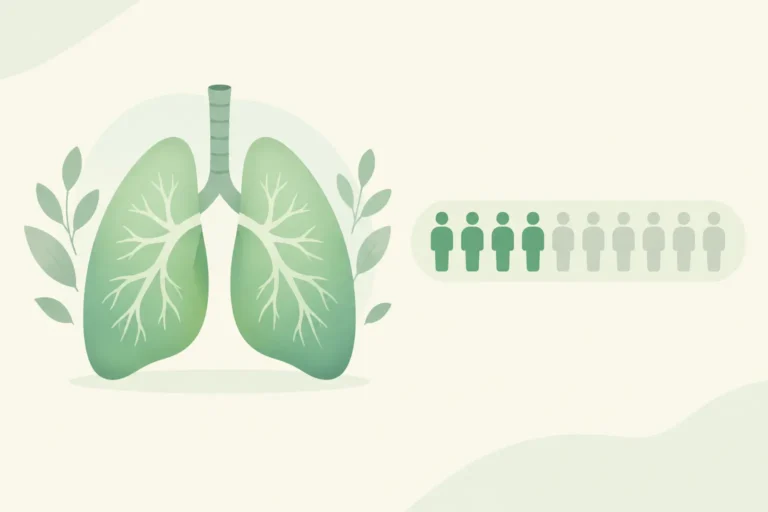
The most current, government-published smoking statistics Ireland data comes from the Healthy Ireland Survey 2025, the eleventh wave of Ireland’s annual national health survey. It puts the country’s smoking rate at 17% — a figure worth sitting with, because Ireland once set an official target of under 5% by this very year.
Key figures at a glance
| Metric | 2025 figure |
|---|---|
| Current smokers (daily + occasional) | 17% (13% daily, 4% occasional) |
| Ex-smokers | 30% |
| Never smoked | 53% |
| Current e-cigarette users | 8% (5% daily, 3% occasional) |
| Current nicotine pouch users | 1% |
| Attempted to quit in past 12 months (of current smokers) | 46% |
Adult prevalence and the 10-year trend
Smoking prevalence in Ireland has fallen substantially since the survey began, but that decline has flattened out in recent years. From 2015 to 2025 (no survey was run in 2020 due to COVID-19 restrictions), the reported rate moved: 23% (2015), 23% (2016), 22% (2017), 20% (2018), 17% (2019), 18% (2021), 18% (2022), 18% (2023), 17% (2024), 17% (2025). In the survey’s own words: “Smoking rates have remained broadly static since 2019.” Most of the improvement Ireland has seen happened between 2017 and 2019; the six years since have been close to flat.
Look at the shape of that curve and two distinct periods emerge. Between 2015 and 2019, Ireland cut its smoking rate by 6 percentage points in just four years — a genuinely fast decline by international standards. Since then, the rate has moved within a narrow 17-18% band for six consecutive survey waves. Whatever combination of price rises, plain packaging, workplace and public-space smoking bans, and public health messaging drove the earlier fall appears to have run into diminishing returns against a harder core of remaining smokers.
HSE Ireland’s own quit-smoking advice, aimed at people considering a quit attempt.
For how Ireland compares with other countries, see our smoking rates by country ranking, and for the UK’s parallel trend, our UK smoking statistics roundup.
By age, sex, and education
The 2025 survey found men still smoke more than women overall — 20% of men versus 14% of women, daily or occasionally — though the gap has narrowed since 2015, when it was 24% versus 21%. The 25-34 age group has the highest smoking rate of any age band at 22% (16% daily, 6% occasional), a group that has actually seen the sharpest decline of any age band since 2015, when it stood at 32%. At the other end of the age range, people aged 75 and older smoke the least, at just 6% (down from 7% in 2015).
The pattern within younger age groups is more mixed than a simple “everyone is quitting” story. Among 15-24 year-olds, smoking fell for women (19% in 2015 to 13% in 2025) but actually rose slightly for men (19% to 21%) over the same period. A similar divergence shows up among 35-44 year-olds, where women’s smoking rate fell faster (25% to 13%) than men’s (28% to 24%). Overall, women’s smoking rate has dropped further than men’s across nearly every age band since 2015 — a genuine narrowing of what was historically a wide sex gap, but one driven almost entirely by women quitting rather than men doing so at the same pace.
Education tracks smoking rates closely: people with a Leaving Certificate or lower level of education smoke at 21%, nearly double the 11% rate among those with higher levels of education — a gap the survey notes “is consistent with findings from 2015.” The average age Irish smokers report trying their first cigarette is 16, and the average age of starting daily smoking is 18; men typically start about a year earlier than women on both measures (first cigarette: men 15, women 16; daily smoking: men 18, women 19). People with no formal education or only primary-level education start earlier still, trying their first cigarette around age 15 and smoking daily by 17, compared with 16 and 19 respectively for those with a degree or higher.
Vaping and nicotine pouches in Ireland
E-cigarette use has held steady at 8% of the population (5% daily, 3% occasionally) across 2023, 2024, and 2025 — flat, not rising, contrary to how the trend is sometimes described. Separately, the share of people who say they tried vaping in the past but no longer use e-cigarettes has crept up, from 13% in 2024 to 15% in 2025. Uptake is concentrated among the young: 18% of 15-24 year-olds currently vape, and within that age group, usage is now higher among young women (19%) than young men (16%) — a reversal from 2024, when young men vaped more.
Among e-cigarette users overall, half (50%) are ex-smokers, a third (33%) are current smokers, and the remaining 17% have never smoked cigarettes at all. Device preference splits by age: younger users lean toward disposable devices (50% of 15-24 users, 52% of 25-34 users), while users aged 45 and older mostly use refillable devices (67%). Fruit flavours dominate among younger vapers (81% of 15-24 users use fruit-flavoured liquid at least monthly), while older users are more likely to stick with tobacco flavour (41% of 45+ users).
Nicotine pouches remain a small niche by comparison: just 1% of the population currently uses them daily or occasionally, and 93% have never tried one at all. Usage is highest among men aged 15-24 (5%).
Cigarette prices and excise after Budget 2026
Ireland’s Budget 2026, delivered in October 2025, raised excise duty on a pack of 20 cigarettes by 50 cents, effective from budget night — pushing popular brands close to €19 a pack for the first time. A separate new tax on vaping was introduced alongside it: 50 cents per millilitre on nicotine-containing e-liquid, effective 1 November 2025, adding roughly €1.23 to a typical disposable vape and pushing a common 10ml bottle of reusable vape liquid from around €5 to about €11.15. For a fuller international price comparison, see our cigarette prices by country guide and our cigarette tax by country breakdown.
Tobacco Free Ireland: progress against the 5% target
In 2013, Ireland’s then-Minister for Health, Dr James Reilly, wrote in the foreword to the Tobacco Free Ireland policy: “I am pleased that the target date of 2025 has now been set for Ireland to become tobacco free – less than 5% of the population smoking.” That target year has now passed. The actual 2025 figure, per the Healthy Ireland Survey, is 17% — more than three times the goal. This isn’t a case of the target being narrowly missed; it reflects a plateau that set in around 2019, years before the target date arrived, after which national prevalence essentially stopped falling.
The same 2013 policy document cited a 2013-era baseline of “5,200 people die every year from smoking related diseases in Ireland” and roughly €500 million in 2009 health expenditure directly attributable to smoking-related disease — figures that predate the current survey data and shouldn’t be read as current 2025/2026 estimates, but which illustrate the scale of harm the 5% target was designed to address.
None of this means Ireland’s tobacco control efforts have failed outright — the country’s smoking rate has still dropped by nearly a third since 2015 (23% to 17%), and youth smoking-adjacent metrics like “never smoked” have risen. But the specific, published 5%-by-2025 target was not met, and describing Ireland as on track toward “tobacco free” status without noting that gap would be misleading.
Quit attempts and how people actually quit
46% of current smokers say they tried to quit in the past 12 months — almost identical to the 45% recorded back in 2015. What’s changed is how they tried: in 2025, 67% of smokers who attempted to quit did so with no quitting aid of any kind, up sharply from 48% in 2015. Of the 33% who did use some kind of aid, nicotine replacement products (patches, gum, lozenges, spray) were the most common at 18%, followed by e-cigarettes at 11%, tobacco-free nicotine pouches or pods at 2%, and the HSE’s own www.quit.ie service, a hypnotist, another aid, or prescribed medication each at 1%.
30% of current smokers say they’re either actively trying to quit right now (14%) or planning to (16%) — down somewhat from a combined 32% in 2015 (11% trying, 21% planning), though the split has shifted, with more smokers now saying they’re actively trying rather than just planning. Notably, 19% of people who attempted to quit in the last year say they are not currently planning another attempt, slightly higher than 15% in 2015 — a small but real increase in people who tried once, didn’t succeed, and aren’t currently gearing up to try again.
For method-by-method comparisons that go beyond what Ireland’s national survey tracks, see our smoking cessation statistics roundup.
Methodology
All prevalence, trend, and quit-attempt figures in this article come from the Healthy Ireland Survey 2025 Summary Report, Wave 11 of an annual survey commissioned by Ireland’s Department of Health and conducted by Ipsos B&A. Fieldwork ran from November 2024 to April 2025 with a sample of approximately 7,500 people aged 15 and older, representative of the population living in Ireland. The first five waves (2015-2019) used face-to-face interviews; the 2020 wave was cancelled due to COVID-19 restrictions, and the survey has used telephone interviewing since 2021 — a methodology change worth keeping in mind when comparing pre- and post-2020 figures directly, since a switch in survey mode can itself shift self-reported results independent of any real behaviour change. Budget and pricing figures come from Budget 2026 coverage published by RTE, Ireland’s national broadcaster. The Tobacco Free Ireland target comes from the Department of Health’s 2013 policy document of the same name.
Frequently Asked Questions
What percentage of people in Ireland smoke?
17% of the population are current smokers (13% daily, 4% occasional), according to the Healthy Ireland Survey 2025, Wave 11, fieldwork November 2024 to April 2025.
Did Ireland meet its Tobacco Free Ireland target?
No. Tobacco Free Ireland, launched in 2013, set a target of under 5% smoking prevalence by 2025. The actual 2025 rate was 17%, more than three times the target, based on the Healthy Ireland Survey 2025.
Who smokes the most in Ireland?
Adults aged 25 to 34 have the highest smoking rate at 22%, and men smoke more than women overall (20% versus 14% in 2025). People with a Leaving Certificate or lower level of education smoke at nearly double the rate of those with higher education (21% versus 11%).
How many people in Ireland vape?
8% of the population currently use e-cigarettes (5% daily, 3% occasional) as of the 2025 Healthy Ireland Survey, unchanged since 2023, while 77% have never tried one.
How much does a pack of cigarettes cost in Ireland after Budget 2026?
Budget 2026 raised excise duty on a pack of 20 cigarettes by 50 cents, pushing popular brands close to €19, effective from budget night in October 2025 (RTE, Budget 2026 coverage).
What percentage of Irish smokers try to quit each year?
46% of current smokers report attempting to quit in the past 12 months, similar to 45% in 2015, according to the Healthy Ireland Survey 2025. However, 67% of smokers used no quitting aid at all during their last attempt.
Start your own quit attempt today
Two-thirds of Irish smokers’ last quit attempt used no support at all. iQuit gives you a free craving log, SOS breathing tools, a euro-based savings tracker, and a day counter to try a different approach.
Download iQuit Free on Google Play
Download on the App Store