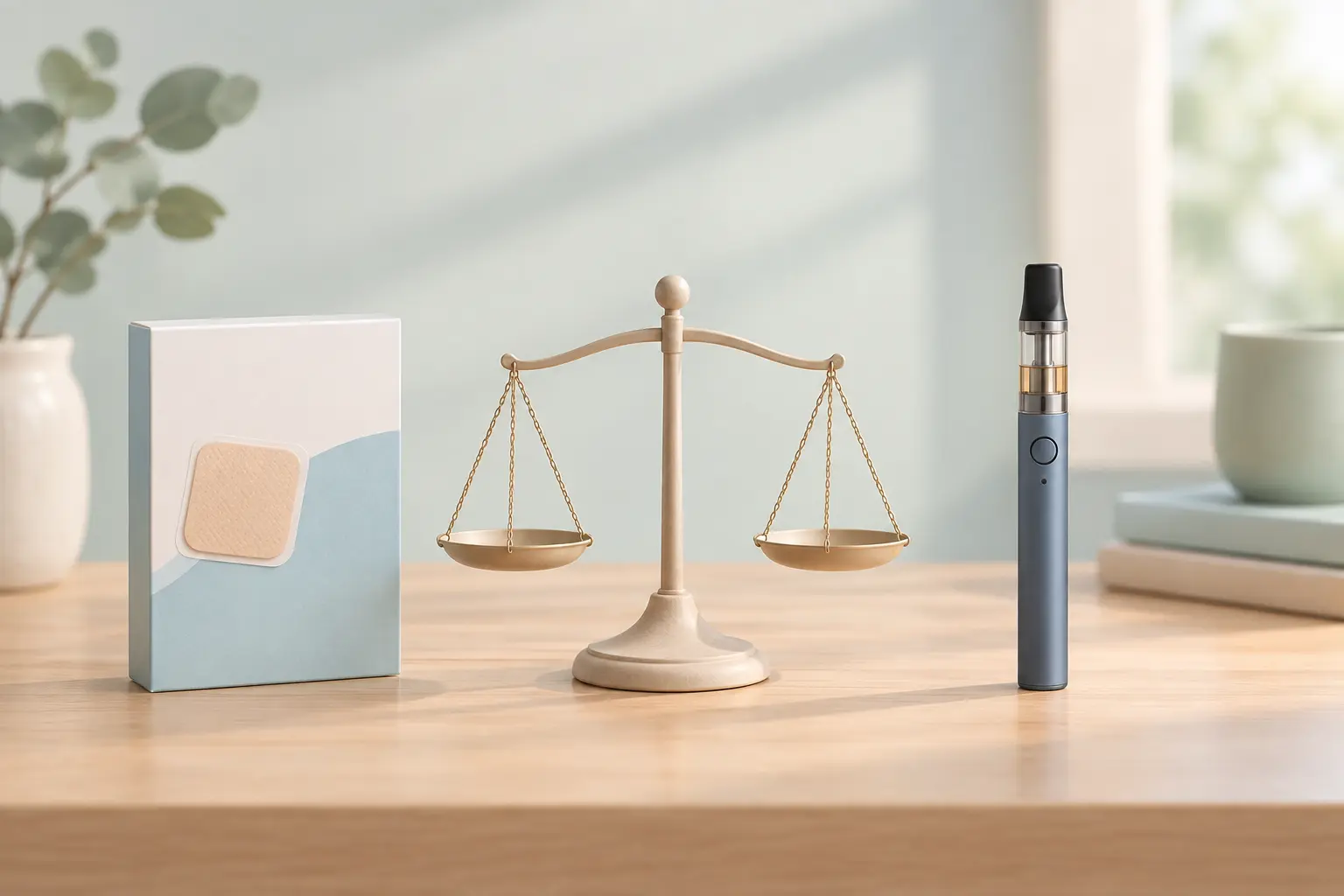
Choosing between vaping vs nicotine patches to quit smoking is a real decision, and the evidence is stronger than most people expect. In the best-known head-to-head trial, adults given an e-cigarette starter pack were more likely to be smoke-free at one year than adults given nicotine replacement of their choice. But there is a catch that rarely makes the headline: most of the successful vapers were still vaping a year later. This guide goes through the trial and the latest Cochrane review, what the FDA and the NHS say, and how to pick. It is general information, not medical advice. For vaping alone, see does vaping help you quit.
The short answer by country
In the UK, the NHS says nicotine vapes “can be a good way to quit smoking” for adult smokers, while also saying vapes “are not completely harmless”. In the US, the FDA’s list of approved cessation products names patches, gum, lozenges, nicotine spray, the nicotine inhaler, varenicline and bupropion, and no e-cigarette appears on it.
So the science and the regulatory position point in slightly different directions. The research says nicotine e-cigarettes can help people quit better than nicotine replacement does. The FDA has simply not approved one as a quit-smoking product. Whichever you choose, the goal is the same: stop smoking completely, and eventually stop the nicotine too.
What the trials compared
The key study is a randomized trial published in the New England Journal of Medicine, 2019. It enrolled 886 adults attending UK NHS stop-smoking services. One group received nicotine-replacement products of their choice, including combinations, for up to 3 months. The other received an e-cigarette starter pack with refillable e-liquid at 18 mg per milliliter. Both groups received weekly behavioral support for at least 4 weeks, and the main outcome was sustained abstinence for 1 year, validated biochemically.
The wider evidence is summarized in the latest Cochrane review, a living review by Lindson and colleagues. Its 2026 update (first published in August 2026, searches to 1 January 2026) includes 80 completed randomized trials with 29,861 participants. Note that these studies tested regulated, nicotine-containing e-cigarettes, and the authors caution that illicit products or products with other active substances may have different harm profiles.
Quit rates: what the numbers say
In the NEJM trial, the 1-year abstinence rate was 18.0% in the e-cigarette group and 9.9% in the nicotine-replacement group (relative risk 1.83; 95% confidence interval 1.30 to 2.58). We report the one-year figure exactly as published and did not find a six-month figure in the abstract.
The Cochrane update found that nicotine e-cigarettes increase quit rates compared with NRT, and rates this as high-certainty evidence: relative risk 1.61 (95% CI 1.23 to 2.12), from 11 studies with 4,114 participants. In absolute terms, it says this might translate to an additional four quitters per 100 (95% CI 1 to 7 more). That is a real but modest gain, not a guarantee for any one person.
| Source | Result | Certainty or design |
|---|---|---|
| NEJM trial, 886 participants, 1-year abstinence | 18.0% vs 9.9% (RR 1.83) | Single randomized trial with behavioral support |
| Cochrane update, 11 studies, 4,114 participants | RR 1.61 (95% CI 1.23 to 2.12) | High-certainty evidence |
For wider context on how quit rates are measured, see quit smoking success rates.
Still using the product at one year
This is the trade-off the headline skips. In the NEJM trial, among participants who were abstinent at one year, 80% of the e-cigarette group (63 of 79) were still using their assigned product at 52 weeks, compared with 9% of the nicotine-replacement group (4 of 44).
That means many of the vapers who quit smoking had swapped one nicotine habit for another. For some people that is an acceptable step, because the NHS says vapes give “the nicotine hit without the harmful chemicals that come from burning tobacco”. For others, the aim is to be free of nicotine altogether, and a patch with a defined course fits that better. NHS general advice is to use stop-smoking products for at least 12 weeks, or longer if needed.

Safety and side effects
In the NEJM trial, throat or mouth irritation was reported more often in the e-cigarette group (65.3%, versus 51.2% in the NRT group), and nausea was more common with NRT (37.9%, versus 31.3%). The e-cigarette group reported larger declines in cough and phlegm from baseline to 52 weeks (relative risk for cough 0.8; for phlegm 0.7). There were no significant differences in wheezing or shortness of breath.
The Cochrane update says the proportion of participants with serious adverse events is probably similar between nicotine e-cigarettes and NRT (moderate-certainty evidence). It concludes: “We did not detect evidence of serious short-term harm from nicotine EC, but longer, larger trials are needed to fully evaluate safety.” That is not the same as proving long-term safety. For how vaping compares with smoking itself, see whether vaping is worse than smoking.
A short video on e-cigarettes for quitting
This short Cancer Research UK video looks at e-cigarettes as a smoking cessation tool. It is older than the latest Cochrane update, so read it alongside the numbers above.
Cost per month
We did not verify a current monthly price for vape devices, e-liquid or patches for this guide, so we will not quote one. Prices vary by brand, store and country, and the cheapest option on paper is not always the one you will stick with. For a US snapshot of how nicotine replacement is priced, our guide to the best nicotine gum lists dated per-piece prices, and every NRT form compared covers the other forms.
US vs UK guidance
The FDA consumer update (content current as of July 2022) lists the FDA-approved over-the-counter products as skin patches, chewing gum and lozenges, with nicotine spray and the nicotine inhaler by prescription, and varenicline and bupropion as non-nicotine prescriptions. E-cigarettes are not in that list.
The FDA e-cigarette page (content current as of August 17, 2026) says products marketed for therapeutic purposes, such as to help people quit smoking, are regulated by FDA’s Center for Drug Evaluation and Research. It says e-cigarettes the agency has authorized were found to meet its statutory public health standard, which is not the same as being approved as a quit-smoking treatment. It also says adults who smoke may reduce exposure to many harmful chemicals by switching completely from cigarettes to e-cigarettes, but that “long periods of dual use of cigarettes and e-cigarettes can result in harms to health similar to, or in addition to, the harms from exclusive use of cigarettes.”
In the UK, the NHS stop-smoking products guide lists vapes alongside NRT and nicotine-free medicines as proven options, and recommends vaping only for adult smokers. For the UK’s national scheme, see the UK’s free vape scheme.
Who should pick which
This is not medical advice, but here is a fair way to think about it:
- If you want the best odds on the evidence and accept a nicotine device for a while: a nicotine e-cigarette has the better quit-rate evidence against NRT, with the one-year caveat above.
- If you want a defined end date: NRT, with a course you can step down from, is easier to finish. Gum and patch together can also help; see patch plus a fast-acting NRT.
- If you live in the US and want an FDA-approved route: NRT or a prescription medicine is what the FDA lists.
- If you are under 18, pregnant or have a heart condition: talk to a clinician first. The NHS says children and non-smokers should never vape.
The worst outcome is the one the FDA warns about: dual use, smoking and vaping together for a long period, instead of stopping smoking.
How to get off the vape afterwards
If you choose a vape and it works, plan the exit from the start. Decide on a review date and a plan to reduce, and treat the vape the same way you would treat any quit. Our guide to quitting vaping cold turkey covers the first week, and nicotine gum is another step-down route; see the best nicotine gum.
In iQuit, the craving log with triggers and intensity helps you see when cravings break through, which is useful to discuss with a pharmacist if you are weighing a fast-acting top-up, and craving forecasts show when your risky hours are likely to fall. You can quit your way, cold turkey or gradual reduction, and the SOS tools are there when a craving breaks through. iQuit is free on Google Play and the App Store.

Frequently Asked Questions
Are e-cigarettes better than nicotine patches for quitting smoking?
In trials, yes on average. The 2026 Cochrane update found nicotine e-cigarettes increase quit rates compared with NRT, rated high-certainty evidence, with a relative risk of 1.61 (95% CI 1.23 to 2.12). That is roughly four extra quitters per 100 (Cochrane, CD010216).
What did the 2019 NEJM trial find?
Among 886 adults at UK NHS stop-smoking services, 1-year abstinence was 18.0% with an e-cigarette starter pack versus 9.9% with nicotine replacement of choice (relative risk 1.83; 95% CI 1.30 to 2.58). Both groups had behavioral support (NEJM, 2019).
Do people keep vaping after they quit smoking?
Many do. Among participants who were abstinent at one year in the NEJM trial, 80% of the e-cigarette group (63 of 79) were still using their assigned product at 52 weeks versus 9% of the NRT group (4 of 44) (NEJM, 2019).
Has the FDA approved vaping to quit smoking?
The FDA’s list of approved cessation products names patches, gum, lozenges, nicotine spray, the nicotine inhaler, varenicline and bupropion, and does not include e-cigarettes. Products marketed to help quit smoking are regulated by the FDA’s drug center (FDA consumer update, FDA e-cigarette page).
Are vapes safe for quitting smoking?
The NHS says vapes are not completely harmless but are safer than cigarettes. The Cochrane update found no evidence of serious short-term harm from regulated nicotine e-cigarettes, but says longer, larger trials are needed to evaluate safety fully (NHS; Cochrane).
Is dual use of cigarettes and vapes okay?
The FDA says long periods of dual use can result in harms similar to, or in addition to, the harms from exclusive use of cigarettes, and that smokers need to switch completely to get the full benefit. The aim is to stop smoking entirely (FDA e-cigarette page).
Should I use a patch and gum together?
Combining a slow-acting patch with a fast-acting form such as gum or a mouth spray is a common approach, and the NHS says using more than one NRT can be highly effective. Speak with a pharmacist about the right combination for you (NHS).
How can iQuit help whichever I choose?
iQuit is free on Google Play and the App Store. Its craving log records triggers and intensity, craving forecasts show when your risky hours are likely to fall, and SOS tools help in the moment. It supports your quit alongside any product and does not replace medical advice (iQuit product facts).
Make your quit plan with iQuit
iQuit is free to download on Google Play and the App Store. Log cravings with triggers and intensity, see craving forecasts before your risky hours, and use the SOS tools when a craving hits, whether you choose a patch, a vape or neither.
Download iQuit Free on Google Play Download on the App Store