
If you have decided to quit vaping cold turkey, you do not need a lecture. You need a plan for the next seven days, because the first week is where most of the difficulty sits. This guide gives you that plan: what to do the night before, how to handle each stretch of the week, which vaping-specific triggers catch people out, and when to bring in backup.
It also tells you something most quit-vaping articles skip. The research on quitting vaping is still thin, and the numbers people quote for quitting cigarettes cannot simply be borrowed. Where the evidence is limited, you will see that stated plainly. Our broader step-by-step vaping plan and the plan for quitting nicotine in any form cover the bigger picture.
Is cold turkey right for you?
Cold turkey means you stop vaping completely on a chosen day, with no stepping down first. The NHS describes the alternative as reducing gradually: lowering the nicotine strength, lengthening the gaps between sessions and creating vape-free spaces. It also describes a one-step route where you stop and ask a pharmacist or stop smoking adviser about switching to a nicotine replacement therapy (NRT) product.
Cold turkey tends to suit you if you want a clean line, if earlier attempts at cutting down kept sliding back to the old level, or if your device use is mostly habit rather than all-day nicotine. A taper may suit you better if you vape constantly and a sudden stop would leave a very large gap.
One condition matters more than the method. The NHS guide to quitting vaping says you should only quit vaping if you are confident you can do it without smoking cigarettes. If vaping is what keeps you off cigarettes, protect that first.
What the research says (and does not say)
Here is the honest picture. A 2026 narrative review of randomized trials of vaping cessation interventions found 11 trials involving 8,182 participants, and concluded that “the current evidence base for vaping cessation remains limited.” You can read it in Tobacco Prevention & Cessation via its DOI record. Cigarette success rates simply do not transfer.
| Approach | What the 2026 evidence reports |
|---|---|
| Text-message support | Showed potential beyond 6 months, though findings were inconsistent across trials. |
| Nicotine replacement therapy | Three trials with 567 participants in total: none showed superiority over control after treatment stopped. |
| Varenicline (prescription) | Promising, but trials were small and short. A separate meta-analysis of 3 trials (355 people) reported higher abstinence than placebo, and called its findings preliminary. |
| Cytisine | One trial with 160 participants did not show superiority over control after treatment stopped. |
Two details from that meta-analysis, published in the Journal of Substance Use and Addiction Treatment, are worth knowing. It pooled three trials of 355 people over 8 to 12 weeks and reported a risk ratio of 2.28 for 7-day abstinence with varenicline versus placebo. It also noted that nausea was the most common adverse event, and that the findings remain preliminary. Its DOI record is public. Varenicline is a prescription medicine, so that is a conversation for a clinician, not a self-treatment.
Nothing here says cold turkey does not work. The trials in that review tested supports such as text messaging, NRT and medication, not cold turkey against tapering, so you are choosing on practical grounds. That is fine. Just keep your expectations honest and your backup ready.
The night before: clear every device
Make the decision easy for tomorrow-you. Tonight, remove everything that lets you vape without effort.
- Devices, pods and cartridges. Including the one in the glovebox, the gym bag and the jacket you rarely wear.
- Chargers and e-liquid. A charger left plugged in is an invitation.
- Spares and “emergency” disposables. If you have kept a backup, it is the first thing you will reach for on day three.
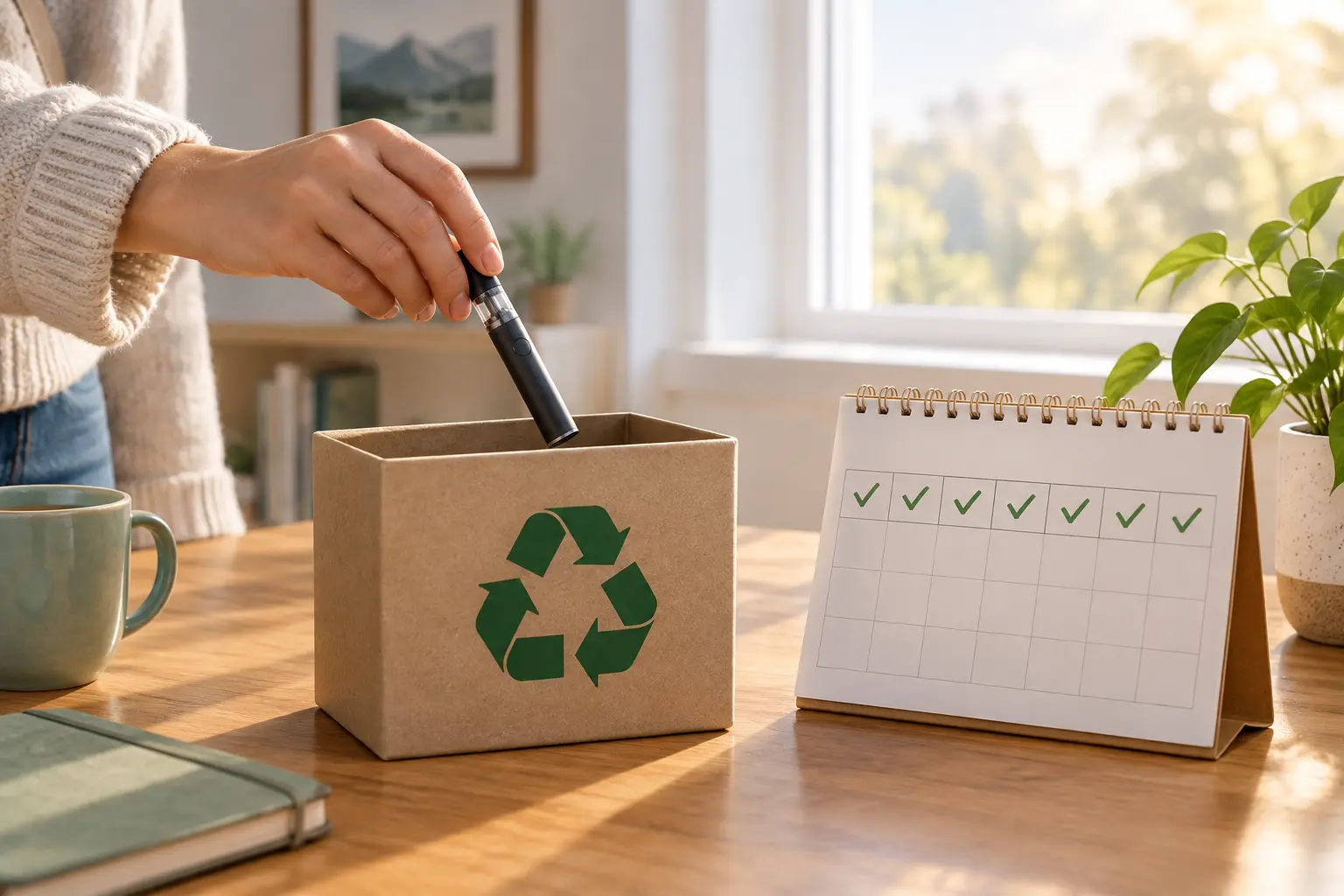
The NHS notes that vapes, including single-use ones, are classed as electronic waste and should never go in general waste, because the batteries can start fires in refuse vehicles. Take them to a recycling point instead of the bin. Our guide to quitting disposable vapes covers the extra pull of cheap, easy-to-grab devices.
Then prepare your replacement tools: something for your hands, sugar-free gum, water, a walk route, and the name of one person you will message when a craving hits. The NHS also suggests teaming up with someone else who is quitting.

Day 1: stay ahead of the first cravings
The first day is about structure, not willpower. Cravings arrive in waves, and each wave passes. The NHS withdrawal guidance puts it simply: remind yourself that cravings and bad feelings are only temporary.
- Replace the first vape of the day. Brush your teeth, drink water, or step outside before you check your phone.
- Move. The NHS suggests a quick burst of activity to get your blood pumping.
- Keep your hands and mouth busy. The NHS suggests carrots, celery sticks or sugar-free gum, and distractions like puzzles or walks.
- Write down each craving. Time, trigger, what you did. By day three you will see a pattern.
Expect some of the withdrawal symptoms the NHS lists for quitting vapes: strong cravings to smoke or vape, feeling irritable or low in mood, trouble concentrating, feeling hungrier than usual, and difficulty sleeping. Everyone’s experience is different, so treat the list as a map, not a prediction.
Days 2 and 3: the stretch to plan for
The NHS says that after quitting smoking, withdrawal symptoms are usually strongest during the first week, and especially in the first 3 days. That page describes quitting cigarettes, and vaping-specific timelines are less well studied, so treat it as a rough guide rather than a schedule. If you want a fuller picture, our vape withdrawal timeline and the hour-by-hour nicotine withdrawal timeline go further.
Whatever the exact timing, days two and three are when the novelty of the decision has worn off and the habit is still loud. Plan them like a hard shift at work.
- Cut the load. Postpone the big presentation, the party, the argument you were saving.
- Sleep on purpose. Difficulty sleeping is a listed symptom, so aim for a wind-down routine and avoid late caffeine.
- Use the same three-minute rule each time. Wait, move, breathe, then decide.
- Eat regularly. The NHS lists feeling hungrier than usual as a symptom, so keep healthy snacks close.

If your own experience of the week is different from the descriptions here, that is normal. The aim of the schedule is to keep your options open when a craving shows up.
Days 4 to 7: build the new routine
By the second half of the week the sharpest edge may be easing, but your habits have not moved yet. The risk now is overconfidence. People feel better, think “one hit won’t matter,” and open the door.
- Re-test one trigger a day, with a plan. The first coffee, the first commute, the first drink. Decide in advance what replaces the vape.
- Tell someone how it is going. Support from friends and family can make a real difference, according to the NHS.
- Celebrate wins. The NHS suggests marking each day vape-free with something small.
- Keep your device-free rules. No buying “just one” for a party.
When you reach day seven, do not declare victory. Move to the next goal. The NHS says that reaching 28 days smoke-free makes you 5 times more likely to quit smoking for good. That figure comes from smoking, so treat it as a useful target, not a vaping statistic.
Triggers specific to vaping
Vaping has quirks that cigarettes do not, and they are why general quit advice can miss.
- Hand-to-mouth habit with no endpoint. A cigarette ends. A vape does not, so there is no natural stopping point to build a break around.
- Stealth use. Because vapes are discreet, you may have vaped in places you would never smoke: meetings, bedrooms, the bathroom. Each place carries its own trigger.
- Charging and flavor rituals. The click of a pod, a favorite flavor, the habit of checking battery level. Name them, then swap them.
- Boredom and screen time. Many people vape while scrolling. Put the phone in a different room for the first meal.
The NHS also suggests creating vape-free spaces as a way to cut down, and the same idea works in reverse for cold turkey: make a list of the spaces that were yours alone and give each one a new job.
When to add backup support
Cold turkey is a method, not a test of character. If the first three days feel unmanageable, add support rather than white-knuckling.
- Ask about NRT. The NHS says that for a one-step quit you can ask a pharmacist or stop smoking adviser about switching to a suitable NRT product. It says that right now Nicorette QuickMist is the only approved NRT for quitting vaping in the UK, and suggests combining it with a nicotine patch. Check what is approved where you live. Remember the 2026 review above: trials of NRT for vaping cessation have not yet shown a benefit over control after treatment stopped, so this is a judgment call to make with a professional.
- Try text support. Truth Initiative says its EX Program text messaging support was tied to nearly 40% higher odds of quitting in young adults aged 18 to 24 in a JAMA Internal Medicine study, and that teens receiving it were 35% more likely to report not using nicotine at 7 months. Those figures are the organization’s own description of its program, so read the program page with that in mind.
- Talk to a clinician about prescription options. That includes varenicline, discussed above.
If anxiety is making this harder, the NHS points to free Every Mind Matters support. Our plan for quitting nicotine in every form also covers support choices in more depth.
Where iQuit fits
iQuit is a quit-smoking app, free on Google Play and the App Store. Its SOS craving tools, such as breathing exercises, grounding and craving surfing, are techniques you can use on a vape craving too, and its craving log lets you record the trigger and intensity each time. If you also smoke, or want to see how the app is described for vape quitting, read how iQuit supports vape cessation.
If you slip
A slip on day three is common enough that it deserves a plan. The NHS says it is okay if it takes a few tries to quit for good, and that using a vape for a short time is fine; you can always try quitting again. It adds that if you had been using a vape to stop smoking, going back to vaping is much better than starting to smoke again.
- Stop at one. One hit is an event, not the end of the quit.
- Write it down. Time, place, mood, who was there.
- Change one variable. Remove the device again, add a backup support, or move the trigger.
- Restart the clock. Day one again, with better information.
iQuit’s streak shields and slip recovery are built for exactly this moment. If you also use nicotine pouches, our Zyn cold turkey first week guide follows the same structure.
Frequently Asked Questions
Is quitting vaping cold turkey harder than tapering?
The trials in a 2026 review tested supports like texting, NRT and medication, not cold turkey against tapering, and it called the evidence base for vaping cessation limited (11 trials, 8,182 participants). Pick the method you will actually follow. The NHS describes both a gradual reduction and a one-step route with nicotine replacement therapy. (Tobacco Prevention & Cessation, NHS)
How long do vaping withdrawal symptoms last?
The NHS says symptoms of stopping smoking are usually strongest in the first week, especially the first 3 days, and last 3 to 4 weeks on average. Vaping-specific timelines are less well studied, so expect variation. Common symptoms include cravings, irritability, trouble concentrating, hunger and poor sleep. (NHS)
What are the symptoms of quitting vaping?
The NHS lists strong cravings to smoke or vape, feeling irritable or low in mood, trouble concentrating, feeling hungrier than usual and difficulty sleeping. Everyone’s experience is different, and knowing what to expect can help you manage the symptoms. If mood drops sharply, speak to a health professional. (NHS)
Can I use nicotine replacement therapy to quit vaping?
In the UK, the NHS says Nicorette QuickMist is currently the only approved NRT for quitting vaping and suggests combining it with a patch. A 2026 review found NRT trials for vaping cessation did not show superiority over control after treatment stopped, so discuss it with a pharmacist. (NHS, Tobacco Prevention & Cessation)
Does varenicline help people quit vaping?
A 2026 meta-analysis of three trials (355 people) reported a risk ratio of 2.28 for 7-day abstinence versus placebo, with more nausea, insomnia and vivid dreams. The authors called the findings preliminary because of small samples. It is prescription-only, so ask a clinician. (Journal of Substance Use and Addiction Treatment)
Should I quit vaping if I also smoke cigarettes?
The NHS says you should only quit vaping if you are confident you can do it without smoking cigarettes. If vaping is keeping you off cigarettes, protect that first. Going back to vaping after a slip is, in the NHS’s words, much better than starting to smoke again. (NHS)
What if I slip during the first week?
The NHS says it is okay if it takes a few tries to quit for good. Stop at one hit, write down the trigger, remove the device again and restart. A slip is information about what to change, not proof that you cannot do it. (NHS)
Start Your First Vape-Free Week With a Plan
You have a plan for the first seven days. iQuit is free on Google Play and the App Store, with SOS craving tools, a craving log for triggers and intensity, craving forecasts and streak shields that help you restart after a slip. It is a quit-smoking app, so use it for the techniques that help, and keep a pharmacist or clinician in the loop for medicines. Download it before your quit night.


