
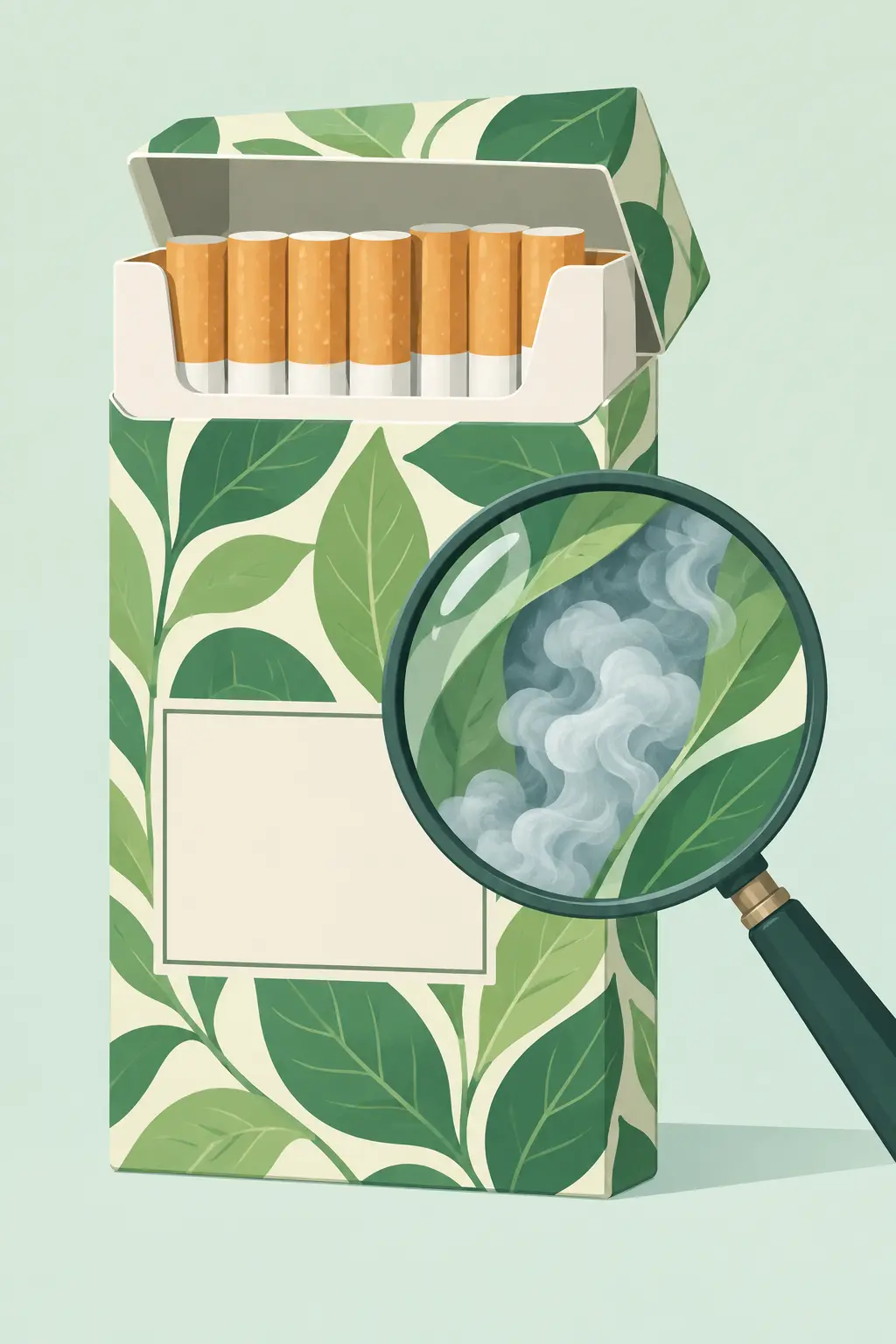
Are natural cigarettes safer? No. Packs that say natural, organic or additive-free still contain burned tobacco, and burning tobacco is what makes smoke dangerous. The American Cancer Society says cigarettes sold with those labels “have not been shown to be safer.” If you are thinking of switching brands to cut your risk, this guide explains what the labels mean, what regulators and researchers have found, and what actually lowers risk.
The Short Answer: No, and Here Is Why
The American Cancer Society addresses this directly in its guide to whether any type of smoking is safe: “Some cigarettes are now being sold as natural, organic, or additive free. These still have tobacco, with the same toxins as other types of cigarettes. They have not been shown to be safer” (American Cancer Society).
The same page explains the underlying problem. When you smoke a regular cigarette, “you expose yourself to over 7,000 chemicals from inhaling the smoke.” It adds that “Toxins also come from burning the tobacco itself, including tar and carbon monoxide.” A label can describe what was added to the tobacco. It cannot change what happens when tobacco burns.
The World Health Organization takes the same line on tobacco in general: “All forms of tobacco use are harmful, and there is no safe level of exposure to tobacco” (WHO). For the full list of what smoke contains, see our article on what is in cigarette smoke: the 7,000 chemicals.
What Natural, Organic and Additive-Free Actually Mean
These words describe how tobacco is grown or what manufacturers add to it. They say nothing about what burning does to your lungs. Here is how each claim compares with the evidence we could verify.
| Claim on the pack | What it describes | What the evidence says |
|---|---|---|
| Natural | Marketing wording about the tobacco | The American Cancer Society says such cigarettes have the same toxins and have not been shown to be safer. |
| Organic | How the tobacco was grown | Same: burned tobacco still produces tar, carbon monoxide and carcinogens. |
| Additive-free | No added ingredients in the tobacco | Same: the American Cancer Society notes that toxins also come from burning the tobacco itself. |
| Light, mild or low | Older descriptors on lower-tar cigarettes | The American Cancer Society says people who smoke them have the same risk of serious health effects, and the FDA has banned the terms “light,” “mild” and “low” for cigarette products. |
| Herbal (no tobacco) | Cigarettes made from other plants | The American Cancer Society says they are still dangerous because they give off tar, particulates and carbon monoxide. |
We cover the older lower-tar claims in are light cigarettes safer than regular and tobacco-free versions in are herbal cigarettes safer. The pattern is the same each time: the label changes, the burning does not.
What Regulators Say About These Claims
In the United States, the FDA regulates any tobacco product sold as lower risk. Its page on modified risk tobacco products explains the standard. A manufacturer seeking permission “generally must demonstrate that the product will significantly reduce harm and the risk of tobacco-related disease to individual tobacco users and benefit the health of the population as a whole.” It also states that “An order permitting the sale of an MRTP refers to specific products, not an entire class of tobacco products” (FDA).
In plain terms, a brand cannot simply declare itself safer. A published 2025 study in Tobacco Control reports that “some tobacco companies replaced the marketing phrase ‘100% natural additive-free tobacco’ with ‘tobacco ingredients: tobacco & water’ (T&W) after receiving warnings from the US Food and Drug Administration” (Weiger et al., 2025). We did not read the FDA warning letters themselves, so we rely on that description of what happened.
The researchers then tested what the newer wording communicates. Their conclusion was that “Like ‘additive-free’, ‘tobacco and water’ marketing claims are commonly interpreted as meaning cigarettes have fewer chemicals or harmful ingredients.” In their experiment, 47.7 percent of people shown the original additive-free pack read it as meaning fewer chemicals or harmful ingredients, and the share was still 27.2 percent and 20.3 percent for the two tobacco-and-water packs. In other words, the change in wording reduced the effect but did not remove it.
How Many People Believe the Labels
The belief is common, and it is strongest among people who smoke. A 2025 analysis of the national PATH Study, covering 29,516 US adults, found that “10.0% of adults, 15.3% of adults who smoke cigarettes, and 34.0% of adults who smoke NAS believed ‘organic’ tobacco products were less harmful, with similar findings for ‘additive-free’” (Drake et al., 2025). NAS in that sentence is Natural American Spirit, a brand the researchers describe as one that uses “organic” and historically used “additive-free.”
| Group | Believed organic products were less harmful |
|---|---|
| All US adults | 10.0% |
| Adults who smoke cigarettes | 15.3% |
| Adults who smoke Natural American Spirit | 34.0% |
Beliefs also seem to shape choices. A longitudinal study using PATH data found that a prior belief that organic and additive-free tobacco products were less harmful increased the odds of later switching to Natural American Spirit (adjusted odds ratio 2.5) (Pearson et al., 2025). The researchers ran parallel analyses for two leading comparator brands, Marlboro and Camel, and those were largely null or in the opposite direction. A note on disclosures: several of the 2025 papers cited in this guide declare that an author has served as a paid expert witness in litigation involving Natural American Spirit or tobacco companies, so read them as research by authors who are also involved in that litigation.
Marketing Changes Perceptions, Not Risk
A randomized online experiment with 1,504 young adults aged 18 to 29 tested what greenwashed cigarette advertising does. Compared with ads without those features, viewers of ads with greenwashed text were more likely to hold inaccurate beliefs about relative harm (adjusted odds ratio 3.92) and about nicotine content (adjusted odds ratio 2.08). In the paper’s words, “Forty-two percent of those who saw an ad with all greenwashed features believed the product was less harmful than other cigarettes versus 2% of those who saw an ad without greenwashed features” (Moran et al., 2025).
The takeaway is not that smokers are careless. It is that packaging works. The same experiment also found misperceptions about addictiveness. If you have been drawn to a natural-looking pack, you are responding to design that was shown to shift beliefs, not to evidence that the product harms you less.
Two points keep this in perspective. First, this article does not claim that any brand is more dangerous than another, because the sources we read compare beliefs and claims rather than measured health outcomes by brand. Second, the safe conclusion is the one the American Cancer Society states: these products “have not been shown to be safer.”
Watch: Why “Natural” Is Not a Safer Choice
Truth Initiative, a public health organization, published a short video on natural-branded cigarettes and the belief that they are less harmful.
Switching Brands vs Quitting
If a natural brand feels like a step toward quitting, here is the honest comparison.
| Question | Switching to a natural or additive-free brand | Quitting |
|---|---|---|
| Do you still inhale burned tobacco smoke? | Yes | No |
| Proven to be safer? | No, per the American Cancer Society | Yes, quitting is the established way to reduce risk |
| Nicotine dependence | Continues | Ends after withdrawal |
| Cost | Continues | Stops |
The first two rows are the heart of it. A switch keeps all of the exposure that makes smoking dangerous. Our do cigarette filters do anything article covers another product feature that feels protective without reducing risk the way people hope. And the same thinking applies to other tobacco products: see is pipe smoking safer than cigarettes for what a large cohort found about pipes.
What Actually Lowers Your Risk
The evidence points one direction: stop smoking. For a full walk-through of methods, medicines and support, see our how to quit smoking in 2026 complete evidence-based guide.

If you are not ready to quit today, there are still sensible steps that do not rely on a label:
- Treat any brand as the same risk. Do not reduce your effort to quit because the pack looks cleaner.
- Talk to a pharmacist or clinician about nicotine replacement or prescription medicines, which are designed to ease cravings without smoke.
- Pick a quit date and tell someone who will support you.
- Track the habit. Seeing how often you smoke and when makes the pattern clearer.
If you are comparing tools, our best quit smoking apps 2026 feature comparison lays out the options side by side.
Using iQuit to Move Past Brand Switching
iQuit is free on Google Play and the App Store. Its dashboard shows days smoke-free, cigarettes avoided and money saved. Those numbers only move when you actually stop, which makes them a useful reality check against the idea that a different brand is progress. You can also log cravings with their triggers and intensity, use SOS support with breathing and grounding exercises when a craving hits, and rely on streak shields and slip recovery that treat a slip as data rather than defeat. iQuit does not treat any condition, and it does not replace advice from a clinician.
Frequently Asked Questions
Are natural cigarettes safer than regular cigarettes?
No. The American Cancer Society says cigarettes sold as natural, organic or additive free still have tobacco with the same toxins as other cigarettes and have not been shown to be safer. Smoke from cigarettes exposes you to over 7,000 chemicals (American Cancer Society).
Are additive-free cigarettes safer?
There is no evidence they are. The American Cancer Society says burning tobacco itself produces toxins including tar and carbon monoxide, so removing additives does not remove the main dangers of smoke. The WHO says all forms of tobacco use are harmful (American Cancer Society; WHO).
Why do people think natural cigarettes are safer?
Marketing seems to play a role. In a randomized experiment with 1,504 young adults, 42 percent who saw an ad with all greenwashed features believed the product was less harmful, compared with 2 percent who saw an ad without them (Moran et al., 2025).
How common is the belief that organic or additive-free tobacco is less harmful?
In the PATH Study, 10.0 percent of US adults and 15.3 percent of adults who smoke cigarettes believed organic tobacco products were less harmful, rising to 34.0 percent among Natural American Spirit smokers, with similar results for additive-free (Drake et al., 2025).
Did the FDA act on natural and additive-free claims?
A 2025 Tobacco Control study reports that some companies replaced the phrase 100% natural additive-free tobacco with tobacco and water after receiving FDA warnings. We did not read the letters themselves. The FDA says a lower-risk product must show it significantly reduces harm (Weiger et al., 2025; FDA).
Are herbal cigarettes safer than regular ones?
No. The American Cancer Society says even herbal cigarettes with no tobacco are still dangerous because they give off tar, particulates and carbon monoxide. They are not a safe substitute for quitting (American Cancer Society).
Is switching brands a good way to cut down on risk?
Not based on the evidence we found. A study found believing organic or additive-free tobacco is less harmful increased the odds of switching to one natural-themed brand, but the sources do not show lower health risk from switching. Quitting remains the proven way to reduce risk (Pearson et al., 2025).
What is a better step than switching to a natural brand?
Set a quit date and get support. A pharmacist or clinician can discuss nicotine replacement or prescription medicines, and a quit app can log cravings and triggers. See our evidence-based guide for every method side by side (iQuit product features).
Quit the Smoke, Not Just the Brand
Change the Habit, Not Just the Pack
Switching brands does not change your health risk or your spending. iQuit shows days smoke-free, cigarettes avoided and money saved, logs cravings with their triggers, and gives you SOS support when a craving hits. Free on Google Play and the App Store.
Download iQuit Free on Google Play
Download on the App Store


