
The little white cylinder on the end of a cigarette looks like a safety feature. Do cigarette filters actually do anything that makes smoking meaningfully safer? The honest answer is uncomfortable: filters changed how cigarettes are smoked more than they changed how dangerous the smoke is — and in one well-documented way, they may have made things worse.
What a Filter Is Actually Made Of
A cigarette filter is a dense bundle of thousands of thin polymer strands of cellulose acetate, a plasticized, semi-synthetic material — not cotton, and not something the body or the environment breaks down quickly. It’s wrapped in paper and packed tightly enough to trap some particles as smoke is drawn through it, which is the entire mechanical principle behind it: a physical strainer for particulates, not a chemical scrubber for gases. Manufactured cigarette filters became standard remarkably fast once the industry adopted them widely, going from a small share of the market in the 1950s to the near-universal default within a few decades.
What Filters Do and Don’t Remove
Filters do reduce the amount of visible tar particles that reach the smoker’s mouth — that’s real and measurable. What they don’t do is filter out the gas-phase components of smoke: carbon monoxide, hydrogen cyanide, and most of the volatile chemicals that make up the roughly 7,000 chemicals in cigarette smoke pass through a filter largely untouched, because they’re gases, not particles a physical strainer can catch. Nicotine itself is barely affected either, which is why filtered and unfiltered cigarettes still deliver comparable amounts, as covered in our breakdown of how much nicotine is in one cigarette.
| Component of smoke | Meaningfully reduced by a filter? |
|---|---|
| Visible tar particles | Partially — this is the filter’s real function |
| Carbon monoxide | No — it’s a gas, not a particle |
| Nicotine | Barely — comparable levels reach the smoker regardless |
| Volatile carcinogens (gas-phase) | No — largely unaffected |
| Overall health risk | Not meaningfully — no filtered cigarette is a safe cigarette |
Ventilation Holes and How Machine Tests Were Gamed
Modern filters usually have a ring of tiny laser-cut holes near the mouth end. On a smoking machine — the standardized device regulators used to measure “tar and nicotine yield” for decades — those holes let in extra air, diluting the smoke sample and producing a lower measured tar number. According to a review by Song and colleagues published in the Journal of the National Cancer Institute in 2017 (JNCI 109:12; open-access copy on PubMed Central), a 2006 US federal court decision determined that machine-rated tar and nicotine yields were “totally unreliable for measuring the actual nicotine and tar any real life smoker would absorb because it did not take into account the phenomenon of smoker compensation.”
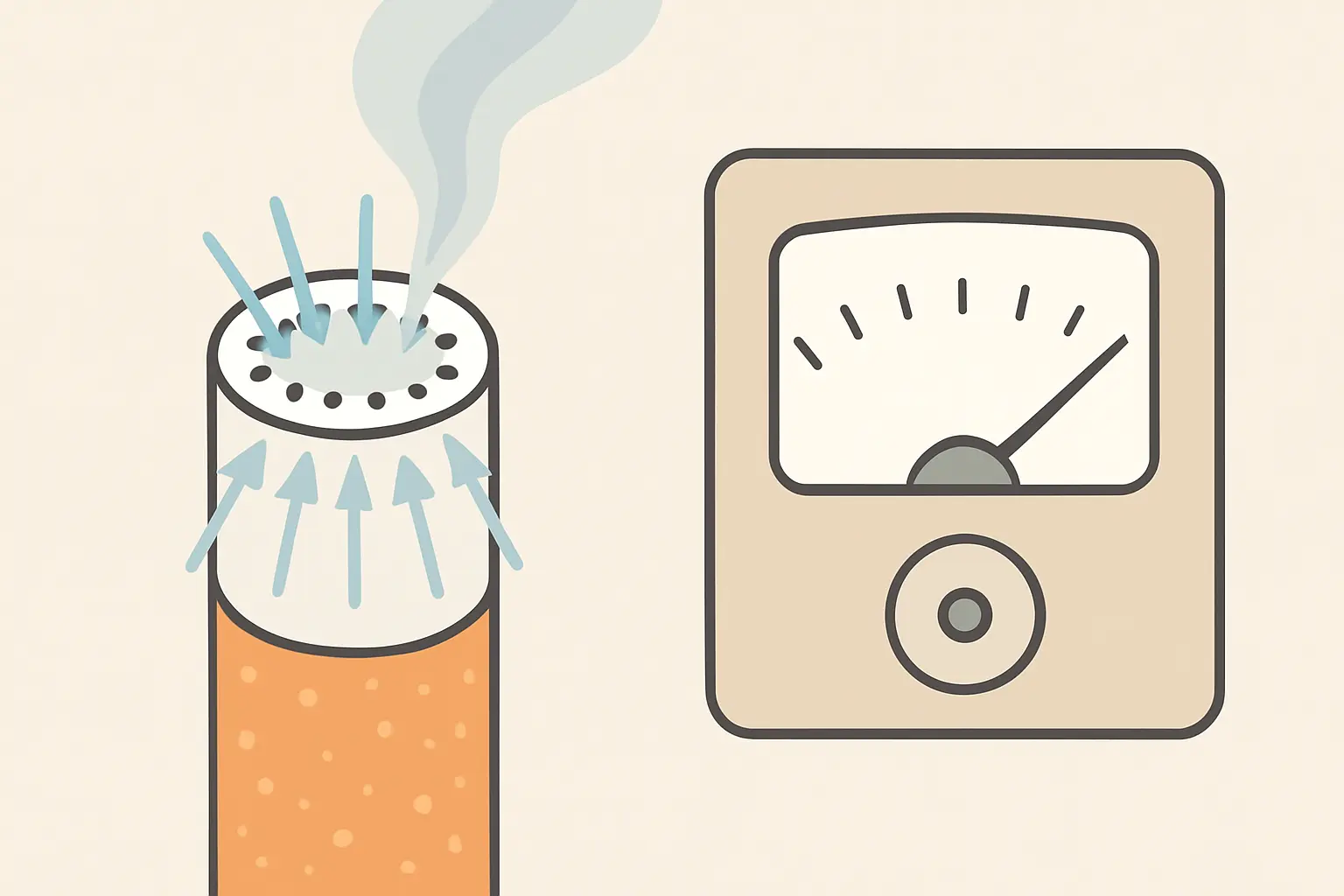
Human smokers cover the ventilation holes with their lips or fingers without realizing it, and take larger, deeper puffs to get the nicotine hit they’re used to — a pattern researchers call compensatory smoking. The machine said the smoke was lighter; the smoker’s actual exposure barely changed, and in some ways got worse, because the deeper puffs pulled smoke further into the lungs.
Why “Light” Cigarettes Were Banned as a Descriptor
This gap between machine-measured “light” cigarettes and real-world exposure is exactly why the US banned the terms. The same JNCI review records that as of June 2010, the Tobacco Control Act prohibited descriptors on tobacco packaging or advertising that convey reduced risk or exposure — specifically including “light,” “mild,” and “low.” The FDA’s own page on these descriptors puts the current rule plainly: manufacturers may not produce or distribute tobacco products labeled or advertised as “light,” “low,” or “mild” without a Modified Risk Tobacco Product order from the FDA, and “if products are marketed as ‘light,’ ‘low,’ or ‘mild’ without an MRTP order, FDA considers these claims to be health fraud.”
The bar for such an order is deliberately high — manufacturers have to meet rigorous criteria before the FDA will authorize a modified-risk claim. The practical effect for shoppers is simple: if you see a pack implying one cigarette is gentler than another, treat the implication as marketing, not measurement.
Myths vs evidence: what filters were sold as
Most of what people believe about filters comes from decades of packaging design rather than from any study. Here is what each belief actually rests on.
| The belief | What the evidence shows |
|---|---|
| “A filter catches the harmful stuff” | It traps some particulate tar. Carbon monoxide, hydrogen cyanide and the other gas-phase toxicants pass straight through — a strainer cannot catch a gas. |
| “Light cigarettes have less tar” | Less tar on a smoking machine. A 2006 federal court decision called machine-rated yields “totally unreliable” for what a real smoker absorbs, because machines do not compensate and people do. |
| “Switching to lights cuts my risk” | Compensatory puffing restores the nicotine dose. The JNCI review links this design change to the rise in lung adenocarcinoma specifically, not to a fall in overall risk. |
| “Filters were a health improvement” | They were a marketing response. The descriptors that carried the health implication have been prohibited in the US since June 2010, and the FDA now treats unauthorized “light” claims as health fraud. |
| “At least the butt is biodegradable” | Cellulose acetate is a semi-synthetic plastic. It fragments into microfibers rather than decomposing, which is why filters now appear in microplastic pollution research. |
The Lung-Cancer Type Shift Filters Are Linked To
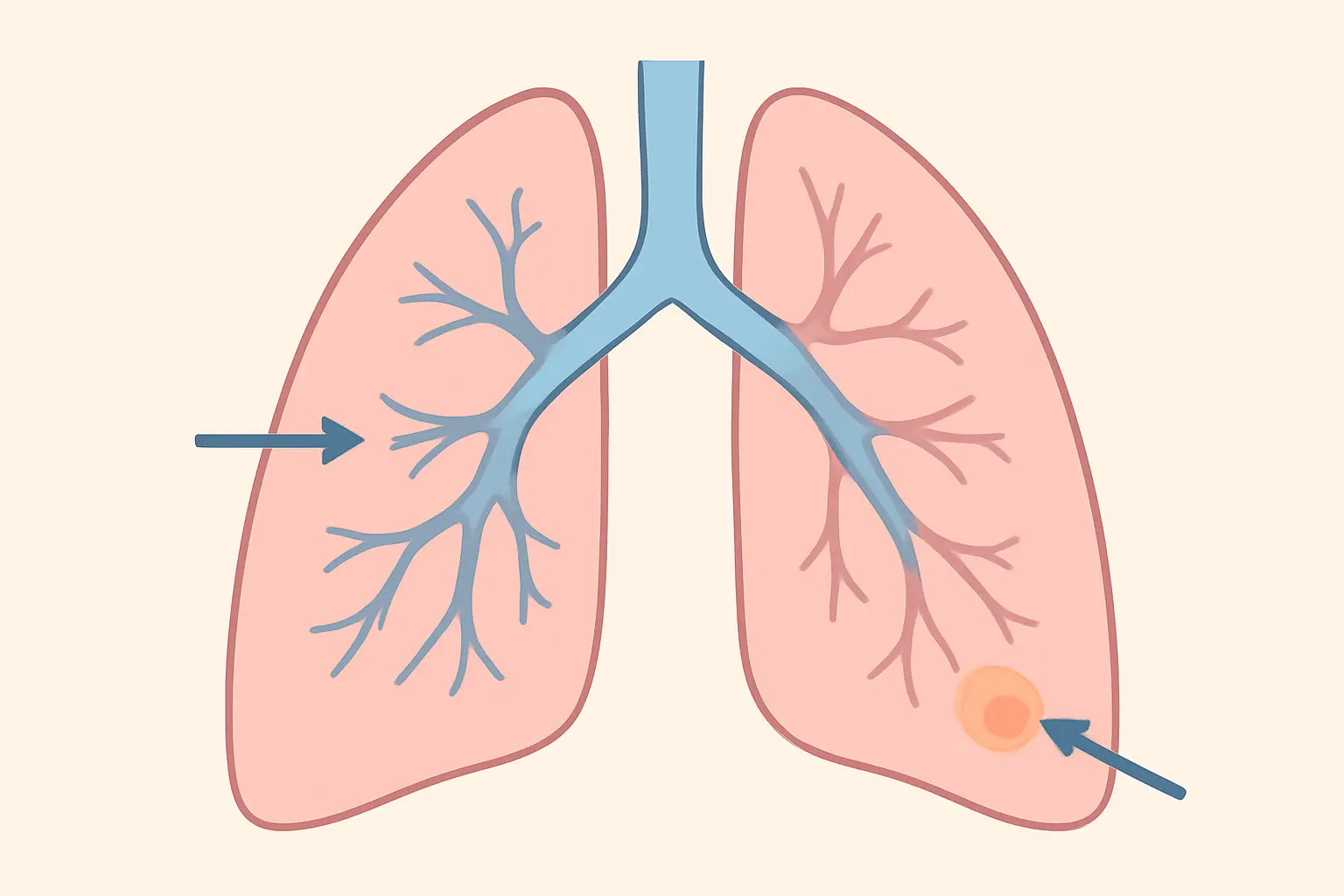
This is the part that turns a marketing problem into a genuine health one. The 2014 US Surgeon General’s Report concluded, in the JNCI review’s summary, that “changing cigarette designs have caused an increase in lung adenocarcinomas, implicating cigarette filter ventilation that lowers smoking machine tar yields.” Adenocarcinoma is a cancer type that develops deeper in lung tissue, toward the periphery, rather than in the central airways where the older smoking-related cancers clustered.
The review lays out the timeline. Filter ventilation was used in about 7% of marketed cigarettes by the end of the 1960s and rose rapidly to between 94% and 100% by 1982. Over the same stretch — the 1960s to the 1980s — the relative risk of adenocarcinoma climbed from 4.6 (95% CI 1.7 to 12.6) to 19.0 (95% CI 8.3 to 47.7) in men, and from 1.5 (95% CI 0.3 to 7.7) to 8.1 (95% CI 4.5 to 14.6) in women, while the risks of other lung cancer subtypes did not increase.
The proposed mechanism has two halves. Deeper, larger compensatory puffs deposit smoke further into the lung’s peripheral tissue, exactly where adenocarcinoma originates. And more ventilation means less air flowing through the burning tip, a cooler coal, and more incomplete combustion — which raises the yield of toxicants including NNK, a potent lung carcinogen, per milligram of nicotine the smoker takes in. Blocking the ventilation holes, the review notes, lowers NNK levels again.
None of this means unfiltered or “extra strong” cigarettes are the safer choice — it means the entire premise that filter design could make cigarettes meaningfully safer has not held up, and in this specific way, appears to have backfired. Our smoking and cancer statistics page covers the broader cancer risk picture, and our quit-smoking myths debunked guide tackles the related “some cigarettes are safer than others” myth directly.
Do Filters Make Roll-Ups Safer?
Roll-your-own cigarettes are sometimes smoked with no filter at all, or with a small cardboard or foam filter tip that has none of the ventilation engineering of a manufactured cigarette filter. Whether or not a roll-up has a filter, the tobacco itself and the smoker’s own inhalation pattern matter far more than the presence of a filter tip — and roll-ups were never sold with the machine-measured tar figures that made “light” manufactured cigarettes so misleading in the first place. If you’re weighing a switch away from roll-ups entirely, our guide on how to quit rolling tobacco covers the practical steps.
Filter Litter and the Environmental Angle
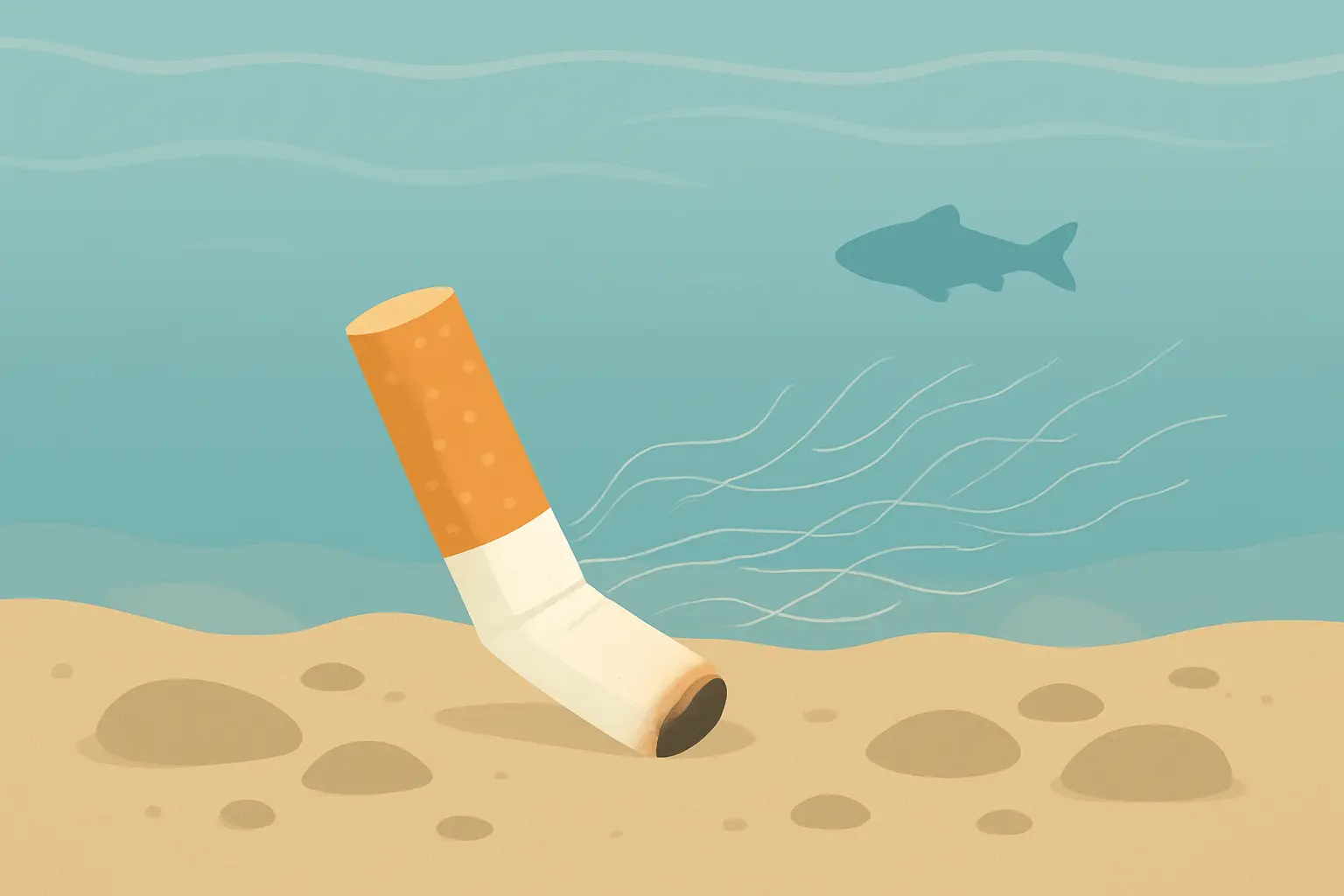
Cigarette butts are widely reported as the most littered item on earth, and the cellulose acetate they’re made from doesn’t behave like ordinary litter — it breaks down into microfibers rather than fully decomposing. Research from the University at Buffalo, led by Ghazal Vasseghi and John D. Atkinson and published in the Journal of Hazardous Materials: Plastics, put numbers on it. According to the university’s January 2026 announcement of the study, a filter releases about 24 microfibers within the first 20 seconds of contact with water, regardless of how the water is moving. A single filter contains more than 10,000 microfibers, and over ten days one butt can shed between 63 and 144 of them depending on water movement.
Scaled up, the researchers calculated under conservative assumptions that anywhere from 71 million to 1.4 billion cigarette butt microfibers are released into New York waters every single day. The filter that was marketed as a health feature has turned out to be a durable, slow-degrading pollutant with no upside for the smoker and a real cost for waterways and wildlife.
What to Do This Week If You Smoke Filtered Cigarettes
Knowing that the filter isn’t protecting you is only useful if it changes something. Four things worth doing in the next seven days, none of which require a quit date yet:
- Stop treating brand choice as a risk decision. Switching from a “smooth” or ventilated pack to a stronger one, or the other way round, is not a health intervention. The only variable that moves your risk is how much smoke you inhale and for how many more years.
- Notice your own compensation. For two days, pay attention to whether you cover the filter holes with your fingers or lips, and how deep your first puff of the day is. Compensatory smoking is largely unconscious; seeing it is the point, not judging it.
- Count, don’t estimate. Log every cigarette for three days rather than recalling a number at the end of the week. Almost everyone under-reports, and an accurate baseline is what makes a taper or a quit date realistic.
- Pick one trigger to break, not all of them. The first cigarette after a meal, or the one with coffee, is a routine rather than a nicotine emergency — and it is the cheapest one to test going without.
If you want to know where reduced-nicotine and non-combusted products sit relative to the cigarette you’re smoking now, our explainer on what tobacco harm reduction actually means lays out the whole risk continuum, rung by rung.
No filter, no “light” version, and no product tweak changes the fundamentals here — stopping is still the only intervention that measurably lowers risk. If you’re weighing how nicotine content itself factors into a quit plan, our piece on very low nicotine cigarettes covers the one product change with real trial evidence behind it. The iQuit app‘s craving tools and quit-plan builder work the same way regardless of what brand or filter type you’re currently smoking.
Filter FAQ
Do cigarette filters actually do anything?
They trap some particulate tar but do not filter out gases like carbon monoxide, and their ventilation holes led smokers to inhale more deeply to compensate, which research links to a rise in a specific lung cancer type (adenocarcinoma). They do not make smoking safe.
What are cigarette filters made of?
Cellulose acetate, a plasticized semi-synthetic polymer formed into thousands of thin fibers. It is a physical particulate strainer, not a chemical filter, and it degrades very slowly in the environment — one filter contains more than 10,000 microfibers (University at Buffalo, 2026).
Why were “light” and “low tar” cigarettes banned?
Because ventilated filters produced lower tar readings on smoking machines while real smokers compensated by puffing harder, so the labels implied a health benefit that didn’t exist. The Tobacco Control Act prohibited those descriptors from June 2010, and the FDA treats unauthorized “light,” “low” or “mild” claims as health fraud.
Do filters cause a specific type of lung cancer?
The 2017 JNCI review by Song and colleagues reports that as filter ventilation spread from about 7% of cigarettes in the late 1960s to 94–100% by 1982, adenocarcinoma relative risk rose from 4.6 to 19.0 in men and 1.5 to 8.1 in women, while other lung cancer subtypes did not rise.
Are unfiltered cigarettes worse than filtered ones?
Neither is a safe option. Filters modestly reduce particulate tar exposure but don’t remove the gas-phase toxicants driving most disease risk, and the compensatory smoking they encourage may offset any benefit. Quitting, not filter choice, is what changes risk meaningfully.
Why does ventilation make the smoke more toxic?
More ventilation means less air flowing through the burning tip and a cooler coal, so combustion is less complete. The JNCI review reports this raises toxicants including NNK, a potent lung carcinogen, per milligram of nicotine the smoker takes in — and that blocking the holes lowers NNK again.
Does covering the filter holes change anything?
It changes the measurement, not your safety. Blocking the vents undoes the dilution a smoking machine relies on, which is precisely why machine-rated tar figures never matched real exposure. It is a reason the ratings were abandoned, not a technique worth using.
Are cigarette filters bad for the environment?
Yes. Cigarette butts are widely cited as the most littered item worldwide. University at Buffalo research found one filter sheds about 24 microfibers within 20 seconds of hitting water and 63 to 144 over ten days, with an estimated 71 million to 1.4 billion entering New York waters daily.
The Only Filter That Actually Lowers Your Risk Is Quitting
No filter design changes your real exposure the way stopping does. iQuit gives you craving tools, milestone tracking and a coach to help you get there — whatever you’re currently smoking. Free on Google Play and the App Store.