
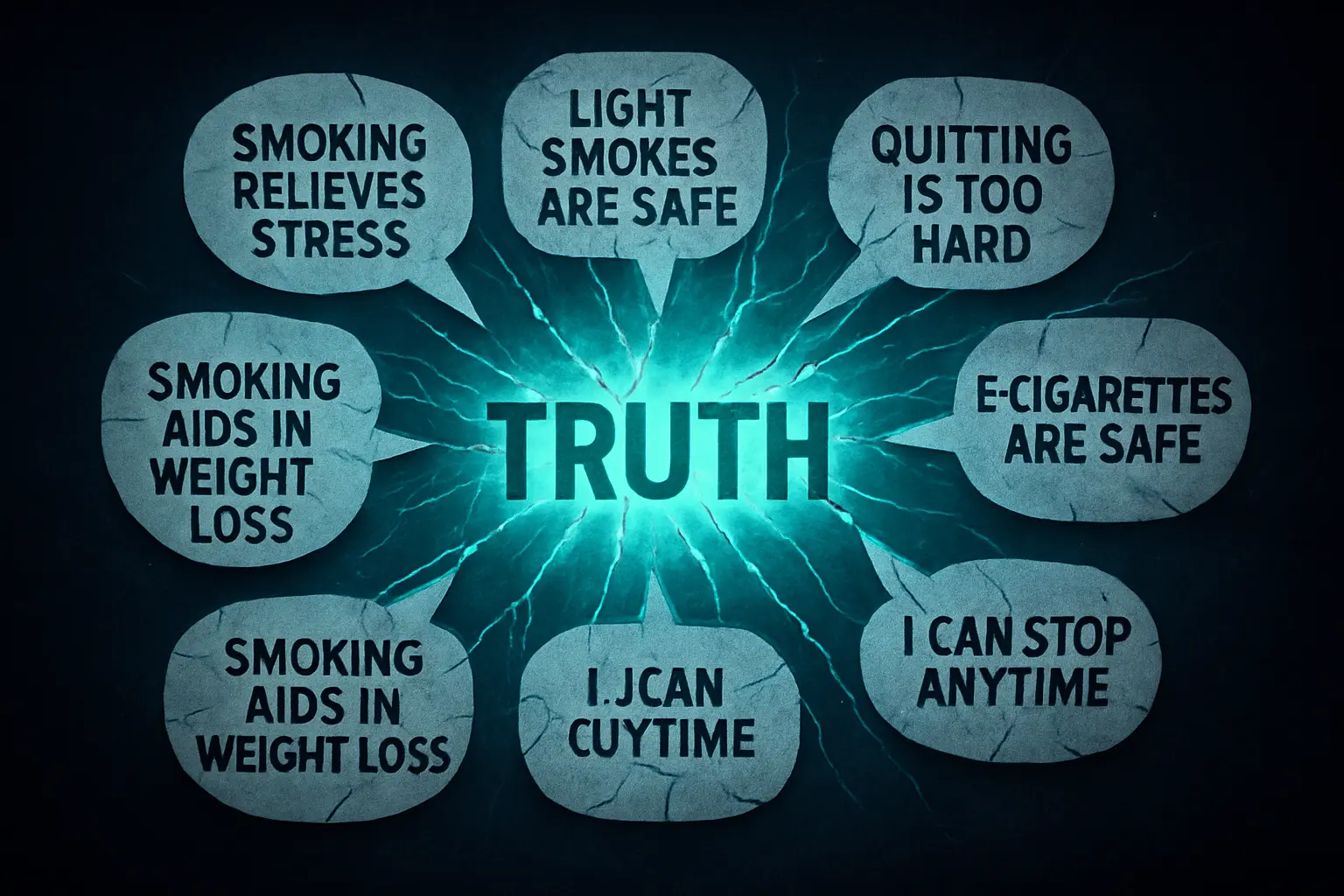
Nicotine keeps people smoking — but misinformation does at least half the work. Every quit counselor hears the same ten sentences, and every one of them is measurably wrong. Here they are, each against the evidence, because a myth you can name is a myth that loses its grip.
The fatalism myths
1. “The damage is already done.” The most expensive lie in smoking. Recovery begins 20 minutes after the last cigarette; excess heart risk halves within a year; quitting at 40 recovers ~9 of the 10 years smoking costs, and even at 60 returns ~3. The full age-by-age case is in is it ever too late to quit.
2. “I’ve failed before, so I can’t do it.” Prospective tracking suggests the average smoker needs many attempts — possibly 30+ — before the one that sticks, and past attempts predict eventual success. Failure history is training data, not a verdict (the attempt statistics).
3. “Smokers I know lived to 90, so it’s genetic luck.” Survivorship bias with a face. For every visible 90-year-old smoker there are the statistical ten who didn’t make 70 — half of long-term smokers die of smoking-related disease. Anecdote isn’t armor.
The method myths
4. “Cold turkey is the only honest way.” No method has a monopoly. Support roughly doubles success versus willpower alone; NRT and medication add further; gradual reduction works for many. The honest metric is what keeps you smoke-free, not what sounds toughest.
5. “Cutting down is just as good as quitting.” Light smoking retains most cardiovascular risk — the dose-response curve is brutally front-loaded. Cutting down works as a runway to quitting; as a destination it keeps nearly all the danger.
6. “Nicotine is what causes the cancer.” Nicotine addicts; the smoke kills. The carcinogens are combustion products — tar, nitrosamines, benzene and friends, catalogued in what’s really in cigarette smoke. This is precisely why NRT is considered safe as a quit aid.
The fear myths
7. “I’ll gain 20 pounds.” Average post-quit gain is ~4–5 kg over a year, a significant minority gain nothing, and the health ledger still favors quitting by an enormous margin. Appetite spikes are real and manageable.
8. “Quitting will wreck me with stress.” Backwards: smokers run higher baseline stress, and quitters’ anxiety and mood measurably improve after cessation — the cigarette was relieving the stress it created, as the relief-cycle illusion unpacks.
9. “Withdrawal lasts months.” The acute phase peaks at 72 hours and fades substantially within 2–4 weeks. What lingers longer are conditioned cues — occasional, brief and beatable — not the chemical siege people imagine.
The permission myth
10. “One cigarette won’t hurt.” One cigarette re-sensitizes receptors within minutes, and most “just one” moments restart regular smoking within weeks. It’s the single most relapse-productive sentence in the language — the mechanics are in what actually happens after just one.
Replace myths with measurements
The antidote to folklore is your own data. The free iQuit app replaces every myth with a counter: recovery milestones instead of “damage is done,” a craving log that shows withdrawal actually shrinking instead of “it lasts forever,” and streak shields instead of “one slip ruins everything.” Beliefs kept you smoking; numbers help you stop.
FAQ
What’s the most harmful quit myth?
“The damage is done” — it cancels quit attempts in the age groups with the most to gain.
Is weight gain inevitable?
No — average ~4–5 kg, often less, and the health math still favors quitting overwhelmingly.
Is nicotine the carcinogen?
No — combustion products are. That’s why NRT is a safe quit aid.
Does one cigarette really matter?
Yes — receptor re-sensitization makes “just one” the top relapse trigger on record.
Swap folklore for a dashboard: download iQuit free on Google Play.