If an appointment, a life insurance medical or a surgery date is coming up, you may be asking: can doctors tell if you smoke? The honest answer is that it depends on what is being checked. There is no single look that proves it, and a doctor will not always know. But some tests do detect tobacco and nicotine use, and those tests are more common than most people expect. This guide explains what the tests measure, how long the traces last, what a clinician can and cannot read from your body, and why telling the truth is almost always the better move for your own care.
The short answer: sometimes, and it depends on the test
Here is the realistic picture. In a routine appointment, nobody is testing you for tobacco unless there is a reason to. A clinician may form an impression, but impressions are not proof, and this article will not claim that a doctor can always tell. When a test is ordered, such as for insurance, a stop smoking service or research, the result can be quite accurate about recent exposure.
Two different things are being measured, and it helps to keep them apart. Some tests look for nicotine exposure. Others look for smoke exposure. A nicotine test cannot tell a cigarette from a patch, and a smoke test cannot tell tobacco from other burned material. The sections below explain each.
One more point before we get into detail. This is a guide to understanding the tests, not to getting around them. If you are hoping to work out how to hide smoking from your care team, the more useful conversation is the one in the last section.
What a clinician might notice without a test
Some doctors and nurses pick up on clues during an appointment, such as the smell of smoke on clothing, a persistent cough or what you say about your habits. These are impressions, and they can be wrong. A cough can have many causes, and the smell of smoke can come from a partner, a workplace or a car.
The same is true in the other direction. Many people who smoke have no obvious outward sign at all. The NHS notes that there are often no signs or symptoms of lung cancer at an early stage, which is exactly why screening programs ask about smoking history rather than waiting for symptoms (NHS, Lung cancer screening).
So the practical answer to “will they just know?” is that you cannot count on it either way. Tests exist because looking is unreliable.
The tests that actually detect smoking
The most thorough overview comes from a 2020 review in Nicotine & Tobacco Research, written by researchers including scientists from the US Centers for Disease Control and Prevention, on the biochemical verification of tobacco use (Benowitz et al., Biochemical Verification of Tobacco Use and Abstinence: 2019 Update).
Cotinine: the nicotine marker
The review describes cotinine as “the major proximate metabolite of nicotine” and “the most widely used biomarker of nicotine intake.” It can be measured in blood (serum, plasma or whole blood), saliva and urine. Serum levels of free cotinine in daily smokers typically average from 100 to 250 ng/mL, while levels in people exposed to secondhand smoke are usually below 3 ng/mL. That gap is why a lab can usually separate a regular smoker from someone who is only around smoke.
Exhaled carbon monoxide: the smoke marker
A handheld monitor measures carbon monoxide in your breath. The same review lists it as detecting consumption of combustible tobacco and other burned products, such as marijuana. It is quick, but it reflects only recent smoking.
NNAL: a longer window
A third marker, NNAL, is a urine marker of exposure to cured tobacco. The review says its half-life in urine is estimated at 10 to 45 days, much longer than cotinine, which is why it can reveal tobacco exposure further back.
| Test | What it detects | Average half-life | Approximate time to cutpoint |
|---|---|---|---|
| Cotinine (blood, saliva or urine) | Nicotine from all sources, including NRT and vapes | 16 hours | 80 to 100 hours |
| Exhaled carbon monoxide | Combustible tobacco and other burned products | 2 to 8 hours, depending on activity | 12 to 24 hours |
| NNAL (urine) | Cured tobacco, such as cigarettes, cigars and smokeless | 10 to 40 days | 2 to 3 months |
Those are averages for regular smokers. The review notes that the half-life of cotinine can vary from 8 to 30-plus hours because of genetic, hormonal and other factors. For people with half-lives of 8, 16 or 30 hours, it says it would take 40, 90 and 150 hours to reach the cutpoint. The review assumes an initial cotinine level of 200 ng/mL and says that, to avoid false positives, it is reasonable to allow 6 to 7 days to assess nonsmoking. Light and intermittent smokers can read low on a breath test sooner, too.
Watch: how a carbon monoxide monitor works
This short video from an NHS stop smoking service explains why carbon monoxide is harmful to smokers and how a monitor measures it, according to the video description.
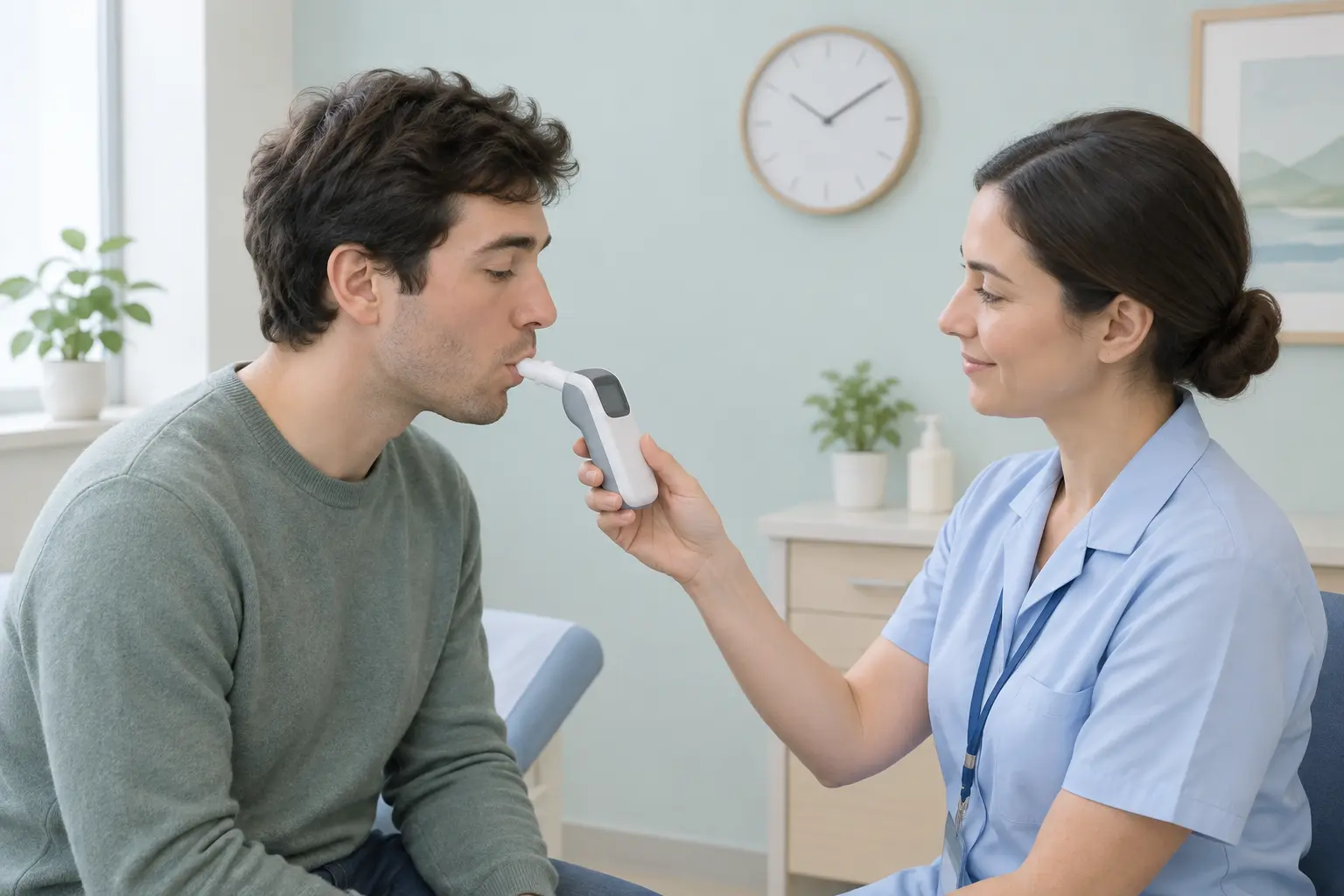
If you want to see what a breath reading means in numbers, our explainer on how to read a carbon monoxide breath test goes through typical results.
Do vapes and nicotine patches show up too?
On a cotinine test, yes. The review says cotinine reflects exposure to nicotine from all sources, including combustible products, non-combustible products and nicotine replacement therapy. A cotinine result therefore cannot tell you whether the nicotine came from a cigarette, a vape, a pouch or a patch. That matters if you are using NRT to quit. If you are tested while on a patch, a positive result may be about the patch, so tell the person doing the test.
A breath carbon monoxide test works differently. Because it detects burned material, a patch or an e-cigarette is not expected to raise it. Neither test is a judgment about which product you used. They are simply measurements.
Insurance medicals, employers and pre-test rules
If your question comes from an upcoming medical for life insurance or a job, our guide on whether employers and insurers test for nicotine covers what those checks usually involve. The basic principle from the research above applies: cotinine will show nicotine exposure whatever its source, and the trace fades over days.
Many people also ask whether smoking before a blood draw changes the result. That is a separate question about test accuracy, and we answer it in can you smoke before a blood test.
It also helps to know how fast the body clears nicotine itself. Our piece on how long nicotine stays in your body goes through the timeline in more detail.
Why honesty helps your care
The strongest reason to tell your doctor is not fear of being caught. It is that smoking changes what care is right for you. Three examples from official sources:
- Medicine doses. The NHS Specialist Pharmacy Service explains that tobacco smoke can induce liver enzymes, affecting drug metabolism, and that some medicines may need dose adjustment or monitoring if a person stops or starts smoking (SPS, Considering drug interactions with smoking).
- Lung cancer screening. The US Preventive Services Task Force recommends annual low-dose CT screening for adults aged 50 to 80 years who have a 20 pack-year smoking history and currently smoke or have quit within the past 15 years (USPSTF, Lung Cancer: Screening). The NHS says people aged 55 to 74 who have ever smoked may be given the opportunity to take part in lung cancer screening with a lung health check. Screening only works if the record is accurate.
- Quitting support. If you are a current smoker, the NHS notes that you will be offered advice on how to stop smoking when you attend a lung health check. Honest answers unlock that help.
Our pack-year calculator guide can help you work out your history before an appointment, since screening rules are often written in pack-years.
What to say to your doctor
You do not need a speech. Short and factual works best. Here is a script you can adapt:
- “I smoke about [number] cigarettes a day, and I have for [number] years.”
- “I have tried to quit [number] times, and here is what happened.”
- “I am thinking about quitting. What support can you offer?”
- “I use [patches, gum or a vape] right now. Please note it before any test.”
Clinicians ask about smoking routinely, so a straight answer is easy to work with. For more phrases and ways to open the conversation, see our guide on how to talk to your doctor about quitting smoking.
A smoke-free streak you can report honestly
One practical use for a quit tracker is simply having accurate numbers to hand. iQuit is free on Google Play and the App Store. Its dashboard shows your days smoke-free, cigarettes avoided and money saved, so when your doctor asks how long it has been, you can answer from your own record rather than from memory. You can also log cravings with their triggers and intensity, and use the SOS tools (breathing exercises, grounding, craving surfing and a virtual cigarette) when an urge hits before a stressful appointment.
If you slip, streak shields and slip recovery are there to help you restart, and you can share what you learned with your clinician. iQuit is a support tool and does not replace medical advice or testing.
Know your numbers before your next appointment
Track your smoke-free days, cravings and savings in one place, and bring an honest record to your doctor. iQuit is free on Google Play and the App Store.
Download iQuit Free on Google Play
Download on the App Store
Frequently Asked Questions
Can a doctor tell if you smoke just by looking?
Not reliably. A clinician may notice clues such as the smell of smoke or a cough, but these are impressions and can have other causes. Tests are what give a measurable answer. Many people who smoke show no obvious outward sign, which is why clinicians ask directly (NHS, Lung cancer screening).
Can a blood test show that you smoke?
Yes, if cotinine is measured. Cotinine is the most widely used biomarker of nicotine intake and can be measured in blood, saliva and urine. Daily smokers typically average 100 to 250 ng/mL in serum, versus under 3 ng/mL from secondhand smoke (Benowitz et al., 2020).
How long after you quit does cotinine fall to a non-smoker level?
On average, regular smokers reach the non-smoker cutpoint in roughly 80 to 100 hours, but individual half-lives vary. The review says that with cotinine half-lives of 8, 16 or 30 hours, it would take 40, 90 or 150 hours to reach the cutpoint (Benowitz et al., 2020).
How long does carbon monoxide stay detectable after smoking?
Exhaled carbon monoxide typically takes 12 to 24 hours to fall to the non-smoker range, and it can drop faster in light or intermittent smokers. The NHS says carbon monoxide in your blood halves after about 8 hours and reaches non-smoker levels after 48 hours (Benowitz et al., 2020; NHS Better Health).
Will vaping or nicotine patches show up on a nicotine test?
Yes on a cotinine test, which reflects nicotine from all sources, including non-combustible products and nicotine replacement therapy. A breath carbon monoxide test detects burned material, so a patch or vape is not expected to raise it. Tell the tester what you use (Benowitz et al., 2020).
Should I tell my doctor that I smoke?
Yes. Smoking can change how some medicines are cleared from the body, so doses may need adjusting or monitoring if you start or stop. It also affects lung screening eligibility. Honest answers let your doctor offer the right care and quitting support (NHS SPS; USPSTF).
Does lung cancer screening depend on smoking history?
Yes. The US task force recommends annual low-dose CT for adults aged 50 to 80 with a 20 pack-year smoking history who smoke or quit within the past 15 years. The NHS says people aged 55 to 74 who have ever smoked may be given the opportunity to take part in a lung health check (USPSTF; NHS).