Yes, some do. The honest answer to do employers test for nicotine is that it depends entirely on who is asking and where you live: a minority of US employers screen job applicants for tobacco, insurance underwriters and surgical teams order these tests far more often, and in many places the practice is restricted or simply is not part of hiring at all. What almost never varies is the chemistry. The lab is not looking for nicotine. It is looking for cotinine, the metabolite your body makes from it, and cotinine hangs around much longer.
This guide explains what the test actually measures, who orders one, how far back each sample type can look, where the law limits testing, and how to plan a stop date when someone else has set the deadline.
The short answer, by who is asking
Three different groups order nicotine tests for three different reasons, and lumping them together is what makes this question so confusing to research.
- Employers. A minority of US employers screen applicants, mostly hospitals and health systems with tobacco-free hiring policies. It is far from universal, and roughly half of US states restrict it.
- Insurers. Tobacco status is one of the few things underwriters are allowed to price on, so they have a direct financial reason to verify it.
- Clinicians. Surgical, transplant and fertility teams test because nicotine changes the outcome of the procedure they are about to perform, not to catch you out.
Whichever it is, do not guess at the rules from a forum post about a different country. Ask the person requesting the test what they are testing for, which sample they want, and what happens if it comes back positive. Those three answers tell you everything you need to plan around.
Cotinine, not nicotine: what the lab measures
Nicotine itself is a poor test target because it disappears so fast. According to Testing.com, the patient resource from the Association for Diagnostics and Laboratory Medicine, nicotine has a half-life of roughly one to two hours, while cotinine, its main breakdown product, has a half-life of about 16 to 20 hours. That single difference is why almost every screen is really a cotinine screen.
Modern labs use liquid chromatography with tandem mass spectrometry to measure nicotine, cotinine and a second metabolite, 3-hydroxycotinine, from one sample. Testing.com notes that cotinine is generally detectable for roughly one to ten days after your last nicotine exposure, depending on how frequently you used it. Our guide to how long nicotine stays in your body walks through what drives that range.
| Substance | What it is | Roughly how long it lasts | What it tells the tester |
|---|---|---|---|
| Nicotine | The drug itself | Half-life of about 1 to 2 hours | Very recent use only, so rarely used alone |
| Cotinine | The main metabolite of nicotine | Half-life of about 16 to 20 hours; detectable roughly 1 to 10 days | Nicotine exposure from any source, including patches and vapes |
| 3-hydroxycotinine | A further metabolite of cotinine | Measured alongside cotinine | Helps confirm the pattern of exposure |
| Anabasine and anatabine | Minor alkaloids found in tobacco, not in medicinal nicotine | Measured in urine by mass spectrometry | Whether the nicotine came from tobacco specifically |
That last row matters more than people expect. Anabasine and anatabine are tobacco alkaloids, and a 2022 analysis of US national survey data notes that their levels have been used to differentiate tobacco product sources and to monitor compliance with smoking cessation programs. A cotinine result says you have had nicotine. An anabasine result is what separates tobacco from a nicotine patch.
Who actually orders a nicotine test
Testing.com lists the usual requesters as surgical teams, transplant programs, insurance underwriters, smoking cessation programs and occupational health services. In practice, the volume is dominated by healthcare and insurance rather than by ordinary hiring.
The clearest published picture of employer testing comes from a single large US institution. A 2025 paper in the Journal of Occupational and Environmental Medicine describing tobacco-free hiring at MD Anderson Cancer Center reports that between 2015 and 2024 the center performed 41,797 tobacco screenings before hire, of which 232 were positive, under 1%. That is one employer with an explicit cancer-prevention mission, and the authors treat it as a case study rather than as standard practice.
Cessation services test for a different reason again. NHS stop smoking services in the UK use a breath test rather than a blood or urine sample: the NHS says you will be offered a breath test showing the level of carbon monoxide in your body, measured again at each meeting. That reading is feedback for you, not a pass or fail, and it falls fast once you stop.
Sample types and how far back they look
Which sample you are asked for tells you something about the window being examined.
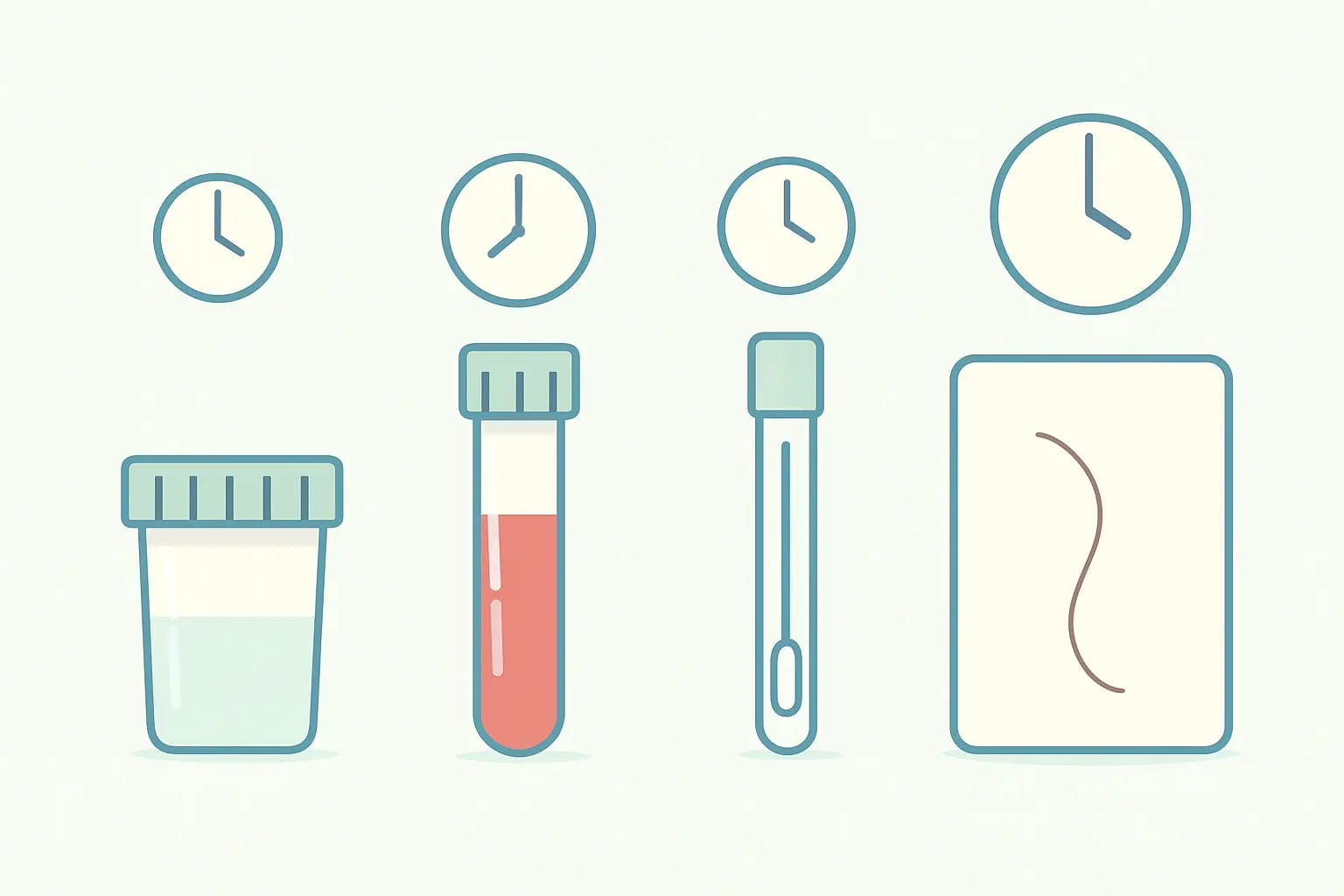
- Blood or serum. The most precise option, and the one used where a threshold matters. Testing.com notes that a cutoff of 10 ng/mL of cotinine is frequently used for surgery qualification purposes in serum or plasma testing.
- Urine. The usual choice for screening, and the sample in which minor alkaloids such as anabasine can be measured alongside cotinine.
- Saliva. Non-invasive and easy to collect on site, which is why it appears in occupational settings.
- Hair. Used mainly in research, where it captures exposure across a longer period than blood or urine can. Published studies of hair nicotine are about measuring exposure over time rather than about pass-or-fail employment screening.
Notice what the list does not include: a reliable way to distinguish a heavy smoker who quit three days ago from someone who has never smoked but lives with a smoker. Secondhand exposure produces cotinine too, which is exactly why cutoff levels exist and why you should say up front if you live or work around smoke.
Is nicotine testing legal where you live?
This is the part that genuinely differs by jurisdiction, and it is where most online advice goes wrong by stating one country’s rules as if they were global.
In the United States, the MD Anderson review reports that 29 states, 58% of them, have smoker-protection laws covering hiring. Those laws vary in what they cover and in how they are enforced, so the only safe move is to look up your own state rather than assume. Where no such protection exists, an employer may lawfully decline to hire tobacco users.
In Great Britain, the framing is different. Section 60 of the Equality Act 2010 states that a person to whom an application for work is made must not ask about the health of the applicant before offering work, with narrow exceptions covering reasonable adjustments, intrinsic job functions, diversity monitoring, positive action, occupational requirements and national security vetting. Health questions and any associated checks generally belong after a conditional offer, not before it.
We could not find a national health service or regulator anywhere that describes routine nicotine screening as a normal part of hiring, so treat any claim that your country definitely does or does not allow it with suspicion until you have read the rule yourself. If you are in the middle of a hiring process, ask for the testing policy in writing.
What a positive result actually costs you
The consequence depends on who ordered the test, and it is usually financial rather than disqualifying.
For health cover bought through the US Marketplace, tobacco use is one of only five factors insurers are allowed to price on, alongside age, location, individual versus family enrollment and plan category. HealthCare.gov states that insurers can charge tobacco users up to 50% more than people who do not use tobacco. Life cover works on the same logic through underwriting rather than a published surcharge, and our breakdown of what smokers pay for life cover shows how wide that gap gets.
For surgery, a positive result usually means a delay rather than a refusal. That delay exists for a reason. The American Society of Anesthesiologists lists breathing problems during and after surgery, a greater risk of pneumonia, a much higher chance of needing a ventilator, slower healing and a more infection-prone incision, and an increased chance of a heart attack around the time of surgery.
For employment, the outcome ranges from nothing at all to a withdrawn offer, depending on the employer’s policy and your state’s law. Ask what happens on a positive before you take the test, not after.
This short video from the American Society of Anesthesiologists explains why surgical teams care so much about tobacco in the weeks before a procedure.
How long before the test you need to stop
Work backwards from the chemistry. With a cotinine half-life of about 16 to 20 hours and a detectable window of roughly one to ten days, a light or occasional user clears faster than a pack-a-day smoker, and nobody clears in an afternoon.
Three practical rules follow from that:
- Give yourself more than a week if you can. The top of the published range is around ten days, so a week is the floor, not a comfortable margin.
- Count every nicotine source, not just cigarettes. Testing.com is explicit that nicotine patches, gum, lozenges, inhalers and e-cigarettes all produce cotinine.
- Declare your nicotine replacement therapy in advance. If you are using a patch or gum to get through the run-up, say so before the sample is taken. Our comparison of the main NRT options covers what each one does, and a tobacco-specific marker such as anabasine is what a careful tester uses to tell medicinal nicotine apart from tobacco.
If the deadline is tight and the craving pressure is high, that is not a character flaw. It is the reason dependence forms in the first place, and it is worth treating with a plan rather than willpower alone.
Turning someone else’s deadline into your quit date
An externally imposed test is an awkward way to start quitting, but it is a genuinely effective one, because it gives you something most quit attempts lack: a fixed date that is not negotiable with yourself.
A workable plan for the fortnight before a test looks like this:
- Set the stop date at least ten days before the sample date, not the night before.
- Write down the first three days you expect to be worst, then plan around them. The stages of nicotine withdrawal are predictable enough to schedule for.
- Deal with the work day separately. Breaks and colleagues are their own trigger set, and our guide to handling cravings at work covers the specifics.
- Log every craving with its trigger and intensity. A week of entries shows you which hours are dangerous, which is far more useful than a general resolve to try harder.
That last point is where a tracker earns its place. iQuit, free on Google Play and the App Store, gives you a quit-date countdown, a running days-smoke-free counter and craving logging with trigger and intensity, so by the time the sample date arrives you have a dated record of exactly how long you have been clear.
It is also worth keeping the odds in perspective. Quitting is common, and it is common at every age and in every group: our summary of who quits, broken down by group is a useful antidote to the feeling that everyone else finds this easier than you do. Smoking remains the leading preventable cause of disease and death in the United States, with the CDC attributing more than 480,000 deaths a year to smoking and secondhand smoke, so the test is a deadline worth using.
Nicotine Testing FAQ
Do employers test for nicotine in a standard drug screen?
Not usually. Nicotine and cotinine are not part of a standard workplace drug panel and have to be ordered separately. Employers that do screen are typically health systems with tobacco-free hiring policies, and roughly half of US states have smoker-protection laws covering hiring (J Occup Environ Med, 2025).
What is the difference between a nicotine test and a cotinine test?
Cotinine is what nicotine becomes in your body, and it lasts far longer. Nicotine has a half-life of roughly one to two hours, while cotinine has a half-life of about 16 to 20 hours, so labs measure cotinine even when the test is described as a nicotine test (Testing.com, ADLM).
How long does cotinine stay in your system?
Roughly one to ten days after your last nicotine exposure, depending on how frequently you used it. Light or occasional users clear toward the short end of that range and heavy daily users toward the long end. Plan for the long end rather than the short one (Testing.com, ADLM).
Can an insurance company test me for nicotine?
Insurance underwriters are among the usual requesters of cotinine testing. Tobacco use is one of the five factors US Marketplace health insurers may price on, and HealthCare.gov says insurers can charge tobacco users up to 50% more than people who do not use tobacco.
Will secondhand smoke make me fail a nicotine test?
Secondhand exposure does produce measurable cotinine, which is one reason laboratories apply cutoff levels rather than reporting any detectable amount as a positive. If you live or work around smokers, say so before the sample is taken so the result can be interpreted properly.
What cotinine level counts as a positive?
There is no single universal threshold, because it depends on the sample and the purpose. Testing.com notes that a cutoff of 10 ng/mL of cotinine is frequently used for surgery qualification purposes in serum or plasma testing. Ask the requester which cutoff they apply.
Is it legal for an employer to refuse to hire smokers?
It depends where you are. In the US, a 2025 review reports that 29 states have smoker-protection laws covering hiring, so the answer differs by state. In Great Britain, section 60 of the Equality Act 2010 restricts health enquiries before a job offer is made, with narrow exceptions.
Does a carbon monoxide breath test detect nicotine?
No. It measures carbon monoxide from burning tobacco, not nicotine, so it does not react to patches or gum. NHS stop smoking services offer this breath test at each meeting as feedback on your progress rather than as a pass-or-fail check (NHS).
Start the clock before the test date, not after
Set a quit date, watch the smoke-free days add up, and log every craving with its trigger and intensity so you know which hours to plan around. iQuit is free on Google Play and the App Store.
Download iQuit Free on Google Play
Download on the App Store