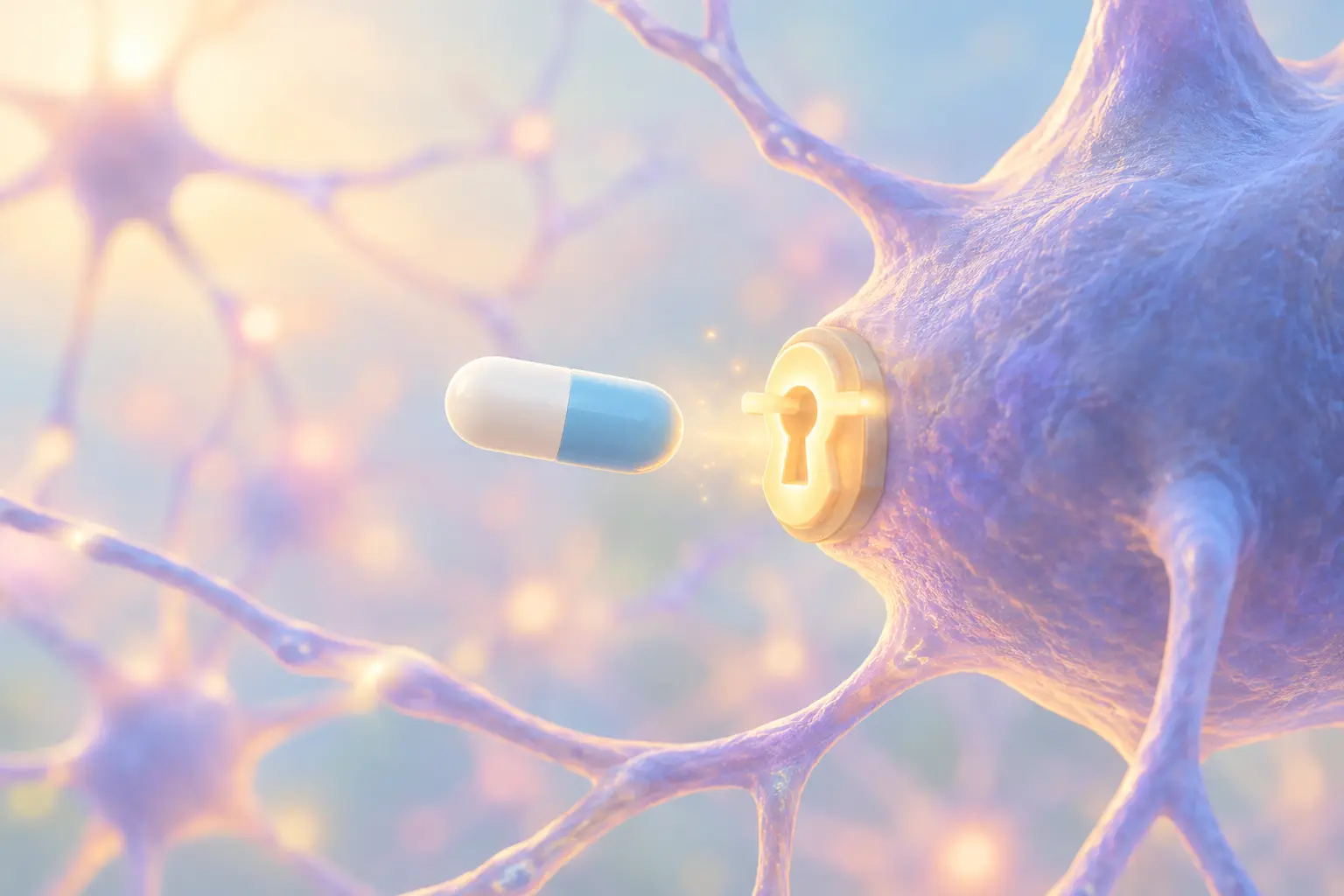
How does Chantix work? Chantix, whose generic name is varenicline, is a prescription tablet that attaches to the same brain receptors nicotine uses. It switches those receptors on weakly, which takes the edge off cravings and withdrawal, while also blocking nicotine from fully switching them on, so a cigarette is less rewarding. Most people notice fewer cravings within the first days, though it is taken for weeks, not days.
The Short Answer: A Partial Agonist at the α4β2 Receptor
When you smoke, nicotine travels to the brain and latches onto nicotinic acetylcholine receptors. The one most tied to dependence is called the α4β2 subtype. Activating it triggers a release of dopamine, the chemical behind the “reward” feeling that keeps people reaching for the next cigarette.
The US prescribing information for varenicline describes what the drug does there. It “binds with high affinity and selectivity at α4β2 neuronal nicotinic acetylcholine receptors,” and its binding “produces agonist activity, while simultaneously preventing nicotine binding to these receptors” (varenicline tablets prescribing information, DailyMed). The label adds that it stimulates receptor activity “at a significantly lower level than nicotine.”
That is what “partial agonist” means: the drug is a weak key that turns the lock part of the way, and while it sits in the lock, nicotine cannot turn it fully.
What That Means for Cravings and Reward
The partial stimulus and the blocking effect do two different jobs, and a Cochrane review of these drugs describes both. Partial agonists “may help people to stop smoking by a combination of maintaining moderate levels of dopamine to counteract withdrawal symptoms (acting as an agonist) and reducing smoking satisfaction (acting as an antagonist)” (Cochrane review of nicotine receptor partial agonists, 2023).
- Less withdrawal: the steady, low-level stimulus keeps dopamine from crashing when nicotine disappears, so irritability, low mood and urges are milder. The NHS says varenicline “can reduce the cravings for nicotine and helps with the withdrawal you get when you stop smoking.”
- Less reward from a slip: because nicotine is partly blocked, a cigarette smoked while taking the drug is less satisfying. The prescribing information links nicotine’s reward to the brain’s “mesolimbic dopamine system,” the pathway varenicline blunts.
Varenicline contains no nicotine. It is not a replacement the way a patch or gum is, which is why people who dislike or have not had success with nicotine replacement sometimes try it. If you want to compare the two approaches in depth, our guide on varenicline vs nicotine patches sets them side by side.
Before You Start: The Prescriber Conversation

Because varenicline is prescription-only, the first step is a conversation with a doctor, nurse or pharmacist who can check your medical history and agree a quit date with you. Bring a list of any other medicines you take, and ask what to do if side effects appear. The patient leaflet in the box repeats the dosing schedule, so keep it handy.
Planning matters because the tablets are started ahead of the quit date, as the next section explains. Knowing your date, and having support lined up for the first weeks, makes the build-up period much easier to follow.
Week One: The Dose Build-Up
Varenicline is deliberately started low and raised over the first week, which is a big part of why it is begun before you quit. The US label says to “begin varenicline tablets dosing one week before the date set by the patient to stop smoking,” with the alternative of starting and then quitting between days 8 and 35 of treatment. The starting week is 0.5 mg once daily on days 1 to 3 and 0.5 mg twice daily on days 4 to 7, then 1 mg twice daily for the remaining weeks (DailyMed label).
The NHS describes the same pattern for the UK, where the brand is Champix: take the lower-dose tablet once or twice a day for the first week, then the higher dose twice a day, starting your tablets “1 to 2 weeks before your stop smoking date,” which “allows you to build up the dose and gradually helps your body get used to the medicine” (NHS, how and when to take varenicline). Your prescriber and the leaflet set your exact dose; this article does not replace them.
Nausea is the most common reason people struggle in these early days. The label calls it “the most common adverse reaction (up to 30% incidence rate)” and notes that dose reduction may help, so tell your prescriber rather than quietly stopping. For what else to expect, see our guide to varenicline side effects and how long to take it.
When Most People Notice It Working
Because the drug is started before your quit date, much of the build-up happens while you are still smoking. The NHS says: “After several days of taking varenicline, you’ll usually notice that you’re craving fewer cigarettes each day” (NHS, about varenicline). That fits the label’s one-week lead-in.
A realistic picture of the first two weeks looks like this:
| Stage | What is happening | What many people notice |
|---|---|---|
| Days 1 to 3 | Lowest dose, once daily (label) | Possible nausea, the most common side effect (label) |
| Days 4 to 7 | Same low dose, twice daily (label) | “Craving fewer cigarettes each day” (NHS) |
| Quit date | Full dose reached; stop smoking | Cravings and withdrawal are reduced, not eliminated |
| Week 2 onward | Continue the full course | Keep logging cravings and triggers so you can see your own trend |
Treat the last two rows as typical rather than guaranteed; people respond differently, and the sources above do not give an exact day when the effect peaks. Cravings still arrive, because habit and context drive them too. Logging them is a simple way to see your own trend rather than relying on memory, and the craving log in iQuit records the trigger and intensity each time.

Course Length: 12 Weeks and a Possible Second Course
Do not stop when the cravings ease. The NHS says it is “important to complete the full 12-week course, even if you have stopped smoking,” because finishing the course “can increase the chance of stopping for good.” If your doctor thinks it will help, they may prescribe another 12-week course (NHS, how and when to take varenicline). The US label likewise recommends an additional 12 weeks of treatment “for successful quitters to increase likelihood of long-term abstinence.”
If you are not ready to stop on a fixed date, the label also describes a gradual approach for people who are sure they cannot quit abruptly: reduce smoking by half within the first four weeks, by half again in the next four, and aim for complete abstinence by 12 weeks, with treatment continuing to 24 weeks in total. Ask your prescriber whether that path suits you.
Stopping can itself bring a short spell of withdrawal. The NHS says stopping varenicline “can sometimes cause nicotine withdrawal symptoms for a short time,” and a doctor may suggest reducing the dose gradually at the end.
Who Should Talk to a Doctor First
Varenicline is prescription-only, so a clinician decides whether it is right for you. The NHS says to tell your doctor before starting if you have ever had an allergic reaction to it, have kidney problems, have ever had problems with your heart, are pregnant or breastfeeding, or have ever had a seizure. It adds that varenicline can cause or worsen some conditions, including depression and other mental health conditions and sleep problems such as insomnia and abnormal dreams (NHS, who can and cannot take varenicline).
The US label carries a warning on neuropsychiatric events, noting that serious ones “have been reported in patients being treated with varenicline tablets” and that some people who stopped smoking may have been experiencing nicotine withdrawal symptoms, including depressed mood. If you notice mood changes, agitation or thoughts of self-harm, contact a clinician urgently.
Availability and generics change, so check our explainer on whether Chantix is still available in 2026 before you ask for it by brand name.
Varenicline vs NRT vs Bupropion in One Table
The Cochrane review of partial agonists pooled randomized trials comparing varenicline with other options. Risk ratios (RR) above 1 mean more people quit with varenicline:
| Compared with | Risk ratio of quitting | What the review concluded |
|---|---|---|
| Placebo | 2.32 (95% CI 2.15 to 2.51) | High-certainty evidence that varenicline helps more people quit |
| Bupropion | 1.36 (95% CI 1.25 to 1.49) | High-certainty evidence that varenicline helps more people quit |
| A single form of NRT | 1.25 (95% CI 1.14 to 1.37) | High-certainty evidence that varenicline helps more people quit |
| Dual-form NRT | 1.02 (95% CI 0.87 to 1.20) | No clear difference in quit rates |
In plain terms, varenicline outperformed placebo, bupropion and a single type of nicotine replacement, and the review found no clear difference against combining two forms of NRT. The review also found moderate-certainty evidence that people taking varenicline were more likely to report serious adverse events than those not taking it, though for cardiac and neuropsychiatric events the evidence was compatible with both benefit and harm.
For the other prescription option, read our bupropion Zyban quit smoking guide. If you would rather avoid prescription medicines, best NRT options compared explains the over-the-counter choices. For the full picture of methods, start with how to quit smoking in 2026 the complete evidence based guide.
Frequently Asked Questions
How does Chantix work in simple terms?
Chantix (varenicline) partly activates the same brain receptors nicotine uses. That small, steady stimulus eases withdrawal and cravings, and it also blocks nicotine from fully activating the receptors, so a cigarette feels less rewarding. It contains no nicotine and is prescription-only (DailyMed prescribing information; Cochrane 2023).
How long does Chantix take to work?
The NHS says that after several days of taking varenicline you will usually notice craving fewer cigarettes each day. It is started 1 to 2 weeks before your quit date, so the early build-up happens while you are still smoking. Responses vary from person to person (NHS).
How long do you take Chantix?
A course of varenicline lasts 12 weeks, and the NHS stresses completing it even if you have stopped smoking. Your doctor may prescribe a second 12-week course to help prevent relapse, and the US label recommends an additional 12 weeks for successful quitters (NHS; DailyMed).
Does Chantix contain nicotine?
No. Varenicline is not a nicotine replacement. It acts on the same receptors but does not contain nicotine, which is why it is a different option from patches, gum or lozenges. It is available only on prescription, so a clinician has to assess whether it is suitable (NHS, about varenicline).
Is varenicline more effective than patches?
A 2023 Cochrane review found high-certainty evidence that varenicline helps more people quit than a single form of NRT (risk ratio 1.25), but no clear difference compared with combining two forms of NRT (risk ratio 1.02). The best choice depends on your history and your prescriber’s advice (Cochrane 2023).
Who should not take Chantix?
Tell your doctor first if you have had an allergic reaction to it, or have kidney problems, heart problems, seizures, depression or other mental health conditions, sleep problems, or are pregnant or breastfeeding. A prescriber will decide whether it is suitable for you (NHS).
What are the most common side effects?
The US label lists nausea as the most common adverse reaction, with an incidence of up to 30 percent, and says dose reduction may help. The NHS lists headaches, feeling sick and dizziness as common side effects. Tell your prescriber if side effects are hard to cope with (DailyMed; NHS).
Log Your Cravings Through the First Weeks
See Your Cravings Change Week by Week
iQuit lets you log every craving with its trigger and intensity, so you can see whether they are getting less frequent or less intense as your quit plan settles in. Free on Google Play and the App Store.
Download iQuit Free on Google Play
Download on the App Store