
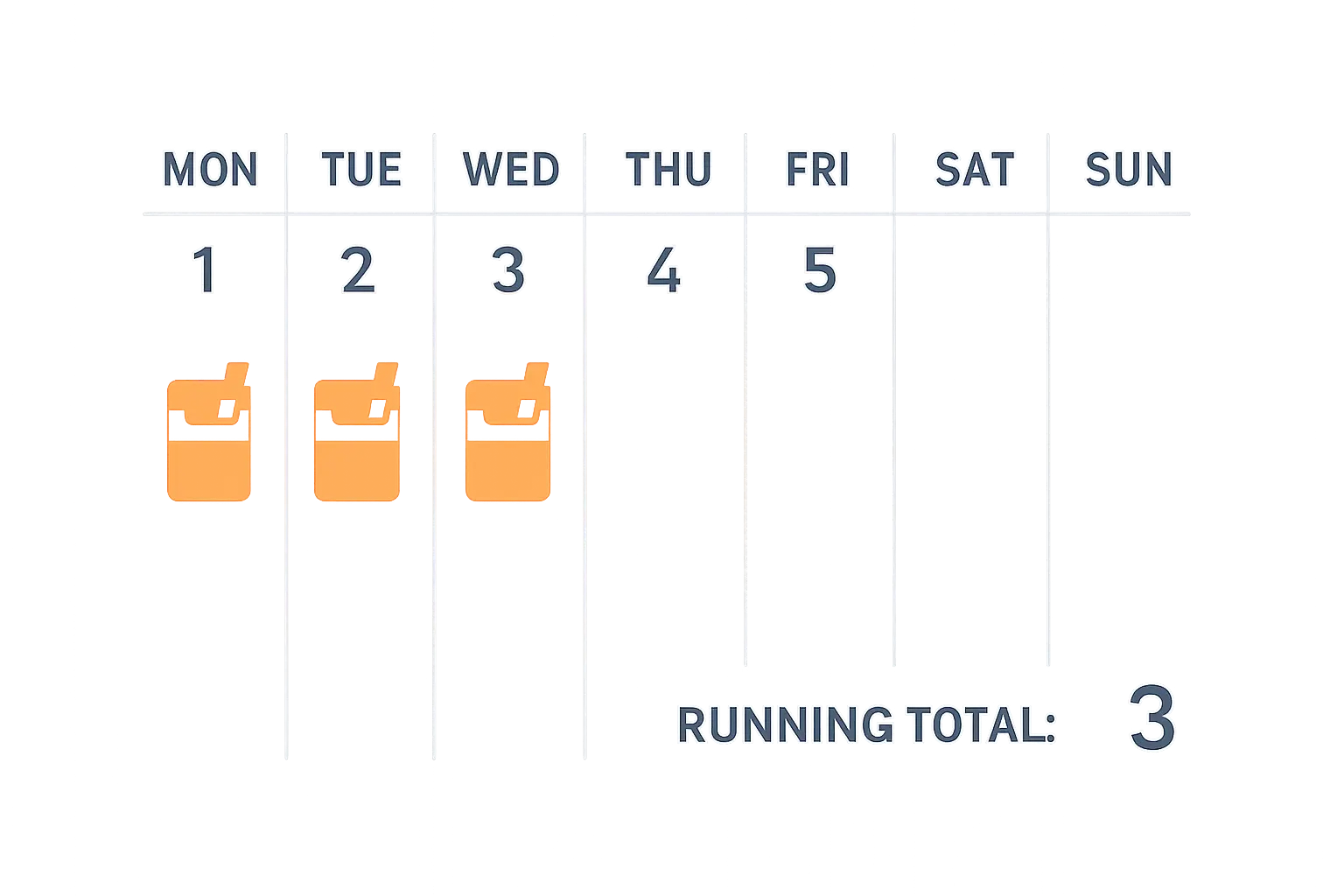
A daily pack habit rarely feels expensive day to day — it’s a few dollars here, a few there. How much do you spend on cigarettes a week is a more useful question than the annual figure most cost calculators lead with, because a weekly number is small enough to actually picture and large enough to notice. This guide builds that number from current 2026 pack prices for four common daily counts, then breaks it down to monthly and annual totals, using your own real numbers rather than a single national average that may not match your state, country or brand.
The Quick Answer at 5, 10, 20 and 40 a Day
Using $10.15 — the 2026 all-state average US retail price per 20-pack, including all federal and state excise and sales taxes, per the Campaign for Tobacco-Free Kids’ “State Cigarette Tax Rates & Rank” factsheet (updated 6/25/2026) — here’s what four daily counts cost per week. This is a national average built from all 50 states plus DC, so your own state may run higher or lower; for a state-level breakdown, see the link below.
| Cigarettes/day | Per day | Per week |
|---|---|---|
| 5 (light) | $2.54 | $17.76 |
| 10 (half a pack) | $5.08 | $35.52 |
| 20 (a pack) | $10.15 | $71.05 |
| 40 (two packs) | $20.30 | $142.10 |
For a full state-by-state breakdown of US pack prices — which range from roughly $6 in the lowest-tax states to $11+ in the highest — see how much is a pack of cigarettes in 2026. The rest of this page uses the national average so the weekly ladder stays comparable across daily counts.
Pack Prices by Country in 2026
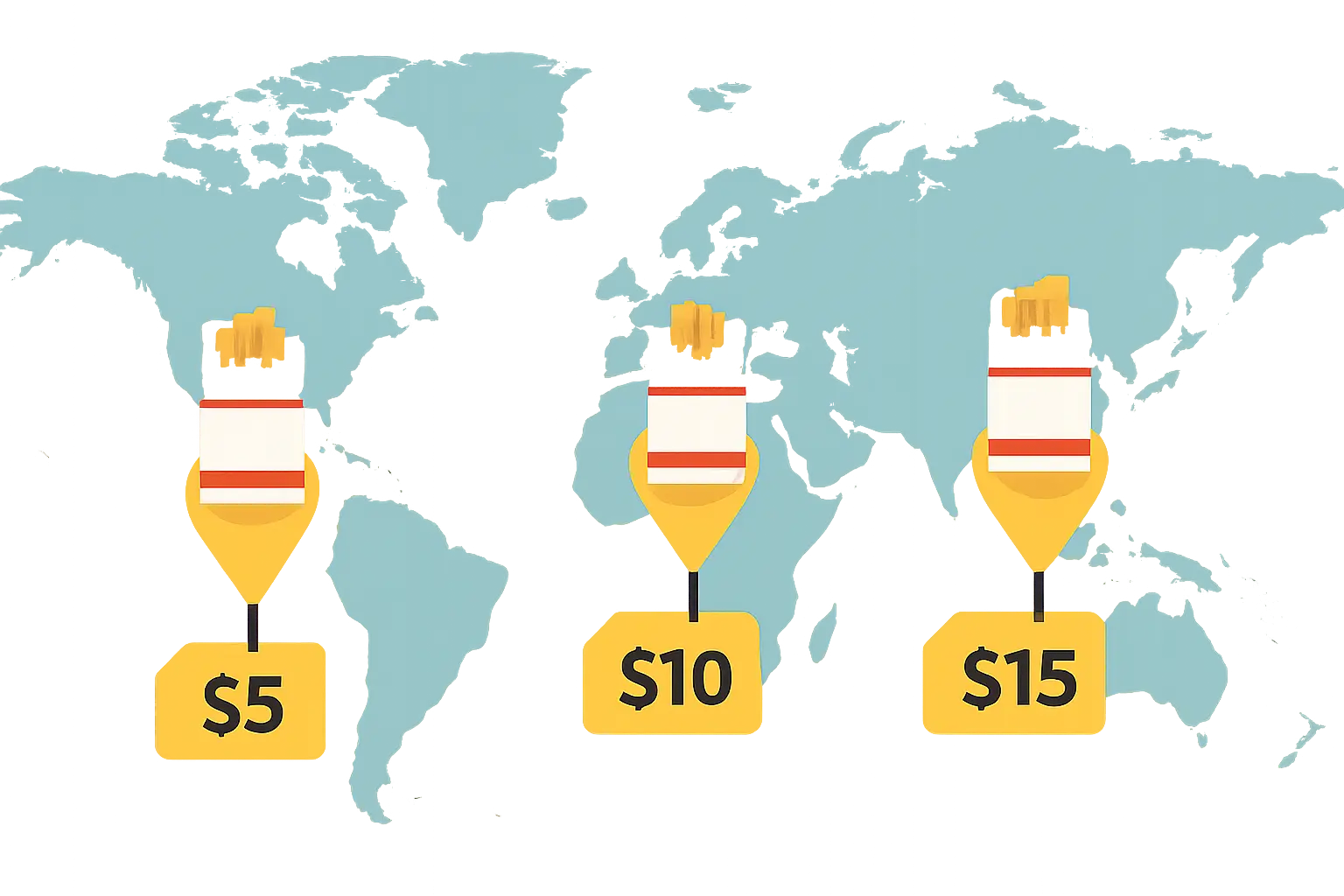
Pack prices vary enormously by country — mostly because of tobacco tax policy, not manufacturing cost. As of April 2026, UK pricing coverage puts a 20-pack at roughly £16.50–£19.00 (about 82% of that is duty and VAT), while the same retailer’s page puts US mainstream brands at $8.00–$10.25, a range consistent with the $10.15 Campaign for Tobacco-Free Kids all-state average used in the calculator above; high-tax states like New York ($14.83 per pack with all taxes, per the same CTFK factsheet) and Rhode Island ($13.72) sit well above the average, while lower-tax states such as Missouri ($8.01) sit below it.
Because these figures shift with each budget cycle and vary by brand within a country, treat them as a snapshot rather than a fixed number — always check the current price for your own state or country before committing to a specific weekly figure. For the full country-by-country breakdown this site maintains, see the true cost of smoking per year by country.
The CDC’s Tips From Former Smokers campaign includes a short first-person account of exactly this kind of cost realization:
Your Weekly Number in Three Steps
- Count your real daily average over the last two weeks, not your “usual” count — most smokers underestimate by a few cigarettes on stressful days.
- Check your actual pack price on a recent receipt, not the price from a year ago (tobacco duty increases are common every year in most countries).
- Multiply: (cigarettes per day ÷ 20) × pack price × 7 for your weekly figure.
If you smoke roll-ups rather than manufactured cigarettes, this formula doesn’t directly apply — see the roll-ups section below for the adjustment.
A worked example: someone who smokes 12 a day and pays $9.50 for their usual 20-pack would calculate (12 ÷ 20) × $9.50 × 7 = $39.90 a week. That’s higher than the 10-a-day row in the table above and lower than the 20-a-day row, which is exactly the point of doing your own math rather than rounding to the nearest table entry — a few cigarettes a day, or a dollar or two of price difference, moves the weekly total by several dollars, and several dollars a week is real money over a year.
Monthly and Annual Totals
Multiplying the weekly figures above out to a full year makes the gap between daily counts much clearer:
| Cigarettes/day | Per month | Per year |
|---|---|---|
| 5 | $77.18 | $926.19 |
| 10 | $154.36 | $1,852.38 |
| 20 | $308.73 | $3,704.75 |
| 40 | $617.46 | $7,409.50 |
A pack-a-day habit at this US average price alone crosses $3,700 a year — before counting lighters, ashtray supplies, or the higher cleaning and dry-cleaning costs some smokers report. For the deeper breakdown of what a full year of smoking costs once every category is included, see the cost of smoking per year in 2026.
It’s worth sitting with the gap between the 10-a-day and 20-a-day rows for a moment: doubling your daily count doesn’t just double the discomfort of quitting later, it doubles the annual bill exactly — from roughly $1,852 to roughly $3,705. That relationship holds at any price point, which is why cutting down from a heavier habit to a lighter one, even without quitting completely, produces a proportional saving you can bank on immediately rather than waiting for a full quit date to see any benefit.
What the Weekly Amount Buys Instead
A $71-a-week pack-a-day habit is close to a weekly grocery shop for one person in many US cities, a mid-range streaming bundle several times over, or a sit-down restaurant meal every single week of the year. At $36 a week (10 a day), that’s a tank of gas or a month of a mid-tier phone plan every few weeks. These comparisons aren’t meant to guilt anyone — they’re meant to make an abstract number concrete enough to actually plan around, the same way a specific savings goal beats a vague “I should save more.”
The comparison works better when it’s personal rather than generic. Instead of “a streaming subscription,” picture the actual thing you’d cancel or add — your own phone bill, your own gym membership, your own coffee order. A weekly figure maps onto a weekly budget line far more directly than an annual total does, which is part of why budgeting apps and money-saved trackers work in weeks and months rather than defaulting straight to a five-year projection. It’s also worth noting that these figures compound: a habit that costs $71 this week costs the same again next week, and the week after, indefinitely, until something changes — the total isn’t a one-off expense, it’s a recurring line item most people never formally budget for.

Roll-Ups and Cheaper Brands: Does It Change Much
Switching to a cheaper manufactured brand typically saves 10–20% per pack rather than solving the cost problem outright, since most of the retail price in high-tax markets is duty, not brand premium. A smoker paying $10.15 for a mainstream 20-pack who switches to a $8.50 budget brand at the same daily count saves about $1.65 per pack — meaningful over a year, but nowhere near the saving from reducing the daily count or quitting.
Roll-up tobacco changes the math differently — cost is calculated by pouch weight and tobacco-per-cigarette rather than a fixed pack price, so a roll-up smoker needs a separate calculation rather than the pack-based formula above: (grams used per week ÷ grams per pouch) × pouch price. Roll-up smokers often use less tobacco per cigarette than a manufactured stick contains, which can make the per-cigarette cost lower, but the habit frequently involves smoking more cigarettes to compensate, narrowing or eliminating the apparent saving. Neither a cheaper brand nor rolling your own reduces health risk meaningfully; both are cost workarounds, not quitting — for readers who smoke exclusively hand-rolled tobacco, how to quit rolling tobacco covers a roll-up-specific plan.
Why the Weekly Number Motivates Better
Annual totals are easy to dismiss as abstract (“I’ll deal with that eventually”); a weekly number is small enough to check against your actual bank statement this Friday. iQuit‘s dashboard shows both — a live cigarettes-avoided counter and a money-saved figure that updates from the moment you set your quit date and your own pack price, so the weekly number keeps being true without you doing the math again. For the same calculation built for a full year and multiple horizons, the quit smoking money saved calculator covers longer time frames, and if vaping is also part of your habit, how much money do you save quitting vaping runs the same method for disposables and pods.
Average daily cigarette counts vary a lot by smoker — for context on where a “10 a day” or “20 a day” habit sits nationally, see how many cigarettes a day the average smoker smokes. Many smokers who track their own count for the first time are surprised to find it’s higher than they assumed, particularly on social occasions or stressful days — which is exactly why a receipt-based weekly figure, recalculated every few weeks, stays more accurate than a single estimate made once and never revisited.
Frequently Asked Questions
How much does a pack-a-day smoker spend per week?
At the 2026 US average retail price of $10.15 per 20-pack (Campaign for Tobacco-Free Kids, “State Cigarette Tax Rates & Rank” factsheet, updated 6/25/2026), a pack-a-day (20 cigarettes) smoker spends roughly $71.05 a week, or about $3,705 a year. In the UK, where a 20-pack runs roughly £16.50-£19.00, the same habit costs about £124 a week.
How much do 10 cigarettes a day cost per week?
At this US average pack price, 10 cigarettes a day (half a 20-pack) costs about $5.08 a day, or roughly $35.52 a week — about $1,852 a year. Your own figure depends on your state or country’s actual pack price, which can vary by several dollars.
Does switching to a cheaper brand save much money?
Typically 10-20% per pack, not a dramatic saving, because in most high-tax markets the majority of the retail price is government duty rather than brand premium. A cheaper brand reduces the bill slightly; it does not meaningfully reduce health risk.
How is roll-up tobacco cost calculated differently?
Roll-up tobacco is priced and taxed by weight rather than per stick, so a per-pack formula doesn’t apply directly. Cost depends on pouch price, pouch weight, and how much tobacco you use per cigarette, which varies by individual rolling habits.
Why do cigarette prices vary so much by country?
Primarily tobacco taxation policy. In the UK, roughly 82% of a pack’s retail price is duty and VAT; the US sets tax at federal and state level separately, which is why prices can range from about $6 in low-tax states to $14+ in high-tax cities within the same country.
Why does a weekly number motivate quitting more than a yearly one?
A weekly figure is small enough to check against an actual bank statement or paycheck, which makes it feel real rather than abstract. Annual totals are accurate but easy to dismiss as a future problem; a weekly number invites an immediate comparison to something you already buy every week.
Watch Your Weekly Cigarette Spend Turn Into Real Savings
iQuit’s free dashboard tracks cigarettes avoided and money saved in real time from your own pack price and quit date — free on Google Play and the App Store.
Download iQuit Free on Google Play
Download on the App Store