
Most quit-smoking advice is written for someone who smokes ten or so a day, which makes it feel useless if you are lighting up 30 or 40 times. Learning how to stop chain smoking starts from a different premise: instead of aiming straight for zero, you build an hourly structure that matches how dependent your body actually is, then step it down on a schedule you can see.
What Counts as Chain Smoking
There’s no single official cutoff, but in practice, chain smoking means lighting the next cigarette from the habit of the last one rather than from a specific craving — often 25 to 40+ a day, sometimes with barely a gap between them. If you regularly smoke within a few minutes of waking, or you genuinely don’t know your daily count because you’ve stopped tracking it, an hourly structure will do more for you than generic quitting advice built around 10-a-day habits.
Baseline: One Day of Honest Counting
Before changing anything, count one full day exactly as it happens — every cigarette, the time, and what you were doing. Most heavy smokers underestimate their own count by a third or more once they actually log it, because a lot of the smoking has become automatic rather than deliberate. This number is your real starting point, not the round figure you’d guess if asked.
If this sounds close to home, our nicotine dependence test gives a more structured way to see how dependent your pattern actually is, and our data on average cigarettes per day shows where your count sits against typical smokers.
Mayo Clinic on how medication can help smokers who choose to cut back before quitting fully.
The Hourly Schedule Method
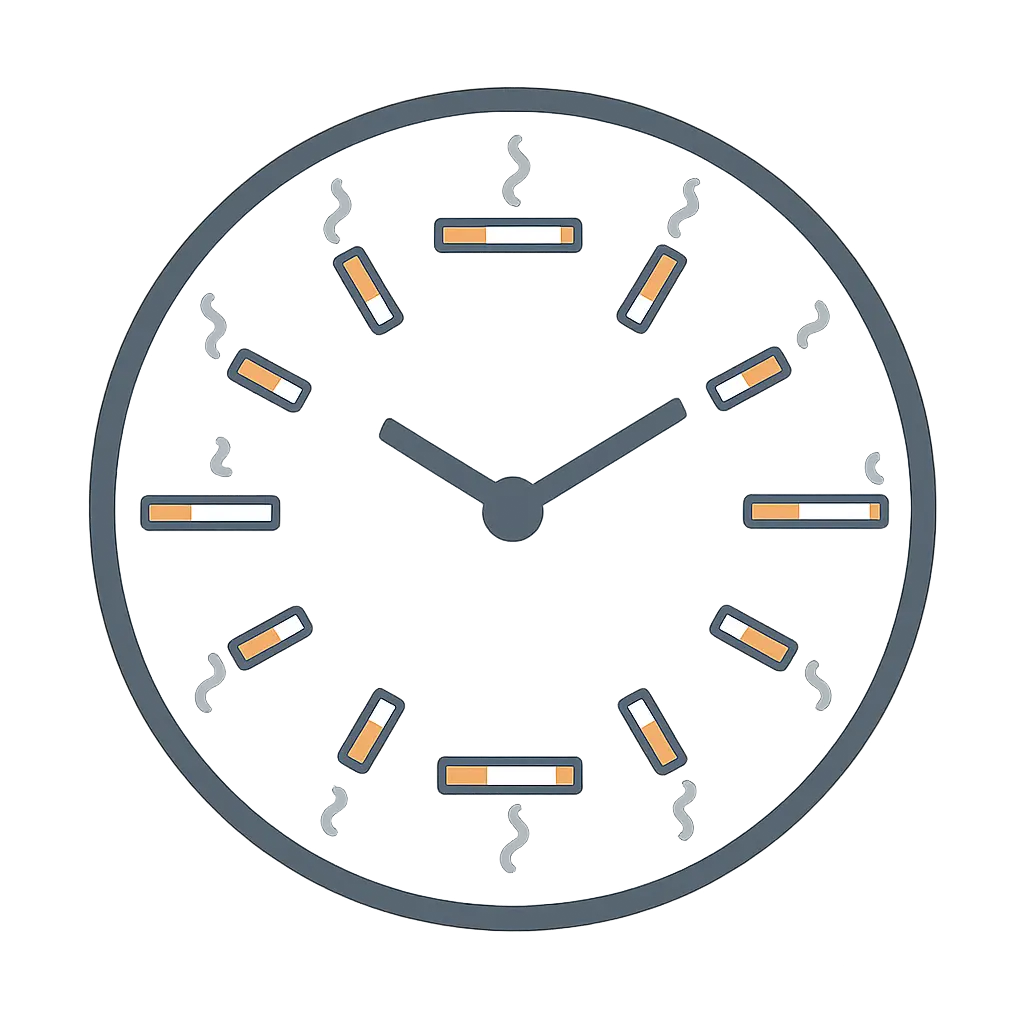
Once you know your real count, convert it into a schedule rather than a target. If you smoke 32 a day across roughly 16 waking hours, that’s about one every 30 minutes on autopilot. The method is simple to describe and hard to do without a schedule: pick a starting interval slightly longer than your current average (say, every 40 minutes instead of every 30), write out the actual clock times for the day, and only smoke at those times — not before, even if a craving shows up early.
This does two things a vague “cut down” instruction doesn’t: it makes the reduction visible (you can see the gaps getting longer week over week), and it breaks the link between “craving appears” and “cigarette happens immediately,” which is often the most automatic part of a heavy habit.
| Week | Target interval | Approx. daily count |
|---|---|---|
| Baseline (before starting) | ~every 30 min | 32 |
| Week 1 | Every 40 min | ~24 |
| Week 2 | Every 55 min | ~18 |
| Week 3 | Every 75 min | ~13 |
| Week 4 | Every 100 min, minus weakest-craving slots | ~9–10 |
This table is illustrative, not a fixed prescription — your own baseline count and how quickly you extend the interval will differ. The point of writing it out this way is that “9–10 a day by week 4” is a concrete, checkable target, where “smoke less” is not.
Delay, Then Drop: The Two-Lever Approach
There are really only two levers in a reduction plan: delay (make the gap between cigarettes longer) and drop (remove specific cigarettes from the day entirely, usually the ones tied to weak triggers like habit rather than genuine craving). Heavy smokers tend to get more mileage from delay first, because 30–40 cigarettes a day usually includes several that were never really wanted — they just followed the schedule of the last one. Dropping those first, before touching the ones tied to real craving, produces a fast early win without a fight.
- Delay lever: Add 10–15 minutes to your interval every few days as it gets comfortable.
- Drop lever: Identify the 3–5 cigarettes in your day with the weakest craving attached, and remove those specific slots from the schedule first.
NRT Levels That Match 30–40 a Day
NICE’s own guidance frames this stage explicitly as harm reduction for people who are “not ready to stop in one go” (NICE NG209), which is exactly what a heavy-smoker step-down plan is. What it doesn’t do is hand you a specific milligram dose for your exact cigarette count — that comes from the product label and your pharmacist, since starting strength depends on more than just cigarettes per day. What matters at this stage is not under-dosing: a heavy habit paired with a low-strength single product is one of the most common reasons NRT gets written off as “not working,” when the real issue was a mismatch in strength. Our combination NRT versus single NRT comparison and the features that actually help heavy smokers both go further into matching support to a bigger habit.
Combination NRT and Why It Fits Heavy Smokers
A steady-release patch covers your background nicotine level across the day, while a fast-acting product (gum, lozenge or spray) handles the sharper cravings that a patch alone can’t reach in the moment. For someone stepping down from 30–40 a day, that combination generally does more than either product alone, simply because the underlying dependence is higher and a single, fixed-release format has less room to flex around it. This is a conversation for your pharmacist or GP, not a self-directed increase — ask specifically about combination options given your daily count. If gum ends up being one of your products and you’re still relying on it well past your quit date, our step-down plan for tapering off nicotine gum gives a dated exit route for that stage too.
The Last Three Cigarettes of the Day
For most heavy smokers, three cigarettes carry an outsized share of the difficulty: the first one after waking, the one after a meal, and the one right before bed. These tend to be the most deeply automatic and the hardest to delay, so it’s usually more effective to leave them for last in your step-down schedule rather than trying to remove them early to prove progress. Get the rest of the day’s schedule solid first; these three will move once the surrounding pattern has already shifted.
Each of the three usually needs a slightly different substitute rather than one universal trick. The waking cigarette often responds well to delaying the first coffee by ten minutes and having a substitute ready at the bedside the night before. The post-meal cigarette is frequently more about ending the meal ritually than about nicotine specifically, so a short walk or brushing your teeth immediately after eating can do more than a craving app alone. The bedtime cigarette is often tied to winding the day down, so replacing the action (stepping outside, a specific drink, a few minutes on the phone) tends to work better than trying to simply skip the moment.
When to Set the Quit Date
NICE frames the goal of any reduction plan as eventually reaching a full stop, not stabilising indefinitely at a lower number — the guidance is explicitly to “reduce people’s harm from smoking if they are not ready to stop in one go,” which describes a route to quitting, not an end state. A reasonable marker: once your schedule has you under 10–15 a day and your last-three cigarettes are the main remaining fixed points, that’s usually the moment to set an actual quit date rather than continuing to step down indefinitely. Evidence on abrupt-versus-gradual approaches is genuinely mixed by study type: a 2022 analysis of English survey data found abrupt quit attempts associated with meaningfully higher quit success than gradual ones even after adjusting for a broad range of confounders (adjusted odds ratio 1.75, 95% CI 1.59–1.93), a pattern the same researchers note has not been replicated in randomized trials comparing the two approaches head-to-head (Garnett et al., Nicotine & Tobacco Research, 2022). Treat the reduction phase as a bridge with a planned end, not a permanent lower-smoking lifestyle — our broader look at whether cutting down actually works covers that evidence in more depth if you want the full picture before committing to this approach.
If you’re managing a heavy habit later in life, our guide to quitting at 60 and older covers the medical review step that matters more once other health conditions or medicines are in the picture, alongside this step-down structure.
Seeing the Schedule Work
A step-down plan lives or dies on whether you can actually see the gaps lengthening. iQuit’s craving log timestamps each entry by trigger and intensity, so your hourly schedule becomes a visible trend rather than something you’re tracking on a scrap of paper — and the predictive craving forecasts start flagging your riskiest hours once there’s a few days of real data behind them.
Frequently Asked Questions
How many cigarettes a day counts as chain smoking?
There’s no official cutoff, but it generally describes smoking 25–40 or more a day, often lighting the next cigarette from habit rather than a specific craving. If you smoke within minutes of waking or have stopped tracking your count, an hourly step-down structure is usually more useful than general quitting advice.
Is it better to cut down or quit cold turkey for heavy smokers?
Evidence is mixed by study type: observational data (a 2022 analysis of English survey data) links abrupt quit attempts to meaningfully higher success even after adjusting for confounders, while trials comparing the two approaches directly have not found the same difference. For very heavy smokers, a structured reduction plan with a planned quit date at the end often works better than either an unplanned taper or an abrupt stop attempted without support.
What NRT strength should a heavy smoker use?
This depends on the specific product’s label and your circumstances, so it should be checked with a pharmacist rather than self-selected. What’s well established is that under-dosing is a common problem for heavy smokers using a single low-strength product — combination NRT (a patch plus a fast-acting product) is often more appropriate for a 30–40-a-day habit.
Why do I keep smoking even when I don’t feel a craving?
In heavy smoking patterns, a large share of cigarettes are triggered by the previous cigarette ending rather than by a distinct craving — the habit runs on its own schedule. An hourly plan with fixed clock times breaks this link because it stops the “last cigarette ended, so it’s time for the next one” pattern from running automatically.
When should I set a quit date if I’m cutting down first?
A reasonable point is once your daily count is down to roughly 10–15 and mainly consists of a few fixed, deeply automatic cigarettes (on waking, after meals, before bed). At that stage, treat reduction as a bridge to a specific quit date rather than a permanent lower-smoking routine.
Turn Your Step-Down Into a Visible Plan
iQuit logs every cigarette and craving by time and trigger, so your hourly schedule becomes a chart you can actually watch move — with craving forecasts that learn your riskiest hours. Free on Google Play and the App Store.
Download iQuit Free on Google Play
Download on the App Store