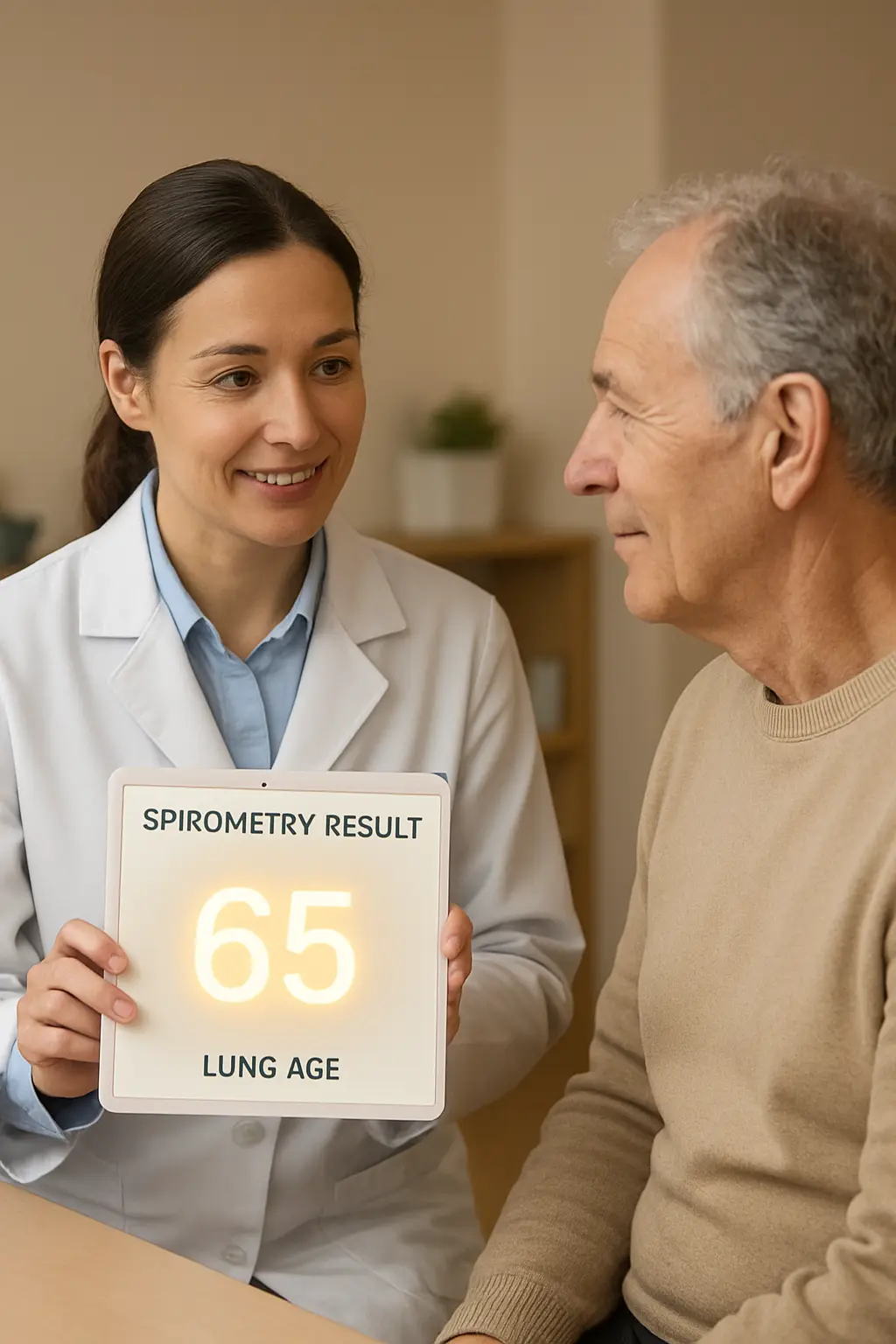
If a pharmacist or nurse just told you your “lung age” is higher than your actual age, it’s natural to feel a jolt of alarm. Take a breath: the lung age test is a communication tool, not a diagnosis, and it’s specifically designed to be a wake-up call rather than a sentence. This guide explains exactly what the number means, where it comes from, why stop-smoking services use it, what genuinely improves after you quit, and how to read your own result without panic.
What Is Lung Age and How Is It Calculated
Lung age is derived from spirometry, a simple breathing test that measures FEV1 — the volume of air you can forcefully exhale in one second. Everyone’s expected FEV1 depends on their height, sex, and age, based on population data from people who have never smoked. Lung age takes your actual FEV1 result and works out which “never-smoker” age it matches: if your FEV1 is what a typical never-smoking 65-year-old would produce, your lung age is reported as 65, even if you are 45. It’s essentially a way of translating a technical number into something instantly understandable, similar in spirit to the underlying FEV1 recovery data this site covers in more clinical detail.
The test itself takes only a few minutes: you breathe in fully, then blow out as hard and fast as you can into a mouthpiece connected to a spirometer, usually two or three times to get a consistent reading. Pharmacies running stop-smoking services, GP surgeries, and dedicated lung health check events increasingly offer this as a walk-in test, precisely because it’s quick, painless, and gives an immediately shareable result.
Why Stop-Smoking Services Use It
Lung age feedback isn’t just a gimmick — there’s trial evidence behind it. A randomized controlled trial in UK primary care, the Step2quit trial published in the BMJ in 2008, found that smokers who were told their lung age were significantly more likely to have quit at one year than those given only a standard spirometry readout — a result that helped establish lung age as a standard part of many NHS and pharmacy stop-smoking consultations. More recent research backs this up: a trial at the smoking cessation clinic in Monastir, Tunisia (BMC Public Health, 2022) reported a one-year abstinence rate of 25.5% among smokers given their spirometric lung age, compared with 16.5% in a standard-care control group. The mechanism seems simple: an abstract risk becomes concrete and personal the moment it’s expressed as “your lungs act ten years older than you,” which is a more motivating framing than a raw percentage.
How to Read Your Result
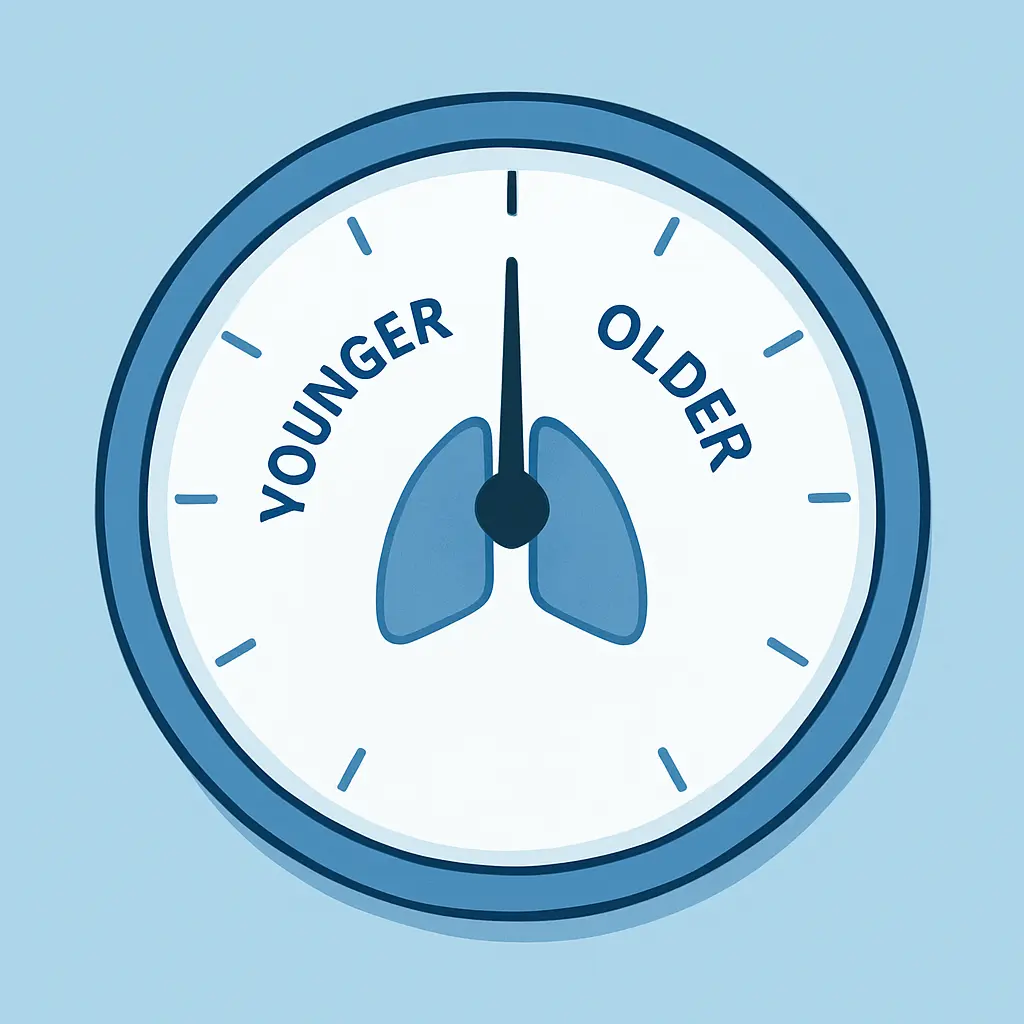
A lung age close to or below your real age is reassuring — it suggests your lung function is in the expected range for someone your age who has never smoked. A lung age noticeably above your real age reflects reduced FEV1 relative to that never-smoker benchmark, most commonly from smoking-related airway changes, though other factors like asthma, prior respiratory infections, or occupational exposures can also lower FEV1 and inflate the number.
It’s also worth noting that the gap tends to widen with pack-years rather than jumping suddenly, which is why two people who both smoke today can have quite different lung age results depending on how long and how heavily they’ve smoked. That’s a reason to see your own number as personal information worth acting on, rather than comparing it directly to a friend’s or a statistic you read online.
| Lung age vs your real age | What it generally suggests |
|---|---|
| At or below real age | Lung function within the expected never-smoker range |
| 5–10 years above | Some reduction in lung function; a strong reason to prioritize quitting now |
| 10+ years above | More significant reduction; worth discussing further assessment with a doctor |
These bands are general orientation, not a clinical scoring system — your clinician’s interpretation of your specific spirometry trace, symptoms, and history always takes priority over a rule of thumb.
What Actually Improves After Quitting
This is the encouraging part. Once you stop smoking, airway inflammation begins to subside and the cilia that clear mucus from your lungs start regenerating — a process detailed in the full guide to how your lungs heal after quitting. The World Health Organization places improved circulation and increased lung function in the 2-to-12-week window after your last cigarette. Critically, the rate of further lung function decline then slows to close to a never-smoker’s normal age-related pace rather than the accelerated decline smoking causes. That means a lung age result taken a year after quitting is very often meaningfully closer to your real age than the one taken while you were still smoking, even if it doesn’t fully close the gap. The evidence on whether smoke-damaged lungs can recover at all is covered further in can your lungs heal after years of smoking.
What’s Fixed and Won’t Change
Not every point of gap closes. Structural damage such as permanently lost elastic lung tissue (seen in emphysema) does not regenerate, so someone with long-term heavy smoking history and significant fixed damage may see their lung age improve meaningfully without ever fully returning to their chronological age. That’s still a real, valuable win — slowing decline and improving function measurably reduces symptoms and disease risk, discussed further in the organ-by-organ recovery guide — but it’s honest to say the number is a floor-raiser, not always a full reset.
How Often to Retest
There’s no single universal schedule — it depends on your starting result, symptoms, and your clinician’s judgment — but many stop-smoking and primary care services offer a repeat spirometry check around 12 months after quitting, since that’s roughly when meaningful FEV1 gains become clearly measurable. Retesting sooner than a few months rarely shows much change, and can be discouraging for no good reason; a year gives the biology time to show real movement.

In between formal retests, day-to-day signs like easier stair climbs or less breathlessness on a walk are a reasonable proxy for progress — see the breathlessness recovery timeline for a fuller self-assessment approach you can use while you wait for your next spirometry appointment.
The Important Caveat: A Communication Tool, Not a Diagnosis
Lung age is deliberately simplified to be motivating, and that simplicity is also its limitation. It doesn’t diagnose COPD, asthma, or any specific condition, and a normal lung age doesn’t rule one out if you have symptoms. Treat it as what the research shows it’s good at: a nudge that makes an abstract future risk feel personal and present enough to act on today, ideally alongside a real conversation with a clinician — the guide to talking to your doctor about quitting has practical tips for that conversation, and the broader picture of what quitting buys you in years is covered in life expectancy after quitting by age.
It’s also worth remembering that FEV1-based lung age is only one slice of the bigger risk picture. It says nothing directly about cancer risk, cardiovascular risk, or the many other ways smoking and vaping affect the body — for that fuller picture, population-level data such as the 2026 vaping and cessation statistics and disease-specific risk tools give complementary context that a single spirometry number can’t capture on its own.
When to See a Doctor
Book an appointment rather than relying on a lung age number alone if you have persistent cough, coughing up blood, unexplained weight loss, chest pain, breathlessness that is worsening or occurs at rest, or any lung age result significantly higher than expected accompanied by symptoms. Spirometry from a stop-smoking service is a screening and motivational tool, not a substitute for full clinical assessment when something feels wrong.
If your result surprised you and you’re not sure what to do next, the single best next step is usually the same regardless of how high or low the number was: book a follow-up conversation with whoever gave you the result, bring your questions, and use it as the concrete starting point for a quit plan rather than a number to quietly worry about alone.
Frequently Asked Questions
What exactly is lung age?
Lung age expresses your spirometry (FEV1) result as the age of a never-smoker whose lungs would typically produce the same reading. It’s a communication method used to make an abstract number feel personally meaningful, not a separate clinical test.
Why did my pharmacist or nurse tell me my lung age?
Because it works. The Step2quit randomized trial (BMJ, 2008) found smokers told their lung age were significantly more likely to quit at one year than those given a standard result, and a 2022 trial in Monastir, Tunisia (BMC Public Health) reported a 25.5% one-year abstinence rate with lung age feedback versus 16.5% with standard care.
Can my lung age actually get better?
Often, yes, at least partially. Airway inflammation subsiding and cilia regenerating after quitting can produce measurable FEV1 gains within months, and the rate of further decline slows to close to a never-smoker’s normal pace, though any fixed structural damage won’t fully reverse.
Is a high lung age result a diagnosis of COPD?
No. Lung age is a simplified communication tool, not a diagnostic label. A high result is a reason to discuss further assessment with a doctor, but it doesn’t by itself confirm COPD, asthma, or any specific condition.
How soon after quitting should I retest?
Most services suggest waiting around 12 months, since that’s roughly when meaningful FEV1 improvement becomes clearly measurable. Testing too soon after quitting can show little change and feel discouraging without reflecting your true trajectory.
Can non-smokers have an older lung age?
Yes. Asthma, prior respiratory infections, occupational exposures, and some genetic conditions can all lower FEV1 and raise lung age independently of smoking history, which is why any unexpected result deserves a clinical conversation rather than assumptions.
Does lung age account for height and sex?
Yes. Expected FEV1 values are calculated from population reference data adjusted for height, sex, and age, since lung capacity naturally varies across these factors even among people who have never smoked.
Should I panic if my lung age is much higher than expected?
No — use it as motivation, not a verdict. It’s specifically designed to prompt action, and much of the gap can improve once you quit. Discuss a significantly elevated result with your doctor for context and, if needed, further evaluation.
Turn a Scary Number Into a Tracked Win
iQuit’s disease-risk insights and 15 health milestones show your body’s recovery building day by day, so a lung age result becomes the start of a tracked improvement story rather than a one-off scare.