
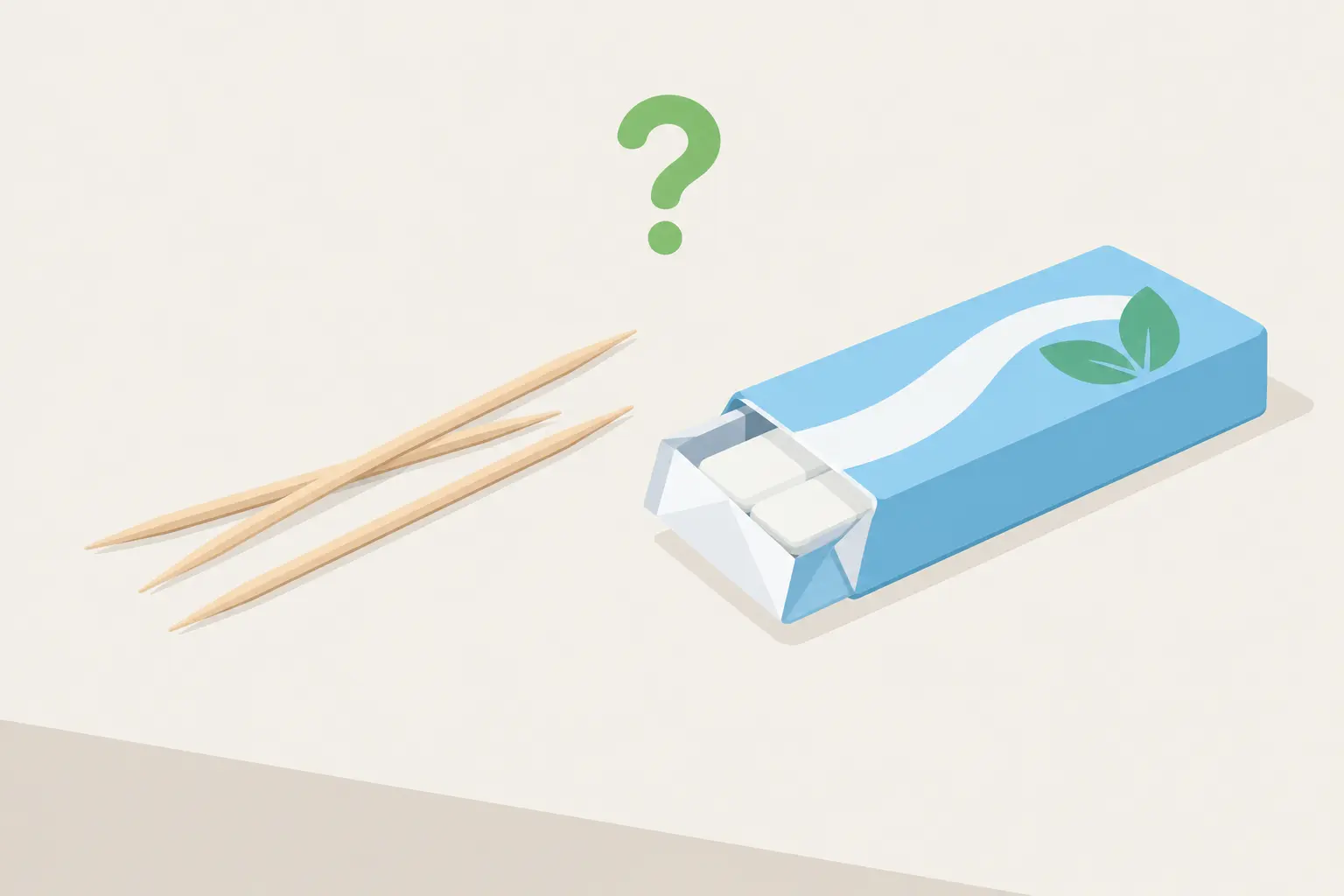
If you are weighing nicotine toothpicks against nicotine gum, the short version is that the two products sit in very different legal and evidence categories. Nicotine gum is an approved quit-smoking medicine with a printed dose schedule. Nicotine toothpicks, as far as the FDA is concerned, are tobacco products that the agency has twice written to one seller about. This guide sets out what the regulator actually said, what we could and could not verify, and what the same oral urge can be handled with instead. If you want the wider picture first, see our guide to every nicotine replacement option compared.
What nicotine toothpicks are
A nicotine toothpick is a flavored toothpick infused with nicotine, meant to be held or chewed in the mouth much like an ordinary toothpick. People who miss the hand-to-mouth routine of smoking are the obvious audience, which is why the product turns up in searches next to gum and mints. The routine itself is a real part of dependence, and our piece on the hand-to-mouth habit explains why a plain object in the mouth can help.
The key word is nicotine. A plain toothpick or cinnamon stick has no drug in it, and we covered those in our comparison of plain toothpicks, mints and gum. A nicotine toothpick does, and that changes how the law treats it.
In its 2025 letter the FDA described the product this way: it determined that the company “manufactures, sells and/or distributes nicotine toothpick products to customers in the United States.” The agency’s position is that these are tobacco products, not medicines and not food (FDA warning letter to Smart Toothpicks LLC, September 11, 2025).
How much nicotine is in a toothpick?
This is the question most readers ask, and the honest answer is that there is no standard dose. Unlike gum, there is no Drug Facts label, no FDA-reviewed strength range and no published dosing schedule for nicotine toothpicks.
The one number we can point to comes from the regulator itself. The 2025 FDA letter names two products it found on sale: “SMART TOOTHPICKS Cinnamon Nicotine Toothpick 3 mg and SMART TOOTHPICKS Peppermint Ice Nicotine Toothpick 3 mg.” So at least one seller labels its picks as 3 mg. That is the product name FDA quoted, not a measured value. We did not fetch any independent lab test, and we did not open any seller price page, so we are not stating what a pack costs or how the nicotine is actually released when you chew.
Compare that with a gum label. The Nicorette Drug Facts label on DailyMed gives two strengths, 2 mg and 4 mg, and a rule for choosing between them: use 4 mg if your first cigarette comes within 30 minutes of waking, and 2 mg if it comes later. A toothpick has no such guidance, so a person using several in a day cannot easily tell how much nicotine they are taking in.

Legal status: what the FDA warning letters say
There are two public letters, more than five years apart, to the same company. Both are on fda.gov.
The 2020 letter
In January 2020 the FDA’s Center for Tobacco Products wrote that it had reviewed the seller’s website and that “dissolvable tobacco products such as nicotine infused toothpicks” fall under FDA jurisdiction. It cited three problems. First, a person younger than 18 had bought Peppermint Ice Nicotine Toothpicks from the website, which the letter said made the product misbranded. Second, the site carried the claim “Nicotine Satisfaction without smoke damage to your lungs”, which the FDA treated as a modified risk claim made without an FDA order. Third, the packaging and advertising lacked the required nicotine warning statement (FDA warning letter, 2020).
The 2025 letter
The September 2025 letter turned on a different point. It explained that on March 15, 2022, legislation extended FDA’s authority to products “containing nicotine from any source,” not only nicotine from tobacco. Under that law, a new tobacco product needs a marketing authorization order. The FDA stated that the two 3 mg toothpicks lacked one, and concluded: “these products are adulterated” and also misbranded (FDA warning letter, 2025).
The agency’s April 2022 notice on the change spells out what it meant for sellers: no sales to anyone under 21, in person or online, and no marketing as modified-risk products without authorization (FDA notice on non-tobacco nicotine products).
What a warning letter is not: it is not a ban order, and we did not verify whether any enforcement followed the 2025 letter. What it does tell you is that, in the FDA’s view, nicotine toothpicks are being sold without the authorization a legal tobacco product needs.
Nicotine toothpicks vs nicotine gum: side by side
| Question | Nicotine toothpick | Nicotine gum (Nicorette label) |
|---|---|---|
| How FDA classes it | Tobacco product; warning letters in 2020 and 2025 | Drug Facts label with the purpose “stop smoking aid” |
| Strength | One seller’s products named as 3 mg in FDA’s 2025 letter; no standard | 2 mg and 4 mg, chosen by how soon you smoke after waking |
| Printed schedule | None that we found | 12 weeks, stepping down from 1 piece every 1 to 2 hours |
| Daily limit | None that we found | No more than 24 pieces a day |
| Trial evidence for quitting | None that we found | Cochrane pooled risk ratio 1.49 against placebo or no NRT |
| Age rule | Not for sale under 21, per FDA notice | Over-the-counter, with label directions |
The gum column comes from the label. It tells you to chew slowly until the piece tingles, park it between cheek and gum, and repeat for about 30 minutes, and it tells you not to eat or drink for 15 minutes before or while chewing a piece. The label also states: “do not use more than 24 pieces a day.”
The same logic applies if you are choosing between gum and the other forms. Our guide to which NRT form suits you walks through lozenges, patches, sprays and inhalers.
Do nicotine toothpicks help you quit? The evidence gap
For gum the evidence is solid. The 2018 Cochrane review of nicotine replacement therapy pooled trials and found a risk ratio of 1.49 for nicotine gum, from 56 trials and 22,581 participants, against placebo or no NRT. That means gum made quitting about one and a half times as likely (Cochrane review CD000146). The FDA adds that cessation products cleared by the agency “can even double your chance of quitting successfully” (FDA consumer update on cessation products).
For nicotine toothpicks we looked and found nothing comparable. On October 4, 2026 we searched Europe PMC for the exact phrase “nicotine toothpick” and it returned five records. The titles were about oral nicotine product marketing and adolescent use, two papers on co-use and perceptions of harm, and an old patent record for a method of making a nicotine toothpick. None of them was a trial of toothpicks as a way to stop smoking.
That is a limited search, and it does not prove that no study exists. It does mean we cannot tell you toothpicks work, and we would be inventing a number if we said so. If your goal is to stop smoking, a product with trial evidence and a printed schedule is a better bet than one with neither.
What the CDC says about using NRT well
Whatever product you choose, how you use it matters. If you would rather watch than read, this short Centers for Disease Control and Prevention video explains how people can combine nicotine replacement therapies when one form is not enough.
The point of the video is that approved products can be matched to your cravings rather than guessed at.
Nothing in that advice applies to unregulated toothpicks, because there is no label that tells you how to dose or combine them. That is the practical gap between an approved product and one that is not.
Teens and flavored picks
Flavor and age are the two things the FDA letters keep returning to. The two products named in the 2025 letter are sold in Cinnamon and Peppermint Ice flavors. And in the 2020 case, an FDA investigation found that a person under 18 bought the product from the seller’s website.
That is the extent of what we can verify. We did not find a figure for how many teens use nicotine toothpicks, so we will not give one. What the letters do show is that a flavored nicotine product was sold online to a minor during an FDA check, which the agency treated as a violation of the federal rule against sales to anyone under 18 cited in that 2020 letter. The agency’s 2022 notice adds that products containing non-tobacco nicotine cannot be sold to anyone under 21.
If you are a parent, the practical step is the same as for pouches and vapes: ask directly, and treat any unfamiliar nicotine product as a reason for a calm conversation, not a lecture. For context on a related product category, see whether nicotine pouches help you quit.
Safer ways to scratch the oral itch
If what you miss is something in your mouth, you have several options that carry no unregulated nicotine. Plain items such as sugar-free gum, a cinnamon stick or a plain toothpick give the mouth something to do. They do nothing for the drug craving, so they work best alongside an approved product if you need one.
For the nicotine itself, the gum label is the model: a defined strength, a schedule, a daily limit and a plan to step down. How long nicotine stays in your body also shapes when cravings peak, which we explain in how long nicotine stays in your body.

iQuit’s SOS tools fit the moments between oral cravings. They include breathing exercises, grounding, craving timers and craving surfing, with no extra nicotine. You can also log each craving with its trigger and intensity, which shows whether the mouth urge peaks after meals, with coffee or in the car. If you want to compare how brands of gum differ, our companion piece Lucy gum compared with Nicorette covers that.
Frequently Asked Questions
Are nicotine toothpicks safe?
We cannot call them safe. The FDA treats nicotine toothpicks as tobacco products, and its 2025 letter said the two products it named lack the required marketing authorization and are adulterated and misbranded. We found no clinical trial testing them (FDA warning letter, September 11, 2025).
Do nicotine toothpicks help you quit smoking?
There is no trial evidence that we could find. A Europe PMC search for the exact phrase on October 4, 2026 returned five records and none tested toothpicks as a quit aid. Nicotine gum, by contrast, has a Cochrane risk ratio of 1.49 across 56 trials (Europe PMC; Cochrane CD000146).
How much nicotine is in a nicotine toothpick?
There is no standard dose. The FDA’s 2025 letter names two products as 3 mg toothpicks, but that is the product name quoted by the agency, not a lab measurement. We did not verify what a user actually absorbs (FDA warning letter, September 11, 2025).
Are nicotine toothpicks legal in the US?
The FDA says products containing nicotine from any source are tobacco products and need a marketing authorization order. In 2025 it said the toothpicks it reviewed had none. A warning letter is not a ban order, and we did not verify later enforcement (FDA warning letter, 2025).
What did the FDA say in the 2020 warning letter?
It said a person under 18 bought Peppermint Ice Nicotine Toothpicks from the seller’s website, that a claim of nicotine satisfaction without smoke damage to your lungs was a modified risk claim without an FDA order, and that the required nicotine warning was missing (FDA warning letter, 2020).
Are nicotine toothpicks better than nicotine gum?
Not on the evidence we found. Gum has a printed 2 mg or 4 mg choice, a 12-week schedule, a limit of 24 pieces a day and trial evidence. Toothpicks have none of these that we could verify (Nicorette label on DailyMed; Cochrane CD000146).
What can I use for the oral urge instead?
Plain items such as sugar-free gum, a cinnamon stick or a plain toothpick occupy the mouth with no nicotine. For the nicotine craving itself, use an approved product as labeled, such as gum, and add breathing or grounding exercises for the short urge (FDA consumer update on cessation products).
Can teens buy nicotine toothpicks?
Federal rules bar sales to minors. The FDA’s 2020 letter documented a person under 18 buying from the seller’s website, and its 2022 notice says products with non-tobacco nicotine cannot be sold to anyone under 21, online or in person (FDA notice, April 2022).
Handle the oral urge with iQuit
iQuit is free to download on Google Play and the App Store. Use the SOS tools, craving timers and craving log for the minutes when your mouth wants something, and track the days and money you save as you go.
Download iQuit Free on Google Play Download on the App Store


