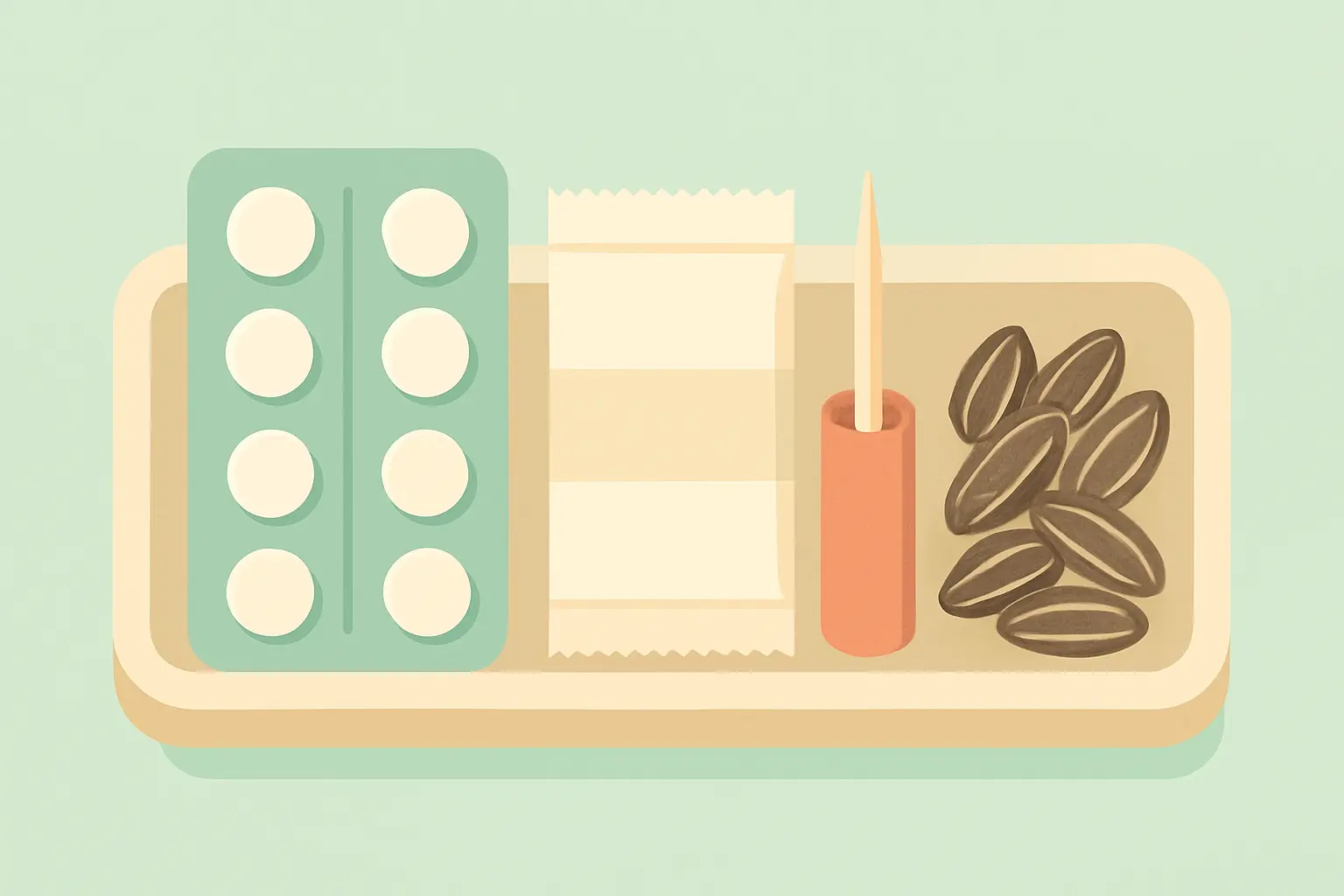
Deciding what to chew instead of smoking gets much easier once you notice you are trying to solve two problems at once. Something in your mouth answers the habit. Only nicotine answers the withdrawal. Sugar-free gum, mints, toothpicks and seeds are free and genuinely useful for the first job. Nicotine gum is a licensed medicine with a dose schedule, and it is the only item on the list with trial evidence behind it.
The two jobs you are asking these to do
A cigarette is a delivery device wrapped in a routine. Take it away and you lose both at once, but they need different replacements.
The first job is oral and behavioral: the hand-to-mouth loop, the pause, something to do with your face while other people talk. The second is pharmacological: nicotine leaving your bloodstream and taking your concentration, your temper and your sleep with it. A mint is a complete answer to the first and no answer at all to the second.

The US National Cancer Institute’s smokefree.gov treats them exactly this way. Its craving page lists keeping your mouth busy with gum or hard candy among its distraction strategies, alongside calling a quitline and going for a walk. These are ways to get through a five-minute urge, not treatments for dependence.
Sugar-free gum
This is the strongest of the non-nicotine options, and the one with an actual professional endorsement attached, though not for quitting.
The American Dental Association notes that chewing gum increases salivary flow through both mechanical action and taste receptors, and that chewing sugar-free gum, added to twice-daily brushing with fluoride toothpaste and daily cleaning between teeth, may contribute to reducing decay risk. Sugar-free gums are sweetened with polyols such as xylitol and sorbitol, which the ADA describes as noncariogenic because oral bacteria cannot use them as fuel.
For a quitter, the practical advantages stack up: it lasts long enough to outlive a craving, it is socially invisible, it costs very little, and it does something mildly good for your mouth at a point when your mouth is recovering anyway. The limitation is simply that it has no nicotine in it.
Mints and hard sweets
Mints beat gum on discretion and lose on duration. A strong mint dissolves in two or three minutes, which is shorter than many cravings, and the sharpness itself is part of the point: a clean, cold taste interrupts the moment.
The distinction that matters is sugar-free versus not. The ADA only considers sugar-free chewing gums for its Seal of Acceptance, and excludes sugar-containing ones deliberately, aligning with World Health Organization advice to keep sugar below 10% of energy intake. A tin of sugary mints chewed through a hard week is a dental bill in slow motion, particularly given how many people find their sweet tooth arrives with their quit date.
If your teeth are part of your reason for stopping, our guide to how teeth and gums recover after quitting covers what actually improves and when.
Toothpicks, straws and cinnamon sticks
These get recommended constantly, and the recommendation has an official source behind it. The smokefree.gov page on appetite while quitting advises keeping your hands and mouth busy with a toothpick or straw, or chewing on carrots, celery or sugar-free mints.
What makes them work is that they replicate the shape of a cigarette rather than the taste. A cut-down straw held between two fingers gives the hands the same job, which is often the part people underestimate. They also cost nothing and never run out.
Be sensible with the wooden ones. A toothpick chewed hard enough to splinter can damage gum tissue, and a splinter is a genuinely miserable way to spend a day in week two. Rotate them, do not sharpen them, and do not chew one while driving or lying down.
Crunchy foods and the weight question
Carrots, celery, apple slices and unsalted nuts are the substitutes most likely to become a different problem. They work, and they come with a caveat worth stating before you build a strategy on them.
smokefree.gov is direct about the risk: increased appetite is a common withdrawal symptom that tends to last longer than the others, taste and smell return to normal so food becomes more enjoyable, and studies show people want more sweet and fatty foods after quitting. It also makes the sharper point that people tend to use food in the same ways they used cigarettes, to handle stress or boredom, reward themselves or pass time.
The fix is not to avoid snacking. It is to pick substitutes that cannot quietly become 600 calories: raw vegetables rather than crisps, water rather than juice, and gum rather than a bag of anything. If weight is a live worry for you, our round-up of quitting without medication covers the behavioral side in more depth.
Nicotine gum: what it adds
Nicotine gum looks like the others and belongs in a different category. Its label says so: nicotine gum is a medicine and must be used a certain way to get the best results. Everything below is from the official product label, read on September 16, 2026.
| Rule | What the label says |
|---|---|
| Which strength | 4 mg if your first cigarette is within 30 minutes of waking; 2 mg if later |
| Weeks 1 to 6 | One piece every 1 to 2 hours |
| Weeks 7 to 9 | One piece every 2 to 4 hours |
| Weeks 10 to 12 | One piece every 4 to 8 hours |
| Minimum that works | At least 9 pieces a day for the first 6 weeks |
| Maximum | No more than 24 pieces a day |
| Technique | Chew slowly until it tingles, park between cheek and gum, chew again when the tingle fades, about 30 minutes in total |
| Before and during | No food or drink for 15 minutes before or while chewing |
Two of those rules are where most people go wrong. Chewing it like ordinary gum releases nicotine too fast and causes hiccups, heartburn and nausea, which is why the label warns against using one piece straight after another. And a coffee ten minutes before a piece lowers how much nicotine you actually absorb, which is exactly the moment a lot of people reach for it.
The evidence gap is the real headline. Cochrane’s 2018 review of nicotine replacement therapy pooled 133 studies with 64,640 participants and rated the evidence high quality. Nicotine gum specifically raised the chance of long-term abstinence with a risk ratio of 1.49 across 56 trials and 22,581 participants. No sugar-free gum, mint or toothpick has ever been tested that way, because nobody claims they are treatments.
The dental cost of each
| Option | Treats withdrawal | Covers the ritual | Dental effect | Cost |
|---|---|---|---|---|
| Sugar-free gum | No | Yes, 20 minutes or more | Raises saliva flow; may help reduce decay risk alongside brushing | Very low |
| Sugar-free mints | No | Yes, briefly | Neutral, polyol sweeteners are noncariogenic | Very low |
| Sugary sweets and mints | No | Yes, briefly | Fermentable sugars feed decay; ADA excludes them from its Seal | Low, rising with volume |
| Toothpicks and straws | No | Yes, hands as well as mouth | Risk of gum injury if chewed to splinters | Almost nothing |
| Crunchy vegetables | No | Yes | Neutral to good | Low |
| Nicotine gum | Yes, that is its purpose | Yes, but with a technique to follow | Chew-and-park reduces jaw strain; follow the label | Highest, but a defined 12-week course |
Which combination actually works
The choice is rarely one or the other, and the useful question is which of the two jobs is currently beating you.
- Light or situational smoker, cravings tied to specific moments: start with sugar-free gum and a straw in the car. If you are still smoke-free in a fortnight, you had a ritual problem and you solved it.
- First cigarette within 30 minutes of waking: that is a marker of real dependence, and the label points you straight at 4 mg nicotine gum. Substitutes alone will be an uphill fight.
- Doing well but caught out at particular moments: patch for the background, nicotine gum for the spikes, sugar-free gum for everything a licensed dose does not need to cover.
- Worried about cost: the free substitutes genuinely reduce how much nicotine gum you get through. Our comparison of generic versus brand nicotine products covers the rest of that gap.
- Unsure which format suits you: our breakdown of gum, patch, lozenge and inhaler and the wider NRT format comparison match products to craving patterns, and the full NRT comparison covers combination use.
One rule holds across all of them: a substitute that you have to think about is working, and one you have started chewing without noticing has become the new habit. That is the point to change something.
Chewing substitutes FAQ
What can I chew instead of smoking?
The US National Cancer Institute’s smokefree.gov suggests keeping your mouth busy with gum or hard candy when a craving hits, and elsewhere recommends a toothpick or straw, carrots, celery or sugar-free mints. All of these address the habit rather than nicotine withdrawal, so treat them as craving-moment tools rather than as a quit method on their own.
Is sugar-free gum as good as nicotine gum for quitting?
No, and they are not trying to do the same thing. Cochrane’s 2018 review of 133 trials and 64,640 participants found nicotine gum raised long-term quit rates with a risk ratio of 1.49 across 56 trials, rated high quality evidence. Ordinary sugar-free gum has no comparable evidence as a cessation aid, because it contains no nicotine and treats no withdrawal.
How do I use nicotine gum properly?
Chew slowly until it tingles, park it between your cheek and gum, then chew again when the tingle fades, repeating for about 30 minutes. Do not eat or drink for 15 minutes before or while chewing. The label says to use at least nine pieces a day for the first six weeks, never more than 24 a day, and not to chew pieces back to back.
Which nicotine gum strength should I use?
The label rule is simple: if your first cigarette is within 30 minutes of waking, use 4 mg; if it is more than 30 minutes after waking, use 2 mg. The labeled course runs 12 weeks, moving from one piece every one to two hours in weeks one to six, down to one piece every four to eight hours in weeks ten to twelve.
Will chewing gum all day damage my teeth or jaw?
Sugar-free gum is the safer choice for teeth, since the ADA notes its polyol sweeteners are noncariogenic and that chewing raises salivary flow. Sugary sweets are the ones to watch, which is why the ADA only considers sugar-free gums for its Seal of Acceptance. If your jaw aches, the chew-and-park technique used for nicotine gum involves far less chewing than ordinary gum.
Are toothpicks a safe substitute for cigarettes?
They are recommended by smokefree.gov alongside straws for keeping your hands and mouth busy, and they replicate the shape of a cigarette better than gum does. The practical caution is splintering: a wooden pick chewed hard can injure gum tissue. Replace them often, and avoid using one while driving or lying down.
Will snacking instead of smoking make me gain weight?
It can. smokefree.gov notes that increased appetite is a common withdrawal symptom that lasts longer than most, that taste and smell return to normal so food becomes more enjoyable, and that studies show people want more sweet and fatty foods after quitting. Choosing raw vegetables, water and sugar-free gum over crisps and sweets is what keeps the substitute from becoming the problem.
Can I use sugar-free gum and nicotine gum together?
Yes, and it is often the sensible arrangement. Nicotine gum is dosed on a schedule and capped at 24 pieces a day, so ordinary sugar-free gum can fill the gaps between doses without adding nicotine. Just keep the 15-minute food and drink rule in mind: finish other gum before starting a nicotine piece.
Find out which cravings a mint can actually cover
iQuit logs each craving with its trigger and intensity, so you can see whether a substitute is holding or whether it is time for a licensed product. SOS breathing and craving timers cover the moments in between. Free on Google Play and the App Store.
Download iQuit Free on Google Play
Download on the App Store